Black Night of the Canadian Field Artillery
This by far the most ambitious raid so far, with five German Navy Zeppelins – L13, L14, L15, L16 and L11 – intending to strike against London. The first four came inland over Norfolk more or less together with L11 some distance behind. Zeppelin L14, commanded by Kapitänleutnant Alois Böcker, came inland near Bacton, Norfolk, around 6.30pm and eventually crossed the Thames estuary near the Isle of Sheppey.

The German Zeppelin L14 (L 1) near Heligoland.
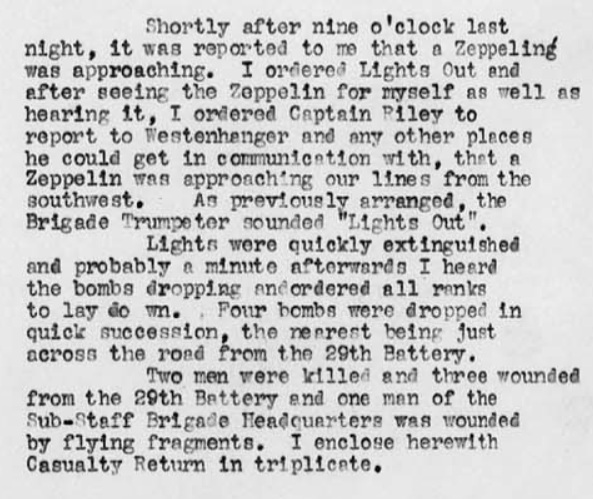
After meandering over Kent, she found herself over the Canadian Army camp at Otterpool, close to Lympne, at about 9.15pm. She dropped four HE bombs: 8th Howitzer Brigade listed two killed and four injured and 5th Brigade, Canadian Field Artillery, listed 13 killed and seven injured. L14 continued towards Westenhanger Camp, releasing two more bombs but these landed on the racecourse before she reached the camp.

5th Brigade war diary: each bomb made a crater 12 feet wide and 5 feet deep.
LZ11 Viktoria Luise
LZ 11 a sister ship to Zeppelin LZ10 Schwaben, with minor improvements such as enhanced steering and an extra eight‑metre segment. It measured 148 m in length, 14 m in diameter, with a gas volume of 18,700 m³. The framework enclosed 18 hydrogen‑filled gas cells. The structure was covered in impregnated cotton fabric. Two engine gondolas and a central passenger cabin hung below the hull.

Credit: Wellcome Library, London.
The front gondola held one of the three Maybach engines (110 kW/150 hp), plus the controls. The rear gondola accommodated the other two engines. The front engine drove a pair of two‑bladed propellers (~500 rpm). The tail featured six vertical rudders and two horizontal stabilizers, giving a turning radius of about 550 m. Total power 330 kW, enabling a cruise speed of 61 km/h and a top speed of 72 km/h.
6th Howitzer Brigade casualties
Killed
The family of Sergeant Edward C Harris arranged to have their son’s remains repatriated to Canada, though the IWGC had declared this illegal in March of 1915.

- HARRIS EDWARD CHARLES 33 13/10/1915 Sergeant Canadian Field Artillery ‘42623’ ST. CATHARINE’S (VICTORIA LAWN) CEMETERY SON OF MRS. FANNIE HARRIS OF 15, LARK ST., TORONTO, ONT.
- O. 308. PETERKIN CHARLES GORDON 27 13/10/1915 Gunner Canadian Field Artillery 8th Howitzer Bde. ‘86676’ SON OF ROBERT PEMBROKE PETERKIN AND IDA PETERKIN, OF BARBADOS, BRITISH WEST INDIES.
- A British subject, Peterkin’s remains not repatriated, he lies buried at SHORNCLIFFE MILITARY CEMETERY.
Wounded

- No. 89038 Gunner F A Rennick – 29th Battery
- No. 86478 Gunner T Voice – 29th Battery
- No. 86672 Gunner R W Morson – 29th Battery
- No. 85536 Gunner O L Tremblay – Bde HQ Sub-staff

Another six men wounded in the 5th Brigade, CFA, along with 16 horses killed and 13 animals wounded. The men killed could not be identified at the scene as their bodies too badly mutilated.

5th Brigade Casualties
The remainder buried at Shorncliffe, except for Gunner Borthwick, buried at Hawick, UK. Note Driver Charles Boeyckens, born in Belgium, still remains at Shorncliffe.
Hawick (Wilton) Cemetery
- Burghal. 153. BORTHWICK PRINGLE 22 13/10/1915 Gunner Canadian Field Artillery 17th Bty. 5th Bde. ‘86398’ HAWICK (WILTON) CEMETERY SON OF CHARLES AND SARAH BORTHWICK, OF 14, TEVIOT CRESCENT, HAWICK.

Shorncliffe Military Cemetery
Plot C
- C. 123. BOEYCKENS CHARLES 27 13/10/1915 Driver Canadian Field Artillery 5th Bde. ‘86396’ Son of Hendrik Boeyckens and his wife Louisa Van Hoorebeeck, of Oppuers, Belgium. The village associated with the Belgian noble family, Snoy et d’Oppuers.

Plot O
- O. 303. PHILLIPS DAVID JOHN 24 13/10/1915 Bombardier Canadian Field Artillery 17th Bty. ‘86372’ SON OF THE LATE JOHN AND MARY PHILLIPS, OF GILVACHVARGEOD, BARGOED, GLAMORGAN, WALES.
- O. 304. LANE SYDNEY GEORGE 23 13/10/1915 Gunner Canadian Field Artillery 17th Bty. ‘86436’ SON OF JOHN AND ANNIE E. LANE, OF 2, ANTWERP VILLAS, DORCHESTER RD., WEYMOUTH, DORSET, ENGLAND.
- O. 305. BAYES ERNEST WILLIAM 23 13/10/1915 Gunner Canadian Field Artillery 5th Bde. ‘86503’ SON OF JAMES AND ANNA MARIA BAYES, OF WALTHAMSTOW, ESSEX, ENGLAND.
- O. 306. SIMPSON RICHARD DYER 34 13/10/1915 Gunner Canadian Field Artillery 17th Bty. ‘86463’ SON OF LAURA C. SIMPSON, OF RUSH, CO. DUBLIN, IRELAND, AND THE LATE WILLIAM SIMPSON.
- O. 307. TRUSCOTT RICHARD STEWART 19 13/10/1915 Gunner Canadian Field Artillery 17th Bty. ‘86474’ SON OF RICHARD AND MARY S. TRUSCOTT, OF LANSDOWNE, WADEBRIDGE, CORNWALL, ENGLAND.
- O. 309. HARRIS WILFRED GEORGE 30 13/10/1915 Gunner Canadian Field Artillery 18th Bty. ‘86658’ SON OF JESSE AND ELIZA JANE HARRIS, OF FARINGDON, BERKSHIRE, ENGLAND; HUSBAND OF BESSIE HARRIS, OF 315, VICTORIA AVENUE, REGINA, SASKATCHEWAN.
- O. 310. McKAY SAMUEL 19 13/10/1915 Driver Canadian Field Artillery 5th Bde. ‘86552’ SON OF ANGUS AND MARION MCSWEEN MCKAY, OF STORNAWAY, SASKATCHEWAN.
- O. 311. DICKSON THOMAS 34 13/10/1915 Driver Canadian Field Artillery 18th Bty. 5th Bde. ‘86791’ Son of Richard and Elizabeth Dickson, of Ballinderry, Co. Antrim, Ireland; husband of Lillie Dickson, of Ryanton, Manitoba. Served in the South African Campaign.
- O. 312. HORN HENRY ADRIAN 19 13/10/1915 Gunner Canadian Field Artillery 18th Bty. ‘86777’ SON OF ALFRED AND FRANCES A. HORN, OF LONDON, ENGLAND.
- O. 313. JOHNSTON DOUGLAS ROUTLEDGE 25 13/10/1915 Gunner Canadian Field Artillery 5th Bde. ‘400004’ SON OF ANDREW W. AND ELIZABETH C. JOHNSTON, OF SUITE 4, ROSEDALE APARTMENTS, OSBORNE ST., WINNIPEG, MANITOBA.

PlotN

- N. 315. SMITH WILLIAM HAMILTON ACKMAN 32 13/10/1915 Private Canadian Infantry 4th Bn. ‘63408’ SERVED AS HAMILTON. SON OF THE LATE WILLIAM H. A. AND KATE SMITH, OF HAMILTON, LANARKSHIRE, SCOTLAND.

Zeppelin L14 Escapes
Having realised he was near the south coast, Böcker turned north, dropping seven incendiary bombs at Frant at 10.30pm, without damage. Ten minutes later, over Tunbridge Wells, Böcker released three HE bombs, smashing a number of windows. L14 approached East Croydon and at 11.20pm commenced dropping 17 HE bombs between Edridge Road and Howard Road. They killed three brothers in Beech House Road, three died in Oval Road, and three in Stretton Road. Fifteen others injured.

Kapitänleutnant Alois Böcker
Turning east the huge locomotive works was now presented to the Zeppelin and was about to receive some attention. Nine Bombs fell on the works damaging the sheds and killing William Bancroft (32), James Gibbs Hardy (56) and Harry Hithersay (23), and injuring two others. One of the injured, Charles Henry Champion died three days later. These men the only officially recorded casualties of the Derby raid, but retired headmistress and widow of a former railway worker, Sarah Constantine, died of heart failure widely blamed on the attack.
Thames
Zeppelin L14 almost collided with L13 between Bromley and Bickley at about 11.30pm before crossing the Thames between Erith and Purfleet where she was engaged by anti-aircraft fire. Other guns also fired parting shots before she finally went out to sea north of Aldeburgh at about 1.45am. In nearly five hours of time over target, 379 bombs dropped accounted for the final casualties including civilians:
- 71 killed
- 128 injured/wounded
Note that soldiers may be injured accidentally, but never categorized as injured when wounded while on active service.

Despite fog that night, the RFC got five aircraft up, however, only one saw a Zeppelin briefly before losing it in cloud. Three of the pilots damaged their aircraft when attempting to land at fog-bound airfields.

Fate of Kapitänleutnant Alois Böcker and L33
On the night of 23 September 1916, eight older models designated to strike the Midlands, while four newer models (L30, L31, L32, and L33) ordered to bomb strategic targets in the London area – their first operational sortie. L33 the first to reach London, the sky above bristling with ominous searchlights. Kapitän-Leutnant Alois Böcker ordered parachute flares to be dropped, blinding the forces on the ground. They were successful in their first bomb run, but were quickly picked up by and fired upon by anti-aircraft weapons. L32 came down at Great Burstead, Essex by Lt Leefe Robinson in a B.E.2c.

L33 came crashing down to a halt on a road in rural England. Böcker and his crew scrambled out in fear of it catching fire. The captain ran to a row of nearby houses, banging on the doors to inform their inhabitants to leave in case the ship exploded. But none of the families responded out of fear of hearing all the chaos and German voices outside.

Prisoners of War
In the end, the ship never blew up, and Böcker and his crew of 21 began walking down the country road in hopes of reaching the coast. Come morning, the military arrived, and his men made POWs for the remainder of the war. L32 claimed by 2nd Lt Frederick Sowrey, also in a B.E.2c. Kapitänleutnant Böcker returned to Germany in an exchange of prisoners, with the usual stipulation that he should not fly in combat again. He did end the war in the air though, as Director of Airship Training at Nordholz.
Zeppelin Marked Pieces
A large and important King Street Derby vase, elaborately decorated with birds and flowers by Harry Sampson Hancock, 1916.

The vase in the Royal Crown Derby Museum and filmed by the BBC for an episode of the Antiques Road Show.
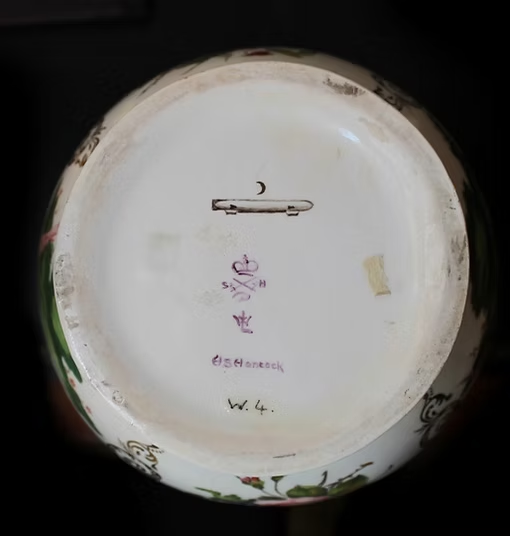
It can be seen with John Sandon from the Antiques Roadshow and Olivia Dean, Chairman of the DPIS. Items such as these often command high prices due to their historical significance and the dramatic nature of the Hindenburg disaster in 1937, which marked the end of the airship era.