IN FLANDERS FIELDS
by Lieutenant Colonel John McCrae
In Flanders fields the poppies blow
In Flanders Fields
Between the crosses, row on row,
That mark our place; and in the sky
The larks, still bravely singing, fly
Scarce heard amid the guns below.
We are the Dead. Short days ago
We lived, felt dawn, saw sunset glow,
Loved, and were loved, and now we lie
In Flanders fields.
Take up our quarrel with the foe:
To you from failing hands we throw
The torch, be yours to hold it high.
If ye break faith with us who die
We shall not sleep, though poppies grow
In Flanders fields
Early Life of Lieutenant Colonel John McCrae
Lieutenant Colonel John McCrae born in Guelph, Ontario, on 30 November 1872, John McCrae the second son of Lieutenant-Colonel David McCrae and Janet Simpson Eckford McCrae. He had a sister, Geills, and a brother, Tom.
The family Scottish Presbyterians and John McCrae a man of high principles and strong spiritual values. Described as warm and sensitive, with a remarkable compassion for both people and animals.
Poetry
John McCrae began writing poetry while a student at the Guelph Collegiate Institute. As a young boy, McCrae also interested in the military. He joined the Highfield Cadet Corps at 14 and at 17 enlisted in the Militia field battery commanded by his father.
John McCrae graduated from Guelph Collegiate at 16 and was the first Guelph student to win a scholarship to the University of Toronto. After attending university for three years, however, forced to take a year off due to severe asthma. This illness recurred throughout his life.
Love
During this year off, he was assistant resident master at the Ontario Agricultural College in Guelph, teaching English and Mathematics. Reportedly, he also fell in love with a friend’s eighteen year-old sister. But, dealt a bitter blow when the young woman died shortly after they met. John McCrae expressed the pain of this loss through his poetry which even then dwelt on the theme of death.

He returned to his studies in Toronto in 1893 and graduated with a Bachelor of Arts degree in 1894. McCrae then attended the University of Toronto medical school.
Children
He spent the summer of his third year as resident physician at the Garrett Hospital in Mount Airy outside Baltimore, a summer convalescent home for sick children. John wrote an essay about his young patients and frequently described the children in his correspondence.
A kitten has taken up with a poor (child) dying of muscular atrophy who cannot move. It stays with him all the time, and sleeps most of the day in his straw hat. Tonight I saw the kitten curled up under the bedclothes. It seems as it were a gift of Providence that the little creature should attach itself to the child who needs is most. (Prescott, In Flanders Fields: The Story of John McCrae, p. 18)
While in medical school, he tutored other students to help pay his tuition. Then, two of his students were among the first women doctors in Ontario.
While training as a doctor, he was also perfecting his skills as a poet. At university, he had 16 poems and several short stories published in a variety of magazines, including Saturday Night.
Military
He also continued his connection with the military, becoming a gunner with the Number 2 Battery in Guelph in 1890, Quarter-Master Sergeant in 1891, Second Lieutenant in 1893 and Lieutenant in 1896. Still at university, he was a member of the Queen’s Own Rifles of Canada of which he became company captain.

In 1898, John McCrae received a Bachelor of Medicine degree and the gold medal from the University of Toronto medical school. Then, he worked as resident house officer at Toronto General Hospital from 1898 to 1899.
In 1899, he went to Baltimore and interned at the Johns Hopkins Hospital where his brother Thomas had worked as assistant resident since 1895. There, both John and Thomas McCrae became close associates of Dr. William Osler, the pre-eminent medical educator of his time.

Glossy sepia photo of 14 doctors and one nurse, all in white uniforms, standing around a group of eight seated boys in the Alexandra Clinic. John McCrae is on the far proper left side wearing a cap and looking down at the children. The other 13 men are students, and the boys are patients. In the background, some medical apparatus is visible including hospital beds. There is an inscription: “Clinic at the Alexandra.”
The Boer War
When the South African War started in October 1899, John McCrae felt a duty to fight. In order to serve in South Africa, requested postponement of a fellowship in pathology at McGill University in Montréal. Subsequently, commissioned to lead an artillery battery from his home town. This Guelph contingent became part of ‘D’ Battery, Canadian Field Artillery.
John McCrae sailed to Africa in December and spent a year there with his unit. When he left South Africa, it was with mixed feelings about war. Still convinced of the need to fight for one’s country, but shocked by the poor treatment of the sick and injured soldiers.
John McCrae resigned from the 1st Brigade of Artillery in 1904. Promoted to Captain and then Major. Not involved with the military again until 1914.
The Young Doctor
Back in Montréal in 1901, John McCrae picked up the thread of his life, resuming his studies in pathology. The years after the war were busy ones for the young doctor. As Governor’s Fellow in pathology and resident assistant pathologist, he had the dual function of research work in the Medical Faculty laboratories at McGill and autopsy duties at Montréal General Hospital.
In 1902, appointed resident pathologist at Montréal General Hospital and later also became assistant pathologist to the Royal Victoria Hospital. In 1904, appointed an associate in medicine at the Royal Victoria Hospital. Later that year, he went to England where he studied for several months and became a member of the Royal College of Physicians.
Practice
In 1905, he set up his own practice although he continued to work and lecture at several hospitals. Appointed pathologist to the Montréal Foundling and Baby Hospital in 1905. Then, in 1908, McCrae appointed physician to the Royal Alexandra Hospital for Infectious Diseases.
During these busy years, he also lectured in pathology at the University of Vermont Medical College in Burlington and in clinical medicine and pathology at McGill. He attended medical conferences in Europe and wrote extensively on medical subjects, including articles for the Montreal Medical Journal and American Journal of Medical Science.
Both John and Thomas McCrae were major contributor’s to Osler’s Modern Medicine, a 10-volume textbook published in 1909. In addition, John McCrae co-authored a textbook on pathology, published in 1912.
He was a respected teacher and doctor, much in demand due to his enthusiasm and sense of responsibility to his patients, students and colleagues. He was a gregarious man with many friends. His busy schedule included time for socializing and holidays.
Although McCrae worked hard at his university teaching and at his increasingly busy practice, the advantage of working in a university was that he could take time off. He holidayed at various times in England, France and Europe . . . At times he worked his passage to Europe as ship’s surgeon; he enjoyed ships and the sea. These were the compensations of a bachelor’s life. (Prescott, In Flanders Fields: the Story of John McCrae, p. 70)
Outdoorsman
An avid outdoorsman, John McCrae invited in 1910 to serve as expedition physician when the Governor General, Lord Grey, journeyed by canoe from Norway House on Lake Winnipeg to Hudson’s Bay.

This is a casual outdoor black and white matte photograph of the Earl Grey party, 1910. John McCrae is one of nine men seen in the photo. He is sitting in the front wearing dark clothes and smoking a pipe on the rocks; trees and the river are seen in the background. There are inscriptions on the front and the back. Front: “In Front of Club House,” in John McCrae’s handwriting. Back: “John McCrae sitting smoking in front.”
John McCrae attended Sunday morning services regularly at St. Paul’s Presbyterian Church in Montréal. Then, McCrae continued to write poetry and a member of the Shakespearean Club and the Pen and Pencil Club, a group of artists, writers and teachers which included Stephen Leacock among its members.
John McCrae also made small, detailed pencil sketches of scenes on his trips, mostly in South Africa, the United States and Scotland.
Service of Lieutenant Colonel John McCrae in the Great War
On August 4, 1914, Britain declared war on Germany. Canada, as a member of the British Empire, automatically at war, and its citizens from all across the land responded quickly. Within three weeks, 45,000 Canadians had rushed to join up. John McCrae was among them. Finally, appointed a medical officer with the First Brigade of the Canadian Field Artillery with the rank of Major and second-in-command.
Just before his departure, he wrote to a friend:
It is a terrible state of affairs, and I am going because I think every bachelor, especially if he has experience of war, ought to go. I am really rather afraid, but more afraid to stay at home with my conscience. (Prescott. In Flanders Fields: The Story of John McCrae, p. 77)
Bonfire
He took with him a horse named Bonfire, a gift from a friend. Later, Lieutenant Colonel John McCrae sent his young nieces and nephews letters supposedly written by Bonfire and signed with a hoof print.

In April 1915, John McCrae was in the trenches near Ypres, Belgium, in the area traditionally called Flanders. Some of the heaviest fighting of the Great War took place there during the Second Battle of Ypres.
On April 22, the Germans used deadly chlorine gas against Allied troops in a desperate attempt to break the stalemate. Despite the debilitating effects of the gas, Canadian soldiers fought relentlessly and held the line for another 16 days.
Second Battle of Ypres
In the trenches, John McCrae tended hundreds of wounded soldiers every day. Surrounded by the dead and the dying. In a letter to his mother, he wrote of the Battle of Ypres.
The general impression in my mind is of a nightmare. We have been in the most bitter of fights. For seventeen days and seventeen nights none of us have had our clothes off, nor our boots even, except occasionally. In all that time while I was awake, gunfire and rifle fire never ceased for sixty seconds ….. And behind it all was the constant background of the sights of the dead, the wounded, the maimed, and a terrible anxiety lest the line should give way. (Prescott. In Flanders Fields: The Story of John McCrae, p. 98)

The day before he wrote his famous poem, one of McCrae’s closest friends killed in the fighting and buried in a makeshift grave with a simple wooden cross. Lieutenant Alexis Hannum Helmer. Wild poppies were already beginning to bloom between the crosses marking the many graves. Unable to help his friend or any of the others who had died, John McCrae gave them a voice through his poem. It was the second last poem he was to write.
Lieutenant Alexis Hannum Helmer
Lieutenant Alexis Hannum Helmer the son of Brig. Gen. R. A. Helmer and Elizabeth I. Helmer, of Gilmour St., Ottawa, Ontario. The following circumstances of his death compiled from letters received by Lieutenant Owen Carsley, Frederic Hague’s father, Frederic Hague from officers in the area at the time. Then, early on Sunday morning, 2 May 1915, Lieutenants’ Hague and Helmer left their position to check on a Canadian Battery who had positioned themselves on the bank of the Yser Canal near St. Julien close to the France-Belgium border. They had only gone a few yards when a six inch, high explosive canon shell burst. Lieutenant Helmer killed instantly.
Soon after In Flanders Felds written, transferred to No. 3 (McGill) Canadian General Hospital in France where he was Chief of Medical Services. The hospital housed in huge tents at Dannes-Cammiers until cold wet weather forced a move to the site of the ruins of the Jesuit College at Boulogne.

When the hospital opened its doors in February 1916, it was a 1,560-bed facility covering 26 acres. Here the wounded brought from the Battle of the Somme, the Battle of Vimy Ridge, the third Battle of Ypres and from Arras and Passchendaele.
The Cost of War
John McCrae deeply affected by the fighting and losses in France. He became bitter and disillusioned.
He felt he should have made greater sacrifices, and insisted on living in a tent through the year, like his comrades at the front, rather than in the officers’ huts. When this affected his health in mid-winter he had to be ordered into warmer surroundings. To many he gave the impression that he felt he should still be with his old artillery brigade. After the battle of Ypres he was never again the optimistic man with the infectious smile. (Prescott. In Flanders Fields: The Story of John McCrae, p. 110)

For respite, he took long rides on Bonfire through the French countryside. Another animal companion was a casualty of the war, the dog Bonneau, who adopted John McCrae as his special friend.
Last Poem
Writing letters and poetry also allowed Lieutenant Colonel John McCrae to escape temporarily from the pressures of his administrative duties at the hospital. His last poem, “The Anxious Dead”, echoed the theme of “In Flanders Fields” but never as popular as the earlier poem.
During the summer of 1917, John McCrae troubled by severe asthma attacks and occasional bouts of bronchitis. He became very ill in January 1918 and diagnosed his condition as pneumonia. Finally, McCrae moved to Number 14 British General Hospital for Officers where he continued to grow weak.
On January 28, after an illness of five days, he died of pneumonia and meningitis. The day he fell ill, he learned he had been appointed consulting physician to the First British Army, the first Canadian so honoured.
John McCrae buried with full military honours in Wimereux Cemetery, just north of Boulogne, not far from the fields of Flanders. Bonfire led the procession, McCrae’s riding boots reversed in the stirrups. His death met with great grief among his friends and contemporaries. Finally, a friend wrote of the funeral:
The day of the funeral was a beautiful spring day; none of us wore overcoats. You know the haze that comes over the hills at Wimereux. I felt so thankful that the poet of ‘In Flanders Fields’ was lying out there in the bright sunshine in the open space he loved so well…. (Prescott. In Flanders Fields: The Story of John McCrae, p. 129)

The Flower of Remembrance
Before he died, Lieutenant Colonel John McCrae had the satisfaction of knowing his poem a great success. Soon after its publication, it became the most popular poem of the Great War. Translated into many languages and used on billboards advertising the sale of the first Victory Loan Bonds in Canada in 1917. Designed to raise $150,000,000, the campaign raised $400,000,000.
In part because of the poem’s popularity, the poppy adopted as the Flower of Remembrance for the war dead of Britain, France, the United States, Canada and other Commonwealth countries.
Today, people continue to pay tribute to the poet of In Flanders Fields by visiting McCrae House, the limestone cottage in Guelph, Ontario where he was born. The house preserved as a museum. Beside it are a memorial cenotaph and a garden of remembrance.

The symbolic poppy and John McCrae’s poems still linked and the voices of those who have died in war continue to be heard each Remembrance Day.
We are the Dead. Short days ago
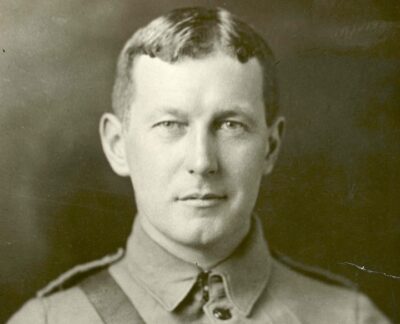
Lt.-Col. John McCrae
We lived, felt dawn, saw sunset glow,
Loved, and were loved, and now we lie
In Flanders Fields.
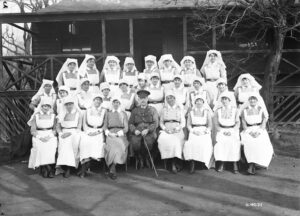
No.1 Canadian General Hospital in the Great War
Please subscribe to CEFRG to be notified by email when there are new posts. Subscription is free, and your email kept confidential.