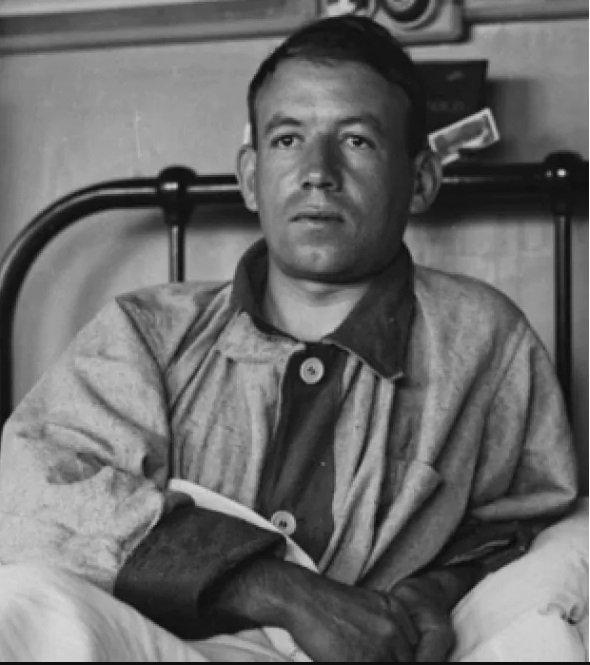
Stretcher Bearer
On 2 September 1918 at the Drocourt-Quéant Line, seven Canadians, including Private John Francis Young awarded the Victoria Cross. The DQ-Line part of the Hindenburg Line, a vast defensive system running through north-eastern France.

The line, or ‘switch’, a system in depth and incorporated a number of mutually supporting lines of defence. The system consisted of a front line system and a support line system, each consisting of two lines of trenches. The system incorporated numerous fortifications including concrete bunkers, machine gun posts and heavy belts of barbed wire.

Zero-Hour
At 5:00 a.m. on 2 September 1918, Canadian and British forces attacked the Drocourt–Quéant Line supported by tanks and aircraft. In twilight, the Canadian 1st Division attacked the line south-eastwards, on the extreme right, south of the Arras–Cambrai road, The Canadian 4th Division attacked in the centre between Dury and the main road and the British 4th Division attacked south of the River Sensee.

Victoria Cross Citation of Private John Francis Young
[ London Gazette, 14 December 1918 ], Dury-Arras, France, 2 September 1918, Private John Francis Young, 87th Bn, Quebec Regiment ( Canadian Grenadier Guards ), Canadian Expeditionary Force.
For most conspicuous bravery and devotion to duty in attack at Dury-Arras sector on the 2nd September 1918, when acting as a stretcher-bearer attached to “D” Company of the 87th Bn., Quebec Regiment.
The company in the advance over the ridge suffered heavy casualties from shell and machine-gun fire. Private Young, in spite of the complete absence of cover, without the least hesitation went out, and in the open fire-swept ground dressed the wounded. Having exhausted his stock of dressings, on more than one occasion he returned, under intense fire, to the company headquarters for a further supply. This work he continued for over an hour, displaying throughout the most absolute fearlessness.
To his courageous conduct must be ascribed the saving of the lives of many of his comrades. Later, when the fire had somewhat slackened, he organized and led stretcher parties to bring in the wounded whom he had dressed. All through the operations of 2nd, 3rd and 4th September Private Young continued to show the greatest valour and devotion to duty.

Investiture
John Young invested with his Victoria Cross by King George V at Buckingham Palace on 30th April 1919 while the British Army still occupying Germany until December 1929.

Medal Group
Medal entitlement of Private John Francis Young,
87th Bn ( Canadian Grenadier Guards ), CEF
Victoria Cross

British War Medal ( 1914-20 )
Victory Medal ( 1914-19 )


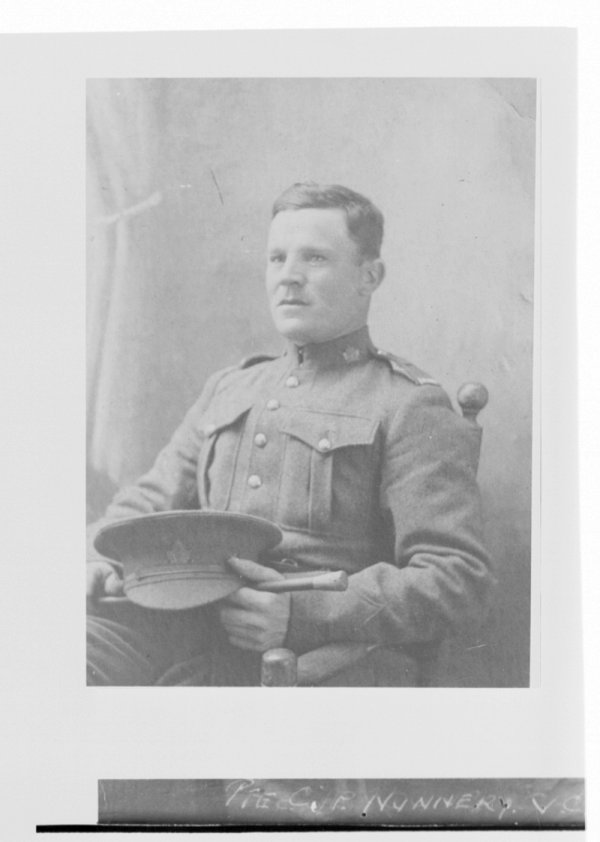
Seven Canadians awarded VCs individually: Bellenden Hutcheson, Arthur George Knight, William Henry Metcalf, Claude Nunney, Cyrus Wesley Peck, Walter Leigh Rayfield and John Francis Young.

Death of Private John Francis Young VC
John Young died from tuberculosis at the early age of thirty-six on the 7th November 1929 in the St Agathe Sanatorium, Quebec, probably hastened by gas poisoning during the Great War (although not officially attributed as such). Young buried in the Mount Royal Cemetery, Montreal.


Equality in Death
The Commonwealth War Graves Commission (CWGC) founded on the core principle of equality in death, ensuring that all service personnel from the British Empire commemorated identically regardless of rank, class, or religion.

The Last Post Fund National Field of Honour and Veteran’s Affairs Canada should take note. A similar placque should be installed near the main gate for LtCol C. Norman Mitchell VC MC, rather than having the gravestone updated, as it recently was in August 2026. Mitchell’s gravestone now twice the size of 16,000 other gravestones in the National Field of Honour in Pointe-Claire.