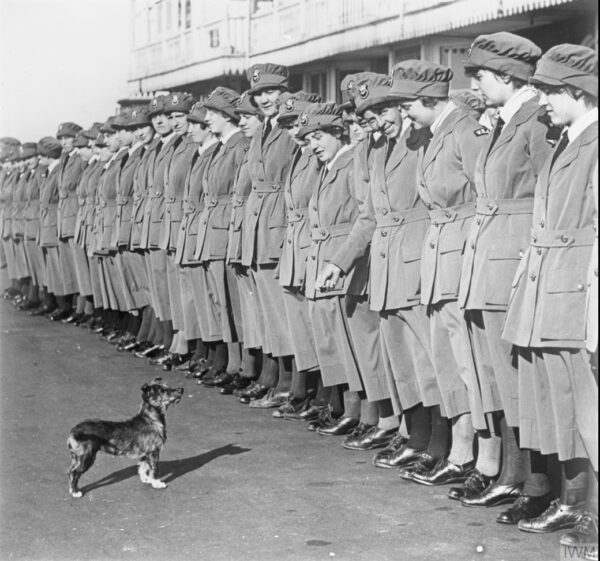
Creation of the WRAF
The Women’s Royal Air Force created on 1 April 1918. 32,000 WRAFs proved a major asset to the RAF. Providing mechanics and skilled workers to ensure more RAF pilots saw front line service in the Great War. Essentially, the WRAF became the backbone of the Royal Air Force (RAF), also created on 1 April 1918.

With the decision to merge the RFC and RNAS to form the Royal Air Force (RAF), concerns raised about the loss of their specialized female workforce.

The need for a separate women’s air service led to the formation of the WRAF on 1 April 1918.

Employment
The majority of women employed as clerks, with shorthand typists the most highly paid of all airwomen.

Women allocated to the Household section worked the longest hours, for the lowest pay.
The Technical section covered a wide range of highly-skilled trades, including tinsmiths, fitters and welders.

By 1920 over 50 trades open to women including tailoring, photography, catering, pigeon keeping and driving.

The work of these women helped release men for combat. In addition, they proved the equal of men in the workplace.

Training


Civilian enrolment swelled WRAF numbers on RAF bases in Britain.
Dame Helen Gwynne-Vaughan
Served as Commandant of WRAF from September 1918 to December 1919. Given the powers of a Brigadier she began the task of re-organisation. In a short space of time she revised the Standing Orders, overhauled the administrative system, opened and equipped Berridge House in Hampstead for the training of officers, authorised the new blue uniform and introduced military protocol.

William Orpen
IWM_ART_003048
Mona Chalmers Watson, Chief Controller of the WAAC in London, had selected Gwynne-Vaughan as her deputy. Watson resigned in 1918 when one of her sons fell ill following surgery.
Cologne, Germany
On 24 March 1919, the first group of WRAFs arrived in France to begin their overseas service. A decision made to send a contingent to Germany.

Ladies of the Rhine
Their purpose to assist the army of occupation and to replace men demobilised from the forces. Based in Cologne, employed as domestics, clerks, telephonists, nurses and drivers and became known as the ‘Ladies of the Rhine’. Dedicated and diligent, they also helped raise RAF morale by staging sports days and dances.

The WRAF assisted in the Allied Occupation of Germany, which had begun on 13 December 1918. Dedicated and diligent, they also helped raise RAF morale by staging sports days and dances.

The order came to finally close down the WRAF contingent on the Rhine in August 1919.

RAF sections, unwilling to lose their airwomen, delayed the disbandment until the last possible moment.


Subscribe
Please subscribe to CEFRG to be notified by email when there are new posts. Subscription is free, and your email kept confidential.

