Pro Patria
At the beginning of the Great War, Canadian military authorities called upon the Royal Canadian Regiment to relieve British troops garrisoning Bermuda. The RCR eventually arrived in France on 1 November 1915, and within two weeks engaged in the trenches of the Ypres Salient in Belgium.

Bermuda Nominal Roll
LtCol Alfred Octave Fages, Major John Henry Kaye, Major Arthur Cavendish Bentinck Hamilton-Gray, Major James Gilchrist Burnham. Captains Ernest Louis du Domaine, Edwin Kenelm Eaton, Charles Richard Edward Willets, Robert John Spinluff Langford, Eric Boyd Costin. Lt and Adjt Ferdinand George MacCulloch.

Added while in Bermuda, Captain’s Francis Lionel Seymour Brett, Oswald Vick Hoad, and George Alexander Henri Trudeau. LtCol Alfred Octave Fages stayed behind and became the commander of Military District No.5.
Halifax
On August 13, 1915, The Royal Canadian Regiment battalion relieved in Bermuda by the 38th Battalion (Ottawa), and sailed for Halifax aboard the S.S. Caledonian.

The Royal Canadian Regiment landed in Halifax four days after leaving Bermuda.
North Common
Troops arrived in lightweight khaki drill uniforms complete with sun helmets, suitable for service in the warm climate of Bermuda.

Royal Canadian Regiment 1915
They would stay in Halifax for two weeks before heading across the Atlantic to serve in Europe as an overseas battalion of the Canadian Expeditionary Force (CEF).

Before leaving for Europe the men were equipped with new Service Dress uniforms fit for service at the front. A group photograph of the newly kitted unit was taken at the Common.

On August 25, the overseas battalion again boarded the S.S. Caledonian.

Royal Canadian Regiment in England
After a day finalizing the re-attestation of the men, so they could legally serve abroad as part of the CEF, they set sail for England.


Shorncliffe
The RCR landed in England at Plymouth and then proceeded by train to Shorncliffe on the country’s Southeastern coast where they would stay for two months.

War Diary of the Royal Canadian Regiment
The war diary begins 20 October 1915 when inspected at Shorncliffe by Major General S Steele. The Regiment now under command of LtCol A H MacDonell DSO (MacDonell would rise to command the 1st Canadian Division). First line transport and Train on parade.

On 30 October 1915, orders received in reference to the departure of Transport and Train. The following day, Lt Westmorland and 54 Other Ranks departed for Southampton.

France
The Machine Gun Section would be among the first RCR troops to step foot in France as they were part of an advanced party of 111 regimental troops that crossed the English Channel aboard the S.S. Basil on October 31, 1915 a day before the rest of the regiment.

On 1 November 1915, the following officers proceeded with the RCR to France. LtCol A H MacDonell DSO, Major E K Eaton, Major C R E Willets, Captains H F R Griffiths, F G MacCulloch, R E Balders, Harry Tredennick Cock, K M Holloway, A E Willoughby, W L Hutton, M C Rosseau, (Rev) G Bullock. A total of 36 officers and 1003 Other Ranks including Sgt-Maj’s H Phillips, H J Beard arrived in Boulogne that same evening. The following day, Soldat Alexandre Albert taken on as interpreter.

The battalion inspected by LtCol E A H Alderson on 6 November 1915, two days before moving to Aldershot Huts with HQ at Westhoff Farm.
Trenches
From 10-18 November 1915, in trenches (by Coys) for instructional purposes attached to 2nd & 3rd Brigades.

A Company left Aldershot Huts for the trenches on 11 November 1915 at 3:30 pm. Two nights later, B Company, along with two platoons each from C and D Company, relieves A Company. Morale of men excellent, night passed quietly on both sectors.
The first battlefield casualty occurred on 28 November 1915. While working in a party, Sgt John Carroll 477155, D Company killed by a rifle bullet (RIDGE WOOD MILITARY CEMETERY).

Corporal John Foreman 477946, killed by a bullet to the head on 11 December 1915 (LA CLYTTE MILITARY CEMETERY).

Cpl Foreman buried at 28.N.7.C.7.5, which corresponds with the cemetery at La Clytte.

7th Canadian Infantry Brigade
On 14 December 1915, the 7th Canadian Infantry Brigade officially becomes:
- Royal Canadian Regiment
- P.P.C.L.I.
- 42nd Canadian Battalion
- 49th Canadian Battalion
LtCol A C MacDonell DSO selected to command the 7th C.I.B.

Pvt Frederick Freeman Laing
11 May 1916 – Situation quiet. Wind S.W. to W. No. 477108 Pte W.J. BRITTON, Wounded by enemy shell fire in right arm at BORDER DUGOUTS. No. 477400 Cpl. HERRON, W.A. slight shell wound, Right leg, and at duty. No. 477734 Pte POULTER, Contusions of neck. Buried by sandbags.

No. 478051 Pte LAING, F. Killed in Action by enemy shell at BORDER DUGOUTS. Buried I.24.c.3.9. Sheet 28 (MAPLE COPSE.)

Maple Copse Cemetery
A true battlefield cemetery, Maple Copse suffered from shellfire for most of the war.

Many of the graves, like that of Pvt Frederick Freeman Laing disturbed. No remains lie beneath his gravestone, but it is known his remains lie buried somewhere nearby.

Laing had been one of seven stowaways taken on strength of the regiment when he surrendered as a stowaway aboard the S.S. Caledonian on 27 Aug 1915.
Royal Canadian Regiment at Mount Sorrel
Heavy casualties suffered by the battalion in four days of fighting. Two enemy attacks repulsed on 2 June 1916.

Many who had served long periods in the battalion, including members of the Regimental football team who for years had been visitors in garrison matches.

At 5 pm on 5 June 1916, a German scout came into our lines and surrendered.

14 Jul 1916 – Patrol encountered enemy and succeeded in dispersing same with bombs, returning to our line without loss. 18 Jul 1916 (Night) – Patrol dispersed enemy working party, bombing them from 12 yards range. Patrol returned safely.

16 Aug 1916 – 3.00 a.m.; Enemy bombing party dispersed. 18 Aug 1916 – 3.00 a.m.; Raid made on enemy trenches which proved unsuccessfully owing to uncut wire.
In August the entire Canadian Corps withdrawn from the Ypres Salient.
Royal Canadian Regiment at Flers-Courcelette
On 15 September 1916 at 9.15 a.m. the Bn moved to CHALK PITS via USNA VALLEY. Moved to Old British front line – R.35.c.2.5 to R.34.b.4.5. as Reserve Bn in the afternoon.

Hqrs moved to CENTRE WAY TRENCH, R.34.d.2.3 the following day, Bn in “jumping off” position at 4:45 pm. Bn advanced to the attack, which proved unsuccessful owing to heavy M.G. fire of enemy and our own artillery range being too long.


Following the attack, relieved by elements of the 52nd & 60th Bns and moved to TARA HILL.
Albert Communal Cemetery Extension
The following men buried at Albert Communal Cemetery Extension on 2 October 1916.
- Lance Corporal George Edmund Young 478043
- Pvt Donald McKay 228218
- Pte Albert Emmett Murphy 228250
- Pvt Ernest Sullivan 455635
BLEST ARE THE PURE IN HEART FOR THEY SHALL SEE GOD


Tara Hill
On 2 October 1916, the Bn moved from ALBERT and relieved 5th CMR Bn in trenches, R.23.a.3.0. to R.22.c.9.7. Sheet 57. D. SE. Three days later, relieved by 8th Border Regt (Imperial) and moved to bivouac at TARA HILL.

At 11:00 pm on 5 October 1916, Relieved part of 42nd Bn in trenches from WEST MIRAMONT ROAD inclusive to KENORA TRENCH inclusive & R.23.b.2.1.
Royal Canadian Regiment at Ancre Heights
The next major battle for the battalion began on 8 October 1916 at Regina Trench. The battalion the only unit to reach its objective. A large number of enemy wounded taken prisoner.

Bn advanced to the attack on REGINA TRENCH taking objective and many prisoners. The objective held for four hours, during which time 3 counterattacks were repulsed. Owing to Bn on Left having failed to reach their objective Bn was compelled to withdraw in order to avoid being outflanked. Moved to SUGAR TRENCH at 10:00 pm.

While stationed in Halifax, LCol Arthur Cavendish Bentinck Hamilton-Gray seriously injured in the Halifax Explosion of December 1916. Gray the son of a Father of Confederation, Colonel John Hamilton Gray of Prince Edward Island.
Royal Canadian Regiment at Vimy
On 31 March 1917, a raiding party entered enemy F.L.T. at S.28.a.50.45 and succeeded in destroying 3 dugouts, inflicting casualties and returning to our lines without a single casualty. Later on in the morning an enemy raiding party was dispersed before reaching our lines. Bn with exception of Coy in line moved to VILLERSAUBOIS, supplying carrying parties.
9 April 1917
All companies of the battalion engaged, and their final objective reached at a distance of about a mile. Final objective taken and being consolidated. Large number of prisoners taken and connection established with both flanks. During the course of the day many enemy counterattacks were repulsed.

On 8 June 1917, the regiment’s C and D Companies participated in a three-battalion night trench raid during the Battle of Lens. As the soldiers moved forward, Milton Gregg led a successful flank attack against a German machine gun holding up the advance. Ninety minutes after the raid began, the RCR began to withdraw. During the retreat, Gregg carried a seriously wounded fellow officer back to RCR lines under heavy fire, despite being wounded himself. Gregg was awarded the Military Cross (MC) for his actions.
Lieutenant Thoburn Stephens Allan awarded the MC in July 1917.
“For conspicuous gallantry and devotion to duty. He led his company in the most gallant manner and recaptured his objective which he succeeded consolidating. He set a fine – example for his men.”
Royal Canadian Regiment at Hill 70
The RCR in reserve on the opening day of Hill 70, but took over the line following the attack. Heavy casualties suffered in repeated German counterattacks.

October 1917
This is Bugler Joseph Henry Quinn 478825, 4′ and 9 3/4″ tall. Misidentified as a Calgary Highlander, he was an original of the Royal Canadian Regiment, and attested on 29 November 1915 in Halifax at 16 years, 2 months of age. Bugler Quinn came over to England on 6 July 1916. It is a mystery why this MIKAN image is categorized in the O-Series (Overseas), suggesting it was taken in Belgium or France.

Supposedly wounded by shrapnel in the right hand at Lens in January 1918. In fact, Quinn had transferred to the Boys Battalion at Bramshott on 3 August 1917. Tried for stealing property of a comrade, he was demoted from Lance-Corporal in August 1917, and awarded three months imprisonment at Bexhill Barracks (remitted by his O.C.). He discharged on 25 December 1918 in Halifax, now standing 5′ 2″ tall, having never served on the front. LtCol D A McCrae noting his Character and Conduct as Indifferent.

Royal Canadian Regiment at Passchendaele
The operations at Passchendaele undoubtedly the greatest strain on the morale and discipline the Regiment had ever undergone, and to come through with success and honour was a most creditable achievement.

9.00 a.m., 30 October 1917, all objectives reported taken. 2 Platoons “A” Coy reinforced 49th Bn. At 11.20 a.m. remainder of “A” Coy reinforced PPCLI. “D” Coy moved forward to reinforce 49th Bn and assist in consolidation of line.

The following day, “A” & “C” Coys relieved 116th Bn in reserve POMMERN CASTLE AREA, “B” Coy to old jumping off trench, Hqrs to WATERLOO PILL BOX. D.9.d.70.85.

On 3 November 1917 at 12.30 a.m. “B” Coy relieved and moved to POMMERN CASTLE AREA. 2.00 a.m. “D” Coy relieved and moved to POMMERN CASTLE AREA. Moved to OUTSKIRT FARM. I.2.b.8.2 on 4 November 1917. The C.O. visited Companies during morning of the 11th, normal shelling during remainder of the day. “A” and “C” Companies moved from POMMERN CASTLE area to the Transport Lines. Before leaving the Salient, “B” Coy captured a German MG and 4 prisoners on 14 November 1917.
Shot at Dawn
No members of the Royal Canadian Regiment executed during the Great War. However, in December 1917, and in February 1918, two men sentenced to death for When on active service, Deserting His Majesty’s Service.
Private Thomas Howell 715976 absent from 11 a.m. 14 Nov 1917 to 1.45 p.m. 9 Dec 1917. In arrest awaiting trial 9 Dec 1917. Tried and convicted by FGCM of When on active service, Deserting His Majesty’s Service and sentenced to Death, 27 Jan 1918. Sentence commuted to 2 years Imprisonment with Hard Labour by G.O.C. 1st Army. Pte Howell rejoined the RCR in July and would discharge on 14 August 1919 in Truro, NS.

Private Joseph Henry Morrison 715869 absent from 11 a.m. 14 Nov 1917 to 3.30 p.m. 10 Dec 1917. In arrest awaiting trial 10 Dec 1917. Tried and convicted by FGCM of When on active service, Deserting His Majesty’s Service and sentenced to Death, 28 Jan 1918. Sentence commuted to 5 years Penal Servitude by G.O.C. 1st Army. Placed under suspended sentence 6 Feb 1918 G.O.C. 1st Army. Pte Morrison rejoined the RCR in July. He was sanctioned again in September 1919 for burning his bed boards and AWOL, finally returned to Canada later that month.
AWOL
At least nine RCR tried for While on Active Service Striking a Soldier or Superior Officer, another eight for intentionally, negligently or carelessly wounding themselves or another soldier, and nearly 40 When on active service, Absent without Leave. Only two officers of the RCR sanctioned.
Lt Percy Beaumont
Lieut Beaumont court-martialed in 1918. Charges were from the following sections of the Army Act: 9(2) – Disobeying a superior officer; 15(1a) – Absence without leave; 16 – Disgraceful Conduct; and 40 – Conduct to prejudice of good order and military discipline. (Lieut Beaumont is recorded as belonging to the 17th Res Bn. at the time of his Court Martial.)
Lt Percy Beaumont wounded in action 30 Sep 1918. He would be SoS in Montreal on 22 November 1919. Interestingly, reported in the September 1926 Connecting File: “Lieut. P. Beamont: last address, 33 Eintrachstrasse, Cologne, Germany.”
Lt George Cecil Pickford
1917 – AA Section 19; Drunkenness. Dismissed from His Majesty’s service following Court Martial for Drunkenness, 20 Mar 1917. Re-attested with the 20 Reserve Battalion at Shoreham Camp, Sussex, UK, for service in the ranks, 9 Aug 1917. Pte G C Pickford 842324, 20th Reserve Battalion, SoS on Discharge in Halifax on 1 May 1919.
Royal Canadian Regiment at Amiens
RCR moved to moved to GENTELLES WOOD on 6 August 1918. Bn moved to QUARRY at U.19.d.8.3. and vicinity.

On the opening day of the Battle of Amiens, 8 August 1918, the RCR on the extreme right of the Canadian Corps, with French troops on the left. Moved to jumping off position, edge of HAMMON WOOD. C.18.b. and D.13.a. at 6:55 am. One platoon assisted the French on right by cutting off a party of the enemy and pushed on to MEZIERES in D.26. Final objective gained and consolidated from WHIT HOUSE. D.20.b. central to D.15.central.

“C” Coy supported the PPCLI in attack on PARVILLERS on 12 August 1918 as German counterattacks intensify.

Attacked PARVILLERS. All objectives gained and PARVILLERS captured by 4 a.m. 15 Aug 1918. On 19 Aug 1918 – entrained ST NICHOLAS, headed back to the Arras front. Training for a few days, and resting on the 24th, the Bn once again prepares to go into battle.
Royal Canadian Regiment at the Scarpe
On 26 August 1918, the RCR attacked with the PPCLI on the left. By the end of the day, an advance of some 3,000 yards achieved. 9.45 a.m. Advanced to the attack, passing through MONCHY, meeting with heavy opposition on reaching the Eastern outskirts of the town.

After heavy fighting line was eventually established along FACTION and LONG TRENCHES running through I.32.center andO.2.b. & d. Sheet 51.B.

On 26 August 1918, Lt M F Gregg MC led a bombing attack against two German machine-gun posts in Monchy-le-Preux during the Battle of the Scarpe. Although wounded, he carried on and killed the crews of both guns. Gregg’s platoon was soon cut off, but he linked up with RCR soldiers on his left flank. He then successfully fought off a German counterattack. These actions resulted in the award of a second MC to Gregg.

Victoria Cross of the Royal Canadian Regiment
For his part in operations at Cambrai between 27th September and 1st of October, Lt M F Gregg MC & Bar awarded the Victoria Cross for bravery and initiative.

On 28 September, thick barbed wire and strong enemy machine-gun fire from both flanks held up the RCR at the Marcoing Line. Milton Gregg wormed his way forward to the wire, found a gap large enough for one man at a time and directed his soldiers into a German trench. He next led his men in an attack with bombs (as hand grenades were then called) along the German trench.

When the enemy counterattacked, the situation quickly became critical once Gregg’s men ran out of bombs. Although wounded, Gregg returned to his own lines under heavy fire to pick up more bombs. He rejoined his men, now reduced in numbers, and led them against the German trenches, despite being wounded a second time.

By the time Gregg cleared the German trench, he had personally killed or wounded 11 enemy soldiers and captured 25 prisoners and 12 machine guns. On 30 September, he repeated this feat and led another attack against enemy positions. This time Gregg was so severely wounded, he had to be evacuated and hospitalized.

For his courage and determination, Gregg was awarded the Victoria Cross. He received it from King George V at Buckingham Palace on 26 February 1919.
Major Charles Beresford Topp DSO & Bar
The only specific item I remember is a recommendation for the award of the V.C. to Lieut, M.F. Gregg. This I wrote some days later from a base hospital. I probably signed it Major, 42ND Battalion, although undoubtedly the report itself would state that during the period mentioned I was in command of The R.C.R.

Major Topp write the history of the 42nd Canadian Infantry Battalion.

Royal Canadian Regiment at Canal du Nord
On 28 September 1918, the RCR supported by the PPCLI attacked near the Marcoing Line near Raillencourt.

On the 30th, the 7th Brigade attacked Tilloy with the PPCLI on the left, and the RCR on the right.

Captain Malcolm Isbester Military Cross Citation
Lt. Malcolm Isbester, R. Can. R., Nova Scotia R. – For marked gallantry and able leadership in action during the operations near Cambrai, commencing 28th -September, 1918. When the enemy delivered a heavy counter-attack and almost surrounded his company, he dashed forward with a party of men at them, shooting five himself, while his party inflicted heavy casualties. Later, when the commanding officer and adjutant had become casualties, he took command of the battalion and showed great ability to command. –SUPPLEMENT TO THE LONDON GAZETTE, 4 OCTOBER, 1919
Hon Capt Albert Edward Andrew MC Citation

Rev. Albert Edward Andrew, Can. Chaplains Serv., attd. R. Can. R., Nova Scotia R. – For conspicuous gallantry during the operations near Cambrai, from 27th September to 1st October, 1918. For forty hours, without any interval for rest, he made repeated trips into No Man’s Land, often in the face of heavy machine-gun fire, bringing back into our lines wounded. On several occasions he organised and guided stretcher parties to a dressing station through heavy shell fire. Throughout he displayed fine devotion to duty. – SUPPLEMENT SUPPLEMENT TO THE LONDON GAZETTE, 4 OCTOBER, 1919; Issue number: 31583, Page number: 12352

Major Ralph Edward Balders MC Citation
Capt. Ralph Edward Balders, Royal Canadian Reg., Nova Scotia Reg. – For conspicuous gallantry and devotion to duty during an attack on Bois de Gart on 26th August, 1918. When the attack was held up he went through intense enemy fire to the front line to ascertain the situation, and returned to battalion headquarters with information causing the reserve company to be sent to fill a gap in time to meet an enemy counter-attack. On 28th, in answer to an urgent call for reinforcements, he saved a critical situation with his two companies on Artillery Hill, where the enemy was heavily attacking. He did excellent work. – SUPPLEMENT TO THE LONDON GAZETTE, 1 FEBRUARY, 1919; 31 January 1919, Issue number: 31158, Page number: 1705
CSM Charles Henry Pope DCM, MM
Company Sergeant Major Pope died 30 September 1918.

For conspicuous gallantry and devotion in carrying an important message through several intensely bombarded areas. He exhibited the greatest courage and determination, and a total disregard of all personal danger. – SUPPLEMENT TO THE LONDON GAZETTE, 19 AUGUST, 1916 – 477732
Raillencourt Communal Cemetery Extension
Sixteen men of the Royal Canadian Regiment buried at Raillencourt Communal Cemetery Extension.

Pvt Waldo Lyman DCM, MM
Son of James Lyman, of Cheverie, Hants County, England. Spouse of Sylvia Mary Lyman, of Halifax, Nova Scotia. Distinguished Conduct Medal, London Gazette # 31128 dated 14 January 1919.
“For conspicuous gallantry and devotion to duty as stretcher bearer on 26th August, 1918, during the attack on Bois de Sart. When our line had been withdrawn after a heavy hostile counter attack he proceeded in front of the line under heavy machine gun fire and in direct view of the enemy, and attended to a number of our wounded who had been left behind. He himself carried two men back and dressed the remainder. He was indefatigable in his care of the wounded, and his splendid work executed at great personal danger undoubtedly saved many men’s lives.”
Another five Royal Canadian Regiment buried at St. Olle British Cemetery, dominated by casualties of the 116th Battalion.

Divisional Reserve
In Divisional Reserve 2-9 October 1918 near Bourlon. Moved into Corps reserve 10-19 October 1918.
19 October 1918
NCOs

Officers
Lt Milton Fowler Gregg fourth from left in the center row.

Foret de Raismes
Passed through the 1st Cdn Inf Bde on line of ST AMAND – RAISMES ROAD in P.27.central. and P.34.a. continuing the advance through the FORET DE RAISMES at 7 am on 22 October 1918. By 3pm, Holding general line North to South through Q.22. and Q.23.central.

Continued to advance as far as FRESNES, line established being from FRESNES through R.13.d. and Q.18.central on 23 October 1918. The following day, established captured positions, and then the Line advanced to Railway running through R.13.b. and Q.12.b on 25 October 1918.
On 26 October 1918, relieved by 1st CMR Bn and moved into Divisional Reserve at AREMBERG. V.19.a. Sheet 44.
Following Divisional Reserve, moved to ONNAINS (Onnaing). X.15. Sheet 44 on 6 November 1918.
RCR the Pursuit to Mons
At the beginning of November, Valenciennes captured and the final advance began. Bn moved to QUIVERAIN in Bde Reserve on 7 November 1918. Moved forward in support of PPCLI passing through THULIN – BOUSSU – HORNU and relieving the PPCLI at JEMAPPES.

Outposts established South of GHLIN and in MONSGHLIN ROAD on 10 November 1918. “D” Company pushed forward gaining the road running North from MONS in K.19.central.
Mons Bergen Cemetery
MONS(BERGEN) COMMUNAL CEMETERY located in the north east of the town of Mons, on the Chemin de la Procession a road leading from the N56 connecting Mons to Brussels. Mons remained in German hands from the Battle of Mons (23 August 1914) until the arrival of the Canadian Corps on 11 November 1918.

The communal cemetery extended by the Germans on its north side and in this extension, now part of the town cemetery, were buried Russian, French, Italian, Romanian and Belgian soldiers, as well as German and Commonwealth. The 4th Canadian and 1st Casualty Clearing Stations, besides field ambulances, were posted in the town after the Armistice. They opened a new cemetery (MONS BRITISH CEMETERY) across the road from the East gate of the communal cemetery, but the graves made there were later removed to the communal cemetery.
Private Mell Cady
While advancing along the canal to capture a bridge crossed by the Jemappes road, Pte M Cady 488415 hit in the head by an enemy machine gun bullet and instantly killed.

Private Frank William McLean
While taking part in the capture of MONS, and when near to the town, Pte F W McLean’s platoon detailed to complete a crossing over the Canal, whilst manoeuvring along the Canal bank, he was hit in the head and instantly killed by a machine gun bullet.

Son of George E. McLean, of Pictou, Nova Scotia.
Bugler Thomas Edward Stevens

Son of William and Josephine Stevens, of 612, Robie St., Halifax, Nova Scotia.
Lieutenant Donald De Vere Shields
During operations at MONS, Lt D Shields detailed to take his Platoon along the canal in front of MONS and make a good crossing. Whilst manoeuvring along the canal bank, the enemy, who was well placed on the high slag heaps, opened up machine gun fire on the platoon, hitting Lieutenant Shields in the chest and stomach. His body was found in the canal the next morning by Canadian Engineers and he was buried with military honours in MONS CEMETERY at the special request of the Civil population.

Donald the son of W. F. and Eunice G. Shields, of Brooklyn, Queen’s Co., Nova Scotia.
VALENCIENNES (ST. ROCH) COMMUNAL CEMETERY
St Roch Communal Cemetery situated on the north-east side of Valenciennes, about 1.5 kilometres from the centre. Valenciennes remained in German hands from the early days of the war until 1-2 November 1918, when entered and cleared by the Canadian Corps; 5,000 civilians were found in the town. In November and December 1918, the 2nd, 57th, 4th Canadian and 32nd Casualty Clearing Stations were posted at Valenciennes and the last of them did not leave until October 1919.

The cemetery also contains 34 burials from the Second World War, all but one of them airmen. A memorial tablet of white marble affixed to the outside wall of the shelter building, commemorating the Commission’s former gardener, the late Robert Armstrong.
Robert Armstrong
An ex-Irish Guardsman, Mr. Armstrong held an Irish passport and, as a neutral, allowed to continue at work in the cemetery after the outbreak of the Second World War. His sympathies impelled him to assist Allied soldiers and airmen to escape, and he was arrested by the Germans at the end of 1943. The original death sentence commuted to 15 years imprisonment, and he was deported to Germany, dying at Waldheim Camp, Saxony, in December, 1944.

For his help to Allied escapees he was posthumously awarded the Medaille de Resistance Francaise, and the tablet was a voluntary token of remembrance from the people of Valenciennes and the surrounding district.
Lance Corporal Clarence Alden Waterman MM & Bar killed in action on 25 October 1918 and buried at VALENCIENNES (ST. ROCH) COMMUNAL CEMETERY.

Piper Archie McLellan MM
St Roch also contains the grave of the last Royal Canadian Regiment soldier to die in battle, that of Pvt Archie McLellan MM, a distant relative of the author. Piper A McLellan died of wounds (GSW side) at No. 4 Casualty Clearing Station.


Private Clarence M Sholds
Private C M Sholds also died of wounds (GSW abdomen) at No. 4 Casualty Clearing Station.

Lt Martin King
During the night of 10/11 November 1918, bridges crossed by B Company, and one platoon of A Company, attached to the 42nd Bn under Lieutenant Martin King reached the square of Mons where he was greeted by the Mayor, and so was the first allied officer to enter Mons since 1914.

At 11.00 a.m. the ARMISTICE SIGNED, and 9th Bde passed through the Bn’s position.

In the early morning of November 11, 1918, shortly after fighting their way into the Belgian city of Mons, The RCR received a letter that an armistice would come into effect at 11:00 a.m. While the war was effectively over, the regiment would not see Canada for another four months. They would stay in Mons for one of those months.
15 November 1918
General HORNE made a ceremonial entry into MONS. 7th Canadian Infantry Brigade supplied Guard of Honour. Capt. H.T. COCK, M.C., in charge of R.C.R. detachment. Representative parties from all units in General HORNE’s Army marched pass in the GRAND PLACE.

A selected party from each battalion formed a Guard of Honour.

The 3rd Canadian Division accorded the distinction of a special detachment which formed up opposite the reviewing stand (four deep), gave the general salute and were inspected by the Army Commander and the Burgomaster.

The entire ceremony attended by an immense number of civilians.

At 14h00 a Te Deum Service for the King of Belgium took place in the Cathedral.

Brig-Gen J A Clarke DSO & Bar lunched with the Governor of the Province of Hainaut.


Also during the day, the 5th Canadian Divisional Artillery, attended a celebration mass for King Albert I in Thulin, a town near Mons.
5 December 1918
King George V holds an investiture in Valenciennes, 5 December 1918, attended by the 7th Canadian Infantry Brigade.

The Sebourg Chateau near Valenciennes, King George V’s headquarters, was guarded by men of the Princess Patricia’s Canadian Light Infantry.

Bourgeois
Following a month spent in Mons, the Bn arrived in Nivelles on 12 December 1918. “B”, “C” and “D” Coys. obtained billets in Hospital just outside NIVELLES. Three days later, arrived in billets in BOURGEOIS sous RIXENSART about 15.00 hours. On the 28th, Lt M F Gregg VC MC & Bar proceeded on leave with Lt A T E Crosby.
Moved from BOURGEOIS to ALSEMBURG by road on 28 December 1918. On successive days, moved from ALSEMBURG to GOYCK by road, moved from GORCK to LIERDE-STE-MARIE by road.
New Year’s Eve
A days rest from march to compile demobilization return. Saw the year out without ceremony or celebration. Billets poor. Weather rainy. 35 O.R’s proceeded on leave to U.K.
1919
Renaix
The Battalion moved to RENAIX by road on New Year’s Day, 1919. Weather fine. Billets good. Mess-dinner for all Officers held in the evening at H.Q. Mess. The first mess-dinner for many months.

The remainder of January spent in Estaimbourg, a village of Wallonia and a district of the municipality of Estaimpuis, located in the province of Hainaut, Belgium.
The Battalion, less 320 all ranks at present at BAISEUX, marched out of ESTAMBOURG at 18.45 on 1 February 1919 and proceeded to BAISEUX. The next day spent en route. Train halted for a hot meal at DOULLENS at about 08.00 hours and again at ROMESCAMP at about 15.45 hours.

The R.C.R. make their way through Belgium and Northern France to the port city of Le Havre. After several days spent in Le Havre, they embarked across the English Channel to England aboard SS MONAS QUEEN on the 6th. The RCR eventually arrived in Weymouth, and proceed to Bramshott Camp.
This period spent in arrangement of documents. All ranks medically and dentally boarded and then sent on 8 days leave. On 28.2.19. the Battalion paraded in full marching order for inspection by the Commanding Officer. The Regimental Colours then brought on parade and the Battalion marched past them.
On March 1, 1919, the Royal Canadian regiment boarded the Adriatic and started their journey across the Atlantic back to Canada. The official CWRO photographer added many images to the “M-Series” on this day.
Return to Canada
Liverpool


SS ADRIATIC


Departure

The RCR arrived in Halifax on March 9, 1919. Cock mentions that they were greeted with “an enthusiastic reception by the inhabitants.”

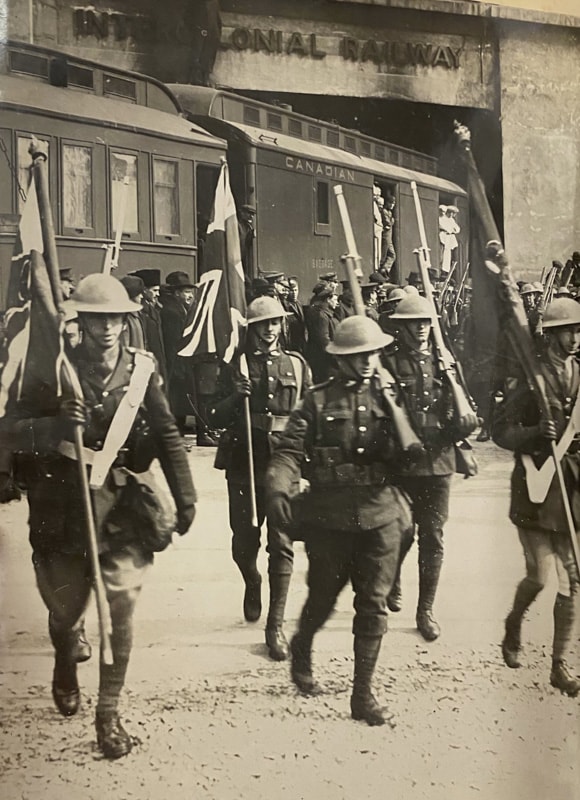
The photographs included in the manuscript show a large crowd gathered to watch the regiment as they marched through the streets. Union Jack flags, bunting, and large arches, one reading “HALIFAX WELCOMES HER FIGHTING SONS,” adorned the parade route.


The men made their way to North Common where they were accommodated in huts and in the nearby armoury, just as they had been three and half years earlier. Shortly after arriving at the Common, The RCR overseas battalion was disbanded.
Milton Fowler Gregg, VC, PC, OC, CBE, MC and Bar
- From February 1934 to August 1945, he was sergeant-at-arms of the House of Commons.
- In August 1936, Gregg commanded the guard of honour at the unveiling of the Vimy Ridge National Memorial by King Edward VIII.
- When the Second World War broke out in September 1939, Milton Gregg reenrolled in the Permanent Force and became second-in-command of the RCR.
- In February 1940 appointed commanding officer of the West Nova Scotia Regiment (WNSR).
- Col Gregg returned to Canada in 1942 and commanded the Officers’ Training Centre (Eastern Canada) in Brockville, Ontario.
- Promoted brigadier in 1943 and appointed chairman of the Officers’ Selection Board.
- In December 1945, while University of New Brunswick president, his appointment as a Commander of the Order of the British Empire (CBE) for his wartime service was announced.
- In 1947, Prime Minister William Lyon Mackenzie King personally asked Gregg to join his cabinet.
- Served as Minister in three consecutive portfolios: Fisheries (2 September 1947 to 18 January 1948), Veterans Affairs (19 January 1948 to 6 August 1950) and Labour (7 August 1950 to 20 June 1957).
- He represented the United Nations in Iraq (1958–59), UNICEF in Indonesia (1960–63) and Canada at UN headquarters in New York.
- One of Gregg’s final public duties was as Canadian High Commissioner to British Guiana as it transitioned to the independent state of Guyana (1964–67).

Order of Canada
In December 1967, Gregg became one of the first recipients of the newly created Order of Canada, to honour the centennial of Confederation. On 24 December 1978, Gregg’s Victoria Cross and his other medals stolen at a function at the RCR Museum in London, Ontario.

His medals have never been recovered. Milton Fowler Gregg, VC, PC, OC, CBE, MC and Bar died 13 March 1978 in Fredericton, NB.
Colonel William Martin King
Colonel William Martin King died in 1969 at the age of 75 in Halifax, Nova Scotia. He was the first British officer to enter Mons, 11th November, 1918.
- Lieut.-Col. commdg. Princess Louise Fusiliers 1930-35;
- Col. commdg. 17th Inf. Bgde. 1937-39;
- served in World War 1939-45;
- apptd. Depy. Asst. Adj. Gen. M.D. 6. Halifax. N.S., 1 Sept. 1939;
- Asst. Adj. & Q.M.G. (1st Grade Staff Appt.) M.D. 1, London, Ont. 1943-46;
- retired with rank of Col., May 1946;

Major Hamilton-Gray
Arthur Cavendish Bentinck Hamilton-Gray died in 1924. He had been seriously injured in the Halifax Explosion.
Major James Gilchrist Burnham
James Burnham died in Toronto on 13 June 1925.
Major Ferdinand George MacCulloch
Major MacCulloch died on 12 October 1941.
Perpetuation of the Royal Canadian Regiment
With the amalgamation of The Oxford Rifles and The Canadian Fusiliers in 1954, forming the London and Oxford Fusiliers (3rd Battalion, The Royal Canadian Regiment), and that regiment’s amalgamation with The RCR in 1958, the story of The RCR in the Great War also encompasses the stories of those two proud regiments of the Canadian Militia.

The last act of the amalgamation took place in 1958, when the Regimental Senate of The RCR confirmed that the Regiment would adopt all perpetuations originally carried by The Oxford Rifles and The Canadian Fusiliers.

This decision formally recognized the perpetuation by The RCR of five infantry battalions (the 1st, 33rd, 71st, 142nd and 168th Battalion) and one machine gun battalion (the 2nd Bn, C,M.G.C.) of the CEF; and of these, two passed down battle honours of their own into the history of The RCR (plus eight honours held by The Oxford Rifles).

The Regimental Rogue & The Royal Canadian Regiment Museum
The most in-depth research on the Royal Canadian Regiment in the Great War by Captain (Ret’d) Michael O’Leary, CD, SMV – the expert on the RCR. Captain O’Leary a subject matter expert and champion of Canadian military history research for well over 20 years, established The Regimental Rogue web site, and a volunteer advisor and guide at the Royal Canadian Regiment Museum. He has helped many Canadian families connect with their past to appreciate our nation’s achievements and sacrifices.

The Sovereign’s Medal for Volunteers recognize the exceptional volunteer achievements of Canadians from across the country and celebrate a wide range of voluntary contributions.
Credit: MCpl Vincent Carbonneau, Rideau Hall, OSGG
In 2015, O’Leary awarded the Sovereign’s Medal for Volunteers for his work on researching Great War soldiers and for sharing his work with the Canadian public through the website “The Regimental Rogue.” On this website, Michael has collected, displayed and wrote about a variety of military topics. He is also a collector of badges and medals to The RCR, which allowed for continuing his research on the Regiment and expand upon his understanding of soldiers’ experiences.

