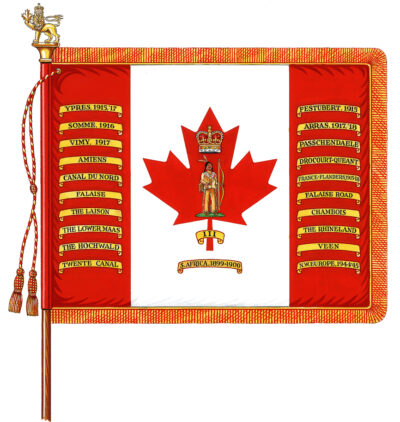
Minister of Militia General Sam Hughes allowed only three regiments to recruit nationally in the Great War. Princess Patricia’s Canadian Light Infantry (P.P.C.L.I.), Royal Canadian Regiment (RCR) and Canadian Grenadier Guards (CGG).

Organization of the 87th Battalion (Canadian Grenadier Guards)
87th Battalion (Canadian Grenadier Guards) organized in September 1915 under the command of Colonel F. S. Meighen. Mobilized at Montreal and recruited in Gaspé, Eastern Townships, Pembroke, Dundas County and the mining districts of Ontario and Quebec.

Minister of Militia, Sam Hughes allowed only three regiments to recruit nationally, RCR, PPCLI and CGG. Though the CGG could not actively recruit outside their assigned districts, they were still open to recruits throughout Canada. Of the 4,169 men (i.e., excluding officers), who passed through the 87th :
- 1,542, less than 37% recruited by / through Quebec, 1,680
- 40% came from Ontario,
- 471 / 11% came from the Maritimes, mostly New Brunswick,
- 36, less than 1%, originated from Western Canada.
- 440 / 11% of unknown origin, or other locations such as Newfoundland, USA and Australia.

1915 Battle Honours
Over 350 Canadian Grenadier Guards drafted into the 14th Battalion (RMR) prior to the formation of the 87th Battalion. These men would see action at Second Battle of Ypres in April 1915 under LtCol Frank S Meighen, C/O of the Royal Montreal Regiment, and later the first C/O of the 87th Battalion.

On or after shortly after 24 February 1915.
MIKAN No. 3194254
Important to note the Canadian Grenadier Guards bear Battle Honours for these engagements, prior to the arrival of the 87th Battalion.
- YPRES, 1915;
- FESTUBERT, 1915;
Following Ypres, Meighen requested leave to Canada and replaced by Major W. W. Burland as commander of the 14th. After arriving back in Montreal during the summer of 1915, Meighen praised his former unit, “I knew that our men were all right, but I never expected that from the outset they would act like seasoned veterans. I could never ask to command better troops.”

In spring 1915, Meighen helped to organize the 87th Battalion (Canadian Grenadier Guards). By June 1916, he was promoted to brigadier general in charge of training Canadian troops at Bramshott, England.
Halifax
The 87th Battalion embarked from Halifax 25 April 1916 aboard EMPRESS OF BRITAIN. Disembarked England 5 May 1916, with a strength of 36 officers, 1026 other ranks.

87th Battalion embarked aboard EMPRESS OF BRITAIN on 22 April 1916 from Halifax.
Officers
Lieut.-Colonel Irving Putman Rexford, Major’s John Roger Anderson, Archd Lorne Campbell Gilday, Franklin Howard Hall, George Gordon Lewis, Harold Le Roy Shaw, Gilbert Sutherland Stairs (Rhodes Scholar, Harvard Law School), Hon Captain’s Rev John Wright Wayman, Arthur William Reed. Hon Lt George Tomlinson Dodge.

Rexford, Manager of a Trust Company, the son of REXFORD, Elson Irving teacher, Anglican clergyman, educational administrator, and office holder; b. 17 June 1851 in Bolton Township, Lower Canada, son of Orrin Rexford and Eliza Dimond; m. 13 Sept. 1882 Louisa Norris in Montreal, and they had five sons and three daughters.
Notable Members
Lt Henry Hutton Scott of St Matthew’s Rectory, Quebec, the son of the 1st Division’s Chaplain.

- Sgt Alexander McClintock, US Navy, from Lexington, KY.
- Private William Anson Olgilvie from Aylwin, Quebec.
- Pvt Whiteford Stewart Dobbs from Alabama, USA.
- Pvt Harry Barnhart 277498 from Malone, NY.
Lt Col R W Frost DSO
Lt Col R W Frost DSO and the Canadian Grenadier Guards proceeded to France on 11 August 1916. Frost had already been blown up twice while serving at the front with the 14th Battalion.
Promoted to Lt-Col in March of 1916, Rexford had been C/O of the 87th Battalion from 6 April 1916 to 22 July 1916.
France
Arrived Le Havre, France on 12 August 1916. 4th Canadian Division, 11th Canadian Infantry Brigade. Reinforced by 22nd Canadian Reserve Battalion and, after 8 May 1917, by 23rd Canadian Reserve Battalion.
Connaught and Alberta Camps
18 August 1916 at Connaught Camp, proceeding to Alberta Camp the next day.
Trenches
First day in the trenches 25 August 1916 Lt F H Mingie wounded in leg while supervising a ration party. Sgt Plaine wounded in chest while in charge of a working party. First Gas-Alarm on 29 August 1916.

First Casualty
On 5 September 1916 in the trenches, Pte Alexander Beveridge Sinclair 541411 KIA (Son of Donald Alexander and Laura Belle Sinclair, of St. Thomas, Ontario.). Pte S P Kelley wounded, would die two days later. Twenty-three men of the 87th fall in September 1916. Most buried at RENINGHELST NEW MILITARY CEMETERY with only six men named on YPRES (MENIN GATE) MEMORIAL.

Leaving the Ypres Salient, in October 1916 the Canadian Grenadier Guards on the Somme. They return to what LtCol Agar Adamson will refer to as ‘That God-forsaken Land’ a year later.
Regina Trench
21 October 1916 87th Battalion attacked Regina Trench. Casualties heavy with 110 killed during the month of October 1916. More than half, 63 men missing, and named on VIMY MEMORIAL.

Missing, Captain Henry Hutton Scott. BORN AT DRUMMONDVILLE, P.Q. SON OF CANON F. G. SCOTT AND AMY BROOKES, OF 355, MOUNTAIN ST., MONTREAL.


Captain Robert Bickerdike shot in the neck and evacuated to England. The forty-seven year old Bickerdike returned to the field in February 1917 with a promotion to major. He was twice mentioned in dispatches and received the Distinguished Service Order in January 1918.
Desire Trench
On 18 November 1916, Pvt Harry Barnhart 277498 declared dead (VIMY MEMORIAL). Harry a Mohawk of the Bay of Quinte. He had been missing, presumed dead, and though his grave had been seen in No Man’s Land, he remains among The Missing.

Many Indigenous, Black and Asian soldiers served with the Canadian Grenadier Guards because religion, race and ethnicity meant nothing to the CGG recruitment officers. The CGG discriminated in only one way with a height requirement of 5′ 5″.

Major Ernest George Fosbery
Pvt Harry Barnhart went missing same day Major Ernest George Fosbery wounded. Evacuated to England, and returned to Canada, Fosbery would be appointed an official war artist with the rank of Major and amongst a variety of war subjects; he completed paintings for the Canadian War Memorials which included portraits of two Canadian Victoria Cross recipients.

Pte. M.J. O’Rourke, V.C., and Sgt. W.T. Holmes, V.C., both of which are now in the Canadian War Memorials collection at the National Gallery of Canada.

Thanks to Fosbery, A Y Jackson transferred to the Canadian War Records branch as an artist where he went on to create important pictures of events connected with the war, and later worked for the Canadian War Memorials as an official war artist from 1917 to 1919.

Sgt Alexander McClintock
Also at Desire Trench, Sgt Alexander McClintock wounded by 22 pieces of shrapnel in his leg, 18 November 1916.
Lt-Col Rexford returns to England on 3 December 1916. In April of 1917 he left His Majesty’s Service at 33 years of age.

1917

rnold Smith
https://www.canadianletters.ca/collections/all/collection/62083/doc/226
Forty-seven year old Captain Robert Bickerdike returned to the field in February 1917 with a promotion to major (he had been shot in the neck at Regina Trench).
After twenty total months in the field and eight months in command of the 87th, LtCol R W Frost fell sick with rheumatic fever and tonsillitis. Described as sweating, pale and anemic, he was evacuated from the field just before the battle of Vimy Ridge. Major Harold LeRoy Shaw assumed command in his absence. Frost later diagnosed with disordered action of the heart. He served on the general staff with Canadian Headquarters in London until the end of the war.

Major H LeRoy Shaw
Despite the overall success by the 87th Battalion in achieving its objectives during the battle at great cost, Shaw deeply affected by battalion casualties during the battle and opted to return to Canada and resign his commission. Official war historian G.W.L. Nicholson would later blame Shaw for failing to target a German trench with artillery bombardment, leading to “machine-gun fire cut[ting] down half the 87th’s leading wave.”
Vimy Ridge
Alphabetically, the first casualty of the Great War, Private John Richard Aaron (VIMY MEMORIAL). As such, John receives much attention, not so much because he arrived in Canada during 1911 as a British Home Child. Son of the late William John and Emily Aaron, of Everton, Liverpool, England. Pvt Aaron one of 138 originals killed-in-action on 9 April 1917 – a decimating total.

Ninety-three of the 138 casualties buried in CANADIAN CEMETERY NO.2, NEUVILLE-ST. VAAST.
ars decimationis
The French Army known to have legally practiced the ‘Art of Decimation’ in 1915. In response to mutiny among the troops, 1 in 10 soldiers would be selected by lottery among the offending unit to be executed.

Decimatio referred to the execution of one in ten men in a Roman legion as punishment for cowardice, mutiny, or desertion.
Decimation would later take a more ‘honoured’ meaning among several units of the CEF in the Great War, in particular, the P.P.C.L.I., thrice a victim of this cruel term.
Sergeant Charles Edward Minshull
Sgt Minshull’s body found at 36c.S.15.c (about 100 yards north of CANADIAN CEMETERY NO.2, NEUVILLE-ST. VAAST) and reburied on 9 September 1919. Authorities unable to contact his wife Alice Minshall of Montreal.

Sergeant John Galoway Taylor
Sergeant John Galoway Taylor the son of George and Mary Taylor; husband of Mary Paterson Taylor; brother of Bell. G. Miller of Perth.

Corporal Donald Angus MacLeod
Cpl MacLeod the son of Donald and Mary MacDonald MacLeod, of Danville, Province of Quebec, Canada.

LCpl Peter Burgess Armstrong
Son of William H. Armstrong and Amelia McDonald Armstrong, 138, Charron St., Montreal, Province of Quebec, Canada.

Sergeant J Maher

CSM William Phillips
Son of John and Anne Phillips; brother of A. L. Phillips, of 416, Phillips Place, Montreal, Province of Quebec, Canada.


Standing before the memorial LtCol J V P O’Donahue DSO.
Canadian Cemetery No.2, Neuville-St. Vaast
MIKAN No. 3395020
LtCol James Vincent Patrick O’Donahue DSO
Following the Battle of Vimy Ridge, LtCol J V P O’Donahue DSO assumes command of the Canadian Grenadier Guards on 8 May 1917.

Back to camera center, LtCol J V P O’Donahue DSO.
Canadian Cemetery No.2, Neuville-St. Vaast
MIKAN No. 3395021
Sergeant Alexander McClintock discharged from the CEF on 28 June 1917, and returned to the USA, where he wrote Best O’Luck.
Dominion Day


Hill 70
Unlike Vimy Ridge, most of the casualties from the Battle of Hill 70, 77 of 116, named on the VIMY MEMORIAL. Only a few of the casualties from the battlefield recovered, even fewer died of their injuries in the rear areas.
- Pvt James H Bain MM (CABARET-ROUGE BRITISH CEMETERY, SOUCHEZ)
- Pvt Paul Baudin MM
- Lt Percy John Jackson MM
- Sgt Russell Stephenson MacLagan MM
- Sgt William McLandlish DCM
- Private Slattery MM (VILLERS STATION CEMETERY, VILLERS-AU-BOIS).

Prisoner of War

Missing-in-action, Pvt J J Boston, of Belfast. On 24 September 1917, Boston a PoW at Limburg (transferred to Dulmen in October).
Memorial Service, 16 September 1917
Gen. D. Watson who unveiled this Memorial reading the names of the fallen at 2:30 pm. Note the listing of soldier’s names on the near side of the memorial, who died of wounds during the Vimy Ridge operations of April, 1917. Maj. Gen. David Watson the C/O of the 4th Canadian Division, which the 87th Battalion a unit of.

Canadian Cemetery No.2, Neuville-St. Vaast, 16 September 1917.
Canadian Cemetery No.2, Neuville-St. Vaast
At this time, Canadian Cemetery No. 2 known as the cemetery of the 87th Battalion. Following the Armistice hundreds of graves from the 11th Cdn Inf Bde added to the cemetery.

MIKAN No. 3379711
The cemetery reopened for burials in 1931, receiving its last Canadian burial in 1947. Despite the cemetery’s name, the large majority of the dead are British.

Tumpline
The CEF designated tumpline companies during the Great War to carry materials, including guns, to the front.

In 1882, French Canadian shoemaker Camille Poirier, who had immigrated to Duluth, Minnesota in 1870, added a tumpline to the typical backpack used by settlers, and created the Duluth Pack – a brand of backpack still used by outdoor enthusiasts.

The headpiece secured to the top of the head as opposed to the forehead, as this allows for the back, rather than the neck, to support the weight of the load.

3522012
The tumpline tied so that the pack sits just above the hips. A properly secured tumpline will ensure the pack does not interfere with a soldier’s stride.

Although tumplines not used until 1917, their use, which originated with the First Nations people of Canada, proved to be a very effective means of carrying heavy loads.
11th Canadian Infantry Brigade Staff
After the death of Lieutenant Colonel Hart-McHarg at the second battle of Ypres in late April 1915, Victor Odlum assumed command of the 7th Battalion.

On 10 July 1916, promoted to brigadier general in command of the 11th Infantry Brigade, a post he held until the end of the war.

Odlum helped to formulate and implement many of the trench raiding tactics that made the Canadian Corps famous. Multiple times wounded, Odlum earned the DSO and six times mentioned in dispatches.
On 21 October 1917, Lieutenant Albert Joseph Maingot ToS of the 87th in France.
Passchendaele
Thirty-six originals died during the month of November 1917, as expected, the majority (20), named on the YPRES (MENIN GATE) MEMORIAL. Only a few burials made on the battlefield.

Pvt B K Westerlund
Private Bruno Konstantin Westerlund (PASSCHENDAELE NEW BRITISH CEMETERY) buried in Plot I.A.13 – the only casualty of the Canadian Grenadier Guards buried here.

Private Matthew Provan (POTIJZE CHATEAU GROUNDS CEMETERY)

Pvt R Kirkpatrick (NINE ELMS BRITISH CEMETERY)

1918
Prisoner of War
Pvt John Joseph Boston
Boston a PoW of Barack Lazarette Mulheim a Ruhr. PoW Private J J Boston 139521 died 4 January 1918 and buried at COLOGNE SOUTHERN CEMETERY. Son of Joseph and Elizabeth Boston, of Belfast.

Lieutenant Albert Joseph Maingot granted 14 days leave on 12 February 1918, and month after returning to the unit, admitted to No. 4 CFA. Maingot would spend the next few months in and out of hospital with a bade case of acne vulgaris.
Sir Douglas Haig
The Field Marshall Commanding in Chief inspects the brigade, including No. 3 Company, 4th Divisional Train, and 11th CFA, CAMC at Bruay, 28 February 1918.

MIKAN No.3522097
The troops were very steady on parade and the march past well done, and the C-in-C expressed himself as being very pleased with the showing made by the brigade.


3522095

After the march past, Field Marshall Haig spoke for a few moments to the Battalion Commanders, complimenting them on the smart appearance of the men. The C-in-C was heartily cheered by the Brigade as he left.


LtCol J V P O’Donahue Wounded
On 5 April 1918, as LtCol J V P O’Donahue prepared to go over the front line, he was struck by a piece of shrapnel in the right leg above the knee. Although he wanted to stay on duty, it was General Odlum who convinced him to seek treatment. After reporting to Brigade headquarters, O’Donahoe walked to the field ambulance.
Major J S Ralston MC
With LtCol J V P O’Donahue in hospital, on 6 April 1918, Major J S Ralston MC takes command of the Canadian Grenadier Guards.

LtCol J V P O’Donahue DSO died of septic poisoning on 8 May 1918 at the hospital in Etaples, exactly one year after taking command of the 87th.
LCol Kenneth Meikle Perry DSO & Bar
LtCol K M Perry DSO & Bar of the 13th Battalion, takes command on 15 May 1918, replacing the late LtCol J V P O’Donahue DSO. On the morning of 12 May 1918, the battalion had held a memorial service for its fallen commander. Many senior division and brigade officers attended including Major General David Watson and Brigadier General Victor Odlum.

At the service, General Odlum spoke about the close bond he had forged with O’Donahoe:
I saw Lt-Col O’Donahoe for the first time about a year ago, when he reported to me to command the 87th Battalion. But though I had never seen him before, I had received splendid reports on him, and, acting on the strength of these reports I had applied for him. I have never since regretted that action.

…as a result of it all, there grew up between us one of the greatest and one of the best friendships that has ever come into my life.
Euology
You, Officers and men of the 87th have lost a gallant leader. And I have lost a trusted and dear friend. The whole Canadian Corps has lost a tried and able soldier. – (Brig-Gen. Odlum’s eulogy, 87th Bn. War Diary, 12 May 1918, 30)
Hon Captain George Tomlinson Dodge awarded the MC in June 1918.
Suffering from PTSD, former CGG Sgt Alexander McClintlock commits suicide in New York on 28 June 1918.

LtCol F S Meighen CMG
LtCol F S Meighen CMG, the first CO of the CGG, and the first CO of the Royal Montreal Regiment, takes command on 14 October 1918, until 7 March 1919. LCol Perry had received assurances that he would be allowed to return to the 13th Battalion if the command once again became vacant. One month after McCuaig promoted to brigadier general in October 1918, Perry resumed command of his original battalion.
General Victor Odlum


Bapaume Post Military Cemetery
In June 1916, the front line crossed the Bapaume road between the site of this cemetery and the village of La Boisselle. The attack on La Boisselle on 1 July not successful, and several days passed before the village taken. The cemetery begun almost at once by the divisions engaged in this sector and 152 graves in Plot I, Rows B to I, made before the end of January 1917, when the cemetery closed.
These three graves in the first row of Plot I in Bapaume Post Military Cemetery.

Lt James William Williams, Major F E Hall, Major John Simon Lewis 87th Battalion, KIA 18-11-16.1 July 1918.
BAPAUME POST MILITARY CEMETERY, ALBERT
MIKAN No. 3403381
Major John Lewis


Major Franklin Edward Hall


Lt James William Williams
Son of the Right Reverend Lennox Williams, D.D., Bishop of Quebec and Caroline Annie (nee Rhodes) of Bishopthorpe, Quebec. Husband of Evelyn Fisher (formerly Williams), of Sackville, New Brunswick. Lt. Williams held a Bachelor of Arts from Oxford University.


Battle of Amiens
Special mention made of the following for their work during the attack:
- Lt W W Beveridge
- Sgt T E Fudge 138574
- Pte R J McLaughlin 1057373
- Pvte C E George 458236
- Pvt D McKenzie 178165
- Private G Greennalgh 457176
Major I S Ralston MC
Killed-in-action on 10 August 1918, Ralston had led the CGG since 6 April 1918.

Cpl C T Henriksen MM
Corporal Carl Thorvald Henriksen MM (LE QUESNEL COMMUNAL CEMETERY EXTENSION)

Dury
While out on patrol, Lt Maginot wounded just before midnight, 2 September 1918 at Dury. Captain McKiney and Lts Tasker and Fogarty killed.

At noon on 3 September 1918, troops of the Guards liberated Ecourt-St-Quentin, having been on the edge of Saudemont.

Lieutenant Albert Joseph Maingot
Lt A J Maingot had returned to the 87th in time for the Last Hundred Days, but had his blighty in early September.

Lt Albert Joseph Maingot evacuated to England early September 1918 with a GSW to his left hand (2 September 1918). Following 15 days in hospital, discharged on 2 October 1918. He would finally unite with his unit on 5 January 1919.


3522286
Private John Francis Young VC, 87th (Canadian Grenadier Guards) Battalion
“For most conspicuous bravery and devotion to duty in attack at Dury-Arras sector on the 2nd September, 1918, when acting as a stretcher-bearer attached to ‘D’ Company of the 87th Bn., Quebec Regiment. This company in the advance over the ridge suffered heavy casualties from shell and machine-gun fire.”

Canadian Grenadier Guards
Pte. Young, in spite of the complete absence of cover, without the least hesitation went out, and in the open fire-swept ground dressed the wounded. Having exhausted his stock of dressings, on more than one occasion he returned, under intense fire, to his company headquarters for a further supply.

“This work he continued for over an hour, displaying throughout the most absolute fearlessness. To his courageous conduct must be ascribed the saving of the lives of many of his comrades. Later, when the fire had somewhat slackened, he organised and led stretcher parties to bring in the wounded whom he had dressed. All through the operations of 2nd, 3rd, and 4th September Pte. Young continued to show the greatest valour and devotion to duty.”

Somehow, sources on the web attribute 7 VC’s to the 87th Battalion CEF. Private John Francis Young VC, 87th (Canadian Grenadier Guards) Battalion the only member of the Canadian Grenadier Guards to earn the highest award for Valour.
On 10 October 1918, Hon Captain George Tomlinson Dodge MC wounded at duty and admitted to No 33 CCS. Discharged to his unit, he would soon be readmitted to No 37 CCS, dangerously ill.
Valenciennes

VALENCIENNES (ST. ROCH) COMMUNAL CEMETERY
Hon Captain George Tomlinson Dodge MC, died of influenza, 27 November 1918.

1919
LtCol R Bickerdike DSO & Bar
On 7 March 1919, LtCol R Bickerdike DSO assumes command of the Canadian Grenadier Guards. He was twice mentioned in dispatches, and received the Distinguished Service Order in January 1918, and a Bar to it in 1919. Bickerdike led the troops home following demobilization in June.
11th CIB March Past, 25 March 1919
11th Inf. Brigade march past. – ‘Inspection of 4th Cdn Div. by King Albert of Belgium.’ March 1919. His Majesty the King of the Belgians inspected the 11th CIB on the practice track near Groenendael.


3522665

Renbaan van Groenendaal
The structure above since replaced by Oude Koninklijke Loge and this former racetrack now a heritage park – Renbaan van Groenendaal.


Return to England
The 87th Battalion returned to England 3 May 1919. Disembarked in Canada 6 June 1919. Demobilized 8 June 1919. Disbanded by General Order 149 of 15 September 1920. Colours deposited in Canterbury Cathedral.
Brass and bugle bands. Published a photographic record, 1916. Perpetuated by The Canadian Grenadier Guards.
Lieut.-Colonel Irving Putman Rexford d. 21 Oct. 1936 in Westmount, Que.
Lieutenant Colonel F. S. Meighen died on 19 January 1946 at the age of seventy-five.
Major Harold Le Roy Shaw died in 1947 and buried at Knowlton Cemetery, Knowlton, Quebec.
Lieutenant Colonel Kenneth Perry, D.S.O. retired from the army in 1943 and died in 1949.
Lieutenant Colonel R. Bickerdike, D.S.O. & Bar died in Montreal on 9 November 1958.

