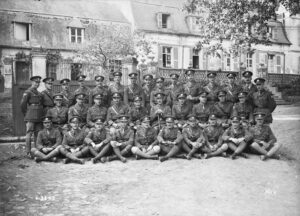
Private George Warren Hatfield of the 25th Battalion sent back to England when discovered underage. Sent back to the front with the Royal Canadian Regiment when old enough to die. And, he did so, only three months before the Armistice.

Enlistment of Private George Warren Hatfield
George Warren Hatfield born 20 May 1898 (1899) in Quinnan, Yarmouth County. Son of Joseph and Elizabeth Hatfield, Cemetery Street, Yarmouth.
Private George Warren Hatfield 734477 enlisted with A Company, 112th Overseas Battalion on 30 March 1916 at Yarmouth with previous experience in 29th Battery, CFA, Home guards and Cadets. George stood 5′ 5″ tall, 140 pounds with fair complexion, blue eyes and dark brown hair.
112th Overseas Battalion
Organized in November 1915 under the command of Lieutenant-Colonel H B Tremain. Mobilized at Windsor, Nova Scotia, and recruited in Hants, Kings, Digby, Yarmouth, Queens, Shelburne, Lunenburg, Annapolis and Halifax counties. Embarked from Halifax 24 July 1916 aboard OLYMPIC. Disembarked England 31 July 1916 with a strength of 36 officers, 1090 other ranks. Drafts of 122, 212 and 40 to 25th Battalion in October 1916, and later absorbed by 26th Canadian Reserve Battalion on 4 January 1917.
George arrived in England on 31 July 1916 with the 112th Battalion. Following a summer spent in training, proceeding overseas, George writes his will on 2 October 1916. Taken on strength of 25th Battalion in the Field, 6 October 1916.
25th Battalion
Organized in October 1914 initially under the command of Lieutenant-Colonel G A LeCain. Mobilized at Halifax and also recruited in Nova Scotia (Halifax, Sydney, Yarmouth, Amherst and Truro).

Embarked from Halifax 20 May 1915 aboard SAXONIA, later disembarked in England on 29 May 1915 with a strength of 42 officers, 1081 other ranks. Arrived in France 15 September 1915 with the 2nd Canadian Division, 5th Canadian Infantry Brigade, and later reinforced by 26th Canadian Reserve Battalion.
Underage
Caught underage, George returned to England after a month at the front, 22 November 1916. Assigned to the Boys Battalion on 16 January 1917. Taken on strength of 185th Battalion at Witley Camp, 9 February 1917.
185th Overseas Battalion
The 185th Battalion authorized on 1 February 1 1916, under the command of Lieutenant-Colonel Frank Parker Day. The previous month, Canadian military authorities had approved the formation of the Nova Scotia Highland Brigade and appointed Lieutenant-Colonel Alison Hart Borden as its Commanding Officer. The 85th Battalion (Nova Scotia Highlanders), Lt-Col. Day’s former unit, established in September 1915 and recruited to full strength during the autumn of 1915, became the Brigade’s senior component. The 193rd Battalion, authorized four days prior to the 185th, formed a third unit, while the newly created 219th Battalion completed the Brigade’s ranks.

During the spring of 1917, military authorities in England commenced organization of a 5th Canadian Division at Witley Camp. The 185th was assigned to the Division and diligently trained while awaiting the order to proceed to the continent.
17th Reserve Battalion
Organized at Seaford on 10 January 1917 initially under the command of Lieutenant-Colonel E C J L Henniker. Formed by absorbing 103rd and 121st Battalions. Absorbed 225th Battalion on 6 February 1917. Reinforced 54th and 102nd Battalions and 2nd Canadian Mounted Rifles. Absorbed by 1st Canadian Reserve Battalion on 15 February 1918.

Transferred to 17th Reserve Battalion at Bramshott, Witley on 23 February 1917. Ceases to be attached GDD Hastings, On Command of HQ 5th Canadian Division, Witley, 10 March 1917.
SoS to RCR Overseas on 7 April 1918 at Bramshott. Left for RCR 9 April 1918, arriving in the field on 21 April 1918.
Royal Canadian Regiment
On garrison duty in Bermuda, September 1914 – August 1915. Left Bermuda 13 August 1915 aboard CALEDONIAN. Left Halifax 26 August 1915. Disembarked England 5 September 1915. Arrived in France 1 November 1915. Corps troops until 24 December 1915 when it joined 7th Canadian Infantry Brigade, 3rd Canadian Division.

Battle of the Scarpe (1918)
Following the brilliant success of the Canadian Corps (Lieutenant-General Sir A.W. Currie) at Amiens on 8 August 1918, the Corps moved back north to rejoin First (British) Army near Arras. Later, in mid-August, plans laid for First Army to attack east toward the German-held Drocourt-Quéant Line, an extension of the Hindenburg Line. The 2nd (Major-General Sir H.E. Burstall) and 3rd (Major-General L.J. Lipsett) Canadian Divisions began the advance on 26 August attacking on a four-mile frontage between the village of Neuville-Vitasse and the River Scarpe.
The Canadians quickly captured the villages of Monchy-le-Preux and Guémappe. The Germans subsequently withdrew into the prepared positions of the Drocourt-Quéant Line and the Canadians continued their advance with plans to attack the Drocourt-Quéant Line on 30 August 1918. In the operation, RCR total casualties 196, 32 killed including Private George Warren Hatfield.
Vis-en-Artois British Cemetery
Vis-En-Artois and Haucourt taken by the Canadian Corps on 27 August 1918. The cemetery begun immediately afterwards and used by fighting units and field ambulances until the middle of October. It consisted originally of 430 graves (in Plots I and II) of which 297 Canadian and 55 belonged to the 2nd Duke of Wellington’s Regiment. Increased after the Armistice by the concentration of graves from the battlefields of April-June 1917, August and September 1918, and from the smaller cemeteries in the neighbourhood.
The cemetery now contains 2,369 burials and commemorations of the Great War. 1,458 of the burials unidentified but special memorials to eight casualties known or believed to be buried among them. Other special memorials commemorate four soldiers buried in other cemeteries whose graves could not be found on concentration.
Please subscribe to CEFRG to be notified by email when there are new posts.