Canada’s Youngest VC Recipient

Lt Alan Arnett McLeod, VC, pilot (born 20 April 1899 in Stonewall, MB; died 6 November 1918 in Winnipeg, MB). During the war, McLeod awarded the Victoria Cross (VC) for his heroic actions during and after an aerial battle with enemy fighters. He died shortly after returning to Canada. A victim of the 1918 influenza pandemic that claimed the lives of millions worldwide, including some 50,000 Canadians.
Early Life of Alan Arnett McLeod
Alan McLeod the son of Alexander and Margaret McLeod. Born on April 20, 1899, and lived in the small town of Stonewall, north of Winnipeg. When he was 14, he joined a militia unit, the 34th Fort Garry Horse. He spent the summer of 1913 at a training camp performing menial tasks. But, he was happy to be in uniform.

When the First World War began in August 1914, McLeod was too young to remain in the militia. In 1916, he tried to join the cadet wing of the British Royal Flying Corps, which trained pilots in Canada. But, told he had to wait until he was 18 and returned to the Fort Garry Horse. He tried again in April 1917 and accepted for pilot training along with his friend Allan Fraser.
Allan Fraser
Finally, on June 2, 1917, McLeod announced, “I passed my exams OK and leave for Camp on Monday.” This, however, soon followed by the more sombre news that his friend Allan Fraser had died in a training crash at Deseronto, Ontario.

McLeod left behind a trail of chatty letters to his family. Displaying the demeanour of a small-town teenager eagerly adapting to a rapidly broadening world. During training at the University of Toronto, he revealed occasions of homesickness, but he made friends easily. He sometimes wrote of boredom with military discipline and some aspects of training. But, he took it all in stride and wrote, “I’m sure going to work harder than I ever did before so if I fail it won’t be my fault.”

War Service of Alan Arnett McLeod
Alan McLeod successfully completed theoretical training in engines, map reading, theory of flight, cross-country flying and wireless telegraphy at No. 4 School of Military Aeronautics at the University of Toronto. He then began pilot training at Long Branch, just west of Toronto. His first flight was on 4 June 1917 on a Curtiss JN4 trainer. He made his first solo flight five days later, after little more than two hours of in-flight instruction.
“I made a bombing success of it and did really well, but I made up for that this morning.”
Camp Borden
In mid-June, McLeod posted to Camp Borden for advanced training.

School of Aerial Gunnery
McLeod qualified as a pilot on 30 July 1917 and then attended the School of Aerial Gunnery. On 20 August, Second Lieutenant McLeod sailed from Montreal on the SS Metagama and docked in England on 1 September. On arrival, he had 10 days leave in London, subjected to nightly German bombing raids during his stay.

No. 82 Squadron
On 14 September, McLeod posted to No. 82 Squadron at Waddington, Lincolnshire. The squadron flew the Armstrong Whitworth F.K.8. Nicknamed the “Big Ack,” a large, lumbering two-seater aircraft (pilot and observer) used overseas and for home defence. After two months, No. 82 Squadron due to be sent to France. But, McLeod still not old enough to go (pilots had to be at least 19 to serve in combat).

“I looped one the other day. I was the second person here to do it, they’re perfectly safe but people didn’t know it, you’d think you were riding in a parlour car they ride so smooth, but I’d much rather fly a smaller machine, they are easier to stunt with.”
No. 51 (Home Defence) Squadron
Transferred to No. 51 (Home Defence) Squadron at Marham, Norfolk. The squadron flew the F.E.2b, a two-seat fighter. Mainly on night patrols over London, searching for German Zeppelins and Gotha bombers. McLeod served with 51 Squadron for two months before posted to France. A shortage of pilots may have been the reason for this decision, since Lt Alan Arnett McLeod still underage.

France
On 29 November 1917, Lt Alan Arnett McLeod arrived at No. 2 Squadron, stationed at Hesdigneul-lès-Béthune in northeast France. The squadron equipped with the Big Ack and flew army cooperation missions such as artillery spotting and photographing enemy lines. It was also used on day and night bombing sorties.
No. 2 Squadron
Commanded by Major Wilfred Rippon Snow, No. 2 Squadron had been among the earliest RFC units in France. And, performed its front-line observation duties with an aggressiveness that McLeod enthusiastically embraced, Boasting, “this is the crack squadron of France and anyone who is not up to the mark gets kicked out.”
McLeod flew his first sortie the day after arrival. He spent the next few weeks complaining of cold and boredom until December 19, when he flew an artillery spotting mission with Lieutenant J.O. Comber in F.K.8 B5782 and tersely reported: “Unsuccessful shoot on BY-75 owing to mist. Scrap with 8 Huns, 1 spun away.” In ironic contrast to the dubious nature of the aerial victories later confirmed to McLeod, this “out of control” may have had a definite outcome. Because, Royal Prussian Jagdstaffel 20 logged the loss of Leutnant Walter Braun, wounded at 1405 hours over Faumont (in No. 2 Squadron’s sector), and dying of his wounds at the Dourges hospital in France the next day.

On January 3, 1918, Lt Alan Arnett McLeod fired 100 rounds at German troops along La Bassée’s main street. On the 12th, Major Snow noted, he “attacked and dispersed with machine gun fire from 800 feet the crew of a very troublesome anti-aircraft battery at La Bassée.”
McLeod decided to use his bomber as a fighter whenever he could. On several missions behind enemy lines, he and his observer engaged and shot down German aircraft. He received a Mention in Despatches.
A Daring Operation
He was honoured with a Mention in Despatches for a daring operation on January 14, 1918, when he and his observer, Lieutenant Reginald Key, attacked and brought down a heavily-defended observation balloon. They were set upon by three German fighters. However, Lieutenant McLeod, by skillful flying, placed his machine in a position to permit his observer full range of his gun to send one of the enemy aircraft down.
Military Cross Recommendation
“He has shown keenness in his work,” Snow concluded on McLeod, “and I regard him as a most capable and reliable artillery pilot.” On January 16, Lieutenant-Colonel Leslie Gossage, commander of No. 1 Wing to which No. 2 Squadron was attached, responded to Snow’s report by writing, “I desire to submit the name of the undermentioned officer for the immediate award of the Military Cross (MC), for consistent gallantry and devotion to duty.” The application languished for more than two months, then was marked “Cancelled,” most likely because McLeod was being considered for a higher decoration by then.
Lieutenant Arthur William Hammond
In March 1918, Key posted out of the squadron and McLeod assigned Temporary Lieutenant Arthur William Hammond as his regular observer. The son of Master Mariner Henry Hammond and Alice Kincaid, Hammond born on August 29, 1890 at Walton on the Hill, Lancashire. He served in the Horse Guards, followed by the Royal Engineers as a temporary second lieutenant in October 1915, before entering the RFC as an observer.

On February 18, 1918, Hammond on a photographic mission with Captain Jack Manning Allport from New South Wales, Australia, when they came under attack by six Pfalz D.IIIs. Coolly manning his Lewis gun, Hammond credited with shooting down two of their assailants, one in flames. This action took place at La Bassée, while at nearby Armentières No. 2 Squadron lost Lieutenant Alfred Jones Homersham and Captain Sydney Broadbent, both killed in B211 by Bavarian Jasta 23’s Leutnant Max Gossner (d. 5 April 1973).

Jasta 23b in turn recorded that Leutnant Heinrich Kütt came down wounded, undoubtedly by Hammond. Hammond and Allport both subsequently awarded the MC for this action and subsequent missions in which “a large number of hostile batteries were photographed, engaged and successfully silenced, as well as some of our long range batteries calibrated on hostile targets.”

Heroism in the Air
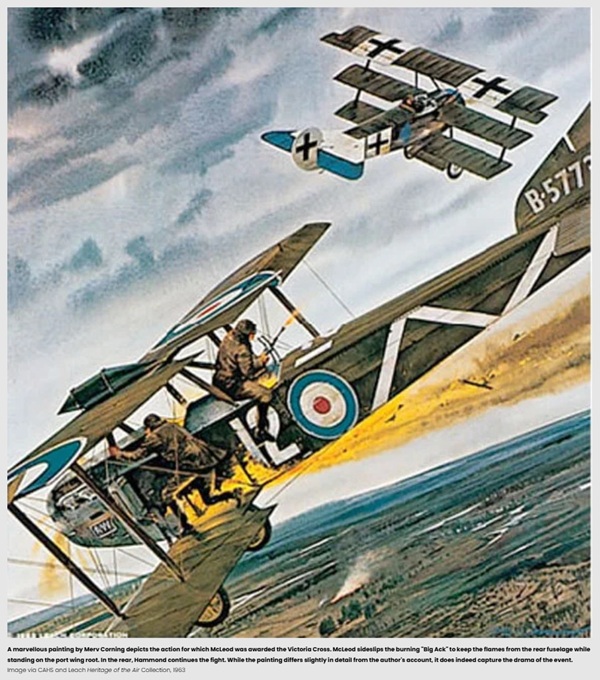
On 27 March 1918, Lt Alan Arnett McLeod and his observer, Lieutenant Arthur Hammond, on a bombing mission behind enemy lines. Suddenly, a Fokker fighter appeared out of the clouds slightly below them and only 200 metres away. McLeod manoeuvred his bomber so Hammond could fire at it. After three short bursts from the Lewis gun, the enemy aircraft plummeted to the ground.

As McLeod and Hammond were congratulating each other, eight more Fokkers attacked from different directions. McLeod manoeuvred the bomber, allowing Hammond to fire at the enemy planes in turn. Hammond shot down three of them before another enemy fighter came up under their bomber and fired into its belly, puncturing the fuel tank and starting a fire. Both McLeod and Hammond were wounded.
One leg in the cockpit
Lt Alan Arnett McLeod climbed out onto the wing and controlled the aircraft from the side of the fuselage with one leg inside the cockpit. By side-slipping steeply, he kept the flames to one side, allowing Hammond to continue firing. (In a side-slip, a plane moves sideways relative to the oncoming airflow.) Although Hammond could use only one arm, he somehow managed to fire at another German fighter as it closed in for the kill. The Fokker fell away. Hammond continued firing all the way to the ground.
By the time McLeod crash-landed the plane in no man’s land, he had been wounded five times and Hammond six. Despite this, McLeod was able to drag his observer away from the burning wreckage just before its remaining bombs and ammunition exploded. German small arms fire wounded McLeod a sixth time as they hid in a shell hole. That night, South African soldiers rescued them and carried them to a medical facility.
On 4 September, McLeod received the Victoria Cross from King George V at Buckingham Palace. His father travelled from Canada to attend the investiture. Hammond received a bar to his Military Cross.
Victoria Cross Citation
The London Gazette of May 1, 1918, announced the award of the Victoria Cross (V.C.) to Lt Alan Arnett McLeod with the following citation:

Lt A W Hammond MC
“While flying with his observer, Lieutenant A. W. Hammond, M.C., attacking hostile formations by bombs and machine gun fire, he was assailed at a height of 5,000 feet by eight enemy triplanes which dived at him from all directions, firing from their front guns. By skilful manoeuvring he enabled his observer to fire bursts at each machine in turn, shooting three of them down out of control. By this time Lieutenant McLeod had received five wounds, and while continuing the engagement a bullet penetrated his petrol tank and set the machine on fire.

He then climbed out on to the left bottom plane, controlling his machine from the side of the fusilage, and by sideslipping steeply kept the flames to one side, thus enabling the observer to continue firing until the ground was reached.

Wounded
The observer had been wounded six times when the machine crashed in “No Man’s Land” and 2nd Lieutenant McLeod, notwithstanding his own wounds, dragged him away from the burning wreckage at great personal risk from heavy machine-gun fire from the enemy’s lines. This very gallant pilot was again wounded by a bomb whilst engaged in this act of rescue, but he persevered until he had placed Lieutenant Hammond in comparative safety, before falling himself from exhaustion and loss of blood.”

Lt Alan Arnett McLeod VC’s Return to Canada
After his VC presentation, Alan McLeod returned to Canada with his father. He was officially welcomed home in a ceremony at the Winnipeg train station on 30 September 1918, followed by a public reception in Stonewall. He told crowds at both events that he would return to the front. McLeod still weak from his ordeal, however, and contracted the Spanish flu, a strain of influenza originating in China, then sweeping the world. He died in the Winnipeg General Hospital on 6 November and buried in the Old Kildonan Presbyterian cemetery in his hometown.

On May 9, 2017, at the historical Old Kildonan Cemetery in Winnipeg, Manitoba, Lt Alan McLeod VC received his proper CWGC headstone.

Among those present at the dedication were Hamilton, Ontario, resident Alan Adams, a nephew of Alan McLeod, and Kathleen Williams, a grandniece of Arthur Hammond. Although he never knew his heroic uncle, Mr. Adams said Alan McLeod lives on in his imagination from the stories passed down from the family.
Legacy of Lt Alan Arnett McLeod VC
Alan McLeod VC Avenue
There are several tributes to McLeod’s courage, including Alan McLeod VC Avenue in his hometown, Stonewall.

Alan Arnett McLeod VC
This road is named in honour of 2nd Lieutenant Alan Arnett McLeod, VC at the National Field of Honour, Pointe-Claire.

McLeod Building
He was inducted into Canada’s Aviation Hall of Fame, Edmonton, Alberta, in 1974. The McLeod Building at CFB Borden, Ontario, houses the Air Force Annex at Base Borden Military Museum.

Lt. Alan McLeod Building
The Lt. Alan McLeod Building provides quarters for students at 3 Canadian Forces Flying Training School, Portage la Prairie, Manitoba.

No. 301 (Alan McLeod, V.C.) Squadron, Royal Canadian Air Cadets
In 2009, the No. 301 (Alan McLeod, V.C.) Squadron, Royal Canadian Air Cadets was established in Stonewall.

Canada’s Aviation Hall of Fame
Alan Arnett McLeod was inducted as a Member of Canada’s Aviation Hall of Fame in 1974 at a ceremony held in Edmonton, Alberta. Canada’s Aviation Hall of Fame (CAHF) no longer located in Edmonton but now housed within The Hangar Flight Museum in Calgary.

More
The Commonwealth’s most decorated serviceman LCol William George Barker good friends with Canada’s most popular pilot, Billy Bishop.


