42nd Battalion (Royal Highlanders of Canada) organize February 1915 initially under command of Lieutenant-Colonel George Stephen Cantlie DSO. Cantlie on special leave of absence to Canada, 14 December 1916. He would return to command the 20th Reserve Battalion. Major R.L.H. Ewing taking command in his absence. The 42nd Battalion (Royal Highlanders of Canada) mobilize at Montreal, and they also recruit in Montreal.
Royal Highlanders of Canada in England
Royal Highlanders of Canada embark Montreal 10 June 1915, aboard RMS HESPERIAN. Later, on night of 4 September 1915, submarine SM U-20, under command of Kapitanleutnant Walther Schwieger, torpedoes HESPERIAN. Earlier, Schwieger sank RMS LUSITANIA. While being towed to Ireland, HESPERIAN sinks on 6 September 1915. Thirty-two people die, including Private Charles Kinglsey 46850, 17th Battalion.
In 2017, it is reported scuba-diving pirates have ransacked the shipwreck. HESPERIAN contains the body of a Montreal socialite philanthropist. The ship was carrying the body of Frances Stephens, a victim of the LUSITANIA.

The 42nd Battalion disembark England, on 19 June 1915 with a strength of 40 officers, 978 other ranks. Following a summer of training, arrive in France on 9 September 1915, with the 3rd Division, 7th Infantry Brigade.
Reinforced by 20th Reserve Battalion, organized at Shoreham on 8 January 1917 under the command of Lieutenant-Colonel A. A. Magee, formed by absorbing 148th and 171st Battalions. Absorbed 236th Battalion on 14 March 1918, and finally, reinforced 13th and 42nd Battalions. They then moved to Bramshott Camp on 11 October 1917. To Ripon on 20 January 1919. Finally, at the end of the Great War, absorbed by 23rd Reserve Battalion on 28 April 1919.
Major C.B. Topp, MC
Lieutenant-Colonel Charles Beresford Topp DSO & Bar, MC, writes the history of the 42nd Battalion in the Great War. Colonel Topp, with characteristic diffidence, passes lightly over the splendid service he rendered. He was the 42nd’s Platoon Commander, Company Commander, and Second in Command of the Battalion. Finally, always reliable, with quiet manner and intrepid skill, he was a tower of strength.

Of course, Topp does not mention his Military Cross in the battalion history. Lieutenant-Colonel Topp died on 12 August 1949.
Battle of Vimy Ridge
Following the Battle of Vimy Ridge, Lieutenant William Rider-Rider captures Major Topp in several photos. Officers are inspecting German guns, taken at the fighting near La Folie Wood.


Robert Alexander Giles, MM
A few months later, Lieutenant William Rider-Rider captures this mis-identified unit – the 13th Battalion. Soldier on the right recently identified as Corporal Alexander Giles, of the 42nd Battalion.

The soldier kneeling, cleaning parts in the bucket, is the Grandfather of Richard Giles. Corporal Robert Alexander Giles, MM, 841030. Enlists at Montreal, 15 December 1915 with the 148th Overseas Battalion, then transfers to the 20th Reserve Battalion after arrival in England, 8 January 1916. Finally, reverts to ranks at own request, and sent to 42nd Battalion (Royal Highlanders of Canada) on 10 November 1917.
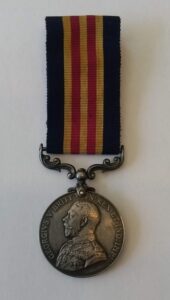
Lance-Corporal Alexander Giles awarded the Military Medal for actions at Monchy-le-Preux and Boiry Notre Dame, 27 August 1918. Following the battle, Brigadier-General John Arthur Clark, DSO, CO 7th Canadian Infantry Brigade, sent a congratulatory message. In four attacks the Brigade defeated eleven enemy Regiments, and succeeded in taking many strong positions against overwhelming odds. My one conclusion is that no officer has ever had finer troops to command.
Major-General Louis J. Lipsett
Prior to leaving the 3rd Division on 29 August 1918, Major-General Louis James Lipsett, CB, CMG, issued a Special Order. He concluded. I feel that I am leaving good comrades, and good friends, and I do so with the deepest regret. I wish you all the best of luck for the future. Then, on 13 September 1918, Lipsett visits the 42nd Battalion to say goodbye to the NCOs and officers.

Corporal Robert Alexander Giles is wounded on 29 September 1918 at the Battle of Canal du Nord. Two weeks later, Major-General Lipsett, is commanding the British 4th Division. He is struck in the face by a machine-gun bullet near Saulzoir, France. Major-General Lipsett soon died from massive blood loss.

Corporal Giles invalided to England on 3 October 1918. Then, he is posted to the Quebec Regimental Depot at Bramshott Camp. Finally, on 28 February 1919, transferred to Kinmel Park for return to Canada.
Robert here during the Kinmel Park Riots of 4-5 March 1919, but not involved. See Private Roy Edward Henley. Corporal Giles departs for Canada on 15 March 1919 aboard HMT ROYAL GEORGE.
Royal Highlanders of Canada September 1918
These photos captured by Lt. William Rider-Rider may have been taken in Dainville, west of Arras in late September, as per the MIKAN annotation. This was the only opportunity during this month for the men to assemble for such photos.

Unit photos like these however, are taken some time after the men have come out of the line. The men need an opportunity for a Bath Parade. There was no such opportunity for the 42nd Battalion in September 1918. Why? They were much too active.

The month is an annotation error, and these photos are likely captured in Mons, Belgium, the week following the Armistice.

The Last Day of the Great War
Relieving the PPCLI in the line on the morning of 10 November 1918. The troops of the 42nd Battalion press the attack on the center of Mons just before midnight. Then, at 01h00, on 11 November 1918, the Royal Highlanders of Canada control the area around the train station. Two hours later, the first patrol enters Grand Place. Thus, the 42nd Battalion awarded the honor of recapturing Mons. Within the hour, the town of Mons under control of the 7th Canadian Infantry Brigade.
Then, at 05h00, the Golden Book taken from the vaults at the Hotel-de-Ville. Before the pandemonium which takes place later that morning, Firstly, Lieutenant Louis Hodgins Biggar signs the book. Secondly, Lieutenant Jordayne Wyamarus Cave, also of the Royal Highlanders of Canada signs. They are the first to sign the Golden Book in over four years.
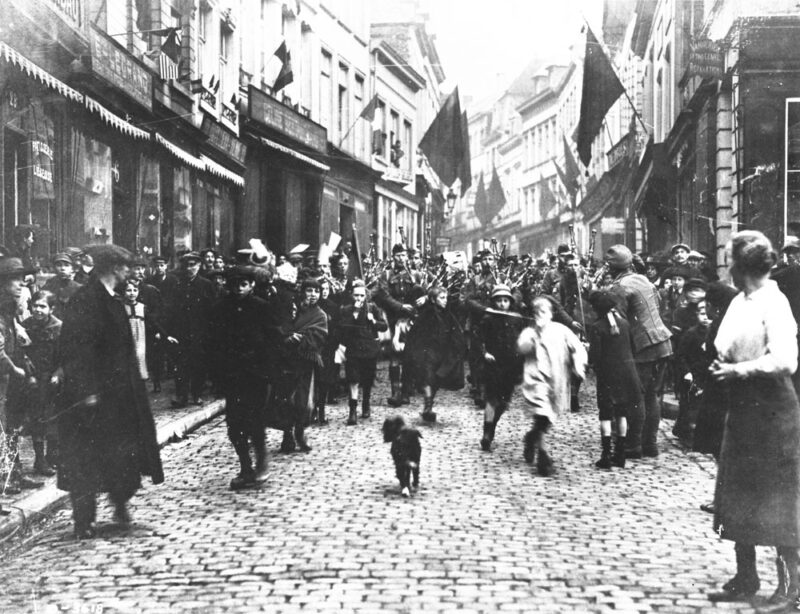
At 09h00, word is received the Armistice has been signed. Two hours earlier, the Band of the 42nd Battalion has already departed for Grand Place, Mons.

Lt. William Rider-Rider must be tagging along with the Royal Highlanders of Canada. He captures the image above of the Band of the 42nd Battalion, heading to Grand Place, Mons. Then, Rider-Rider is prepared for the 42nd Battalion as they enter the Grand Place. But, with little time to set-up, in a rare-instance for this highly-skilled photographer, the exposure is slightly off.
Nevertheless, Lieutenant William Rider-Rider captures an iconic image of the Great War below. The Liberators of Mons.

Grand Place, Mons
Note the many flags. These flags have not been seen in Mons since August 1914. However, the Canadian standard may not be among them. The 5th Lancers (attached to the Canadian Corps) escorted Sir Arthur Curie into Grand Place. The 5th Lancers were the last British troops to have been in Mons in 1914. They ceremoniously return as the first British troops to re-enter Mons.
Well understood by the town officials is that the Canadian Corps have captured Mons. However, many of the people of Mons have been expecting British troops. There is a little confusion with the mixed contingent entering Grand Place. But, at the sight of Sir Arthur Currie riding his steed Brocklebank, the crowd erupts in unanimous applause.


Golden Book
At 11h00, in the Grand Place, the Mayor presents Brigadier-General J.A. Clark, DSO, G.O.C. 7th Canadian Infantry Brigade with the Keys to the City. Many commanders, including Sir Arthur Currie, also sign the Golden Book. Much of the film in this video is captured at this time. And later, when Sir Arthur Currie ordered another victory parade. Every unit of the Canadian Corps is represented. Currie made sure of it.
Kilties have also not been seen in Mons since 1914. With the exception of POWs.

Return of Royal Highlanders of Canada
42nd Battalion (Royal Highlanders of Canada) return to England 8 February 1919. Entrain at Liphook Station for Liverpool. Disembark Liverpool on S.S. ADRIATIC, 1 March 1919. Arrive in Halifax, 9 March 1919. The voyage is without unusual incident. Corporal Robert Alexander Giles MM departs two weeks later, on HMT Royal George.


These are the Canadian soldiers who captured the town of Mons on the last day of the Great War.

The 42nd Battalion return to Canada with the 7th Brigade of the 3rd Canadian Division. Along with the Royal Canadian Regiment, the PPCLI, and the 49th Battalion (Edmonton Regiment). They left aboard S.S. ADRIATIC.

Montreal
Upon arrival in Halifax, the unit entrains at once for Montreal. Then, they arrive on the morning of 11 March. Exactly four months after having entered Mons on Armistice Day. The 42nd Battalion is one of the first to arrive in Montreal. But now, the city is decorated with flags, bunting and streamers. Then, they are greeted by the Mayor of Montreal, and saluted by Major-General Wilson. Following the celebrations, the last command is given, “DIS-MISS.” Dispersal of all ranks to their homes proceeds immediately.
Demobilize on 11 March 1919. Then, Corporal Robert Alexander Giles MM disembarks in Halifax on 25 March 1919. Colours deposited in 5th Regiment (RHR) Armoury in 1919. Finally, disbands by General Order 149 of 15 September 1920. Finally, perpetuated by The Black Watch (Royal Highland Regiment) of Canada.
More
The 42nd Battalion were a very popular battalion for the photographers in the Great War. Even more popular among the official photographers was the 29th (Vancouver) Battalion, recently featured in a post.

Please subscribe to CEFRG to be notified by email when there are new posts. Subscription is free, and your email kept confidential.