Josiah and Louisa Goodyear, of Grand Falls, Newfoundland had three of their five sons die in the Great War. Goodyear brothers, Oswald Raymond ‘Ray’, Stanley ‘Stan’ Charles and Hedley ‘John’ Goodyear died in successive years in France and Belgium.

“Possibly one of the best books I have ever read. If I could write, this would be the book I would have wanted to create.” – Mimi Attleson
A combination of the Newfoundland Regiment’s digitised records and an acclaimed family memoir, The Danger Tree, written by David Macfarlane, one of the surviving brother’s grandsons, means that a great deal known about Raymond Goodyear and his five brothers, two of whom, like him, killed in the war.
A 50 minute television movie produced in 1997, starred Mark Critch best known for his work on the comedy series This Hour Has 22 Minutes.
Lieutenant Stanley Charles Goodyear MC
Stanley Charles Goodyear enlisted on 8 September 1914, the first brother to do so. Stanley was a champion heavyweight boxer in Newfoundland.

Son of Josiah and Louisa Goodyear, of Grand Falls, Newfoundland. Brother of Lieutenant Hedley John Goodyear, 102nd Battalion, killed in action 22 August 1918 and Lance Corporal Oswald Raymond Goodyear, Royal Newfoundland Regiment, killed in action 12 October 1916, Harold Kenneth, Roland and Daisy (also known as Kate).

Stanley promoted Lance Corporal pm 3 October 1914. He embarked aboard SS FLORIZEL on 3 October 1914 from St John’s.
Josiah (Joe) Robert Goodyear
Stanley Charles closely followed by Josiah Robert on 19 September 1914. Josiah’s gunshot wound in his right thigh made it difficult for him to walk far.
Harold Kenneth Goodyear
Harold Kenneth enlisted in February 1915. Both Kenneth and Josiah invalided out of the army.

Lance Corporal Oswald Raymond Goodyear
Oswald Raymond enlisted on 23 November 1915. Lance Corporal Oswald Raymond Goodyear 2156 Royal Newfoundland Regiment. Youngest of the Goodyear Brothers, he had failed twice to enlist (underage).
Lieutenant Hedley John Goodyear MC
Whilst Hedley John waited until 28 March 1916 to enlist.

Roland Goodyear
Eldest of the Goodyear Brothers, Roland waited to long to enlist, and was denied when he did – to prevent the unlikely occurrence of all his brothers dying in battle.

Roland died aged 93 in Grand Falls. His obituary reveals he had become quite successful.

Roland’s son, Flight Lieutenant Hedley Charles Cornick Goodyear, shot down over Germany in 1944 (HANOVER WAR CEMETERY).

Daisy Margaret (Kate) Goodyear Gordon
Daisy Goodyear served as a nurse during the Great War. Kate trained as a nurse at St. Luke’s in Ottawa, where she challenged her superiors when chastised for using the officer’s floor for an enlisted man.
“So, let me tell you, as long as I am in this hospital, and so long as there is an empty bed, no soldier will ever spend the night in the hallway. I will not have it!”
The enlisted man remained on the 3rd floor. Kate married Captain (Dr) Ernest Joseph Gordon in 1921. She passed away in 1986 and buried at ST GEORGE CEMETERY, Brant County, Ontario.
Captain Ernest Joseph Gordon
Captain Ernest Joseph Gordon served with the C.A.M.C. in the Great War. Following service in the London Area, proceeded from No.7 Canadian Stationary Hospitalto No. 3 Casualty Clearing Station (France) in August of 1918. He proceeded home to Canada following demobilization.

Goodyear Brothers in 1915
LCpl Stanley Charles Goodyear promoted Corporal on 13 February 1915. Corporal Stanley Charles Goodyear promoted Transport Sergeant on 14 June 1915, and sailed with the British Mediterranean Expeditionary Force on 20 August 1915. He served with the 1st Composite Battalion on the Western Egyptian Frontier from November 1915 to February 1916.
Private Harold Kenneth Goodyear promoted Corporal on 13 April 1915, and Sergeant on the 21st, Promoted 2nd Lieutenant later on 30 October 1915.
Goodyear Brothers in 1916
Sergeant Stanley Charles Goodyear returned to the British Expeditionary Force on 2 March 1916. Embarked Port Said for Marseilles, France on 10 March 1916. Stanley promoted to 2nd Lieutenant on 10 May 1916. Appointed Transportation Officer for the Newfoundland Regiment.
Kenneth wounded on 1 July 1916. Kenneth’s gunshot wound in his left elbow meant it would not bend beyond a right angle. At 3rd London General Hospital, Wandsworth, 2nd Lieutenant Harold Kenneth Goodyear granted a Leave of Absence on 19 September 1916, and granted permission to return to Newfoundland. He sailed on 27 September 1916, bound for HQ in St. John’s.

Oswald killed, 12 October 1916
Oswald Raymond killed on 12 October 1916, only 18 years of age. He died a horrible death, split open by shrapnel.

Bancourt British Cemetery
No. 182 Labour Company exhumed Oswald’s remains from 57c.N.24.b.7.9 on 7 October 1919 and reinterred at Bancourt British Cemetery, Plot VIII, Row M, Grave 5. The battlefield burial about 500 meters NNE of the sugar factory north of Le Transloy.

Bancourt a village which lies approximately 4 Kms due east of Bapaume on the north side of the D7, Bapaume to Bertincourt road. The cemetery situated east of Bancourt village, 300 metres off the D7 on the north side.
Bancourt occupied by Commonwealth forces in March 1917. Lost a year later during the German offensive in the spring of 1918, but recaptured by the New Zealand Division (in particular, the 2nd Auckland Battalion) on 30 August 1918.

The cemetery begun by the New Zealand Division in September 1918; the original cemetery is now Plot I, Rows A and B. The remainder of the cemetery made after the Armistice when graves brought in from the battlefields east and south of Bancourt and from certain Allied and German cemeteries.
Second Lieutenant Kenneth Goodyear promoted Lieutenant on 30 October 1916.
Josiah wounded, 21 November 1916
Josiah wounded on 21 November 1916.
Goodyear Brothers in 1917
On 11 July 1917, Lieutenant Kenneth Goodyear transferred to the Forestry Corps.
2nd Lieutenant Stanley Charles Goodyear promoted to Lieutenant on 1 August 1917.
Stanley killed, 10 October 1917
Lieutenant Stanley Charles Goodyear and his horse killed by an enemy shell on the evening of 10 October 1917. He was in charge of a group of soldiers taking military supplies to the front by horse and mule. A British officer of the 10th Lincoln Regiment, Captain D. Charles recorded:
His body was left there and was buried the next day by my party immediately south of the church by the side of the road. Map reference of grave, Sheet 20 U22 D67 18. – Report 27 October 1917.

Stanley killed on 10 October 1917 near the Brombeek stream at Langemarck, just prior to First Battle of Passchendaele (12 October 1917). A precise location given for the battlefield grave (accurate to within 5 yards). 20.U.2 D.67.18

Stanley buried by his comrades on the field, where many battlefield burials in the Passchendaele salient destroyed during Second Battle of Passchendaele. An attempt may have been made by Roland Goodyear to locate the gravesite. Roland Goodyear, eldest of the Goodyear Brothers, had been denied permission to enlist.
Sint-Paulus Bekeringskerk
The church where Lieutenant Stanley Charles Goodyear’s body buried completely destroyed in the Great War and rebuilt in 1923-25. Because everything lost during the war, the church, apart from its stained-glass windows, contains no major ecclesiastical treasures.

Petrus Nyssens was an engineer with the Public Works Department and chairman of the St. Jacobs church council in Ghent. He owned three farms in the municipality of Langemark. The couple also had a country house there. The family known as major benefactors of the church and donated this stained-glass window, among other things, in gratitude for their survival during the war.
Whip and Spurs
Only Stanley’s whip and spurs recovered prior to his burial. See the final entry in this post to understand what became of the whip.
8 June 1932
Harold Kenneth Goodyear sent a telegram enquiring as to the location of ‘STAN AND RAYS’ graves.
Handwritten reply referred to Report Langemarck 80-1, Grave just north Langemarck for Stanley. By this time, Oswald’s (Ray) body moved to ‘Baucourt’ (Beaucourt) Military Cemetery from Geuedecourt, 2 miles east of Bapaume (57C.N.27.a.4.8).
Kenneth also mentioned the efforts or Reverend LtCol Nangle to locate the grave.

Beaumont-Hamel Newfoundland Memorial
Since Stanley has no grave, he is commemorated on the Newfoundland Memorial. Field-Marshal Earl Douglas Haig, Commander of the British Expeditionary Force during the Battle of the Somme, officially unveiled the Memorial on June 7, 1925.


2 July 1961
The first notable instance of pilgrimages arranged by the Department of Veterans Affairs at the behest of Myles Murray, the Newfoundland Provincial Secretary. To bring eight Royal Newfoundland Regiment survivors of 1 July 1916 to Beaumont-Hamel as attendees of the opening on 2 July 1961 (the Sunday nearest Memorial Day) of the Park’s newly constructed Caretaker’s House. Followed by the dedication and the unveiling by Premier Joey Smallwood of a memorial plaque honouring the feats of the Regiment at Beaumont-Hamel. Following these ceremonies, a commemorative service held at the caribou memorial, after which the pilgrimage party visited the battlefield.
Though unrecognizable after the battle, the “Danger Tree” originally a plum tree. The Veteran reported in 1925 that the tree had been re-erected.

The previous evening, the Beaumont-Hamel survivors had toured the Memorial Park, revisiting their old combat ground, as well as No Man’s Land and the German sector of the front line.


Ken Goodyear
In his Report to the Canadian Legion, Grand Falls Branch in 1961, Ken Goodyear recounted:
“The trenches are practically as they were in 1916, except for the fact that there are old rifles with the wood decayed from them, steel helmets rusted out, barbed wire posts in the ground, and old bombs lying around that we never had a chance to use.”
One could also, he continued, readily situate the points where the different companies had made their advance during the attack, although he could only approximate the location where he himself had been wounded in battle. The Danger Tree, Goodyear noted, had since died, although “its foundation” was preserved, as a landmark, in concrete.

Lieutenant Stanley Charles Goodyear MC
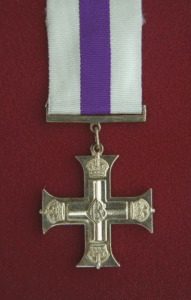
Before the year over, Lieutenant Stanley Charles Goodyear posthumously awarded the Military Cross, 28 December 1917.

“For most conspicuous and continuous good work as a transport officer of the Battalion during the past eighteen months in France. His resourcefulness invariably overcomes all difficulties.” – London Gazette, 28 December 1917
Goodyear Brothers in 1918
Battle of Amiens
Lt Hedley J Goodyear did not serve with a Newfoundland Regiment but with the 102nd Battalion, Canadian Infantry. A graduate of Victoria University, Toronto, teaching at Regal Road Public School when he enlisted. The letter he wrote to his mother on 7 August 1918, the eve of the opening of the battle of Amiens, became famous as ‘the last letter home of Hedley Goodyear’ and was regularly read at Armistice and Memorial Day services.
“My eyes fixed on tomorrow with hope for mankind, and with visions of a new world.” – Hedley’s second-to-last letter home.

Hedley killed, 22 August 1918
Believed that Hedley had been killed after writing. However, the letter he wrote on 17 August, in which he told his mother that he was “hun-proof”, really was his last letter home. He was shot by a sniper in the head, and killed instantly on the 22nd.

Hillside Cemetery, Le Quesnel
Le Quesnel village, which had been for sometime in Commonwealth hands, captured by the Germans on 27 March 1918, but retaken on the following 9 August by the 75th Canadian Infantry Battalion. Hillside Cemetery made by the Canadian Corps in August 1918. The cemetery contains 108 Great Warr burials, three of them unidentified.

Lt Hedley John Goodyear buried beside Pte William Robert Hunter, also of the 102nd Battalion, at Hillside Cemetery, Le Quesnel. William died two days after his Lieutenant. Son of Mr. and Mrs. Isaiah Hunter, of Hilly Grove, Manitoulin Island, Ontario.

At Kenmore, Perthshire, Scotland (Newfoundland Forestry Corps HQ), on 24 November 1918, Lt Kenneth Goodyear placed a request to return home immediately as his father was ill. Given permission to proceed in addition to being one of the Conducting Officers on 27 November 1918. Embarked on 11 December 1918 for Newfoundland.
Passing of the Goodyear Parents in 1930
In 1930 while visiting their daughter Daisy Margaret ‘Kate’ Gordon, in Brant, Ontario they died only 3 days apart. Josiah on May 10, and Louisa 2 days later.

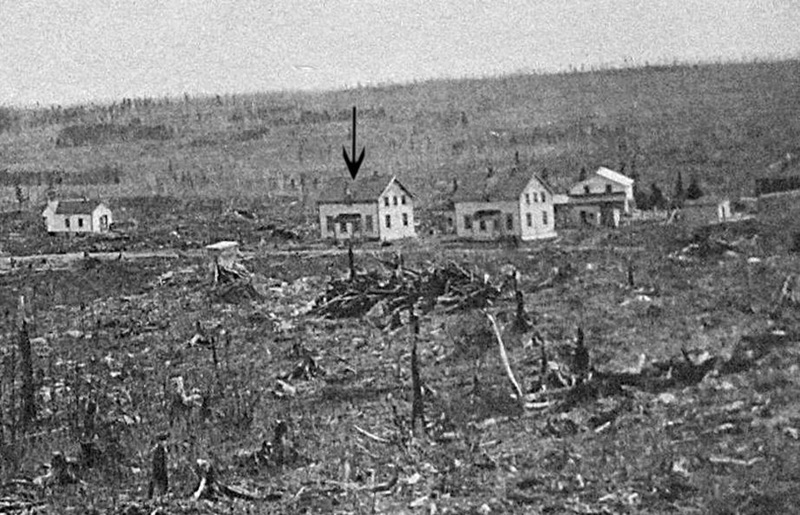
This is the house they lived in right up to their deaths in 1930. It was on High Street, on the same site as the present Post Office. The smaller building at left was the town’s first medical clinic.
Goodyear Avenue, Grand Falls
Today, the 2nd Battalion of the Royal Newfoundland Regiment, part of the 5th Canadian Division is stationed in the town. A building program had began in 1906, lasting until 1912, with a later development thrust after the war that lasted until 1922. In this period, a total of 485 houses constructed.

Some of the post-War streets named for battlefields in Europe where Newfoundland soldiers suffered major losses, or after soldiers – Goodyear Avenue. The Beaumont Avenue development the first stage of a housing development saw the building of Suvla, Monchy, Polygon and Haig Road’s during the 1920’s. In the 1960’s a new housing development took place in the Goodyear Avenue subdivision which came on the heals of the big new hospital on Union Street.
Whip
Mr Terry Goodyear (a retired judge and nephew of Lt Stanley Goodyear), recalls that when the Goodyear home demolished to provide space for the present Memorial United Church, a whip, the possible significance of which he did not recognize at the time, removed from the attic of the home.
Remembrance Day at Memorial United
Every year at the Sunday morning service prior to or on November 11th this list of Grand Fall’s Fifteen read out loud by a member of the Royal Canadian Legion. Hedley’s last letter home often read. The Fifteen read-aloud at the first service following the war by the Goodyear Brother’s mother, Louisa Goodyear.

- Eli Abbott
- George Edward Pike
- Gordon Rowsell
- Japeth Hounsel MM
- Robert Brandfitt Porter
- Stanley Goodyear MC (Goodyear Brothers)
- William S Hann
- Daniel Barrow
- Frederick Wilcox
- George Goudie
- Hedley Goodyear MC (Goodyear Brothers)
- Oswald Raymond Goodyear (Goodyear Brothers)
- William John Martin
- Wilson Brown


