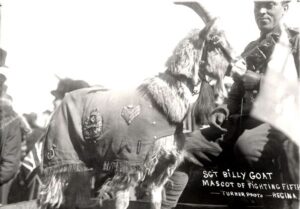
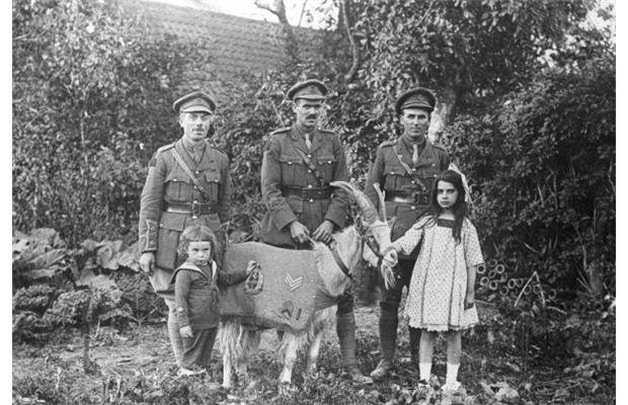
On 23 August 1914, a train carrying soldiers of the 5th Battalion (Western Cavalry) stopped at Broadview, Saskatchewan. A group of recruits noticed young Daisy Curwain, and her cart goat, named Bill. They asked Daisy if they could have her goat as their good luck mascot. At first, Daisy reluctant to part with her proud pet. But, the men promised Bill would be well-cared for, and returned to the Curwain farm on their way back home. Daisy agreed, gave Bill a warm good-bye hug, and thus began the service of Sergeant Bill.

Mascots
The men had told Daisy Curwain a bit of a white lie promising Bill would be well-cared for. The truth being Bill would be the one providing the care. Mascots understood their role well, never flinched, nor hesitated to provide care, comfort and protection in the Great War. Simultaneously, mascots provided instruction and leadership for the men.

Some mascots excelled in providing care, such as Nanny of the Canadian Mobile Veterinary Section, while others like Bill more suited to provide protection in the trenches. With their shared experience, there existed a level of camaraderie among the mascots much appreciated, and emulated by the men.

Service of Sergeant Bill in the Great War
Bill proceeded with his new family of friends to Valcartier training camp in Quebec. Much to everyone’s surprise, in spite of very prominent veins in his legs, Private Bill passed the medical exam. His attestation accepted without a word from RSM Robert Blair DSM.

Soon afterwards, all kinds of stories developed among the men regarding the reason for the RSM’s apparent favoritism of Bill. Private Bill was the only one of the battalion who ever appeared on parade without being punished for not shaving.
Salisbury Plain
The Atlantic voyage made in October 1914, and several months spent at Salisbury Plain in training. Then, in early February 1915, orders received to leave behind all surplus baggage and to burn all refuse and waste matter and leave the camp in perfectly sanitary condition. Finally, after a grueling tramp of about an hour, the battalion reached Amesbury and prepared to entrain.

At this point an unusual difficulty presented itself. Lieutenant-Colonel George Stuart Tuxford swore, as is the divine right of the colonel, that the goat must be left behind. However, the men of the 5th had other ideas.
Sergeant Harold Baldwin
According to Sergeant Harold Baldwin 13080, who penned Holding the Line from the front:
We could not part with Billy; the boys argued that we could easily get another colonel, but it was too far to the Rocky Mountains to get another goat. The difficulty was solved by buying a huge crate of oranges from a woman who was doing brisk trade with the boys. The oranges sold like hot cakes and in a jiffy the orange box was converted into a crate and Billy [was] shanghaied into the crate and smuggled aboard the train.
Sergeant Harold Baldwin, Holding the Line (Chicago: A. C. McClurg & Son, 1919)
Sergeant Harold Baldwin received his Blighty on 25 March 1915 at Festubert. Struck in the lower leg by a bullet, fracturing both bones, he lay exposed for over 24 hours, guaranteeing infection set in. Amputation four days later at Fazakerley, Liverpool. Finally, Harold’s recovery exemplary for a soldier, doctor’s noting he looks well and feels well.

Exasperated with Bill’s antics, Lieutenant-Colonel Hugh Marshall Dyer DSO replaced Tuxford on 6 January 1916. As for Bill, his only weakness, a fondness for canteen beer, unequaled by the 5th Battalion’s most seasoned trooper. Luckily, for Bill, and the battalion, beer usually hard to obtain.

Battle of Neuve-Chappelle
During the Battle of Neuve-Chappelle in March 1915, Private Bill saved the life of two men in his platoon. Taking the full force of an enemy shell, shielding his comrades from injury, Bill knocked unconscious for nearly an hour.

Private Bill rose in rank for the second time within a month, promoted to Sergeant just prior to the Battle of Frezenburg Ridge during the Second Battles of Ypres.
Second Battle of Ypres
Bill’s life in the trenches an exciting one. At Ypres, Bill found in a shell crater standing over a very nervous Prussian guardsman. Bill himself had been wounded in the back by shrapnel. Bill’s reputation began to grow beyond the battalion. Because, everyone in the 2nd Canadian Infantry Brigade, from Private to Colonel, would hear of the now famous mascot’s daring capture of a German POW.

During the Second Battle of Ypres, Corporal Bill gassed along with his boys, but survived.
Court Martials

Given his fondness for canteen beer, Bill developed a propensity to eat important papers left lying around. Sergeant Bill caught the ire, once again, of the Colonel, when caught eating the nominal roll. Bill was promptly Court Martialed, and reduced in rank to Corporal. However, Bill subsequently redeemed himself in battle, regaining the rank of Sergeant.

Corporal Bill wounded twice at Festubert, where he became a hero by knocking three soldiers into a trench, seconds before a shell burst precisely where they had been standing. Before the close of 1916, Bill Court-Martialed twice more, once for striking a superior officer. “He turned his back on me”, Bill had baaed in his defense.

Already, Sgt. Bill Court-Martialed three times, and had been sentenced to two periods of 14 days Field Punishment No. 1. These infractions caused the men to love him even more, for his issues had always involved those with authority. Bill well on his way to becoming the most often disciplined member of the Canadian Corps.
Vimy Ridge and Hill 70
Sergeant Bill fought at Vimy Ridge, and shell shocked at Hill 70. Admitted No. 2 Canadian Field Ambulance on 17 August 1917. Following a very short recovery at the Canadian Mobile Veterinary Section, Bill discharged on 27 August, and rejoined his unit in the field the following day.
![Sergeant Billy, dated Sept. 17, 1918. Back row: Lt. GA Wildig, Lt. F Chinoweth, Lt. TW Cogland, MC, Lt. A Rackham. Front row: Capt. WE Lloyd, Capt. ER Osler [killed in action].](https://i0.wp.com/cefrg.ca/wp-content/uploads/2021/02/Sergeant-Billy-dated-Sept.-17-1918.jpg?resize=780%2C474&ssl=1)
By war’s end Bill one of the few original soldiers of the 5th still active, and the only original mascot of the Canadian Corps to enter Mons on Armistice Day.

Germany
The March to the Rhine began in late November 1918, and concluded on 13 December as the 1st Canadian Division crossed the Rhine at Cologne. The 2nd Canadian Division crossed the bridgehead to the south at Bonn, the Canadian Corps Commander, Sir Arthur Curie accepting the salute.

Bill’s only true disappointment of the war came that very morning, when a lottery prevented the 5th Battalion (with Bill in the lead), to be the first battalion to cross the Rhine river. Mascot, and Bugler Anthony Ginley 26265 of The Royal Montreal Regiment (14th Battalion) received the honour. Bill furious, and swore Ginley would “Get what’s coming to him”.
The Montreal Boy Mascot
When the Canadian Contingent’s supply transport approached Salisbury Camp upon its arrival in England, the local citizens spied an unusual sight. When the supply convoy first hove into view a tiny wasp of a lad was discovered on one of the caissons. Ginley blowing lustily on a battered bugle, the cracked notes flaring up in a strange crescendo. Around his shoulders was a big overcoat loaned him by a grizzled sergeant.
The youngster a Montreal newsboy who stowed away on one of the ships and who became the pet mascot of the contingent. He put in every spare moment on shipboard practicing the bugle and hoped to qualify as a performer on that instrument in order that he may follow the troops to France.
The Toronto World, Saturday, October 17, 1914, pg. 1, col. 1
Bugler Ginley, like many a mascot, accomplished so much more – he made it all the way to Germany. After the men crossed the bridge at Cologne, the units mixed and congratulated one another.
As the only furless mascot of the Canadian Corps, Bugler Anthony Ginley stood out in a crowd. As some men of the 14th Battalion approached the 5th in Cologne, Ginley and Bill’s eyes met. Immediately, Sgt. Bill broke ranks and charged directly at Ginley. Though this young bugler outweighed Bill by over twenty pounds, still, it was no contest.

Bill caught Ginley in the mid-section, and sent him flying into a limber. Winded and dazed, Ginley slowly rose to his feet and stuttered. “S-s-s-sorry, S-s-s-s-Sergeant Bill”. The men of the 5th roared, threw Bill on their shoulders, and carried him into the local canteen for some German beer to continue celebrating.
Valor
For his valor and over four and a half years’ service, Sergeant Bill awarded the 1914/1915 Star, the British War Medal, and the Victory Medal. After Sergeant Bill accompanied his men to Cologne, he marched in the grand Victory Europe parade wearing an embroidered blue plush coat emblazoned with sergeant’s stripes.

Demobilization
Bill spent a couple of months in Khaki School at Warnant-Dreye in early 1919. A sub-municipality in the municipality of Villers-le-Bouillet in Liège Province, Belgium. He met a local widowed Nanny named Giselle, and fell in love.

Immigration problems forced Bill to leave her behind, and he returned to Saskatchewan with his unit, where it demobilized on 24 April 24 1919.

Keeping the promise they hade made over four years earlier, the 5th Battalion then returned Bill to Miss Curwain on the family farm. Bill lived several more years, while receiving many visits from his former comrades.

The Death of Sergeant Bill
After his death Bill stuffed, mounted and displayed in the Saskatchewan Legislative Building. His body eventually returned to Broadview, where he still holds a place of honor in the Broadview Museum.

More
The 1st Battalion, Saskatoon Light Infantry (MG) has the great honour of perpetuating the 5th Battalion C.E.F. The Battle Honours carried on its Colours earned by one of the greatest battalions of the Great War.
Other Great Mascots
The variety of mascots in the Canadian Corps revealed only two common denominators. Firstly, though few rose to the rank of Sergeant, all displayed the same valor as Sergeant Bill. Secondly, they all shared that mischievous streak, albeit none would be court-martialled as often as Bill.
The Thief
This Jackdaw is a pet of the Canadian S.C. and was found on the Somme.

The bird continually stealing, but still remains the mascot of the Column.
Wickey
The 8th Battalion monkey named Wickey. However, Wickey originally served with the 5th Canadian Infantry Battalion.

A soldier named John Uprichard 874741 and his mates kidnapped/stole/rescued him from the 5th Battalion in 1915 and he was with the battalion though the war. After the war he lived with Uprichard in Winnipeg and several articles were written about the monkey in the Winnipeg Tribune. Uprichard’s story of Wickey is in the Royal Winnipeg Rifles Museum Archives and told in the Battalion history Holding Their Bit.
Other Goats
Goats one of the most popular mascots in the Canadian Corps during the Great War.

The Commanding officer of a Canadian Mobile Veterinary Section, a captain in the Canadian Army Veterinary Corps, offers a cigarette to a pet goat in front of horse lines (MIKAN No. 3397578).

The 3rd Battalion of the 1st Canadian Infantry Brigade also had a goat (MIKAN No. 3404910), as did the 16th Battalion (Canadian Scottish) of the 3rd Canadian Infantry Brigade (MIKAN No. 3405915).

No Mascot Too Small For the Task


Please subscribe to CEFRG to be notified by email when there are new posts. Subscription is free, and your email kept confidential.

