Possibly one of the Hallu Eight
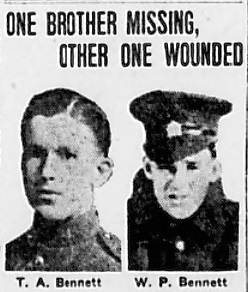
Private Thomas Allan Bennett 148073 born 8 April 1895 in Kars, Ontario (a village on the Rideau River within Rideau-Goulbourn Ward in the city of Ottawa). A Methodist and carpenter by trade. Son of Daniel Charles Bennett and Louisa Jane Bennett, of 583 Alverstone Street, Winnipeg, Manitoba.

Attestation of Private Thomas Allan Bennett
Private Thomas Allan Bennett previous service with the 100th Winnipeg Guards. Thomas attested with the 78th Battalion later on 3 August 1915 and stood 5′ 5″ tall, 130 pounds, with dark complexion, grey eyes and dark hair. Brother of Private Wesley Preston Bennett 4070229, of the 8th Battalion, CEF.
78th Battalion (Winnipeg Grenadiers)
Organized in July 1915 under the command of Lieutenant-Colonel James Betram Mitchell soon succeeded by Lieutenant-Colonel James Kirkcaldy. Later, mobilized at Winnipeg, and recruited in Winnipeg district. Then, a draft of 5 officers and 250 other ranks sent to England on 25 September 1915. Later embarked from Halifax 22 May 1916 aboard EMPRESS OF BRITAIN, disembarked in England 29 May 1916, with a strength of 37 officers, 1097 other ranks.

Disembarked in France 12 August 1916 with the 4th Canadian Division, 12th Canadian Infantry Brigade. Later reinforced by 11th Canadian Reserve Battalion, and after 5 September 1918, reinforced by 18th Canadian Reserve Battalion.
Finally, returned to England 1 May 1919, and disembarked in Canada 7 June 1919, demobilized 12 June 1919 and disbanded by General Order 149 of 15 September 1920. In addition, Colours donated by 100th Winnipeg Grenadiers, and deposited in Canterbury Cathedral for duration of war. Later deposited in St Matthew’s Church, Winnipeg, brass band, published a photographic record, 1915, and perpetuated by The Winnipeg Grenadiers.

Private Thomas Allan Bennett embarked for France from Bramshott on 12 August 1916 (Private Bennet buried exactly two years later by the German Alpine Korps in Hallu, France). Pvt Bennett later sent to Grenade Course, 28 August 1916.
Private Thomas Allan Bennett Wounded
Shrapnel wound, back and left shoulder, 18 October 1916. Private Thomas Allan Bennett admitted No.1 General Hospital, Etretat, 18 October 1916, and later admitted to General Hospital, Nottingham, 22 October 1916. Private Thomas Allan Bennett left for unit, 21 April 1917, later arriving in the field, 28 April 1917.
Pvt Thomas Bennett later granted Good Conduct Badge, in the field, 3 August 1917.

Private Thomas Allan Bennett granted 14 days leave to England, 19 December 1917, later returning to unit 5 January 1918.
Death of Private Thomas Allan Bennett
This soldier last seen with his company, during an enemy counter-attack on our positions in the village of Hallu. No further information received concerning him. The Canadian Corps advanced quickly during the Battle of Amiens. However, the advance halted on 11 August 1918 as the German Alpine Korps, and other units counter-attacked in the vicinity of Hallu.
German Alpine Korps
With great respect for their foe, the German Alpine Korps buried at least eight to twenty-two men of the Winnipeg Grenadiers on a very hot afternoon, 12 August 1918 in Hallu, France, along with some French soldiers, and men of their own unit.

In the Fall of 1919, Herbert Hunter (he married into the family of Lt. Clifford Abram Neelands) visited the graves of the Hallu Eight, having been provided the coordinates by the Imperial War Grave Commission Office in London, England. He noted the cross of Lt. Neelands written in German, “Here lies an Officer of the Winnipeg Grenadiers”.

The Hallu Eight
Later in 1919, the villagers of Hallu began to return to their totally devastated homes. Discovering a graveyard in their community built by the German Alpine Korps. Deliberately, the people desecrated the graves found there, mistaking every Allied soldier’s grave for that of a German soldier. The German Army looted graves during the Great War in search of metal for ammunition casings.

When exhumation teams began to scour the area from 1919 to 1923, not a single body retrieved from the makeshift cemetery. Until then teenager, Fabien Demeusere discovered the Hallu Eight on his parent’s property in 2007/2008. Fabien had found the south-western edge of the cemetery (more bodies remain to be discovered on the property immediately adjacent to the Demeusere family).
The Missing
Over 20,000 Canadian soldiers remain missing from the Great War. Perhaps upwards of 12,000 of those soldiers, like these men of the Winnipeg Grenadiers, once buried by their comrades or foe. These graves later obliterated by shelling. Or, simply lost (primarily due to the rudimentary records of the IWGC from 1914 to 1916).

With only five of the Hallu Eight positively identified, candidates for the three Unknowns include Private Thomas Allan Bennett, Sergeant William Edward Jones 147918, and Private Albert Edward Ahmed 652217. Bennett and Jones are highly likely. In the same Company as those identified men, and joined the unit during the same period. In addition, may have known each other prior to the Great War. Very common to have friends in the same unit. Private Ahmed considered as his family today are certain of his location (Caix British Cemetery).
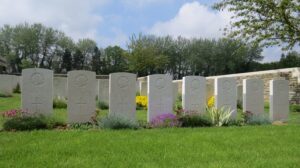
Caix British Cemetery
One of the three Unknowns among the Hallu Eight surely must be Private Thomas Allan Bennett.

Caix occupied by Commonwealth troops in March 1917. Later lost during the German advance in March 1918, and recaptured on 8 August 1918 by the Canadian Corps.
Caix British Cemetery (called at first Caix New British Cemetery) made after the Armistice when graves (mainly of March and August 1918) brought in from the battlefields and smaller cemeteries.
Beaucourt Chateau German Cemetery, Beaufort German Cemetery, Caix (Old) British Cemetery, Cayeux Chateau German Cemetery, De Luce British Cemetery, Le Quesnel German Cemetery, and later Ridge Cemetery, Hangard all concentrated to Caix British Cemetery.
The cemetery contains 373 Commonwealth burials of the Great War, 73 of them unidentified. The cemetery designed by Sir Herbert Baker.
More
- Home of CEFRG
- Soldiers and Nursing Sisters
- Units (Brigades, Battalions, Companies)
- Battles of the Great War
- Blog
- Cases
- Cemeteries
- Memorials
- On This Day
- About CEFRG
Please subscribe to CEFRG to be notified by email when there are new posts. Subscription is free, and your email kept confidential.