MacPeck

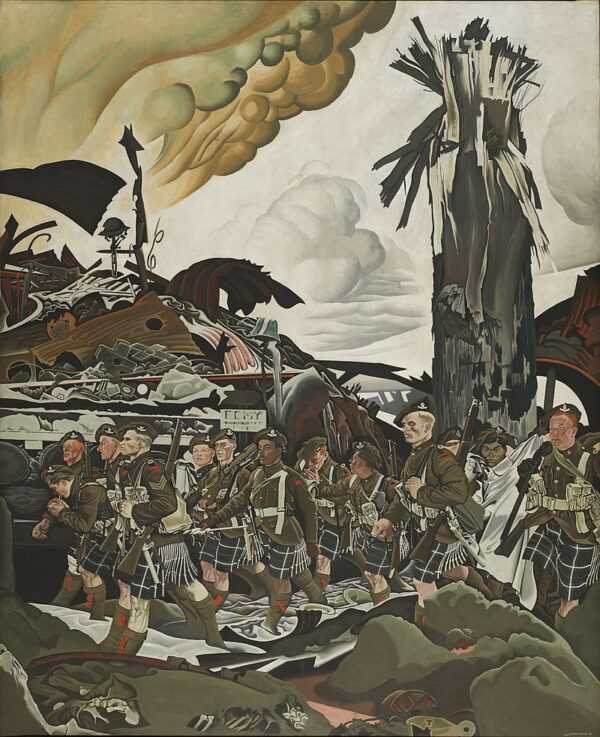
The Conquerors – originally titled The Victims renamed after objections from LCol Cyrus Wesley Peck VC, DSO & Bar, the commanding officer of 16th Battalion (Canadian Scottish), CEF.
Colonel Peck is at home with his Shelley and Keats: he can quote extensively from these poets. He has read practically all of the works of Dickens and Thackeray, and revels in the characters portrayed in them. He is a student of history and a philosopher; he has an intense liking for music. Altogether, despite opinions to the contrary, a temperament which makes for strength on the battlefield to the soldier leader who has a right to that name.
Canadian Scottish Regiment Historian H. MacIntyre Urquhart
Early Life of Cyrus Wesley Peck
Born 26 April 1871, Hopewell Hill, NB. Educated at Hopewell Hill Superior School. In June 1887, at the age of 16, he and his family moved to New Westminster, British Columbia, then later to Skeena, BC. Peck grew up to be a big man, standing 5′ 9″ tall, 225 pounds, with hazel eyes.

Enlistment of Cyrus Peck in the CEF
Treated for gastritis since enlistment. Previous service as LCol of 68th Regiment, 20 August 1914. Married to Kate E Peck, Royal Mansions, 1183 Pacific Ave, Vancouver, BC.
The 68th Regiment (Earl Grey’s Own Rifles) a Canadian militia unit based in Prince Rupert, British Columbia, authorized in May 1914 and officially redesignated as the 68th Regiment in November 1914. It later became part of the North British Columbia Regiment in 1920.
Appointed Captain of 30th Battalion, 1 November 1914. 30th Battalion organized in November 1914 under the command of Lieutenant-Colonel J H Hall. Mobilized at Victoria, and recruited in Prince Rupert, Kamloops, East Kootenay and Victoria.

Embarked from Halifax 23 February 1915 aboard MISSANABIE, SOUTHLAND and MEGANTIC. Disembarked England 6 March 1915, with a strength of 35 officers, 978 other ranks. Became a reserve battalion on 29 April 1915. Peck promoted Temporary Major, 25 April 1915.
France
Proceeded to 16th Battalion, France on 26 April 1915 following the Second Battle of Ypres.

16th Battalion (Canadian Scottish)
The 16th Battalion (Canadian Scottish Regiment) organized in Valcartier Camp in September 1914, composed of recruits from Victoria, Vancouver, Winnipeg and Hamilton. Commanded by Lieutenant-Colonel R G E Leckie. Embarked Quebec 30 September 1914 aboard SS ANDANIA, and later disembarked England 14 October 1914 with a strength of 47 officers, 1111 other ranks.

Following the 2nd Battle of Ypres, the command of Number 1 Company passed to Major Peck, who held the appointment until wounded at Festubert.
Battle of Festubert-Givenchy
At an hour, very close to dawn (19 May 1915), Numbers 1 and 3 Companies of the 16th Battalion, under Major Peck and Captain Morison, arrived from support to relieve Numbers 2 and 4 Companies and continue the digging of a trench.

The following morning, Number 1 Company (Major Peck) on the right, to capture, by flank attack, the house at M.10, where it would link up with the 15th Canadian Battalion, which was to attack to a line from L.11 to M.10 simultaneously with the attack on the Orchard. The bombardment of the houses of the Orchard began without drawing any retaliation from the enemy, and then came zero hour – seven forty-five.
First Wound Stripe
Peck wounded during the taking of the Orchard, 20 May 1915. Invalided to England, 23 May 1915.

Second Tour of LCol Cyrus Wesley Peck
Proceeded to 16th Battalion, France on 5 July 1915.
Battle of Mount Sorrell
2 June 1916
Early on the morning of June 2nd, No. 1 Company proceeded to the practice ground, and between ten and eleven a.m. inspected by Major C. W. Peck, Acting Commanding Ofl’icer in place of Lieut. Colonel Leckie who was on leave until the evening of June 4th. This duty completed, Major Peck and the company commander left for Brigade Headquarters where they were due to discuss details of the raid plan.

Mentioned in Despatches, 15 June 1916, London Gazette No 29623.
3 November 1916
The change of commanding officers took place on 3 November 1916. On this date Lieut.-Colonel E. Leckie who took over in August, 1915, proceeded to England, to command the 2nd Canadian Reserve Brigade. He was succeeded in the command of the 16th by Major C. W. Peck. To be Temporary LCol and to Command 16th Battalion, 15 November 1916.

LCol C W Peck DSO Mentioned in Despatches, 2 January 1917, London Gazette No 29890.
Sick
Invalided to England, 15 April 1917.
Dyspepsia
Admitted to No. 14 General Hospital, Boulogne, on 14 April 1917. Evacuated to No.1 London General Hospital on 15 April 1917.

On 18 April 1917, in London, Peck recovered from an acute attack of dyspepsia. Some flatulence, but much improved – vomiting ceased. Examined again on 2 May 1917, still complaining of flatulence and occasional vomiting. Has improved with diet, but suffers distress after every meal.

Mentioned in Sir Douglas Haig’s Despatches, 1 June 1917, London Gazette No 30107.
DSO
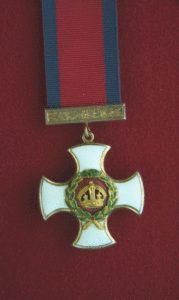
Awarded the DSO for Distinguished Service in the Field, 4 June 1917, London Gazette No 30111.
LCol Cyrus Wesley Peck’s Return to France
LCol Cyrus Wesley Peck DSO arrived in France on 7 June 1917.

LCol Cyrus Wesley Peck DSO granted 14 Days Leave, 17 November 1917.
Third Tour
ToS, 16th Battalion, France, on arrival from England, 1 June 1917. Mentioned in Despatches, 1 June 1917, London Gazette No 30107. Awarded the Distinguished Service Order, London Gazette No 30111, 4 June 1917.
Battle of Hill 70
Major-General Sir Archibald Cameron Macdonnell, General Officer Commanding the 1st Canadian Division, tells a good story illustrating this trait.

‘On the eve of the Hill 70 attack I visited the 16th, arriving at billets as the Battalion was about to move off to the assembly area. I found the men gathered about their Commanding Officer [Peck]. They were listening intently to a stirring battle address the concluding words of which ran something like this.’
Major-General Sir Archibald Cameron Macdonnell, General Officer Commanding the 1st Canadian Division

‘The Brigade Commander, the Divisional Commander, the Corps Commander knows, and God knows you are the best of men-none ever better.’
C W Peck to men of the 16th Battalion
3rd Canadian Infantry Brigade
LtCol C W Peck DSO assumed Temporary Command of 3rd Canadian Infantry Brigade, from 10 January 1918 to 15 January. On 13 January a Platoon Competition held at BOIS DES DAMES (Sheet 36b.D.26.d.25.10) to determine best platoon to compete for the Divisional Commander’s Cup, later won by 15th Battalion (48th Highlanders of Canada), narrowly edging out the 16th Battalion.

LtCol C W Peck DSO again assumed Temporary Command of 3rd Canadian Infantry Brigade from 15 February 1918 to 15 March 1918 when he left for CCS, Ruitz.

Mentioned in Despatches, 28 May 1918, London Gazette No 30706. Awarded the Victoria Cross, London Gazette No 31012, 15 November 1918.
VC Citation
“For most conspicuous bravery and skillful leading when in attack under intense fire.
His command quickly captured the first objective, but progress to the further objective was held up by enemy machine-gun fire on his right flank.
The situation being critical in the extreme, Colonel Peck pushed forward and made a personal reconnaissance under heavy machine-gun and sniping fire, across a stretch of ground which was heavily swept by fire.
Having reconnoitered the position he returned, reorganized his battalion, and, acting upon the knowledge personally gained, pushed them forward and arranged to protect his flanks. He then went out under the most intense artillery and machine-gun fire, intercepted the Tanks, gave them the necessary directions, pointing out where they were to make for, and thus pave the way for a Canadian Infantry battalion to push forward. To this battalion he subsequently gave requisite support.
His magnificent display of courage and fine qualities of leadership enabled the advance to be continued, although always under heavy artillery and machine-gun fire, and contributed largely to the success of the brigade attack.”
London Gazette, no.31012, 15 November 1918
Second Wound Stripe
LCol Cyrus Wesley Peck VC DSO wounded (shell gas), 5 October 1918.
Mentioned in Despatches, 31 December 1918, London Gazette No 31009.

Final return to England
LCol Cyrus Wesley Peck VC DSO, awarded Bar to the Distinguished Service Order, London Gazette No 31119, 11 January 1919.
“During an attack he showed fine courage and leadership. He led his battalion, under difficulties caused by heavy mist, to its final objective, nearly three miles, after severe fighting. He personally led his men in an attack on nests of machine guns protecting the enemy’s guns, which he captured. Some of the guns were of 8-inch calibre.”
Bar to the Distinguished Service Order
26 January 1919
He received his VC at York Cottage, Sandringham from King George V on 26th January 1919, a few days after the Bar to his DSO was gazetted.
Investiture


To be retained in England for return to Canada Echelon. To attend Session House of Commons, and is posted to M R Depot, Seaford, 5 January 1919.
LCol Cyrus Wesley Peck’s Return to Canada
ToS MHQ Ottawa on 30 April 1919. SoS from the CEF on 20 August 1919.
Colonel Peck possessed many gifts which fitted him for the command of men. He was a gallant fighter. He had a thorough under standing of human nature and a well balanced sense of humour fitted for every occasion. He had imagination; but what endeared him most to those who served under him, was his devotion to them and willingness to share danger, risk for risk, with the man in the ranks. He believed with a religious fervour that no such men as his own had ever lived before.
Urquhart
Transferred to Canadian Scottish Regiment as Lieutenant-Colonel, 28 April 1920. Colonel of Canadian Scottish Regiment from 26 November 1921 when transferred to Reserve of Officers as Colonel.
LCol Cyrus Wesley Peck VC defeated in the 1921 Canadian election but in 1924 re-elected to the Legislative Assembly of British Columbia and re-elected again in 1928.
Lt-Col, 2nd Reserve Battalion, Canadian Scottish Regiment from 7 April 1925.
In 1929 he attended the VC Dinner at the House of Lords, and was appointed aide-de-camp to two Governor-Generals, Lords Byng and Tweedsmuir, and in 1936 he was appointed to membership to the Canadian Pensions Commission, a position he held for 5 years.

To Corps Reserve, circa 1937.
In 1956, on his 85th birthday, a group of the Canadian Scottish Regiment paid their respects before he travelled to London for the VC Centenary in Hyde Park in June.
Death of a True Canadian Hero
Peck died 27 September 1956 of a heart attack and buried at New Westminster Crematorium, Vancouver, British Columbia, Canada (half his ashes scattered off Prince Rupert Sound).

In 1987 his sons presented his medals to the Canadian Scottish Regiment, and on 2 September 1993, transferred to the Canadian War Museum, Ottawa in a ceremony held on the 75th anniversary of his VC action.
A Legendary Canadian Citizen Soldier
The unveiling/dedication of the bronze plaque recognizing Lt Col Cyrus W. Peck took place during the Remembrance Day Service, 11 November 2015, in Prince Rupert, British Columbia after a year and a half in the planning and casting of a Lt Col Peck bronze plaque.

The bronze plaque will be mounted on a large quarried stone, supplied by the City of Prince Rupert Works Department, and placed in Rotary Park facing Lt Col Peck’s beloved Metlakatla Passage where his ashes were committed.

Metlakatla Pass

Metlakatla Pass designated a national historic site of Canada in 1972 because:
- the remarkable density of Late Period (ca. A.D. 500 to 1770) archaeological and historical village sites that collectively mark the traditional wintering grounds of ancestral Coast Tsimshian on the northwest coast of British Columbia;
- archaeological sites dating back five thousand years uniquely document the development of social complexity on the northern coast of British Columbia.

This is supported by the presence of forty six historic and pre-contact archaeological sites along the shoreline of the Metlakatla Pass; and, its involvement in an ambitious mission and acculturation experiment in the late 19th century.
Peck Lake
Peck Lake, Port Edward, B.C., named in honour of Lieutenant-Colonel Cyrus Wesley Peck, VC, DSO and bar.


