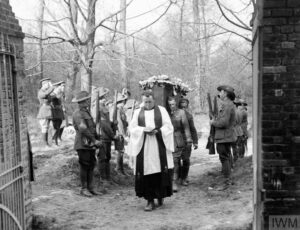
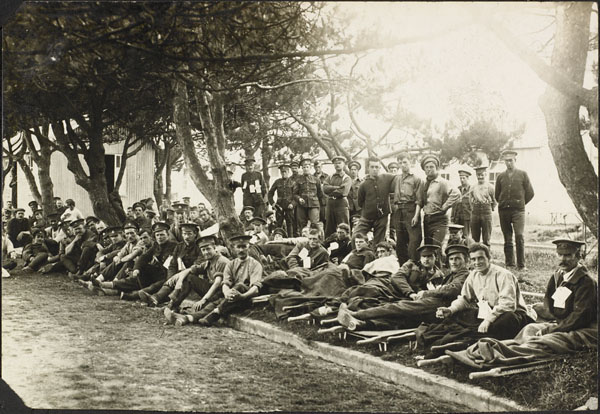
The Canadian First Division’s Chaplain Captain (Reverend) Frederick George Scott one of the most well-documented soldiers in the Great War. From The Great War As I Saw It, by Frederick George Scott, comes the story of his Blighty, over four years into his service, and just prior to the end of the Great War.
Blighty
blighty: a wound suffered by a soldier sufficiently serious to merit being shipped home to Britain

No. 2 Canadian General Hospital, Le Tréport, France
Delegates for Blighty!
MIKAN No. 5065578
The Somme
The 10th Battalion relieved that night by the 8th, the C.O. of which made his headquarters with the C.O. of the 5th Battalion in a large dugout by the sunken road. There, late at night, I shared a bunk with a young machine-gun officer and had a few hours of somewhat disturbed sleep.

The next morning, Sunday, September the 29th, the fourth anniversary of our sailing from Quebec, our men were having a hard time. The German defence at Cambrai was most determined, and they had a large quantity of artillery in the neighbourhood. I went back to the road and into the trench beyond the wire and found a lot of men there. The parapet was so low that the men had dug what they called, “Funk holes” in the clay, where they put as much of their bodies as they could.

Service
Sitting in a bend of the trench where I got a good view of the men, I had a service for them, and, as it was that festival, I read out the epistle for St. Michael and All Angel’s Day, and spoke of the guardianship of men which God had committed to the Heavenly Hosts. Going down the trench later on, I came to a place from which I could see, with my glasses, a German machine-gun emplacement and its crew. I went back and asked for a sniper.

A man who said he was one came up to me and I showed him the enemy and then directed his fire. I could see from little puffs of dust where his bullets were landing. He a good shot and I think must have done some damage, for all of a sudden the machine-gun opened fire on us and we had to dive into the trench pretty quickly. I told him that I thought we had better give up the game as they had the advantage over us.

Snipers
To snipe at the enemy seemed to be a curious way to spend a Sunday afternoon, but it was a temptation too hard to resist. I crawled back through the trench to the road, and there finding a man who had just lost his hand, directed him to the aid post near Battalion Headquarters.

Cambrai
I accompanied him part of the way and had reached the edge of the sunken road, when a major of the Engineers came up to me and said, “I have got a better pair of German glasses than you have.” It was an interesting challenge, so we stood there on a little rise looking at the spires of Cambrai and comparing the strength of the lenses. Very distinctly we saw the town, looking peaceful and attractive.

Ste. Olle Church near Cambrai. 3404070
Enemy bombardment
Suddenly a tremendous crash in front of us, a lot of earth blown into our faces, and we both fell down. My eyes were full of dirt but I managed to get up again. I had been wounded in both legs, and from one I saw blood streaming down through my puttees. My right foot hit and the artery in the calf of my leg cut. I fell down again with a feeling of exasperation that I had been knocked out of the war.
The poor major was lying on the ground with one leg smashed. The same shell had wounded in the chest the young machine-gun officer who had shared his bunk with me the night before. I believe an Imperial officer also hit in the abdomen and that he died.

The_Stretcher-bearer_Party
10th Battalion Chaplain
The chaplain of the 10th Battalion who happened to be standing in the sunken road, got some men together quickly and came to our help. I found myself carried off in a German sheet by four prisoners. They had forgotten to give me my glasses, and were very much amused when I called for them, but I got them and have them now. The major not only lost his leg but lost his glasses as well.

German O.P. on Arras-Lens road. September, 1917. Captured German Observation Post, disguised as a tree.
Observation Post
The enemy had evidently been watching us from some observation post in Cambrai, for they followed us up with another shell on the other side of the road, which caused the bearers to drop me quickly. The chaplain walked beside me till we came to the aid post where there were some stretchers. Placed on one and carried into the dressing station at Haynecourt.

They had been having a hard time that day, for the village heavily shelled. One of their men killed and several wounded. I felt a great pain in my heart which made it hard to breathe, so brought into the dressing station I said, “Boys, I am going to call for my first and last tot of rum.” I was immensely teased about this later on by my friends, who knew I was a teetotaller. They said I had drunk up all the men’s rum issue. A General wrote to me later on to say he had been terribly shocked to hear I was wounded, but that it was nothing in comparison with the shock he felt when he heard that I had taken to drinking rum.
Rum
‘SRD’ which stood for ‘Supply Reserve Depot’; other, more ironic, interpretations of the initials have included: ‘Seldom Reaches Destination’, ‘Service Rum Diluted’ and ‘Soon Runs Dry’. Soldiers on active service issued with 2.5 fluid ounces (one-eighth of a pint) of rum at the discretion of their commander or on the recommendation of their medical officer. Commonly issued during or after the dawn ‘stand to’.

The rum jars have S.R.D. marked on them. This stands for Supply Reserve Depot
Other, more ironic, interpretations of the initials have included: ‘Seldom Reaches Destination’, ‘Service Rum Diluted’ and ‘Soon Runs Dry’.
Everyone in the dressing station was as usual most kind. The bitter thought to me I was going to be separated from the old 1st Division. The nightmare that had haunted me for so long had at last come true, and I was going to leave the men before the war was over. For four years they had been my beloved companions and my constant care.

Triage
I had been led by the example of their noble courage and their unhesitating performance of the most arduous duties, in the face of danger and death, to a grander conception of manhood, and a longing to follow them, if God would give me grace to do so, in their path of utter self-sacrifice. I had been with them continuously in their joys and sorrows, and it did not seem to be possible that I could now go and desert them in that bitter fight.

When the doctors had finished binding up my wounds, carried off immediately to an ambulance in the road, and placed in it with four others, one of whom was dying. It was a long journey of four hours and a half to No. 1 C.C.S. at Agnez-les-Duisans, and we had to stop at Quéant on the way.

Field Ambulance
Our journey lay through the area over which we had just made the great advance. Strange thoughts and memories ran through my mind. Faces of men that had gone and incidents that I had forgotten came back to me with great vividness. Should I ever again see the splendid battalions and the glad and eager lives pressing on continuously to Victory? Partly from shell holes, and partly from the wear of heavy traffic, the road was very bumpy. The man above me was in terrible agony, and every fresh jolt made him groan.

The light of the autumn afternoon was wearing away rapidly. Through the open door at the end of the ambulance, as we sped onward, I could see the brown colourless stretch of country fade in the twilight, and then vanish into complete darkness, and I knew that the great adventure of my life among the most glorious men that the world has ever produced was over.’

They took me to the X-ray room and then to the operating-tent that night, and sent me off on the following afternoon to the Base with a parting injunction that I should be well advised to have my foot taken off; which, thank God, not found necessary. From the C.C.S. at Camiers, two days later sent to London to the Endsleigh Palace Hospital near Euston Station, where I arrived with another wounded officer at 2.30 a.m.
Return to England
I was put in a little room on the seventh storey, and there through long nights I thought of our men still at the front and wondered how the war was going. The horror of great darkness fell upon me. The hideous sights and sounds of war, the heart-rending sorrows, the burden of agony, the pale dead faces and blood-stained bodies lying on muddy wastes, all these came before me as I lay awake counting the slow hours and listening to the hoarse tooting of lorries rattling through the dark streets below. That concourse of ghosts from the sub-conscious mind was too hideous to contemplate and yet one could not escape them.

The days went by and intimations at last reached us that the German power was crumbling. Swiftly and surely the Divine Judge was wreaking vengeance upon the nation that, by its over-weaning ambition, had drenched the world in blood.
More
Previously posted, the Reverend’s search for the remains of his son, Captain Henry Hutton Scott.

And, the Reverend’s last moments with Sgt William Alexander, Shot at Dawn.

Contact CEFRG

