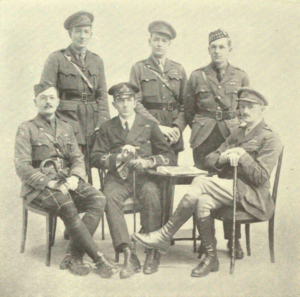
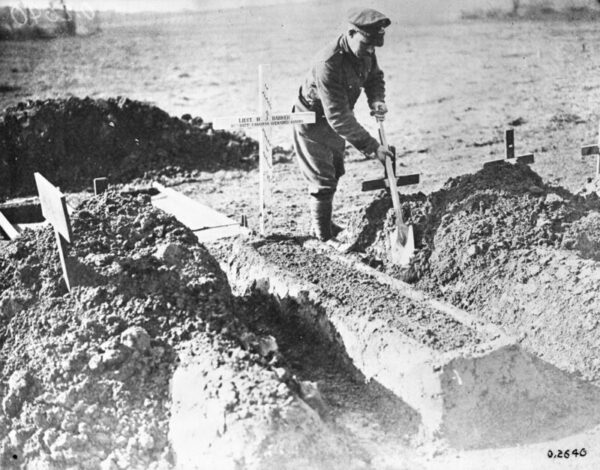
The Smith Brothers, George, Duncan Lumsden and Alexander Smith, sons of John Smith, of Lavington, British Columbia, and the late Margaret Smith (nee Geils). Their father John Smith waited for the return of his sons in vain. Two of his sons among the Missing, the other lies buried in Villers Station Cemetery.
Pioneer George Smith
The first of the the Smith Brothers to enlist, Private George Smith 430246 attested with the 48th Battalion, CEF on 3 March 1915 at Willows Camp, in Vernon, BC. George, a Fireman, stood 5′ 5″ tall, with fresh complexion, grey eyes, and fair hair. He was Presbyterian, 22 years and 4 months of age.

3rd Canadian Pioneer Battalion organized as 48th Canadian Infantry Battalion in February 1915. Commanded by Lieutenant-Colonel W. J. H Holmes. Left Montreal on 1 July 1915 aboard SS GRAMPIAN. Arrived in England 10 July 1915.

Pioneer George Smith AWOL at Shorncliffe, awarded 14 days of F.P. No. 2 and forfeits 11 days pay. The following month, awarded 72 hours detention, 6 October 1915. George admitted to Moore Barracks with Orchitis, 5 December 1915.

48th Battalion redesignated 3rd Canadian Pioneer Battalion, 25 January 1916. George discharged from hospital on 5 February 1916. Arrived in France 9 March 1916, 3rd Canadian Division (3rd Pioneer Bn withdrawn, 8 May 1917 and replaced in 3rd Division by 123rd Battalion. Personnel dispersed to 7th, 29th and 75th Canadian Infantry Battalions).
Godewaersvelde
Resting in billets at Godewaersvelde on 12 March 1916. Practical training in the trenches two days and No.1 Company proceeded to the front line trenches the same night. The first week in the trenches ends on 21 March as they return to billets in Godewaersvelde.
Captain A.F. Whiteside killed instantly by shell-fire at the Ramparts at 11:20 a.m. on 28 March 1916. Buried at Poperinghe the following day. April is spent tunneling under the MENIN ROAD, REGENT STREET and constructing dugouts at ZILLEBEKE BUND.
Battle of Mount Sorrel
Work continues at a good pace in May, while casualties are usually one wounded and one O/R killed per day. The enemy increases the bombardment on 1 June 1916, and casualties begin to mount, as the 3rd Battalion is consistently under fire during the Battle of Mount Sorrel.

Pioneer George Smith reported on 12 June 1916, Missing since 3 June 1916. On 31 July 1916, previously reported as Missing since 3 June 1916, now Killed-in-Action on 3 June 1916. George’s body never recovered, therefore he is named on the Menin Gate Memorial.

Private Duncan Lumsden Smith
The last of the Smith Brothers to enlist, Duncan Lumsden Smith born 30 November 1898, Aberdeen, Scotland. Private Duncan Lumsden Smith 687783 attested 22 February 1916, Vernon, B.C. with the 172nd Battalion. Duncan, a Farmer, stood 5′ 8″ tall, with ruddy complexion, blue eyes, and fair hair. He was Presbyterian, 18 years and 3 months of age.

172nd Battalion organized in January 1916 under the command of Lieutenant-Colonel J. R. O. Vicars. Mobilized at Kamloops. Recruited in Kamloops district. Before departing for England, Duncan receives news of his brother George’s death in the Battle of Mount Sorrel. The 172nd Battalion embarked from Halifax 25 October 1916 aboard SS MAURITANIA.

172nd Battalion disembarked England 31 October 1916. Strength: 31 officers, 972 other ranks. Drafts of 200 to 54th Battalion and 101 to 2nd Canadian Mounted Rifles in December 1916. Also reinforced 47th and 72nd Battalions. Absorbed by 24th Canadian Reserve Battalion on 4 January 1917.

Private Duncan Smith entered France on 7 December 1916 with the 54th Battalion. The 54th Battalion had organized in May 1915 under the command of Lieutenant-Colonel W. M. Davis. Private Duncan Smith arrived at his unit’s location in Ourton on 12 December 1916. The 54th inspected by the Corps Commander, Sir Julian Byng on 15 December 1916. The Battalion moved to Guy-Servins on 21 December 1916, and into the front lines in the Vimy Sector the following day.
Divisional Gas Attack
The months leading to the Battle of Vimy Ridge find the 54th Battalion constantly rotated into the front line, with rests in Berthonval, Hersin-Coupigny, and Chateau-de-la-Haie. On 1 March 1917, the 54th Battalion take part in a Divisional Gas Attack. The 22nd and 75th Canadian Infantry Battalions also engaged.

A terribly costly day for the 54th Battalion, six Officers killed, seven wounded. Seventy-seven Other Ranks killed, 126 wounded. Private Duncan Lumsden Smith died during the attack on 1 March 1917. Duncan’s body never recovered, therefore named on the Vimy Memorial.
Private Alexander Smith
The second of the Smith Brothers to enlist, Alexander Smith born 3 March 1894, Edinburgh, Scotland. Private Alexander Smith 472633 attested 17 November 1915, Saskatoon, Sask, with the 102nd Battalion, CEF. Alexander, a Farmer, stood 5′ 8″ tall, with dark complexion, grey eyes, and dark brown hair. He was a Congregationalist, 21 years and 8 months of age.
102nd Battalion organized in November 1915 in Comox, B.C., under the command of Lieutenant-Colonel J. W. Warden. Embarked from Halifax 20 June 1916 aboard EMPRESS OF BRITAIN. Disembarked England 28 June 1916. Strength: 37 officers, 968 other ranks.

Private Smith disembarked in France 11 August 1916, with the 72nd Canadian Infantry Battalion, 4th Canadian Division, 11th Canadian Infantry Brigade. Alexander first arrived in the trenches on 27 August 1916. In the Kemmel area during September for training, the 72nd Battalion does not take part in the Battle of Flers-Courcelette.
Camblain l’Abbe
The latter half of October spent in the Albert area, working on communication trenches. The 72nd Battalion leave the Somme in early December 1916, and by 22 December 1916 they are found at Camblain l’Abbe.

Inquiry
Private Alexander Smith accidentally killed 27 May 1917, shrapnel wounds to his face (severe), one hand blown-off, and arm shattered.
On 29 May 1917, the G.O.C. of the 12th C.I.B renders his report on an incident of 27 May 1917.
Private J. Robertson 472710 had extracted from the nose cap of an enemy shell, the detonating part. Private V.F. Lade 129950 was standing about 4 feet away. Private Alexander Smith 472633 was holding this part in his hand, and Robertson was using a hammer on it. No other witness than Private Lade was near at the time. Privates Robertson & Smith were too badly wounded to give statements.
Accident due to attempting to take a German fuse apart. The man (Pte. Smith) has been punished enough for disobedience of Orders.
Brigadier-General J.M. MacBrien, 12th C.I.B.
Of the three Smith Brothers, only Alexander is buried in a CWGC cemetery. Villers Station Cemetery, Plot X, Row B, Grave 3.

More
The Jameson Brothers in the Great War
The Hermanson Brothers in the Great War
Botterell Brothers in the Great War
The Cameron Brothers in the Great War
The Grant Brothers in the Great War
Pearson Brothers in the Great War
The McMurray Brothers in the Great War
Please subscribe to CEFRG to be notified by email when there are new posts. Subscription is free, and your email kept confidential.