Lt Eric Henri Kennington produced 170 charcoal, pastel and watercolours before returning to London in March 1918. Kennington served in the British army from 1914 to 1915 when invalided out. He went back to France in 1917 as an Official War Artist and concentrated on depicting the common soldier – true to his belief in the working man as hero. Whilst in France, Kennington admitted to a Casualty Clearing Station at Tincourt-Boucly to be treated for trench fever.

There he made a number of sketches and drawings of men injured during the bombardment that preceded the German 1918 Spring Offensive. Some of these drawings became the basis of the completed painting Gassed and Wounded.

Bourlon Wood


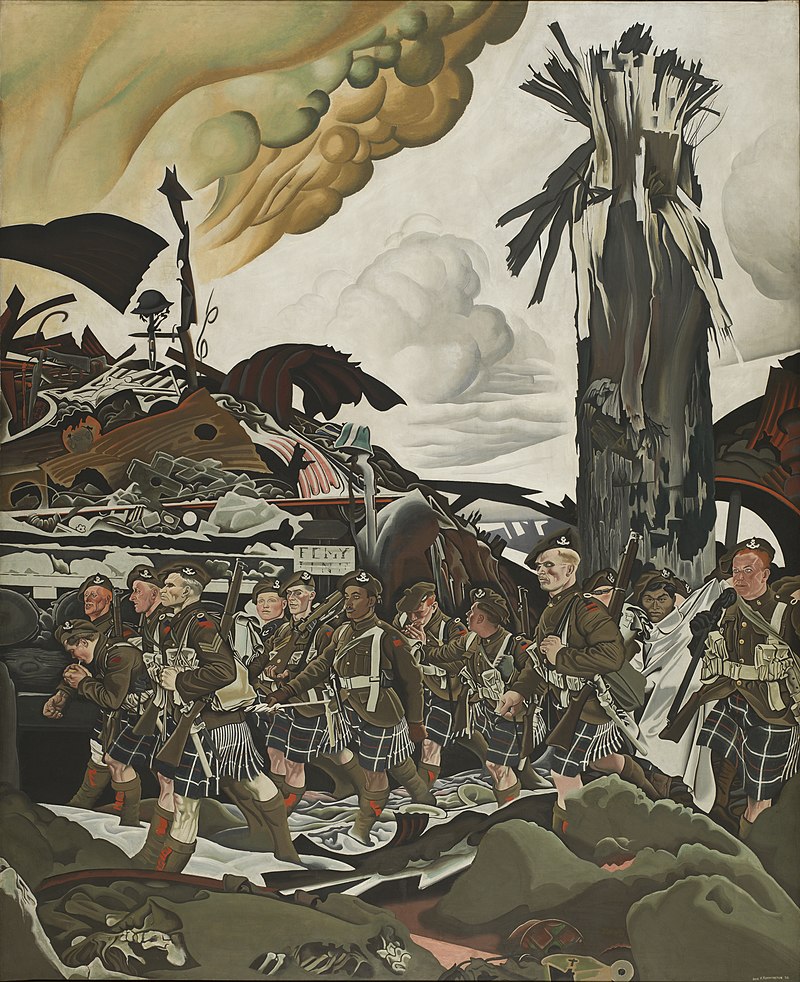
The Conquerors/The Victims
In November 1918 Lt Eric Henri Kennington commissioned by the Canadian War Memorials Scheme to depict Canadian troops in Europe. That month he returned to France as a temporary first lieutenant attached to the 16th Battalion (Canadian Scottish), CEF. The eight months Kennington spent in Germany, Belgium and France, working for the Canadians, resulted in some seventy drawings.

The Conquerors by Lt Eric Henri Kennington. Originally titled The Victims renamed after objections from Lieutenant-Colonel Cyrus Wesley Peck, the commanding officer of 16th Battalion (Canadian Scottish), CEF.

In the publication, ‘British Artists at the Front’ (Country Life, London, 1918), the subject of this work further explained: ‘The drawing was made when a battalion was marching back from the trenches to rest, and this good fellow was carrying a tired friend’s rifle and helmet as well as his own.’
Trees on the Somme


The Kensingtons at Laventie (1915)

A platoon of British soldiers standing in a village street with a whitewashed wall in the background, snow and debris on the ground. The figures loosely grouped on the left, with one lying on the ground and another to the right. Each man stares in a different direction. Certain metal objects – a helmet, a fork and a belt-buckle picked out in gold metallic paint.

Soldier’s Grave, Martin le Puich, 1919


Lance Corporal Smith, 1st Argyll Battalion, Home Guard

Ruined Buildings
Initially, Lt Eric Henri Kennington affiliated with the Department of Information, and under their employment returned to France as an artist in 1917. It was in this period that Kennington began to execute his landscapes and ‘hut-scapes’, which depict the abandoned buildings and ruined countryside in Ribecourt, Havrincourt and Bourlon.

These works, primarily executed in pastel, were in the words of the artist, a documentation of the ‘oddity and sadness and compete novelty’ of the decimated landscape in France

Britain’s Efforts and Ideals

Back to Billets
Image: a full length portrait of a British infantryman in full kit, with his rifle resting between his legs. He bears the rank of Lance Corporal on his right arm, with a green divisional insignia on his shoulder.

In a letter to Ernest Blakley of the Imperial War Museum on 2 October 1934, Kennington describes the background for the work: ‘The picture was painted at home from drawings made in 55 C.C.S. (Casualty Clearing Station) in Tincourt near Peronne during the bombardment that preceded the 1918 German offensive.’ (IWM War Archive: IWM 245(B)/6 Part 3)
INTERIOR OF AN ADRIAN HUT, 1918

Mustard Gas
This sketch depicts a blinded soldier recovering from the chemical effects of mustard gas.

Most gassed soldiers recovered their sight within four to six weeks, but some blinded permanently.
Gassed and Wounded

Based on drawings made at a Casualty Clearing Station near Peronne during 1918 just as the Germans bombarding the English lines in a prelude to their last big offensive. The painting powerfully conveys the cramped conditions and darkness of the Station. Wounded soldiers rest cheek by jowl and the shadowed figure of one of the orderlies dominates the foreground forming an unusual focal point. Note: This artwork relocated in August 1939 to a less vulnerable site outside London when the museum activated its evacuation plan.
Alfred Théodore Joseph Bastien in the Great War
Hon Lt Lt Alfred Théodore Joseph Bastien born 1873 in Ixelles, Brussels, Belgium. While serving in the CEF with Canadian War Memorials Fund, employed as a war artist (at his own expense), and at one time attached to the 22nd Battalion (Royal 22e Régiment), painting several snipers of the “Van Doos” on the battlefield.

Lieutenant A Y Jackson in the Great War
In 1915, after the outbreak of the Great War, Private Alexander Young Jackson 457316 enlisted in the 60th Battalion, CEF and sent to Europe. Wounded in the Battle of Sanctuary Wood in June of 1916. While recovering in the hospital in Étaples in northern France, he met Lord Beaverbrook. Soon he was appointed an artist with the Canadian War Records and immediately required to paint a portrait, despite his lack of experience with such themes. His subsequent works more in keeping with his preference for landscapes. From 1917 to 1919, Lieutenant A Y Jackson worked for the Canadian War Memorials as a war artist.

Major William Orpen in the Great War
Major William Orpen (later Sir William Orpen 1878-1931) born in County Dublin and trained as an artist at the Slade School. Orpen elected ARA in 1910. When War commenced in 1914, Orpen raised funds for the War Effort by auctioning blank canvases on which the purchaser’s portrait would be painted. In 1915, commissioned into the Army Service Corps and carried out routine administration work at Kensington Barracks.

Private Reuben Alvin Jukes in the Great War
Private Reuben Alvin Jucksch (Jukes) born on 5 July 1887 to Ernst August Jucksch and Maria Kalbfleisch of Hanover, Ontario. ‘Jukes’ not an official war artist, but family tradition holds that his commanding officer turned a blind eye when Jukes painted the scenes that confronted him whilst on active service.

Mary Riter Hamilton in the Great War
Mary Riter Hamilton produced the largest known collection of Great War art, yet she is still virtually unknown today.

Sapper William Redver Stark in the Great War
Sapper William Redver Stark born 4 February 1885 in Toronto to William Mackenzie Stark (1843-1922) and Ethel Copps (1854-1921). Prior to the Great War, studied art at the Ontario College of Art in Toronto and at the Philadelphia School of Fine Arts. William subsequently served with the Canadian 1st Construction Battalion (later renamed as the 1st Battalion, Canadian Railway Troops) in Canada, England, France and Belgium from 1916-1918, where, in his spare time, he did numerous sketches of the areas or the locations he visited on leave.


