Graphic Artist
1st Battalion, Canadian Railway Troops
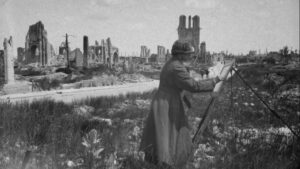
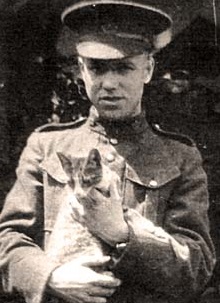
Sapper William Redver Stark born 4 February 1885 in Toronto to William Mackenzie Stark (1843-1922) and Ethel Copps (1854-1921). Prior to the Great War, studied art at the Ontario College of Art in Toronto and at the Philadelphia School of Fine Arts. William subsequently served with the Canadian 1st Construction Battalion (later renamed as the 1st Battalion, Canadian Railway Troops) in Canada, England, France and Belgium from 1916-1918, where, in his spare time, he did numerous sketches of the areas or the locations he visited on leave.

Canada’s experience of the Great War captured officially by commissioned artists such as A.Y. Jackson and David Milne through the Canadian War Memorials Fund. However, many other artists captured their experiences of the war.
William Redver Stark fonds
The William Redver Stark fonds at Library and Archives Canada (LAC) includes 14 sketchbooks of restored drawings and watercolours. Williams collection provides an intimate perception of day-to-day activities on the Western Front.

The sketchbooks contain images of soldiers at work and at rest. In addition, William captured German prisoners, artillery, landscapes, and even sights at the London Zoo where Stark went while on leave.

William also a Member of The Society of Graphic Artists. He submitted works (mostly landscapes and animal depictions) to the Ontario Society of Artists and The Royal Canadian Academy prior to the Great War.

The William Redver Stark fonds donated to LAC in 2005 by his nephew, Douglas Mackenzie Davies and family. His wife, Sheila Margaret Whittemore Davies, and their two sons, Kenneth Gordon Davies and Ian Whittemore Davies.
Enlistment with 1st Construction Battalion
William Redver Stark 1081275 born 4 March 1886 (actually 4 February 1885) in Toronto. Mother Mrs Ethel Stark of 538 Sherbourne St, Toronto. A stenographer by trade. Enlisted on 6 June 1916, at this time standing 5′ 5″ tall, 132 pounds. Medium complexion, grey eyes, brown hair and 30 years, 3 months of age.

1st Battalion, Canadian Railway Troops
Organized in April 1916 as 1st Canadian Construction Battalion initially under the command of Lieutenant-Colonel Blair Ripley. Recruited throughout Canada, mobilized at Valcartier and later left Halifax on 13 September 1916 aboard SS NORTHLAND. Arrived in England on 22 September 1916 with a strength of 23 officers, 846 other ranks, and later converted into a railway construction unit.

Sapper William Redver Stark embarked from Halifax on 13 September 1916, per SS NORTHLAND, later disembarking in Liverpool on 23 September 1916.

France
The 1st Battalion proceeded overseas on 25 October 1916, later landing at Le Havre in two sections on 26 October 1916, and immediately marched to No 1 Rest Camp. Finally, Sapper William Redver Stark arrived in Candas, Somme on 30 October 1916.

Candas
On 18 November 1916 the battalion took over the Candas-Acheux Railway between Candas and Colincamps.

Sapper William Redver Stark arrived at Plateau, Somme near Albert on 10 December 1916.

Froissy
HQ moved to Froissy, Oise on 15 February 1917. On 18 February 1917, Private Ernest Shearer Gilmore 1081600 killed by a shell near the station.

Pte Ernest Gilmore married to Mary Elizabeth Gilmore, living in Montreal and working as a carpenter when he enlisted at the age 18. Ernest later buried at Combles Communal Cemetery Extension.
Vimy
On 9 April, 1917, began the Battle of Arras. Canadians attacked and within a few days, captured Vimy Ridge, then the strongest German fortress on the Western Front. Canadian Railway Troops laid steel to within a short distance of the front line, as well as moved supplies and ammunition forward on standard and light gauge lines. The wounded evacuated over them to Field Ambulance Dressing Stations and Casualty Clearing Stations.

Messines
The next big Offensive in 1917 at Messines, and there the Railwaymen from Canada contributed their quota to success, in spite of interruptions caused by enemy shell fire, the almost impassable sea of mud which they were compelled to cross, and the many other obstacles that beset the path of railway construction on the battlefield-obstacles that are unknown to the civilian railroad worker.

Peronne
HQ moved to Peronne on 29 April 1917.

Rosendael-sur-Mer
Move to Rosendael on 20 June 1917 (Rosendaël is a former commune in the Nord department in northern France. In 1971 it was merged into Dunkirk).

Sketchbook No 10 has a paper label on the inside cover with a bookseller’s information. Ragons-Boyaval Dunkerque 1F10. This represents the location of the bookseller where the sketchbook came from in Dunkerque, and the location of the building. In addition, 1F10 the price paid for the sketchbook.

International Corners
Preparing for the Battle of Passchendaele, 1st Battalion moves 5 kilometers north-east of Poperinghe, Belgium on 1 August 1917.

[At] the time I made this drawing, the front line trenches were only a mile away and to the left of me [British?] light artillery were firing about 3 mile range – I was put under arrest temporarily for drawing so near lines of fire.
William Redver Stark
International corners the intersection of the Eikhoekstraat (N321) and Koekuitsraat in Vleteren, Belgium (Sheet 28.A.9.a.15.35), 5 kilometers north-east of Poperinghe.

William granted leave to UK on 17 January 1917, later rejoining his unit on 11 February 1917.

Designation of William’s unit changed to 1st Battalion, Canadian Railway Troops, 10 February 1917.
Passchendaele
Railway Troops struggled during the bitter fighting of the final attack at Passchendaele. Conditions horrible, yet the Canadian Corps prevailed.


Granted fourteen days leave on 11 December 1917, however, William late rejoining his unit. Sapper William Redver Stark sentenced to forfeit 3 days pay on 8 January 1918, for While on Active Service, AWOL from 7:30 am, 1 January 1918 to 7:30 am, 2 January 1918, forfeits an additional two days pay under R W.

Operation Michael
March, 1918, when the German Offensive began in the Somme sector, necessary to leave many miles of standard and light gauge railways in the hands of the enemy.
Seven Battalions of the Corps of Canadian Railway Troops withdrawn from railway work and employed for a time on the construction of a rear defence trench system. This work, carried out under the direction of Major-Genera} Stewart, assisted by 20,000 troops from Labour, Engineer, Road and other technical Units.

Troops constructed a rear defence trench system with over 30 miles frontage, in addition to 120 miles in total trenches.

When the task completed, they had built a defensive trench system on a front over 30 miles, with a total trench mileage of approximately 120 miles. In addition many strong points and machine gun emplacements built and the whole front protected with thick belts of wire.
Spring Offensive Continues
Later in the Spring of 1918, the Germans launched offensives to the north, intending to reach the Channel Ports, and force a conclusion to the war.

This, too, placed a considerable strain on the Corps of Canadian Railway Troops as once put to work on the construction of broad gauge lines and the elaboration of the light railway system which acted as a feeder to the front line trenches.
Boves
First of two trains arrives in Boves at 9 am on 26 March 1918. Troops moved off to Thezy-Gilmont, and accommodated in Billets.

Bethencourt
HQ moves to Bethencourt on 1 April 1918.

Conchy-sur-Chance
HQ moves to Conchy-sur-Chance on 1 May 1918.

Boubers-sur-Canche on 1 June 1918. Working on Wimereux Viaduct.
Baseball
On 7 July 1918, the battalion beats the baseball team of the 3rd Battalion, 11 to 3 in the All Canadian Railway Troops Baseball League. During the month, in addition to construction of the HESDIN-FREVENT LINE, the battalion operated a Marion Steam Shovel in the Ballast Pit at Aubrometz.

Work continued until the end of July, and at the beginning of August, preparations made by the Railwaymen for the work which would be required of them in the Battle of Amiens.
Work comprises of the putting in of heavy timber centring in three large masonry arches. The timber being sufficient to carry a dead load of the structure, the live load of the heaviest train on top and in addition a two-deep steel rails covering that has been placed on the floor of the bridge as a bomb burster. The work comprises the framing and erection of about 200,000 feet of timber and over a mile of steel rail.
War Diary – 1st Battalion, Canadian Railway Troops
Wimereux Viaduct
The battalion also constructed bomb proof shelters or dugouts for Canadian Nursing Sisters. Also, personnel at the WAAC in Montreuil, No 3 Canadian General Hospital, Boulogne, and No 3 CCS, Ligny. Finally, work in connection with the WIMEREUX VIADUCT completed.

Amiens
There arrived a moment when it became necessary for the Canadian Railway Troops suddenly to transfer themselves into fighting men. During the last four days of March, with the enemy advancing on Amiens, one Battalion of the Corps of Canadian Railway Troops called on to take part in the defence of the city.

The Railwaymen promptly organised 16 Lewis Gun teams and held tenaciously to the position allotted them until relieved by troops from the New Zealand Division.
Battle of Amiens
HQ moved to Rosieres in August of 1918, work on the HESDIN-FREVENT LINE continues while constructing a two-pile trestle for the French at St Pol. The battalion suddenly called to Longeau (near Amiens) on the first day of the battle.

By the 31st, two bridges at Froissy and Bray over the Somme, previously destroyed by the enemy, repaired.
Return to Peronne
During September of 1918, the battalion’s overall performance exemplary. Between La Chapelette and Peronne, three timber bridges over the canal reconstructed, while simultaneously laying double-track between Chaulnes and La Chapelette.

The PERONNE-ROISEL LINE commenced on 9 September 1918. The yards at PERONNE, DOINGT, CARTIGNY, TINCOURT and ROISEL all completed before the end of the month. In addition, 22 bridges, four of which steel-girder type spans, two pile-trestle bridges constructed. All while maintaining an average of about 30 miles of track per day.
If that not enough, the battalion continued to operate the CHAULES-PERONNE LINE until 8 September 1918. And, then the TINCOURT LINE to 21 September 1918. Finally, the men not once afforded the opportunity of a Sunday off for DIVINE SERVICE.
HQ moved to Warquaix (Hamelet today) east of Roisel on the Somme, on 3 October 1918.
Villers-Plouich
Near VILLERS-PLOUICH a delayed-action mine exploded just after both tracks completed, but traffic resumed within eight hours.

Battle of Cambrai
Troops moved to Wambaix, south east of Cambrai on 21 October 1918.

Caudry, south-east of Cambrai, shelled and burnt during the August 1914 Battle of Le Cateau.

At the time, on the left flank of the line of the retreating British Expeditionary Force. It remained under German occupation until recaptured in late 1918.
Sapper William Redver granted ten days leave in Paris, 28 October 1918, later rejoining his unit on 28 October 1918.

Armistice
News of the Armistice received while troops working on the line from Le Cateau to Landrecques. Troops moved to Le Cateau on 21 November 1918.

Sapper William Redver Stark transferred to England and posted to CRTD, Witley for purpose of demobilization, 13 January 1919. Posted to Ripon on 27 January 1919. Finally, attached to Kimmel Park for return to Canada, 22 February 1919.

Sapper William Redver Stark ToS No 2 District Depot, Toronto on 13 March 1919, and later discharged 26 March 1919 in Toronto.
Armistice
After the Armistice, William submitted works to expositions in Wembley, England and Paris. Following the Great War, he worked as a freelance graphic artist for the Toronto Star Weekly. At the same time, worked as a freelance illustrator of educational and children’s books.
Stark married to Marjorie Crouch in 1921. The couple had one daughter, Anita, unfortunately, she died in her late teens. William Redver Stark died in Toronto on 26 November 1953. Buried in Mount Pleasant Cemetery. Marjorie died in 1963.