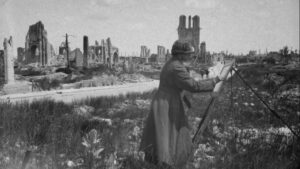
Trooper Albert Levinson, Lord Strathcona’s Horse (Royal Canadians), R.C.A.C., wounded and taken prisoner on the first day of the Battle of Amiens, 8 August 1918. He eventually recovered from his wounds and proceeded to Giessen Camp near Frankfurt, Germany where he met a four-year survivor of the camp, Lieutenant Lewis Pash Renateau, 13th Canadian Infantry Battalion, Black Watch (Royal Highlanders of Canada).

2293331 Lord Strathcona’s Horse (Royal Canadians), R.C.A.C. A 19-year-old law student, Private Albert Levinson 2293331 enlisted on 10 February 1917 at Tuxedo Park in Winnipeg. Mother Mrs A Levinson of 137 Langside St., Winnipeg, Manitoba.

PoWs Lt Lewis Pash Renateau and Arthur Nantel
In 1915, having previously been reported missing, confirmed that Lewis, (now Lieutenant Renateau of the 13th Battalion, Royal Highlanders of Canada) taken prisoner at St Julien, near Ypres, on 24 April 1915.

Private Arthur Nantel 25980 of the 14th Battalion, Royal Montreal Regiment, taken prisoner on 5 May 1915.

Both Renateau and Nantel eventually transferred to the Giessen POW camp.

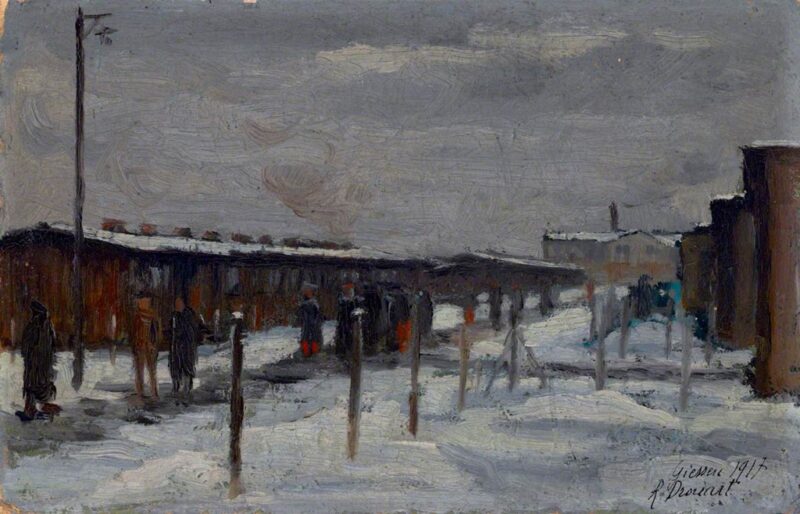
Lewis repatriated following the Armistice, and returned to Canada with a painting on the back of a tin box by French artist and fellow PoW, Raphael Drouart. This painting shows French PoWs – their distinctive blue coats and red trousers standing out against the snow – mingling with British, Canadian and other Allied prisoners.

This painting executed on the lid of a ration box and it bears the name of the recipient on the reverse, Lewis Renateau 24314 of the 13th Canadian Infantry Battalion, Black Watch (Royal Highlanders of Canada). The contents of the box also listed:
- Margarine
- Potted Meat
- Biscuits
- Prunes
- Cherries
- Camp Pie
- Golden Syrup
- Lemonade Powder
- Service Rations
- Cocoa
- Milk
- Sugar

Mannschaftslager Giessen
The Giessen camp (Mannschaftslager Giessen) for Allied Prisoners of War, near Frankfurt, well ordered and sanitary. As German POW camps went, it was not the worst.
“The place is well drained, the water is excellent, the sanitary conditions are good too, the sleeping accommodations are ample,” wrote Private Simmons, a Canadian POW in Giessen.

As well as a church it boasted a makeshift artists’ studio for the inmates to use, where Drouart, a French officer with the Allied French Army, painted scenes of camp life.

While there, Raphael Drouart (1894 – 1972) painted his portrait.

The Burlington Magazine
In September 1916, The Burlington Magazine published a letter from Lewis.
THE CAMP AT GIESSEN, HESSE
We have received from a Canadian artist, Mr. Lewis Renateau, with whom we are otherwise unacquainted, the letter published below, which may relieve the anxiety of the friends of prisoners in one German camp. We have also received from Mr. H. Walter Barnett, as specimen of the work of this imprisoned society of artists, a photograph of a very pleasing pencil drawing of our correspondent, Mr. Renateau, by one of his fellow-prisoners, Mr. Albert Venelle. Mrs. A. A. Humphrey, 122 Victoria St., S.W., desires us to say that she will gladly receive any gifts on behalf of these interned artists.
Letter from Penateau
GENTLEMEN, – We have received many numbers of The Burlington Magazine from Mrs. A. A. Humphrey (122 Victoria St., S.W.), and she writes to me that you were the kind donators. We appreciate them greatly and send you our most grateful thanks and best wishes,
The “we” consists of about twenty men of many various talents and qualities, from theatrical scenic painters to wood-carvers. The best artists here are Raphael Drouart (Parisian), Arthur Nantel (on “The Standard” Montreal), Tisseire, caricaturist (Parisian), and as students of art, A. Venelle (Brussels), Patoisseaux (Nantes), Alain Beddoe (Ottawa). The rest are architects, decorators, furniture designers, etc.
We are very well treated and can work as we can work as we like and get in any materials from the town we need that we can afford, so that we are really very well off.
Thanking you again for your, kindly thought and gifts on behalf of the Giessen Art Fraternity,
I remain, Yours truly,
LEWIS RENATEAU.
Lewis’ stepfather died in 1917 and on 12 May 1923, his mother married artist Major C. T. Holland in Kensington Registry Office, London. However, the marriage ended with the death in London of Major Holland aged sixty-nine in 1927. After the war, Lewis returned to Canada to be demobilised and on 8 April 1919 he married Ruth Meryl Smith in Montreal. The couple returned to England, initially to Kensington in London. Lewis joined the Port of London Authority as a naval architect and remained with them for forty years.
Lewis Pash Renateau died on 9 October 1978 at Couch Hill Lane, Burley Ringwood, Hampshire. His funeral held at Bournemouth Crematorium on 17 October. He was survived by his wife Avalon, two children and two grandchildren.
Arthur Nantel
Arthur Nantel began his career as a commercial artist in his home town of Montreal, and although he had no formal training he spent a lifetime earning a living in the arts.

In August 1914, at age 41, he enlisted with the 14th Royal Montreal Battalion.

Battle of St. Julien
Pvt Nantel first saw action at Ypres, Belgium, in April 1915, during the Battle of St. Julien.

He was captured there and spent the remainder of the war at Giessen, a German prisoner of war camp.

For the first few years, Nantel’s captors saw him as a valuable commodity, exploiting him at every opportunity. He and a few other talented PoWs were given a small hut that they nicknamed Giessen Studio.
“I sat at my easel, trying to earn the value of a piece of wurst (sausage) to assuage my voracious appetite…. Distinguished officers vied with each other in their efforts to have the monopoly of selling my works at a profit of 7,000 per cent.”

In 1917 he helped design a monument for the men who died in captivity at Giessen, but that same year there was a change in command at the camp and Giessen Studio was shut down.

Nantel ground out the remainder of the war in hard labour.

His last seven months of internment were spent slaving in a mine.

Alain Brookman Beddoe

Alain Beddoe also captured during Second Battle of Ypres and spent two and a half years in PoW Camps Gießen and Zerbst.

The Alan Beddoe collection at Library and Archives Canada contains designs and studies for the Book of Remembrance, postage stamps, posters, crests, money, architecture, coats-of-arms, and a new Canadian flag. In 1948 Beddoe started work on a WWII Book of Remembrance and followed it with books for the Korean and South African Wars, his work on these Books of Remembrance
spanning 30 years.
Fort Garry Horse
Trooper Albert Levinson landed in France on 8 December 1917 with the Fort Garry Horse.


Lord Strathcona’s Horse
Trooper Levinson transferred back to the Lord Strathcona’s Horse on 25 June 1918.

Influenza
Trooper Albert Levinson’s first bout of influenza in July of 1918 as he was admitted to No. 41 CCS. Returned to his unit from No 5 General Hospital, Rouen on 22 July 1918.

Battle of Amiens
Trooper Albert Levinson reported missing on the first day of the Battle of Amiens, 8 August 1918. One of fifteen missing men of the LSH.
Reported Missing


Giessen Camp (Mannschaftslager Giessen)
The Giessen camp for Allied Prisoners of War, near Frankfurt, well ordered and sanitary.

As well as a church it boasted a makeshift artists’ studio for the inmates to use, where Drouart, a French officer with the Allied French Army, painted scenes of camp life.

Private Lewis Renateau 24314 taken prisoner on 24 April 1915 at the Battle of Gravenstafel. Eventually repatriated to England on 16 December 1918, a four-year survivor of Giessen Camp.

Lewis Renatueau released at Dover on 18 December 1918. Lewis made his way home to Canada on HMT SCOTIAN from Liverpool on 25 March 1919.

Arthur Nantel painted this image of the Marksburg castle above the town of Braubach in Rhineland-Palatinate, Germany. In March 1945, the castle badly damaged by American artillery from across the Rhine.

Darmstadt
At one time Trooper Albert Levinson hospitalized in Darmstadt (wounded in lung) on 10 September 1918.

Albert recovered from his wounds and later transferred to Giessen Hesso.


Located in Camp


Dies in German Prison Camp
Though having recovered from his wound, Private Albert Levison died of influenza on 10 October 1918 and buried at Giessen Jewish Cemetery, Germany.

Death of Trooper Albert Levinson
Albert died of Influenza (not wounds as per his grave marker)shortly before the camp liberated, and buried at Giessen Jewish Cemetery. Following many exhumations to other cemeteries following the Great War, Trooper Albert Levinson remains the only war casualty buried at Giessen due to religious grounds. From the perspective of halakhah, the removal of remains from a grave generally barred because of concern for the dignity of the dead. Had Levinson been interred in a gentile cemetery, his body may have been exhumed for reburial in a Jewish cemetery.
Giessen Jewish Cemetery
On 17 February 1925, the Graves Registration Officer visited the cemetery. Giessen a town in central Germany approx 70km north of Frankfurt am Main. The “Judischer Friedhof” can be found on the left. The CWGC grave is to the right of the building in the 4th row of graves on the left of the path. The cemetery address is: Friedhofsallee, 35396 Gieben Germany

Grave of Trooper Albert Levinson
The majority of the Great War graves in Germany moved into four permanent cemeteries after the war. However, a few graves could not be moved on religious grounds or for other reasons and they remain in their original locations in German military and civil cemeteries. Giessen Jewish Cemetery contains one such Commonwealth burial of the war.

From the perspective of kavod hamet, the removal of remains from a grave is generally barred because of concern for the dignity of the dead. Had Levinson been interred in a gentile cemetery, his body may be exhumed for reburial in a Jewish cemetery.
Another CWGC cemetery in Germany contains two graves unable to be moved due to religious grounds.
Euskirchen New Town Cemetery
Euskirchen a town in West Germany approx 40km south of Köln (Cologne). Turn right immediately on entering the cemetery and continue for approx. 50m, the German Plot can be found on the right. The cemetery address is: Frauenberger Straße 158 53879 Euskirchen, Germany.
The 1st Canadian Casualty Clearing Station, 42nd Stationary Hospital and 47th Casualty Clearing Station posted to Euskirchen after the Armistice. Most of the graves in the New Town Cemetery removed to Cologne Southern Cemetery, but the graves of two Indian artillerymen of the Army of Occupation remain.
Driver Kishin Kawar
Driver Kishin Kawar died 1 September 1919. Royal Horse and Field Artillery, Indian Army Eastern Div. Ammunition Col.

Gunner Ram Lal
Gunner Ram Lal died 18 January 1919. Royal Horse and Field Artillery, Indian Army 1st Div. Ammunition Col.


