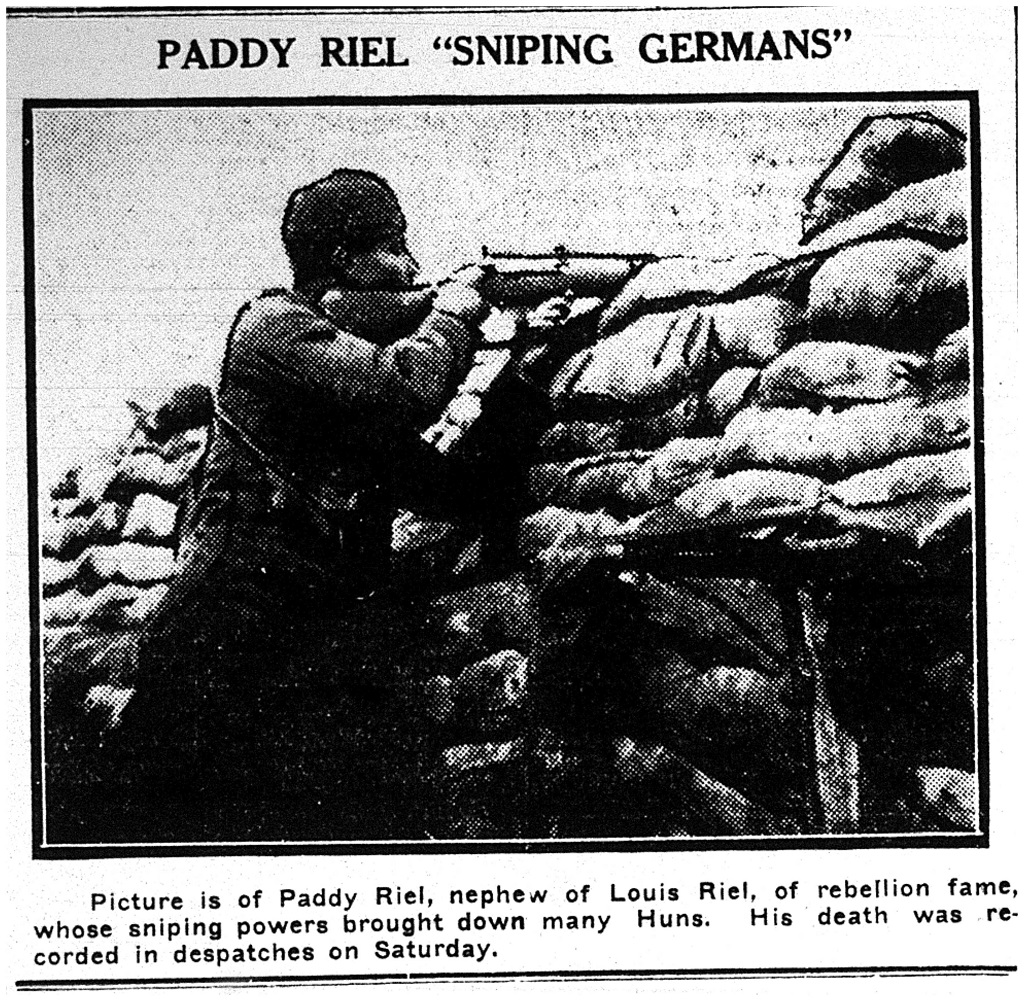
Private Patrick Riel the nephew of Louis Riel. No way! Another accomplished sniper of the the Canadian Corps. Way!

Louis Riel
Louis Riel, Métis leader, founder of Manitoba, central figure in the Red River and North-West resistances died 16 November 1885 in Regina, Saskatchewan. Riel led two Métis governments, central in bringing Manitoba into Confederation.

Louis Riel, circa 1873.
(courtesy Provincial Archives of Manitoba/N-5733)
Executed for high treason for his role in the resistance to Canadian encroachment on Métis lands. Riel initially dismissed as a rebel by Canadian historians, although many now sympathize with Riel as a Métis leader who fought to protect his people from the Canadian government.
Propaganda
How did Patrick Riel become associated with Louis Riel? The story similar to that of the Crucified Canadian.

During the Great War, it has been written Canadians earned a reputation for their savagery. This folklore may have been encouraged by the unfounded story of the Crucified Canadian. Whether true or not, war diaries and personal accounts do record this fact. When men entered the Ypres Salient for the first time, they were shown the spot where the alleged atrocity had taken place.
Library and Archives Canada
Today, many sources still push the claim Patrick Riel related to the famous Métis leader Louis Riel.
Patrick Riel (1876–1916) was a 39-year-old widower who attested in the 8th Battalion in August 1914. He was given Regimental No. 1295, which shows that he was one of the very first people to join up at the outbreak of the war. We can tell that he was illiterate because instead of signing his name on his attestation paper, he marked it with an “X.” Riel was a member of a First Nation in Canada.
He came from Maniwaki, Quebec, a town on the Gatineau River north of Ottawa, which adjoins the lands of the Kitigan Zibi Anishinabeg First Nation, an Algonquin band. Riel was a highly successful sniper on the Western Front before dying in January 1916 from wounds sustained in an artillery attack. He left two daughters. Riel was among the many First Nations people who contributed significantly to Canada’s war effort, despite facing discrimination at home. In this respect, Private Riel was doubly significant, being a descendant of the iconic Métis leader Louis Riel, who had been hanged for treason in 1885.
Library and Archives Canada

An International Rifle Match – Canadians, Australians, New Zealanders, South Africans and Imperials. June, 1916. Sharpshooters appear to be mostly armed with Short Model Lee-Enfield service rifles. A spotter’s scope is set up to view the results.

The Sniper
A new documentary, The Sniper, explores the life of a Métis sniper named Patrick Riel, and reveals some truth (lies in bold).
Patrick Riel was born in Quebec and had three daughters with his wife who died in childbirth, and left them in the care of his community and came to Thunder Bay to work in Shabaqua, Ont. When the war broke out the Winnipeg Rifles were one of the first units to be called to serve.
Harpelle said because Patrick Riel enlisted in Thunder Bay, he was ultimately recorded as a casualty from Thunder Bay.
Jasmine Kabatay, an Anishinaabe freelance journalist from Seine River First Nation in northwestern Ontario.
We know Patrick enlisted in Valcartier, Quebec.

Ron Harpelle teaches history at Lakehead University in Thunder Bay, and is a director of the film. He said Patrick Riel and Louis Riel were related, but only distantly.
Jasmine Kabatay
5th Degree Cousin
The truth? Perhaps very distantly. A fifth-degree cousin.
“Patrick Riel was Louis Riel’s 5th degree cousin.
Jean-Baptiste RIEL-LIRLANDE
Jacques-Michel RIEL-LIRLANDE Jean-Baptiste RIEL-LIRLANDE
Jean-Baptiste RIEL-LIRLANDE Nicolas RIEL
Jean-Baptiste RIEL-LIRLANDE Étienne RIEL
Jean-Baptiste RIEL Maxime-Émilien RIEL
Louis RIEL Joseph RIEL
Louis-David RIEL Patrick-Joseph RIEL
Patrick-Joseph RIEL
est : cousin au 5e degré deLouis-David RIEL“
Courtesy : Dominique Ritchot
Lord Beaverbrook
The originator of the ‘story’ perhaps Max Aitken (also known as Lord Beaverbrook) and such lesser-known figures as Walter Gordon and Reverend R G McBeth propagated myths about Patrick Riel. By 1917, they had turned Patrick Riel into a heroic Métis sharpshooter and a nephew of Louis Riel. The problem is that Patrick Riel not a member of the Métis Nation.

This is the inscription engraved on a silver plate on the butt of a rifle which is on exhibition in the window of the British Columbia building in London, England. Capt. M. A. Fiset, of the 36th Field Battery, sends this information: “No one, I am sure, in London,” he writes, “understood better than I all that this inscription meant. It is too eloquent to need the addition of any words. I beg, however, that the press be good enough to convey to the Riel family and all the Métis nation my personal grief and also my profound admiration for this hero of whom the Métis nation at large must be proud.”
Enlistment of Private Patrick Riel
Private Patrick Riel born 17 March 1876 to Joseph and Louise Latendresse. Patrick had married Menonik (Veronique) Jacko in 1895 at Baskatong. They had four children between 1896 and 1907.
Now widowed, Private Patrick Riel 1295 attested 27 August 1914 in Valcartier, Quebec with the 1st Battalion, 1st Brigade. Eventually, Patrick comes to serve with the 8th (Winnipeg Rifles) Battalion, yet most erroneous sources have him immediately enlisting with the 8th Battalion.
Kitigan Zibi (Désert River)
Next of kin his daughter Catherine (Katie) Riel, of Désert River, Quebec. Mr Peter Jones of Désert River, Katie’s guardian. Patrick stood 5′, 11″ tall, with dark complexion, brown eyes and black hair, thirty-eight years of age at this time.

Who is Métis?
The Métis Nation of Ontario and affiliated organizations use the following terms to define Métis.
- Métis means a person who self-identifies as Métis, is of historic Métis Nation Ancestry, is distinct from other Aboriginal Peoples and is accepted by the Métis Nation.
- “Historic Métis Nation” means the Aboriginal people then known as Métis or Half-Breeds who resided in Historic Métis Nation Homeland;
- “Historic Métis Nation Homeland” means the area of land in west central North America used and occupied as the traditional territory of the Métis or Half-Breeds as they were then known;
- “Métis Nation” means the Aboriginal people descended from the Historic Métis Nation, which is now comprised of all Métis Nation citizens and is one of the “aboriginal peoples of Canada” within s.35 of the Constitution Act of 1982
anishinabeg
Algonquin people call themselves anishinabeg, which carries both the general meaning of “human being”, and the specific meaning of “real (i.e. Indian) people”.
Compared to First Nations in most other parts of Canada, the ten Algonquin communities have very little reserve land. By far the largest parcel the River Desert Reserve belonging to the
Kitigan Zibi Algonquins. Consisting of approximately 43,000 acres, located near Maniwaki, Quebec.

Sniper officers in training (Mont-des-Cats, France). June, 1916. The Canadian divisions had their own sniper training school located at Mont des Cats.
Service of Patrick Riel
Private Patrick Riel Absent from Parade, deprived of 15 Days Pay, 4 June 1915. On 6 November 1915, Private Patrick Riel granted leave, and later returned to duty on 13 November 1915.

Sniping instruction. June, 1916. A captain appears to be instructing a soldier, wearing a “Gor Blimey” style cap in the the use of a mechanism to fire rifles indirectly over the parapet.
In letters sent to friends here by his trench chum, another half-breed, formerly a student at the Qu’Appelle Industrial School, Riel is said to have disregarded potting Germans who were in the trenches. His chief work was to locate snipers from the German side and bring them down.

Crack shot
One story of his keen sight and ability to shoot straight is told when in late April, 1915, he brought down two German snipers within five minutes at a distance of about seven hundred yards. There were men and officers falling regularly on the Canadian side in a certain section of the trench. Riel was watching this spot where the shots came from and decided that snipers were at work. About seven hundred yards away he spied the tree and watched it for a minute, then deliberately aiming, fired and brought down the sniper, who was in one of the lower branches.
Munster Fusiliers
Just as soon as he had scratched another mark on his trusty rifle, he levelled again and from the top of the tree another enemy sniper fell to the ground. The incident was noticed by the officers and duly reported in dispatches. That night the officers looked for Riel, but he could not be found. He had joined a raiding party of the Munster Fusiliers and was out having his little time. The following morning he reported and proudly pointed to five additional marks on his rifle.

Private Patrick Riel Killed in Action
Patrick killed in action by splinter of shell, 14 January 1916.
This rifle was used by Sniper No. 1295, Pte. P. Riel (nephew of Louis Riel, of the Riel rebellion), 8th Battalion (90th Rifles), 1st Canadian Division, B.E.F. With it he accounted for 30 Germans, between March, 1915, and January 15, 1916, when he was killed by a shell at Anton’s Farm, France, 128, near Messines.

Anton’s Farm

“Am reminded as I write of a chance meeting Billy Hill, of A coy, and I had with Paddy Riel, 8th Battalion sniper of Indian descent, in the trenches at Plugstreet in 1915. He told us how he had seen a German private peering over the trench that morning. The man presented a good target but there was something about his attitude which prompted Paddy to believe that he was being forced to show himself, so he refrained from shooting.

Paddy’s hunch proved correct, for as soon as the private disappeared from view, the head and shoulders of a German officer appeared – the latter was apparently satisfied that he could now look around in safety. This was what Paddy was waiting for and, after he had pulled the trigger, he had the satisfaction of being able to cut another notch in the butt of his rifle. Paddy Riel will do no more sniping for he lies under the poppies now. If the shades of Paddy and his uncle should meet – his uncle Louis Riel who was hanged at Regina after leading the ill-fated revolt of the half breeds in ’85, the meeting should prove an interesting one.”
Ploegsteert Wood
A Vertical aerial photograph of the trenches in Ploegsteert Wood in Belgium, taken on 24 March 1917.

The same area in 2015.

Canadian troops engaged in a rat hunt at Ploegsteert Wood near Ypres during March 1916.

Rosenberg Chateau Military Cemetery
Patrick initially buried at Rosenberg Chateau Military Cemetery, used by fighting units from November 1914 to August 1916. The extension begun in May 1916 and used until March 1918.
Red Lodge
Together, the cemetery and extension sometimes referred to as ‘Red Lodge’. Patrick’s body remained here until 1930, when the lawn owner requested the return of his property.

Pte Patrick Riel’s remains exhumed from Rosenberg Chateau 28.T.18.d.35.65 on 4 February 1930 and placed in Berks Cemetery Extension, 28.U.19.b.2.5.
Berks Cemetery Extension
Hyde Park Corner was a road junction to the north of Ploegsteert Wood. Hill 63 to the north-west and nearby the ‘Catacombs’, deep shelters capable of holding two battalions, used from November 1916 onwards.

HYDE PARK CORNER (ROYAL BERKS) CEMETERY
HYDE PARK CORNER (ROYAL BERKS) CEMETERY begun in April 1915 by the 1st/4th Royal Berkshire Regiment and used at intervals until November 1917. The cemetery contains 83 Commonwealth burials of the Great War and four German war graves.

BERKS CEMETERY EXTENSION
BERKS CEMETERY EXTENSION is separated from Hyde Park Corner Cemetery by a road. The extension begun in June 1916 and used continuously until September 1917. At the Armistice, the extension comprised Plot I only, but Plots II and III added in 1930 when graves brought in from Rosenberg Chateau Military Cemetery and Extension, about 1 kilometre to the north-west, when it was established that these sites could not be acquired in perpetuity. The land owner, as was his right, requested the graves be removed.

PLOEGSTEERT MEMORIAL
Berks Cemetery Extension now contains 876 Great War burials. Within Berks Cemetery Extension stands the PLOEGSTEERT MEMORIAL, commemorating more than 11,000 Commonwealth servicemen who died in this sector during the Great War and have no known grave.

The memorial serves the area from the line Caestre-Dranoutre-Warneton to the north, to Haverskerque-Estaires-Fournes to the south, including the towns of Hazebrouck, Merville, Bailleul and Armentieres, the Forest of Nieppe, and Ploegsteert Wood.
Contact Us


Please subscribe to CEFRG to be notified by email when there are new posts. Subscription is free, and your email kept confidential.