CEFRG presents the story of the Hallu Eight in the Great War. Lieutenant Clifford Abram Neelands, Winnipeg Grenadiers, of the Hallu Eight, and the missing men of the German Alpine Korps in the Great War a fascinating case. The Hallu Eight – Winnipeg Grenadiers, discovered by then teen aged boy, Fabien Demeusere on his parent’s property in Hallu, France during 2006 and 2007. The DHH through the Casualty Identification Program took almost eight years to identify five of the men through mitochondrial DNA analysis.

Lieutenant Clifford Abram Neelands
Lieutenant Clifford Abram Neelands born 4 January 1892 in Barrie, Ontario. Son of John Henry and Mary Jane Neelands, of 725, Orange Ave., Long Beach, California, United States. Educated at Barrie High School. Clifford claimed 7 months previous service as a Lieutenant in the 144th Battalion. He was to be a Lieutenant, 6 December 1915. Clifford resigned his Temporary Commission in order to proceed overseas, 20 March 1916.

Second enlistment
Living at 271 Smith Street, Winnipeg, on 25 May 1916. Clifford re-enlisted in the 144th Overseas Battalion CEF in Winnipeg, Manitoba. His parents were now living at the Arlington Apartments, Edmonton, Alberta. Clifford stood 5′ 6″ tall, 126 pounds, with fair complexion, brown eyes, and dark brown hair. He was Methodist.
Sailed from Halifax per SS OLYMPIC, 31 May 1916, arriving Liverpool 8 June 1916. On arrival, given the Acting rank of Sergeant, and transferred to the 11th Reserve Battalion on 19 July 1916. T.o.S. 78th Battalion on 11 August 1916 at Shorncliffe, embarking for France the next day. On 24 August 1916, his rank of Sergeant confirmed in the field.
Cadet School
To Cadet School, 12 December 1916. Clifford suffered from Myalgia (back). He admitted himself to No. 10 Stationary Hospital, St. Omer on 15 December 1916, War Hospital, Keightley, 2 January 1917. Monks Horton Convalescent Hospital, 14 February 1917. Finally, discharged on 20 February 1917. The Medical Board approved 3 weeks convalescence in Belfast, Ireland with his friends.
Discharged from 1st C.C.D., St. Leonard to Canadian Training School, Bexhill, 8 May 1917. His schooling ended 30 June 1917. On 1 July 1917, Clifford, once again, granted a Commission, to be Temporary Lieutenant.
Currently with the 11th Reserve Battalion, Clifford treated for V.D.G. Admitted to Cherry Hinton Military Hospital, Cambridge, on 1 September 1917. Then, admitted to Shaffords Military Hospital, St. Albans on 3 September 1917, finally discharged on 21 November 1917. Before being discharged, Clifford had to appear before a Medical Board. Major S.H. McCoy, Major G.H. Wilson, and Captain F E Rogers of the C.A.M.C., declared Clifford Fit for General Service – Clifford not reprimanded. However, the board warned Clifford against exposure to alcohol.
Once again, Clifford proceeded overseas to 78th Battalion, from Dibgate, 27 February 1918. Proceeded on Lewis Gun Course, 16 March 1918, rejoining his unit on 9 April 1918.
The Battle of Amiens
The story of the Hallu Eight in the Great War begins on the fourth day of the Battle of Amiens. The Winnipeg Grenadiers tasked with taking the village of Hallu. Assembling north and east of Caix, the 78th Battalion move off at 07h00. But, the advance did not take place until sometime later. Proceeding towards Rosieres-en-Santerre on the left. And, Vrely on the right, the 12th Infantry Brigade halted to the west of the villages, and awaited orders for a further advance. There is practically no opposition, with the exception of some heavy artillery east of Vrely.
The advance towards Hallu from Chilly proceeded without incident. With the exception of some long range machine gun fire and field guns. At 14h10, Major Linnell reports the ground very difficult to advance over. Major Linnell then instructed a patrol to reconnoiter the village. Lieutenant Neelands given the task, along with 60 Other Ranks.
Afternoon, 11 August 1918
At 15h00, a message received from “A” Company Major Grant. “A Company has reached the objective, casualties’ slight, strong opposition on the right flank. Arranging with “C” company to hold the line.”
The 78th Battalion firmly in control of Hallu. Having all four companies in the village with two forward posts east of the village. One of the forward posts is occupied by the Hallu Eight. Battalion HQ moved to the village of Chilly.
At 15h45, the enemy begins a heavy bombardment of Hallu. Major Linnell unable to establish communication with the patrol. Following the bombardment, two battalions of the German Alpine Korps began their advance. They probably first encountered the bodies of the Hallu Eight in front of the destroyed houses on Rue des Bourgeois.
Quickly moving through Hallu, the German Alpine Korps ran into resistance at the HQ in Chilly. Lieutenant Kilborn led a flanking attack, and killed the cavalry officer in command at a distance of 30 yards. Bitter fighting, with sweeping machine-gun fire persists through the night. By dawn, the enemy began their retreat. Licking their wounds, the 12th Infantry Brigade cancelled their plans of taking Hallu on 12 August 1918.
Afternoon, 11 August 1918
The afternoon of 11 August 1918 extremely hot. During the lull in fighting in the vicinity, the German Alpine Korps had the opportunity to bury their dead. And, those of their foe. A battlefield cemetery, hastily arranged, soon filled with the dead, and the Fallen given a Christian burial. Such was the fate of the Hallu Eight in the Great War
Two German cemeteries back in Punchy (just east of Hallu). Neither of these cemeteries an “Alpine Korps” cemetery. The men of the Alpine Korps would have known they could have buried their dead back in the existing cemeteries at Punchy. The German Army had held this area for years. However, probable the men of the German Alpine Korps buried along with the men of the Winnipeg Grenadiers here in Hallu. The reason explained by the attitude of the former inhabitants of villages like Hallu and Punchy when they returned to their homes in late 1919.

Displacement
Finding their homes and villages in ruin, one can imagine the pain and suffering of these displaced families. Discovering German soldiers buried alongside their relatives in their own communal cemeteries, and seeing other new cemeteries and memorials dedicated to these men, infuriated the people and spurred wanton destruction.
Herbert Hunter a relative of Lt Neelands, and supplied the coordinates of Clifford’s grave by the London War Graves Office in 1919. This is significant. We know the men buried in a cemetery. Not ‘found in a shell crater’ as believed when the Hallu Eight re-interred at Caix British Cemetery on 13 May 2015.
Re-interment
Though Canadian Prime Minister Stephen Harper in the immediate area, it was Governor General, Colonel-in-Chief The Right Honourable Adrienne Clarkson, representing Canada, who attended the ceremony. The PPCLI – Princess Patricia’s Canadian Light Infantry, supplied the burial party. The German Ambassador, Nikolaus Meyer-Landrut, also in attendance, had no idea the German Alpine Korps had already buried these men.
Also attending family descendants of Lt. Neelands, including, Cliff and Maggie Teague. Clifford was the son of Bessie Neelands Teague. Bessie supplied the mitochondrial DNA necessary to identify Lt. Neelands. So many people involved in the case of the Hallu Eight in the Great War.
Fabien and Hudson
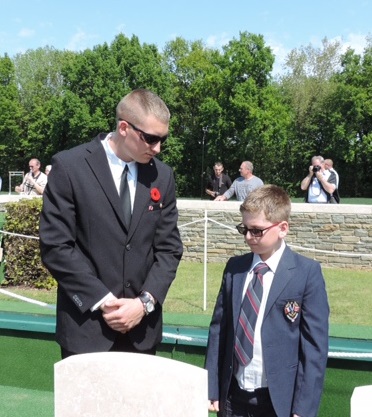
Great-niece Anne Philpot attended with her husband Andrew. Michael Gough and great-great-great-nephew Hudson Alexander Gough Krochak also on hand. Hudson bonded instantly with Fabien. His affection and appreciation of Fabien evident in the photos captured that day. When the time came for Hudson to place flowers on Clifford’s grave, Fabien stepped forward and asked to accompany him. Hudson took the lead and was solemn and thoughtful, with Fabien by his side.

Also in attendance, in period uniform, Mssr. Jean-Paul Brunel of Moreuil (on the left in photo). Mssr. Brunel discovered the remains of Private J.J. Willoughby on his property in 1986. Willoughby was a member of “C” Squadron of the Strathcona’s, led by Lieutenant Gordon Flowerdew VC. But, that is another fascinating story for another day.
Relative Herbert Hunter
Relative Herbert Hunter visited the cemetery in September of 1919. A photo included with the letter home from Herbert. Herbert’s own description, revealed the men had to have been buried by the German Alpine Korps. Herbert wrote home on 9 November 1919 that Clifford’s headstone, written in German, read. “Here lies a Lieutenant of the Winnipeg Grenadiers.” Herbert continued. “He was given decent burial by the Germans and the grave is marked number thirteen as you will see by the record I am enclosing.”

Shortly after Herbert’s visit, the villagers returned to their destroyed homes in the Fall of 1919. When the Imperial War Graves Commission exhumation teams combed the area in 1920, no trace of the cemetery remained. Some cemeteries were guarded against destruction, like the elaborate German cemetery in central Punchy. Others could not escape the wrath of the people. The cemetery on the outskirts of Punchy and the battlefield cemetery in Hallu are two such examples.

Punchy
The IWM images of the alternative cemetery in Punchy led to the discovery of its location in early 2020. On a visit home to his parents home May of 2020, our friend Fabien Demeusere visited the site on 28 May 2020. Confirmed the rubble on the property consisted of pieces of the memorial, also broken pieces of headstones, some with fragments of numbers. Are the remains of the German soldiers still here?

Hallu Eight
Will the remains of more Winnipeg Grenadiers, and men of the German Alpine Korps, be found in Hallu? Perhaps eight to twenty-two other missing Winnipeg Grenadiers will also be found, and an unknown number of German soldiers. The “Hallu Eight in the Great War”, may become the “Hallu Twenty-Eight in the Great War”.

Where would they be found if Fabien had so thoroughly investigated the site in 2006/2007? The cemetery rather large, and the image above from Herbert Hunter reveals they may be found on the property adjacent to the Demeusere family in Hallu.

Please subscribe to CEFRG to be notified by email when there are new posts. Subscription is free, and your email kept confidential.