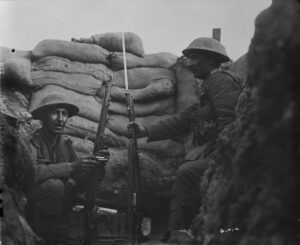
Private Arthur William Coppen MM & Bar
Unfortunately, CVWM does not record the second award of the Military Medal to Private Arthur William Coppen, 87th Battalion, CEF. Arthur was married to Annie Coppen of 1 Henry Street, Woodstock, Ontario (later 96 Delatre St, Woodstock). The location of the former residence, a vacant lot, recently sold for $2.5M.

Pvt Arthur Coppen 127317 enlisted at Woodstock, Ontario with the 71st Battalion (a recruitment battalion).
The 71st organized in August 1915 under the command of Lieutenant-Colonel D. M. Sutherland. Mobilized at Woodstock and recruited in Woodstock, Stratford and Galt. Draft of 5 officers and 248 other ranks sent to England on 20 November 1915.
36th Reserve Battalion
Arthur arrived in England on 1 December 1915 and immediately attached to 36th Reserve Battalion.
In April of 1916, Private Arthur William Coppen docked 7 days pay and confined to barracks for destroying government property.

Otitis Media diagnosed at West Cliff Canadian Eye and Ear Hospital, Folkestone on 12 May 1916.

X-rayed at Moore Barracks Canadian Hospital on 28 May 1916 – right frontal sinus smaller and more opaque than left. Discharged to duty on 5 June 1916, just in time to make it over to France with the 60th Battalion (Victoria Rifles).
60th Battalion
Transferred to 60th Battalion on 6 June 1916 at West Sandling. A week later, ToS in the field – Arthur arrived in France.

Admitted No. 2 CCS on 21 October 1916 at Outreau (myalgia). Admitted No. 7 Convalescent Depot on 25 October 1916, and discharged to duty 5 days later.

Medium Trench Mortar Battery
Arthur On Command with Medium Trench Mortar Battery from 11 November 1916 to 5 December 1916.

Military Medal
Awarded the Military Medal in the field on 31 January 1917. London Gazette No. 29893, dated 6 January 1917.

Admitted to No. 3 Rest Station on 5 February 1917. Discharged from No. 9 CFA on 8 February 1917.
87th Battalion
Transferred to the 87th Battalion on 24 April 1917 (the Victoria Rifles had disbanded). Admitted to No. 10 CFA (defective vision) on 11 May 1917, rejoining his unit a week later.

Arthur granted 10 days leave in August 1917.
1918
Pvt Coppen treated for Otis Media again in February 1918, rejoining his unit on the 23rd.

The family somehow under the impression Arthur had become a casualty in January of 1918, however, on 24 February 1918, Arthur in good health and managed to communicate this to family.
Trouble again with a corneal ulcer in June of 1918, rejoining his unit on 20 July 1918.

Private Arthur William Coppen granted 14 days leave to the UK on 28 September 1918.
Shortly after returning from leave, Private Arthur William Coppen Killed-in-action, 18 October 1918. He would not be with the 87th when they entered Valenciennes on 1 November 1918.

CoD
Private Arthur William Coppen’s CoD mentions he was killed by a shell and later buried in Bugnicourt Communal Cemetery.

But, as we will soon learn, his burial on another side of town in a cemetery constructed years ago by the German Army.

Bugnicourt Communal Cemetery
The cemetery located at 28 Rue de l’Égalité, 59151 Bugnicourt. However, the GRRF refers to a Bugnicourt German Military Cemetery, likely formerly on the D47 at the north end of town. Truly a lost cemetery, no record, other than the IWGC references, exist for Bugnicourt German Military Cemetery.
1919
Bar to Military Medal
Pvt A Coppen’s Bar to the MM awarded posthumously on 14 April 1919.

1922
Exhumation
Arthur’s body remained in Bugnicourt German Military Cemetery for over four years. Unusual it took the IWGC so long considering an obviously known cemetery within city limits. Perhaps, by the time the IWGC arrived in 1919, the German graves had recently ‘disappeared’. Refugees of Bugnicourt may not have been too pleased to find a German Cemetery when they returned in 1919. They would have had plenty of time to erase this presence from their town, as residents of Hallu had in 1919/1920.

Graves of the Winnipeg Grenadiers (78th Battalion) had been made by the German Army, and were written in German, lending the impression to the local residents they were German.
Lt J R Pitman, Registration Officer, No. 3 Area brought Arthur’s body into Cabaret-Rouge during December 1922, along with:

- Lt Alexander Robert Grant MM
- Pvt Leo Antonio Brossard
- Pvt Stephen Henry Taylor
Note GRU teams had no instructions to remove French or German graves while performing their work.

Clearing the rubble)
The CoD’s of these men should prove interesting. Were they with Arthur at the time of his death? Had they all met the same fate? No need to consult their CoD files as the war diary tells all.

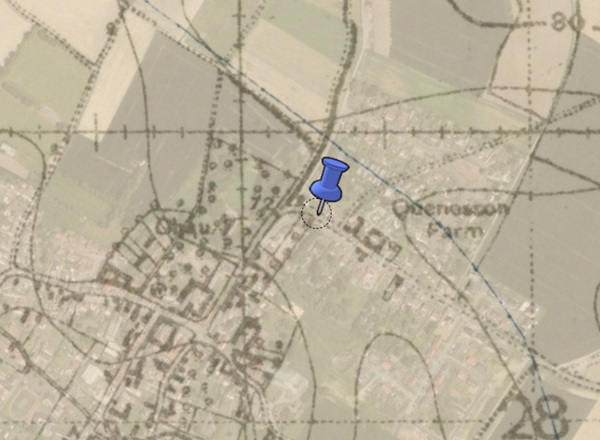
Quennason Farm
Note AI gets one thing right about Quennason Farm – this was the location where Lt Grant and three others killed by a shell. Incorrectly: the men belonged to ‘A’ Company of the Royal Newfoundland Regiment.

Blue marker – Location of Bugnicourt German Military Cemetery
GRRF
The Burial return and GGRF have one discrepancy with regards to the four men of the 87th. Initially Lt Grant identified by a disc (no GRU cross found) as per the Burial Return, but, the GRRF records all four men with a GRU (wooden) cross.

1925
By 1925, their official CWGC headstones erected at Cabaret-Rouge.
GRRF

CABARET-ROUGE BRITISH CEMETERY, SOUCHEZ
“Cabaret Rouge” a small, red-bricked, red-tiled café that stood close to this site in the early days of the Great War. The café destroyed by shellfire in March 1915 but it gave its unusual name to this sector, and to a communication trench that later led Canadian troops up the front-line.

Over 100 local cemeteries concentrated to Cabaret-Rouge in the years following the Armistice. Unfortunately, as customary, CWGC does not record any in their history of Cabaret-Rouge. Only these references can be found.
- Ablain St. Nazaire Military Cemetery
- Blairville Orchard British Cemetery
- Blangy Cross Roads, St. Laurent Blangy
- Blangy Military Cemetery, near Arras
- Edward Road No. 2 Cemetery, Richebourg l’Avoue
- Edward Road No. 4 (Factory Trench) Cemetery, Richebourg l’Avoue
- Vieille Chapelle Old Military Cemetery
It was hoped some reference to Bugnicourt German Military Cemetery might be found.
What Happened to Bugnicourt German Military Cemetery?
A Cabaret-Rouge burial return refers to Cantin C.C.G. Extension (Old). This was located 2 km north-west of Bugnicourt, in or by Cimetière Communal Cantin. This towards Ferin C.C. German Extension, also known to have a concentration to Cabaret-Rouge. Férin now contains 2,119 German Graves, along with 17 Russian POWs, and 5 executed for war crimes by the German Army.

The other closest German cemetery to the south of Bugnicourt, Oisy le Verger German Military Cemetery which no longer exists.
What Happened to the Germans who were buried at Bugnicourt German Military Cemetery?
Contact CEFRG
The post motivated by a comment on FB (Félix 1914-1918 Canadian Railway Troops) from a family member of Private Arthur William Coppen MM & Bar. The descendant under the belief that Arthur had died at Vimy Ridge. I too must admit to being ignorant of my Grandfather’s service, having believed for decades that he had served at Passchendaele. Unfortunately, this notoriously difficult platform to search prevented CEFRG from contacting Ms Coppen, and hoped this post may catch her attention.


