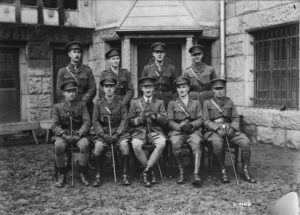
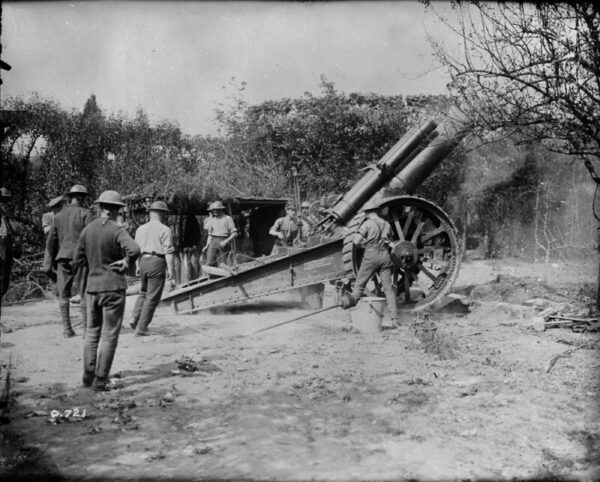
Sergeant Francis Patrick Walshe served with Lt-Col John McCrae in the 1st Brigade, Canadian Field Artillery. Sgt Walshe treated by Dr McCrae after being wounded in preliminary action during the Battle of Flers-Courcelette, September 1916.

Mooncoin Parish
Francis ‘Frank’ Patrick Walshe born 21 October 1893 in Currie, Minnesota. His father, Edward Peter Walshe, 36 and his mother, Annie Marie Agnes Donnelly, 35 at this time. Edward Peter Walshe born 15 January 1987 in Kilkenny, County Kilkenny, Ireland had emigrated to Canada in 1881.

Edward Peter Walshe moved to the USA and married Annie Marie Agnes Donnelly at Currie, Murray County, Minnesota, on 24 July 1890. The family moved north, back to Canada in 1905.
First Contingent
Gunner Frank Walshe 40509 enlisted 22 September 1914 at Valcartier, Quebec. Lt-Col Chas Henry MacLaren approving of the 2nd Field Battery and Lt-Col E W B Morrison also signing.

Frank at this time 20 years, 10 months of age, standing 5′ 11″ tall, 161 pounds, with ruddy complexion, grey eyes, and dark hair. A big man for his time. Examined by Captain Seward at Valcartier Camp on 9 September 1914.

2nd Battery, 1st Brigade CFA
The 1st Brigade CFA sailed on 3 October 1914 with the First Contingent. Disembarked SS SAXONIA at Devonport later on 17 October 1914. Entrained at Aymesbury and finally arrived at West Down North Camp just before midnight.
Photos captured by Lt-Col Henry John Lamb in October of 1914 as the First Canadian Contingent sailed to Plymouth, England.
Henry John Lamb would also capture far more rare photographs than these at the Second Battle of Ypres in April of 1915.
First Casualty
Now on Salisbury Plains, the camp inspected by General Alderson, commanding CEF on 20 October 1914. Alderson addressing the men the next day, accompanied by General Campbell. First casualty reported with the death of Driver George Read 40248, 25 October 1914. Son of James and Jane Griffiths. Buried at Bulford Church Cemetery. The wettest season in decades has caused disease to move through the camp.

Many of the 71 Great War burials in Bulford Church Cemetery made from Bulford Camp, one of the military training grounds directly associated with Salisbury Plain. The cemetery also contains three Second World War burials.
Inspections
General Alderson inspected the camp again on 29 October 1914. The condition of the horses criticized by the commanding officer of the CEF. Rain so hard the next day, horse lines moved. Rained all day Sunday, 1 November 1914, no Church Parade held. On 4 November 1914 inspected by King and Queen, Lord Roberts, Lord Kitchener and other notable’s. Rained so hard the next day, guns moved to a park on hillside to south.

Court Martials
On 23 November 1914, Court Martial held on Gunner Joseph Percy Breiter 40600, HQ Staff. Sentenced to 112 days of detention for theft. In trouble again for insubordination in July 1915, following the Armistice, Breiter goes on to serve in the Russian Expeditionary Force.

On 26 November 1914, Court Martial held on Driver Rufus James Gogo, HQ Staff. Transgression and sentence unknown, but Gogo sentenced 10-12 months hard labour in December 1915, Conduct to the Prejudice of Good Order and Military Discipline.
On 2 December 1914, with wind and rain squalls, the 2nd Battery had route march to Blackheath.
His Majesty the King’s Inspection
Brigade marched to Karkhill, leaving Devizes 12 noon on 3 February 1915. Arrived at 5pm and bivouacked for the night. Brigade took part in the review of the CEF by His Majesty the King on 4 February 1915 at Larkhill Camp.

To France
The Brigade embarked Avonmouth on 8 February 1915. Following a stormy voyage, disembarked at St Nazaire on 11 February 1915. The Brigade en route to the front two days later. In billets at Meteren by 14 February 1915, marching to Armentieres three days later.

Brigade Staff attached to 4th Bde RFA, and Battery Staffs attached to 2nd, 12th, 24th, and 38th Brigades, Royal Field Artillery.
Bois-Grenier
On 22 February 1915, positions reconnoitered as far as Bois-Grenier. Gun placements begun to the north and east. Five days later, the brigade prepares to move south of Fleurbaix. Gun positions of the 22nd Brigade, RFA taken over on 1 March 1915. HQ 1/2 mile SE of Fleurbaix, 1st Battery 300 yards SW of HQ, 2nd Battery right of road, and left section L and immediately S of HQ. 3rd Battery north of road, 200 yards NE of Fleurbaix.

One gun of 4th Battery 2000 yards SE of HQ in close support of Infantry lines. Remainder 4th Battery Les Manoirs, 2000 yards NW of Sailly in reserve. Enemy tranches registered by 1st and 2nd Batteries on the morning of 2 March 1915.
Battle of Neuve-Chapelle
The attack at Neuve Chapelle a major affair. Artillery would be key, and although puny compared to barrages later in the war, impressive at the time.

More shells fired in the opening 35 minute barrage than in the whole of the Boer War.

The railway station at Fromelles registered by the 4th Battery on 5 March 1915.

On 1 April 1915, the 1st Brigade pulls out of Fleurbaix, and redeploys in the Ypres salient.

Second Battle of Ypres
Eight batteries move into position at Poperinghe on 20 April 2015, barely in time for the Second Battle of Ypres.

Right section of the 2nd Battery march to take over position of the 5th and 8th Batteries, RFA.

At 3:30 am on 23 April 2015, the brigade into action on the Yser Canal, 2 miles N of Ypres.


Later in the year, Gunner Frank Walshe promoted to Bombardier, In the Field, 2 December 1915.
Bombardier F P Walshe
Another promotion follows, Bombardier F P Walshe promoted Corporal on 24 April 1916.

Corporal Walshe
Corporal Walshe granted leave of absence to England, 2 June 1916. Frank’s brother Gunner Richard ‘Dick’ Francis Walshe still in Petawawa Camp in Canada at this time.

Sergeant F P Walshe
Corporal Frank Walshe promoted Sergeant, in the field, 21 August 1916.
Battle of Flers-Courcelette
The battery opened fire at 5 am on 3 September 1916, preliminary bombardment to the Battle of Flers-Courcelette.

Later in the morning of 3 September 1916, Sergeant Francis Patrick Walshe wounded when a round exploded prematurely, injuring Frank and five other men on the gun.
Infection
Sergeant Walshe’s wound though not life-threatening, would soon become so. While awaiting evacuation by Field Ambulance, infection had already set in. A few hours after an injury, patients would feel a burning sensation – wound myiasis.

Wound myiasis occurs as a result of egg deposition on decaying flesh or pus-discharging wounds. If the maggots invade rather than stay on superficial layers of exposed tissue, subcutaneous nodules can result.
1st Australian General Hospital
Sgt Walshe admitted to 1st Australian General Hospital, Rouen, 4 September 1916, fractured tibia and fibula. The first amputation, at the point of entry, performed on this day.

1st Australian General Hospital based at the racecourse in Rouen from 17 April 1916 until 7 December 1918. In total, 1AGH admitted 90,298 patients (sick 46,187; wounded, 41,111) — an average of 2,913 per month.
Welsh Metropolitan War Hospital
Sergeant Francis Patrick Walshe admitted to Welsh Metropolitan War Hospital, Whitchurch Glamorgan, 15 September 1916. Unable to contain the infection in Frank’s leg, another amputation of left foot, above the knee performed at Whitchurch.

Whitchurch Hospital also provided solace from shell shock. Dr Edwin Goodall famed for his pioneering work as the medical superintendent of the hospital, known as the Welsh Metropolitan War Hospital during the Great War and run by the military.
Granville Canadian Special Hospital
Sgt Walshe admitted to Granville Canadian Special Hospital, Ramsgate, 4 April 1917. Examined by Captain Robson on 12 April 1917, Ramsgate.

Granville Canadian Special Hospital gained local notoriety in September 1915 when reported that the empty hotel used by German spies. A search by armed police found no evidence. In October 1915 it became a Canadian Hospital with 300 rooms.

A third and final amputation necessary – amputation of Frank’s entire left leg (to the hip) in April 1917.
Return to Canada
Sergeant Francis Patrick Walshe sailed from Liverpool for Canada per the hospital ship SS ARAGUAYA on 11 June 1917.

M H C C, Toronto, 8 July 1917. Frank discharged from His Majesty’s Service, medically unfit, on 30 September 1917. His former commanding officer, Lt-Col John McCrae passed away on 28 January 1918 from cerebral-meningitis and pneumonia.

Later Life of Francis Patrick Walshe
Frank married Margaret Kinnard Reid and they had four children, Margaret Ann (Don) of Dartmouth Nova Scotia, Jean (Buddy) of Red Deer, Alberta, Frankie (Joe) of Drayton Valley, Alberta, and Peter also of Red Deer.

Sergeant Francis Patrick Walshe became Postmaster General in British Columbia following the Great War, and in later life opened the Walshe Funeral Home in Fort Macleod.
As a very young boy on a visit to the west coast in 1965, I, the author of CEFRG, recall staying one night at my great-uncle Frank’s home. I remember sitting on his wooden leg that evening, then seeing it standing idly in the hall the following morning as I woke. I had no idea about his war service at the time.

Sergeant Francis Patrick Walshe died on 12 February 1971, aged 77, in Fort Macleod. The Walshe’s had 20 grandchildren and 7 great grandchildren when Margaret passed away in 1992.
F. P. Walshe School
F P Walshe High School named in Frank’s honor. Located in Fort Macleod, Alberta, approximately 1.5 Hours south of Calgary, Alberta and 30 minutes west of Lethbridge, Alberta. The school recently persuaded not to change it’s name.

Fort Macleod a town of approximately 3100 people, with an economy routed largely in agriculture and also tourism.
Vision: A place to learn and belong
Mission: Empower personal growth through meaningful relationships
Motto: We Are Walshe

