Origins of the Soldiers’ Graves Scandal
The Soldiers’ Graves Scandal gathered momentum in the Fall of 1921 as the Directorate of Grave Registration and Enquiries (DGRE) and the Imperial War Graves Commission (IWGC) announced the end of the Burial Recovery Program on the Western Front. Understandably, the public furious.

This Descriptive Account of the work of the Imperial War Graves Commission written by Mr. Rudyard Kiipling at the Commission’s request.
Treatment of Isolated Graves
After so many years of fighting over densely populated and civilised countries like France and Belgium, it is inevitable that there must be single graves and groups in positions where, when the life of the land goes forward again, they cannot be reached or tended. Some lie in what were once town or village thoroughfares, and will be so again; others by the side of railway stations and goods yards, houses or factories, in arable or pasture fields, parks, gardens and the like. The objections to leaving these graves where they are need not be dwelt upon. No precautions save them from being encroached upon or obliterated in the course of time. There is, moreover, a strong sentiment among all ranks that such scattered graves look lonely, and the instinct of the Services demands that those who fell by the wayside should be gathered in to rest with the nearest main body of their companions. That is what the Commission, with all due care and reverence, proposes to do. – Rudyard Kilping, The Graves of the Fallen.
Tommy
In 1890 Rudyard Kipling wrote his classic poem “Tommy” a bitter condemnation of the tendency to treat soldiers as either heroes when fighting far away or blackguards when at home.
I went into a theatre as sober as could be,
They gave a drunk civilian room, but 'adn't none for me;
They sent me to the gallery or round the music-'alls,
But when it comes to fightin', Lord! they'll shove me in the stalls!

Rudyard Kilping and the King at Vlamertinghe New Military Cemetery 1922
Shilly-shallying
From “ARMY NOTES” by ‘Tommy Atkins‘, 2 October 1921, The People, Milford Lane, Strand, W.C., See pg 218, France and Belgium Army Exhumation Staff.pdf at CWGC Archives. Tommy Atkins (often just Tommy) slang for a common soldier in the British Army.
300 Bodies per Week
The authorities are guilty of a shameful piece of shilly-shallying in this matter of the recovery and reburial of soldiers’ bodies on the battlefields of France. First of all told that the War Office does not accept responsibility, as it is the job of the Imperial War Graves Commission. And, then an official of the latter states to a newspaper reporter: “It is up to the War Office to decide what is to be done.” The War Office then makes the next move, and state that bodies are becoming more difficult to find, whereas an authority on the question, who has been to France, tells me that as many as 300 bodies per week on an average have keen recovered and reburied quite recently.
Money
There is every reason to believe that thousands of bodies are still recoverable and identifiable. Yet the War ‘Office has withdrawn the staff and suspended the work. This means that thousands of mothers and relatives of the deceased to be robbed of the supreme consolation of knowing that their dear ones’ bodies brought to light and reverently reburied in proper cemeteries, where they may be visited—just because some War Office juggle-penny is too I mean in his soul or too poor in his imagination to understand the magnitude of the sacrifice these bereaved ones have made, or the strength of that sentiment which is with them almost a religion.
Burden of Responsibility
Moreover, the trick of one Government department in trying to shift the burden of responsibility on to the shoulders of another. And, vice versa is a contemptible piece of official shuttle-cock which the ex-Service associations should put an end to forthwith. We may perhaps gauge the real strength of War Office “sympathy” in this matter from the fact that. Three years after the armistice, it has got no further in its aft-expressed desire to help the next-of-kin of the fallen to visit the war graves than the grant of a free passport available for 10 days: ” There’s richness for you !” as Mr. Squeers said. – Tommy Atkins
Mr Edward Hempenstall – Soldiers Graves Scandal
Edward Hempenstall, a businessman and Justice of the Peace, of Rockhampton, Queensland, Australia was in Lille during September of 1921. When hearing of the decision to end the Burial Recovery Program, he immediately cabled the Editor of the Daily Mail, Alfred Harmsworth, 1st Viscount Northcliffe.
Cablegram
Visiting battlefields locating graves Australian Friends who made supreme sacrifice and find Director War Graves Winchester House, War Office, has ordered all operations connected with recovery and reburial soldiers to cease Saturday find exhumation officials return to Calais Monday.
Bodies are being recovered in Ypres, Passchendale, Zonnebecke and Pozieres districts and average over 300 weekly. In past three months April, to July, 10,000 recovered with big percentage identified fully.
Have today seen written notification of nearly 100 bodies found British and Australian, 16 found this day in one hour and undertake to point out, 1,000 covered, yet officials here powerless to take any further steps, and these bodies easily recoverable by experienced military staff must be soon ploughed into the earth by farmers or covered over by builders.
Twenty-five percent of recoveries are Australian and my country will answer with loud voice if facts published. Premier Hughes, was at Pozieres two weeks back 12 were taken out within short time on the spot. Suggest you first see Major George Lort Phillips, Australia House, the Director and insist with your weight upon present arrangement be in continued and, extended, but leave you free for publication if you think fit.
Military work must be done by military men. Civilians will fail. Present men, were originally full company 250 but whittled down latterly until now only 58 actual field strength, but doing quite useful work. Residents co-operate willingly and keenly in reporting, finding bodies on farms, but have seen letters stating operations impeded by non-removal.
Directors may claim work being transferred to Imperial War Graves, and the reply is not a single representative of department is here. Not civilian work; and while such change if proposed was being effected we lose hundreds perhaps thousands. Consider London handling of this national matter utter disgrace.

“Cement House” the military name given to a fortified farm building on the Langemark-Boesinghe (now Boezinge) road. The original Cement House Cemetery (now Plot I, an irregular group of 231 graves) begun here at the end of August 1917 and used by the 4th and 17th Division burial officers, by field ambulances and by units in the line until April 1918.
Second cablegram
Edward Hempenstall soon sent a second cablegram to the Editor of the Daily Mail elaborating on the matter.
I was present this week when farmers and others reported that in one place there were 13 British dead in one trench and 10 others in a dug-out. I interviewed a man who saw that day on a farm a body which had worked to the surface. All these dead, and (hundreds, perhaps thousands of others, are abandoned where they lie by the withdrawal of the exhumation company).
I examined the records of Bird Cage Camp at Poperinghe and also at the head office at Ypres and saw the officers and men of the exhumation company. I again repeat that the withdrawal is an absolute disgrace to British and Australian prestige and a dishonour to the dead.
One area at Passchendaele was declared to be clean by London, last September, but between that month and February of this year 8,000 further bodies were recovered from this area. The conditions at Pozieres are very discreditable. I saw a woman looking for her husband’s body. The officials knew where it was, but could not disclose it to her as there was no exhumation or reburial.
Owing to the subsiding of the soil and farming operations bodies are gradually working into sight in many places.
2 June 1937
THE Court of Criminal Appeal today quashed the conviction of Edward Nugent Hempenttall, 55, commission agent, on a charge of having stolen £225, the property of Eliza Burton. Hempenstall had been found guilty, with a strong recommendation to mercy, in the Rockhampton Criminal Court on May 18 last, and Mr Justice Brennan sentenced him to 12 months’ imprisonment with hard labour.
Hempenstall today applied to the Court of Criminal Appeal for leave to appeal against his conviction and sentence on the grounds that the trial Judge misdirected the jury, that his summing up was such as would leave the jury confused as to its functions and powers, and that there was no evidence that Hempenstall used the money knowing it to be other than his own property or that of his firm.
Mr T H Chapman – Soldiers Graves Scandal
In May of 1922, the Adjutant General received a letter via Sir Henry Nilson and Colonel Lord Browne, KBE, IWGC from “some Englishman, who is now living out in France.” The author of the letter, a Mr T H Chapman had wished General Fabian Ware “to be cognizant of the facts,” according to Colonel Browne, but did not wish his name and address to be disclosed.
Extracts from Letter
You are probably under the impression that the work of recovery of British dead had been completed. Certainly the work has stopped, but has by no means been completed, and I would like to point out that within a few kilometres from this town there are hundreds, possibly thousands, but I do not desire to exaggerate, of British bodies that have never been recovered, and which by the process of clearing the ground are now being exposed not only to daylight but to the searching and desecration of the dagoes who are doing the work of clearing the ground.
Where a Frenchman finds a body it is reported to the local Mayor who in turn reports to the I.W.G.C. administrator concerned, but the majority of these men who are working on the battlefields are not French and in consequence every little object – perhaps not of much value except as a means of identification is taken away and the bones scattered about or filled over.
Paying Civilians for Bodies
I am told that the authorities of the I.W.G.C. are entitled to pay the men two francs for each body reported, but a man is not likely to leave his work and walk perhaps 2 kilometres to report a body for two francs, thereby losing perhaps six or seven francs time lost.
The I.W.G.C. do not search for bodies and employ men at frs. 2.50 per hour – when employed actually on the work of exhumation, but when no bodies are reported there is no work, and no pay, the consequence being that any casual labour must be obtained more than often not English.

Gross Inaccuracies Amounting to Wilful Neglect
Extract from the Minutes of 126th Meeting, 4 October 1922
Is a body lying there?
In my workout here I take tourists to all places, and when they say ” There is a body lying there” I have to say “Yes, it is not English”.
I was recently at an American Cemetery with an American and his wife, and the caretaker said to Mdme, “Well Marm I am just trying to do my best” and she replied, “Well, that’s more than the English are doing”. Galling but true.
Can you raise the question in the House, Sir? The whole circumstances are a disgrace to our Nationhood.
Immediate Action
In every case where I find a body I report it to the I.W.G.C. here at Albert and I must say that action is taken immediately. The fault does not lie with the I.W.G.C. here, they are only allowed to pick up “found” bodies. What is required is an organised body of searchers or overseers where the work of clearing up the ground is in process, so that any means of identification may be at once secured. Last week I pointed out some bodies with the result that an action was immediately taken, identification secured in at least two cases.
Unless unavoidable I should prefer that my name & address were not disclosed.
Chapman Interviewed
As to having the question raised in the House, Reverend James Gillies, a friend of Mr Chapman, arranged for him to be interviewed by Captain Walter Elliot, M.P., House of Commons, S.W.1. Following the interview, Elliot wrote to Fabian Ware regarding the matter.
The statements contained in Mr. Chapman’s letter are not in accordance with the facts.
Mr. Chapman has been interviewed and I understand he has promised to write Mr. Gillies modifying the statements he made.
– Captain Elliot to The Vice Chairman, IWGC (Fabian Ware)
No Reply – Soldiers Graves Scandal
No evidence of a response from Mr Chapman to Reverend Gillies that he had had a change of heart contained in the 448 page document from the CWGC Archives: WG 1294/3/2 Exhumation. France & Belgium. Army Exhumation Staff.
Extensive research by CEFRG on two particular cases associated with the Soldiers’ Grave Scandal cannot be included in this post. However, they demonstrate this state of affairs throughout the 1920’s, and into the 1930’s would only be interrupted by the Second World War (See the case of Great War Solider Private G R Sutherland in 1957 below).
Zouave Valley Cemetery
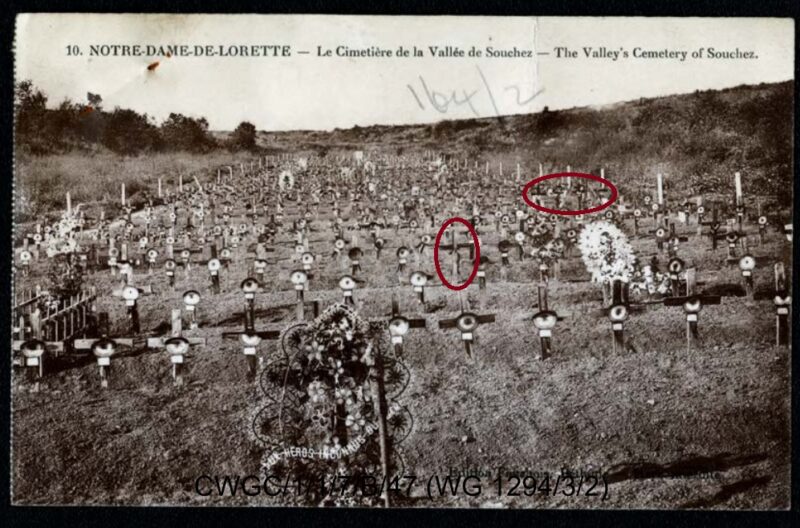
In 1922, a man came in search of his son’s remains, a Corporal Polcher, at La Vallee French Military Cemetery No. 1. The father had been informed the plot with his son’s remains were to be exhumed to Notre-Dame-de-Lorette, with the family’s permission. This plot beside the current CWGC cemetery named Zouave Valley Cemetery.

The French plot at Zouave Valley before Concentration – non-French grave’s with G.R.U.2 crosses circled in red.
No Remains Found
The father of Corporal Polcher present on the day the row containing his son to be exhumed. Records revealed a G.R.U.2 unit had also recorded crosses (Commonwealth) in the same row. Polcher’s grave ‘opened’, only to find no remains existed below his cross.

Note the written comment: “It is the same area that was the scene of the mistakes mentioned by Colonel Begombes in a previous letter.” Pg 2, WG 1294/3/2 Exhumation. France & Belgium. Army Exhumation Staff.pdf

The entirety of Row F searched, with no sign of Cpl Polcher. Worse, many graves were empty, and some contained between two and six sets of remains below a cross with a single name.

Orchard Dump Cemetery
The same G.R.U.2 unit responsible for two Kipling Special Memorials at Orchard Dump Cemetery containing no remains of 42 Canadian soldiers of from the 5th, 18th, 25th and 31st Canadian Infantry Battalions.

No Remains Found
CEFRG has determined the remains of 42 Canadian soldiers, commemorated by Special Memorials on the perimeter walls of Orchard Dump Cemetery, are actually under Unknown Canadian Soldier (UCS) graves within the cemetery.

Several years following their exhumations from battlefield cemeteries into Orchard Dump, their wooden crosses removed and replaced with UCS IWGC type headstones.

Why? The work of the G.R.U.2 unit so unreliable as to render their individual identities unknown. They could only be positively identified as a Canadian soldier.

The decision to commemorate the men with Special Memorials arbitrary and inconsistent with CWGC policy. The wooden crosses should have been replaced by headstones with inscriptions KNQWN TO BE BURIED NEAR THIS SPOT, or BELIEVED TO BE BURIED NEAR THIS SPOT. Or, at least, by this headstone:

The remains of Pvt M J Leadbetter may be below this headstone.
Instead, relatives directed to a headstone with their name almost a hundred meters from their actual location.
Private G R Sutherland
Responding to a perplexed brother of a soldier who had received a picture of his grave at Orchard Dump in the 1920’s, in 1957 (yes, decades later), the IWGC admitted that the exhumation team should not have erected any crosses for these men, for they committed several errors.
“It is observed in connection with this file that the next-of-kin has been advised that the grave of Pte. G. R. SUTHERLAND is No. 22, Row B, Plot 9, Orchard Dump Cemetery.”
‘It is very difficult to reconstruct the facts in this case. The evidence that there was a known and marked grave in Orchard Dump Cemetery in 1920 is not borne out by anything in the WG. file.”
G.R.U.2
The work of this Graves Registration Unit recently covered by Peter Hodgkinson in ‘A serious scandal bringing humiliation and disgrace upon Australian Forces’ – The Australian Graves Service, from the Western Front Association.
The COI determined that ‘this effort to honour the dead shall only be the means of bringing shame and disgrace upon the good name, fame and reputation of Australia.’ Lieutenant Lee stated in his evidence to the court that there were ‘many error’ on the wooden crosses in the cemeteries, involving names and years killed. He blamed this on the fact that ‘Captain Kingston did not supervise the work in the field’.

Graves Registration Unit personnel at Esquelbeque. Ivan L Bawtree collection.
Belgium
G.R.U.2 also known to have worked in the Ypres Salient in Belgium before their dismissal. In 1926, an IWGC caretaker reported he had entered one cemetery to find a Belgian family enjoying a picnic. The caretaker found it disrespectful enough to admonish the family, and further agitated by their response:
Why? Everyone knows there are no bodies buried here.
Soldiers Graves Scandal – CWGC Report – 2021
In April 2021, the Commonwealth War Graves Commission (CWGC) published a report produced by a Special Committee that explored historical inequalities in its commemorations following the Great War. The first of ten recommendations made in that report was for the CWGC to continue this research, expanding its reach and scope.
Second World War
In contrast to the Great War, this report finds no evidence that individuals or groups systematically excluded from named commemoration in the Second World War. Instead, over 650,000 casualties from across the British Empire commemorated by name in cemeteries and on memorials.
Unknown Soldier
Forensic technology changes the concept of an Unknown Soldier today. With DNA analysis, chances of a recovered soldier from post-Great War conflicts remaining unknown is extremely low. Until a non-invasive means of obtaining DNA from CWGC graves of the Great War developed, nearly 200,000 soldiers will remain KNOWN UNTO GOD.

KNOWN UNTO GOD
Subscribe to CEFRG


Comments
2 Responses to “Soldiers Graves Scandal in the Great War”
[…] Soldiers’ Grave Scandal gathered momentum in the Fall of 1921 when the Directorate of Graves Registration & Enquiries […]
[…] Soldiers’ Graves Scandal had gathered momentum in the Fall of 1921 as the Directorate of Grave Registration and Enquiries […]