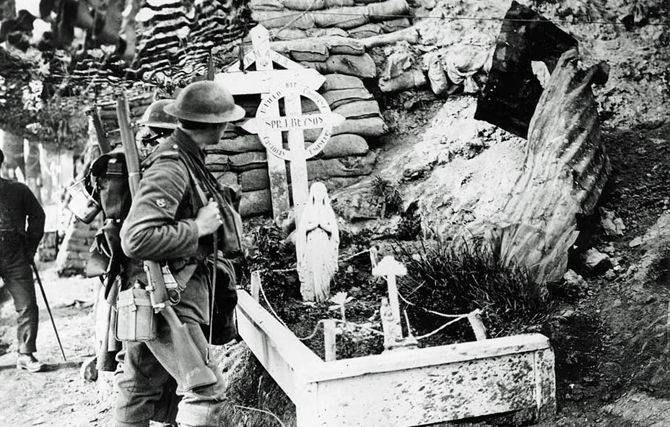
A Canadian at the graveside of a Canadian killed in 2nd Battle of Ypres (22-24 April 1915). This shows a soldier examining a temporary gravesite and cross for Sapper Ivor Beynon 5237 who was killed while on service with the Canadian Engineers, during the Second Battle of Ypres, on April 24th, 1915. His gravesite was later moved from this temporary location to nearby Duhallow A.D.S. Cemetery.

Ivor’s comrade Sapper Robert Warton also killed on this day, but not buried along with him. The exhumation teams in 1920 will note a second cross found at Sapper Beynon’s grave location.
Yser Canal
The exact area noted in Beynon’s Graves Registration Report Form (GRRF) – “200 yards N of the head of Yser Canal, on the east side of the outskirts of the city of Ypres.”

Truly rare to find the exact location of a battlefield burial today. Though the topography has changed considerably, the canal remains.

Service of Sapper Ivor Beynon
Ivor Beynon a Railroad worker born 6 January 1886 in Clydach, Nr Abergavenny, South Wales. Son of Evan and Maria Beynon of 84 Chepstor Road, Cwmparc, Treorchy, Rhondda Valley, South Wales. In 1891 the family living in England and in 1901 in Wales. On 15 September 1910 railway worker Ivor Beynon departed Bristol, England, on the Royal George for Quebec.
Private Ivor Benyon attested 24 September 1914 at Val Cartier at 29 years, 8 months of age with 1st Field Coy, Divisional Engineers. Sailed to England on 3 October 1914 with the First Contingent.

Sapper Ivor Beynon embarked at Avonmouth on 9 February 1915, headed for France.
Second Battle of Ypres
A Canadian Engineer advanced depot established at 28.C.2.c.1.7 in the Ypres Salient on 14 April 1915.

Two days later, a C.E. advanced depot established near the end of the YSER CANAL in a six-storey warehouse at 28.I.2.c.1.7.

The location extremely close to where Sapper Ivor Beynon buried on 24 April 1915, the day of the second gas attack during the Second Battle of Ypres.

At 7:15 am, 23 April 1915, 1st Field Coy, Canadian Engineers instructed to take guard of the three bridges over the Yser Canal, relieving 2nd Field Coy.
Circumstances of Death (CoD)
Instantly killed often reserved for soldier’s when their bodies have been separated by shrapnel, e.g., decapitations. Whereas, a man whose death noted as “near instantaneous” likely received a bullet wound to the chest.

The bridge over the Yser Canal nearly a mile north of Sapper Benyon’s burial location. Essex Farm Cemetery so very close. Puzzling why Benyon not buried at Essex, but this was the very beginning of the first burials at Essex which was an A.D.S. (like Duhallow) during April 1915. Therefore, it is reasonable for Benyon’s grave to have been moved somewhat closer to Ypres central, and further back from the shelling by the enemy. The location also closer to the Canadian Engineer’s Advanced Depot of 24 April 1915.

Likely serving on duty with Sapper Benyon, Sapper Robert I E Warton 5233 also killed in action on 24 April 1915 and also later buried at DUHALLOW A.D.S. CEMETERY. Which raises the question, where was Sapper Warton initially buried?

Sapper’s correct burial location provided by his CoG file. Sheet 28.c.2.b.0.3 in Pilkem, a good kilometer east of the Yser canal.

Sheet 28.C.25.d.1.4 the correct location, not far from Beynon’s grave on the other side of the canal. Interestingly, Warton’s grave also well tended by his comrades, and had a second cross remaining following the war. Also like Beynon, the crosses gave two different dates of death.

Graves Registration Report Form (GRRF)
Like Sapper Warton, an extreme amount of detail in the two pages of Sapper Beynon’s GRRF.

A cross erected with all particulars.

CoG
Sapper Benyon’s remains moved to Duhallow Advanced Dressing Station Cemetery, Ypres, Plot 6, Row C, Grave 5.

Note the CoG mentions two crosses with two separate dates of death (24th and 25th April 1915).

A close up of the second cross reveals the beginning of Beynon’s service number (5237).

Rather remarkable that nearly three years after the image captured, the two crosses still remained over the grave of Sapper Ivor Beynon. The sandbags undoubtedly provided a haven from shell fire.
Duhallow Advanced Dressing Station
Warton noted in his burial location with a GRU cross on 11 June 1917 (only months before the photo of Beynon’s grave). Warton came into Duhallow on 19 February 1919. Family advised Warton at Duhallow 23 March 1922 and buried at VI. A. 8.

Beynon came into Duhallow the day after Warton on 20 February 1919. Family advised Beynon at Duhallow on 29 April 1920, grave VI. C. 5.

Duhallow Advanced Dressing Station, believed to have been named after a southern Irish hunt, a medical post 1.6 kilometres north of Ypres (now Ieper). The Cemetery begun in July 1917, on the day of the Battle of Pilckem Ridge, and Plots I and IV completed by November 1918.

After the Armistice, 633 bodies (of which 228 not identified) brought into this Cemetery from isolated graves and small Cemeteries on the battlefields North, East, and South of Ypres, including MALAKOFF FARM CEMETERY, Brielen, and FUSILIER WOOD CEMETERY, Hollebeke. Malakoff once reported to be the burial location of Lt Alexis Helmer (McCrae’s inspiration for In Flanders Fields). Duhallow A.D.S. Cemetery contains memorials to 10 soldiers buried at Malakoff Farm.

Contact CEFRG


