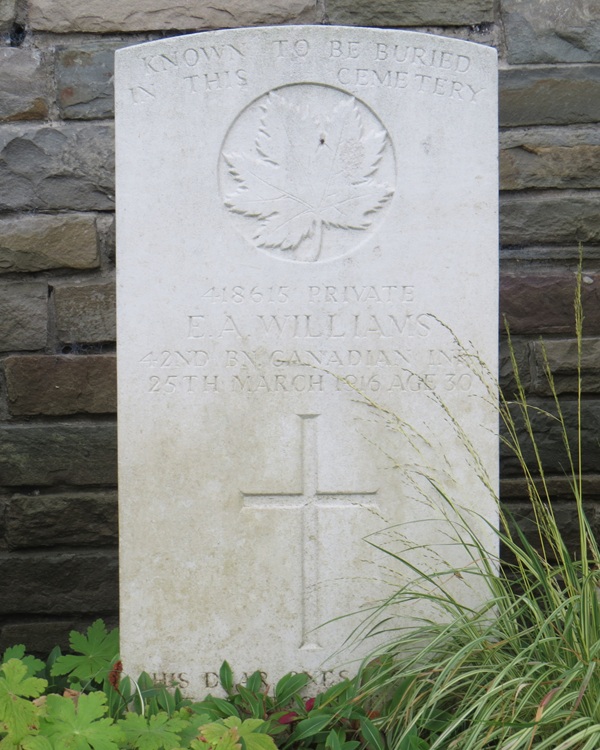
Private Edward Albert Williams enlisted 1 April 1915 in Montreal with the 42nd (Royal Highlanders of Canada) Battalion. A Motorman, living at 162a Le Caron Street, Cote St Paul, Quebec, standing 5′ 7″ tall, with fair complexion, brown eyes and light brown hair. Recently married, to Mrs Edith Muad Williams of 255 Hamilton St, Ville St Emard, Montreal.

Edward arrived in England on 19 June 1915. The 42nd Battalion disembark England, on 19 June 1915 with a strength of 40 officers, 978 other ranks. Following a summer of training, arrive in France on 9 September 1915, with the 3rd Division, 7th Infantry Brigade.
March 1916
On 3 March 1916, while moving into Brigade Reserve the Transport suffered their first casualty – one man (Pte John Smith 418171) and one horse wounded by shrapnel.
Brigade Reserve
Losses on working parties during five days in Brigade Reserve, March 3rd to March 8th, were greater than during the previous tour of four days in front lines trenches, being one man killed (Pte Albert J Cameron 408037) and another seriously wounded. On the afternoon of March 7th five shells dropped uncomfortably near Kemmel Shelters, but did no damage.

Divisional Reserve
On the night of March 8th we moved from Kemmel Shelters into Divisional reserve at Locre, and enemy shell fire along the DRANOUTRE-LOCRE Road again cost us two casualties,

On March 9th the Battalion moved from LOCRE into rest billets north east of BERTHEN, and had the good fortune to be left there during ten days of almost perfect weather.

General Loomis
On March 14th General F O W Loomis DSO arrived from England and assumed command of the 7th Canadian Infantry Brigade.
Two drafts reached us during this period of 38 and 47 men respectively, bringing us up to strength. One drawn from the 36th and 39th Reserve battalions made a particularly favorable impression by the smart, intelligent appearance of the men.

On March 16th word reached us of the promotion to a Lieutenant of Company Sergeant Major W H Thompson, dated March 4th. He was given the appointment of Works Officer.
General Alderson
On March 18th the Battalion paraded by Lt Gen Sir Edwin Alderson KCB commanding the Canadian Corps. He addressed us briefly telling us that the Corps were being sent north to the YPRES Salient where we would meet some strenuous fighting and more uncomfortable conditions than we had been accustomed to, but that he felt confident the Battalion would be ready to meet them.

Casualties
- LCpl John Robert Mcleod (MAPLE COPSE CEMETERY)
- Pte Percival Harold Beake (SANCTUARY WOOD CEMETERY)
- Pvt Wesley Caldwell (SANCTUARY WOOD CEMETERY)
- Pte Joseph Gerone (MAPLE COPSE CEMETERY)
25 March 1916
Up to March 25th, the last day of our tour we had only eight casualties. During that morning, however, the neighbourhood of Border dugouts heavily shelled and four dugouts hit. Our Reserve Company C lost five men killed and ten wounded and a working party from D Company which was passing at the time had seven men wounded.
Casualties
- Pte Biffin 418350 (YPRES (MENIN GATE) MEMORIAL)
- Pvt John Henry Briggs,”C” Coy. 42nd Bn. (28.I.24.c.2.5 SANCTUARY WOOD CEMETERY)
- Pte Croft (MAPLE COPSE CEMETERY)
- Pte Albert Alfred Jackson (SANCTUARY WOOD CEMETERY)
- Pte Harrison Moss (HOOGE CRATER CEMETERY)
Noon brought a lull but at 3:15 pm the enemy started shelling our front line trenches A.7 to A.10 with 5.9 Howitzer, 4.2 Howitzer, shrapnel, and 15 pounders H.E.

Afternoon
The shelling reached its maximum intensity at 3:30 pm and continued very heavy until 4:15 pm where fire began to subside and 4:45 had quieted down.
Our parapet broken in nine or ten places and parados damaged considerably throughout the trench.

Our wire was slightly out along our left company frontage, i.e., A.7 to A.10 with the exception of one complete gap fifteen feet wide made in front of company HQ in trench A.9.
Casualties
The afternoon added seven men killed and seventeen wounded to our list of casualties, including Private Edward Albert Williams killed by a shell.
- Pte Alexander Hendry (SANCTUARY WOOD CEMETERY)
- Pvt James McNaught Leitch (MAPLE COPSE CEMETERY)
- Pvt Robert Samuel Martin (LIJSSENTHOEK MILITARY CEMETERY)
- Pte Singleton (SANCTUARY WOOD CEMETERY)
- Pvt Leonard Strudwick (SANCTUARY WOOD CEMETERY)
- Pvt Edward Albert Williams (SANCTUARY WOOD CEMETERY)
As soon as the wounded had been gotten out, the work of clearing the trench begun and pushed vigorously until about 10:30 pm when our relief by the RCR commenced. Completed at 13:30 am and then we began a long tiresome march back to Camp F on the RENIGHELST-VLAMERTINGHE Road. The last company did not arrive there until 5 am and reveille next day at so late an hour as 10:30 met little enthusiasm.
KNOWN TO BE BURIED IN THIS CEMETERY
Private Edward Williams buried by his comrades at SANCTUARY WOOD CEMETERY. There were three Commonwealth cemeteries at Sanctuary Wood before June 1916, all made in May-August 1915. The first two on the western end of the wood, the third in a clearing further east. All practically obliterated in the Battle of Mount Sorrel, but traces of the second found and it became the nucleus of the present cemetery.

The graves of eight casualties of the 42nd Battalion buried at SANCTUARY WOOD CEMETERY later disturbed by shell fire. They are now commemorated by memorials on the outer wall, as is CWGC custom, with the inscription “KNOWN TO BE BURIED IN THIS CEMETERY.” Their remains do not lie below the grave markers, but presumed to lie under an UNKNOWN grave markers elsewhere in the cemetery.
BURIED ELSEWHERE IN THIS CEMETERY
Private John Perry 477716, Royal Canadian Regiment, fell three days after Edward and also commemorated at SANCTUARY WOOD CEMETERY on the perimeter wall. However, his inscription slightly different – “BURIED ELSEWHERE IN THIS CEMETERY”. The difference subtle, but important. A marker does not lie above Private Perry’s remains in the cemetery, while an UNKNOWN marker somewhere in the cemetery likely lies over Private Williams’ remains.

KNOWN TO BE BURIED IN THIS CEMETERY for graves whose exact spot unknown, but known to be within the cemetery. BURIED ELSEWHERE IN THIS CEMETERY for when a casualty’s actual grave can’t be marked but is known to be nearby.

Several similar markers scattered throughout this battlefield cemetery testify to the destruction it suffered during the war.

Little Soldiers Cemetery
Edward’s War Graves Register File (GRRF) reveals he was buried “In a little Soldiers Cemetery at the foot of Davidson Street.”

From 27 February 1917, Edward’s grave could no longer be located. Note the trench map reference 28.I.24.c.2.5 common to all soldiers buried at SANCTUARY WOOD CEMETERY. However, a more precise location given for Edward’s grave as 28.I.24.d.1.4.

As per the description of the three original cemeteries at Sanctuary Wood, Edward’s grave clearly lost at one of the other plots outside of the present cemetery. His GRRF shows no concentration to SANCTUARY WOOD CEMETERY.
- Private Edward Albert Williams’ remains do not lie anywhere within the perimeter walls of SANCTUARY WOOD CEMETERY.
- His remains lost at the more forward location by February 1917.
MENIN GATE MEMORIAL
Should not Private Edward Albert Williams be named on the MENIN GATE MEMORIAL as he is technically among The Missing with No Known Grave? To change his commemoration would require changing many others like Edward at SANCTUARY WOOD CEMETERY. Now we understand better why his grave inscription bears KNOWN TO BE BURIED IN THIS CEMETERY and not BURIED ELSEWHERE IN THIS CEMETERY.

Bearing in mind the official description of SANCTUARY WOOD CEMETERY, “The first two on the western end of the wood, the third in a clearing further east (Edward’s location)”, any soldier defined as KNOWN TO BE BURIED IN THIS CEMETERY may have originally been buried in the plot further to the east, closer to Hill 62.

Contact CEFRG


