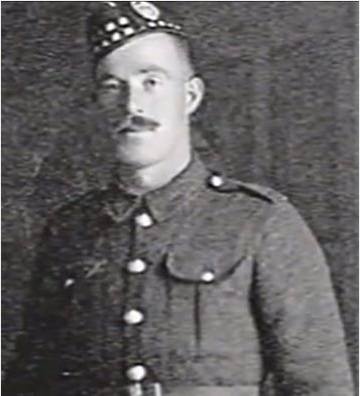
The Crucified Canadian
Sadly, for the family of Sergeant Harry Band, identified by various sources as the Crucified Canadian during the Great War. Soldiers feared only one thing more than dying in the war – not to be recovered from the battlefield, and presumed missing. Furthermore, soldiers knew their family would find no comfort in knowing their soul forever lost. Finally, to be among the Missing, and to know he had suffered a tortured death, an incredibly cruel twist his family should never had known, yet alone believed.

Savagery
During the Great War, written Canadians earned a reputation for their savagery. This folklore perhaps encouraged by the unfounded story of the Crucified Canadian. Whether true or not, war diaries and personal accounts do record this fact. When men of the Canadian Corps entered the Ypres Salient for the first time, shown the spot where the alleged atrocity had taken place.

The simple truth British propaganda concocted the story in response to the Christmas Truce of 1914. Soldiers fraternizing with the enemy threatened to end the war shortly after it began. This Live and Let Live attitude among the troops must be stopped, and what better way than to instill hatred for the enemy among the troops. A modern-day equivalent being the murdered babies in incubators – The Kuwaiti Incubator Hoax, also promulgated by media at the behest of the US government.

Harry Band’s Early Life
Harry Band born 12 August 1885, Montrose, Scotland, then in Kincardineshire. His father Martin Band, Box 101 Kelowna, British Columbia. His siblings identifed as James Band, Springbank Tce, Ferry Rd, Dundee, and Elizabeth Petrie. Harry was a Lineman.
He grew up in Dundee on Springbank Terrace, before he decided to leave for Canada in search of work. Then, Harry found a job in Moncton as a fireman and enlisted in the 15th Battalion Canadian Infantry (Central Ontario Regiment). In addition, Band had served three years in the 1st Forfar Volunteers and three years in the 48th Highlanders.
Harry Band described as a conscientious man and steadfastly refused to drink alcohol.
Enlistment
Private Harry Band 27286 enlisted 18 September 1914 at Valcartier, Quebec with C Company, 15th Battalion, CEF. At this time, he stood 5′ 11″ tall, 180 pounds, with fair complexion, brown eyes and hair – an impressive man of great stature. He was 29 years old and also had tattoos on his back and fingers. Soon after war declared in 1914, quickly rose to the rank of Sergeant.

Harry single, but may have been in love. In addition, every month, he sent $10 of his wage packet to Miss Isabella Ritchie of 93 King Street, Dundee. Then, confirmed in rank of Sergeant on 22 September 1914 while in training in Canada.

Harry sailed for England on 3 October 1914 with his unit – the 15th Battalion.
15th Battalion
Organized in Valcartier Camp September 1914. Composed of recruits from Toronto area. Initially commanded by Lieutenant-Colonel John Alistair Currie. The battalion embarked Quebec on 3 October 1914 aboard SS MEGANTIC.

England
Sergeant Band and the 15th Battalion later disembarked in England 14 October 1914 with a strength of 46 officers, 1109 other ranks. Camp at North Larkhill for several months.

The 15th Battalion arrived at Amesbury on 11 February 1915 and later boarded SS MOUNT TEMPLE at Avonmouth on 12 February 1915.
France
The 15th Battalion later disembarked in St Nazaire, France on 15 February 1915 with the 1st Canadian Division, 3rd Canadian Infantry Brigade. Later reinforced by 5th Canadian Reserve Battalion, mascot, a dog named Bruno., with Pipe band “Highland Laddie”. Finally, by 17 February 1915, the battalion in Hazebrouck, Belgium.

Second Battle of Ypres

Nursing Sister Ursula Violet Chaloner
A typewritten note by a British nurse during the Great War adds weight to the story that a Canadian soldier was crucified with bayonets on a barn door in Belgium by German soldiers in 1915.
The note relates comments by Lance Corporal C.M. Brown to his nurse, Miss Ursula Violet Chaloner, daughter of the first Baron Gisborough. Cpl Brown, apparently recovering from shell wounds, also told Miss Chaloner about a Sergeant Harry Band, who “was crucified after a battle of Ypres on one of the doors of a barn with five bayonets in him.”

The note, found in the Liddle Collection of war correspondence in Leeds University, is yet another piece in the puzzle surrounding one of the most famous, mysterious and vicious incidents of the Great War.
Private George Barrie
On the 24th day of April at St. Julien I saw a small party of Germans about 50 yards away. I was horrified to see that a man in a British uniform was literally crucified, being fastened to the post by eight bayonets. He was suspended about 18 inches from the ground, the bayonets being driven through his legs, shoulders, throat and testicles.
Pte. George Barrie

The Times
The Times identified the crucifixion took place in Ypres in April, 1915:
The story…. of the crucifixion of a Canadian officer during the fighting at Ypres on April 22-23 is in substance true. The story was current here at the time, but, in the absence of direct evidence and absolute proof, men were unwilling to believe that a civilized foe could be guilty of an act so cruel and savage. Now, I have reason to believe, written depositions testifying to the fact of the discovery of the body are in possession of the British Headquarter Staff. The unfortunate victim was a sergeant. As the story was told to me, he was found transfixed to the wooden fence of a farm building. Bayonets were thrust through the palms of his hands and feet, pinning him to the fence. He had been repeatedly stabbed with bayonets, and there were many punctured wounds in his body.
The Times (10 May 1915)
The Great War and Modern Memory

Another well-known rumor imputing unique vileness to the Germans is that of the Crucified Canadian. The usual version relates that the Germans captured a Canadian soldier and in full view of his mates exhibited him in the open spread-eagled on a cross, his hands and feet pierced by bayonets. He is said to have died slowly. Maple Copse, near Sanctuary Wood in the Ypres sector, was the favorite setting… The Crucified Canadian is an especially interesting fiction both because of its original context in the insistent visual realities of the front and because of its special symbolic suggestiveness. The image of crucifixion was always accessible at the front because of the numerous real physical calvaries visible at French and Belgian crossroads, many of them named Crucifix Corner.
Paul Fussell, The Great War and Modern Memory (1975)
Presumed to have died
On 28 June 1916, now for official purposes died on or since 24 April 1915.

Menin Gate Memorial
Sergeant Harry Band’s name found on the Menin Gate Memorial. The story of the crucified Canadian would have been more easy to comprehend, and believe, if Band’s body removed from the “cross” and buried. Finally, the narratives of the various witnesses make no mention of this fact.

Legacy
During and after the war at least three eye witnesses came forward, but there are discrepancies in their stories, such as the place where it happened.
Modern day British historian and film maker Ian Overton claimed the victim as Sergeant Harry Band of the Canadian First Division and murdered on 24 April 1915 — two days after the first German chlorine gas attack. In addition, he believes Band tortured to death in retaliation. Furthermore, Canadian soldiers had been horrified by the German use of poison gas on April 22, and showed little mercy to German soldiers they captured the next day, on April 23.
But, most Canadian historians believe the story is pure propaganda.
All we really have is second-hand reportage. Unless I see rather conclusive evidence, I still think it was a myth thought up by British propaganda.
The late Professor Peter Buitenhuis, of Simon Fraser University

Although Harry originally from Montrose, Scotland, his name included in the original Honour Roll for Dundee.
Contact CEFRG


Or Subscribe
More
- Home of CEFRG
- Blog
- CEFRG on FaceBook
- CEFRG on YouTube
- Soldiers and Nursing Sisters
- Units (Brigades, Battalions, Companies)
- War Diary of the 18th Battalion (Blog)
- 116th Battalion CEF – The Great War
- Les Soldats du Québec Morts en Service
- Webmatters Carte de Route First World War
- Montreal Aviation Museum
- Battles of the Great War
- Cases
- Cemeteries
- Memorials
- On This Day
- About CEFRG
Please subscribe to CEFRG to be notified by email when there are new posts. Subscription is free, and your email kept confidential.