That their “Service rendered ” to His Majesty’s Pigeon Service has been of inestimable value there is no doubt, and pilots and observers found everywhere who owe the saving of their lives to the agency of these little winged heroes.

MIKAN No. 3381000 His Majesty’s Pigeon Service
Heroes they are, for on occasions they have fought their way through the most adverse weather conditions carrying messages which meant everything to those who liberated them.

Intelligence Service
James Bond a fiction; pigeons the real deal. A great many of these extraordinary birds performed critical intelligence work on His Majesty’s Secret Service. The “His” refers to HRH George V, King of the British Commonwealth for the duration of the Great War.

Western Front, 25 October 1914.
Much like their human counterparts, in combat and on the home front, they did their bit selflessly and courageously, and they deserve to be celebrated and remembered. It has therefore become necessary to issue a publication explaining to some extent, their capabilities, management and use.

This Bloody Bird
This story comes from The Memoirs of Field-Marshal the Viscount Montgomery of Alamein, K.G., 1958.
Brigade-Major Montgomery
I returned to the Western Front in France early in 1916, this time as a brigade-major. During the Somme battle that summer an infantry brigade, which had better remain nameless, was to be the leading brigade in a divisional attack. It was important that the Brigade Commander should receive early information of the progress of his forward troops since this would affect the movement of reserves in the rear.

Pigeons
The problem then arose how to ensure the early arrival of the required information, and intense interest was aroused at Brigade H.Q. when it was disclosed that a pigeon would be used to convey the news. In due course the bird arrived and was kept for some days in a special pigeon loft. When the day of the attack arrived the pigeon was given to a soldier to carry. He was to go with the leading sub-units and was told that at a certain moment an officer would write a message to be fastened to the pigeon’s leg; he would then release the pigeon which would fly back to its loft at Brigade H.Q.

The attack was launched and the Brigade Commander waited anxiously for the arrival of the pigeon. Time was slipping by and no pigeon arrived; the Brigadier walked feverishly about outside his H.Q. dugout. The soldiers anxiously searched the skies; but there was no sign of any pigeon.
At last the cry went up: “The pigeon!” Sure enough back it came and alighted safely in the loft. Soldiers rushed to get the news and the Brigade Commander roared out: “Give me the message.”
It was handed to him, and this is what he read:
“I am absolutely fed up with carrying this bloody bird about France.”
History of the Pigeon
Genghis Khan kept tabs on his territories with pigeons. The Greeks learned of Olympic victories via pigeons. Parisians communicated from a city under siege during the Franco-Prussian War with these beautiful birds. Keen to capitalize on the outcome of the Battle of Waterloo, banking magnate Nathan Rothschild kept carrier pigeons at the ready to dispatch news of victory or defeat. Reuters news service employed pigeons in the mid-nineteenth century to bridge the gap in the telegraph lines linking Paris to Germany.

His Majesty’s Pigeon Service
By the 1850s, pigeons kept by merchant or news agencies supplanted by the telegraph. Consequently, the birds sold to individuals, giving rise to the burgeoning sport of pigeon racing, which, unlike horseracing, not the exclusive domain of the wealthy.

Even the royal family couldn’t resist their allure.

The Prince of Wales’ loft in 1898
After receiving a gift of pigeons from King Leopold II of Belgium in 1886, the future Edward VII parlayed them into a royal loft that, to this day, continues to produce champion racers.

His Majesty’s Pigeon Service
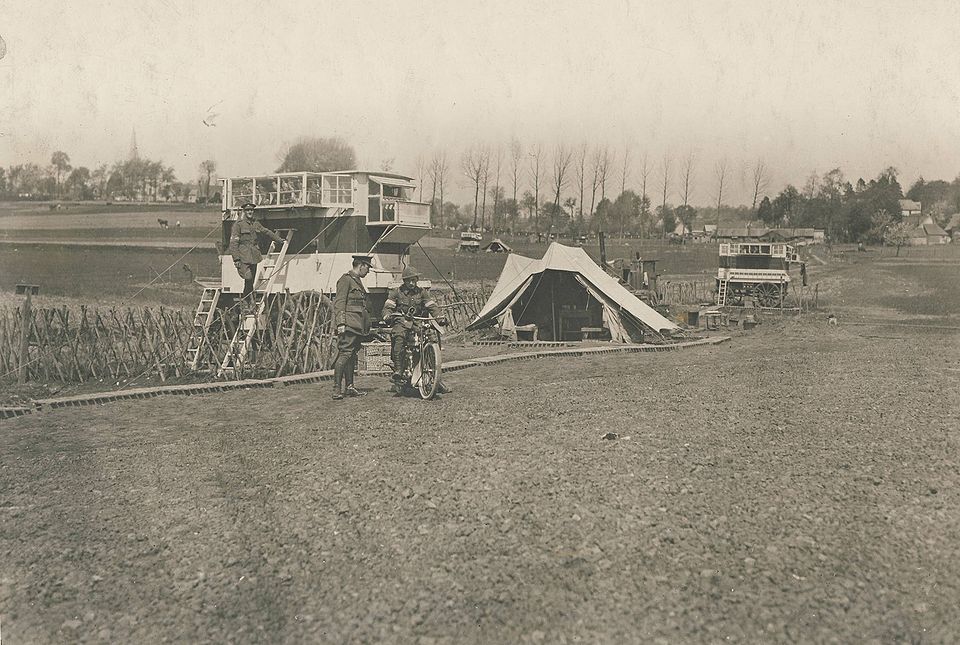
The Loft
The accommodation provided for the birds must be ample, since pigeons will not thrive if kept in a crowded loft. Fourteen to fifteen cubic feet of space reckoned to each bird.

Thus a loft 6 feet wide, 8 feet long, and 7 feet high would accommodate 12 pairs of old birds for breeding purposes. This space will, in addition, accommodate an equal number of young birds until the latter old enough to be removed to a new loft.

His Majesty’s Pigeon Service
Each loft requires installed a trap, or traps, for the birds to enter, each trap fitted with a small electrical apparatus in order to notify the arrival of a bird with its message.
Pride
Soldiers incredibly proud of their feathered-friends knowing they saved thousands of lives. A 95 percent success rate meant 5 percent would meet their death over the trenches in the Great War.

Dickebusch, 27 December 1917.
The interior of the loft light, well ventilated, and fitted with a sufficient number of small perches to accommodate the whole of the inmates.

A French soldier in the Carrier-Pigeon Service holding a pigeon at the Royal Engineers pigeon pens at Sorrus, 2 June 1918. Note the distinguishing badge worn on his arm © IWM (Q 8877)
A standard loft requires, for 150 birds, at least one expert attendant, who should, in addition, be supplied with a fatigue man, whom he can instruct in the handling of the bird in case of his own absence.

Equipment
A standard loft containing 150 birds would require the following personnel and equipment:
- (a) Personnel.
- 1 N.C.O. (pigeon expert).
- 1 Fatigue man.
- (b) Equipment.
- Peas, sacks 4
- Grit, cwts. 2
- Fountains, water 3
- Hoppers, grit 3
- Bath, pigeon 1
- Brush, sweeping (hand) 1
- Pail, iron galvanised (4 gals.) 1
- Can, water toilet 1
- Shovel, fire 1
- Scrapers, “V”-shaped 1
- Nest pans 60
- Nest eggs 60
- Baskets, with troughs “D” pattern 2
- Boxes, seaplane, pigeon Carriers, message 10
- Pads, message Rings, celluloid 144
- Insectide tins 4
- Whiting lbs. 56
- Brushes for whiting 1
- Bins for storage of corn 2
Training
After the pigeon settled to the loft it should be trained by distances along the coast in both directions of 1, 2, 4, 6, and 10 miles.

Thereafter every 10 miles up to as far as the patrols reconnoitre, so that the birds will readily home from whatever point they strike the land.

Before being used for actual message work, pigeons should be given several tosses from the air, and, if possible, at least one toss, one at a time at intervals of about 10 minutes at the extreme limit of the patrol.
It is important that large numbers of pigeons should not be liberated for training in one batch from one stage at the same time. Good pigeons are scarce, and the weather is always a danger. The largest number that should be released at once is twenty.
Flying at Night
Pigeons have been trained to fly at night, but for only comparatively short distances, and also in the twilight.

MIKAN No. 3381007
His Majesty’s Pigeon Service
This latter is of greatest value, especially when a pigeon has been released late in the evening with a message of distress.

His Majesty’s Pigeon Service
Young Pigeons
Pigeons, if well and liberally fed, will rear young at nearly all seasons of the year, but the best time to select for mating the birds is about the middle of February. The cock and hen birds must be separated for about a month before they are mated.

Behind them 9 reserve stations with another 92 birds.
Eight days after mating, the hen will lay her first egg; then after an interval of a day the second egg should be laid. The young will hatch 17 days later. Both cock and hen sit and rear the young, the cock covering the eggs from 11 a.m. to 3 p.m., and the hen sitting during the remainder of the day and night. It is important to note this fact in order to arrange the birds training flights.

His Majesty’s Pigeon Service
As soon as the young are old enough, they should be placed in a separate loft. A few days later, when accustomed to perch, sleep, and feed in this loft, they can be let out, but must not be given training flights until quite accustomed to the surroundings of their new home. This requires from two or three weeks’ exercising flights.

Military Communications and Electronics Museum Archives
Malloch Photo Album
The young pigeons, known as “squeakers,” should be ready for Service work when three months eld; at this age good strong young birds will be ready to accomplish flights of from 10 to 50 miles, if they have been well trained.
Writing the Message
The message should contain fully but briefly what is required.

His Majesty’s Pigeon Service
It should always give the name of the station to which the machine belongs or the serial number of the pigeon loft, and in the cases of forced landings convey the following information as far as possible:
- Cause of landing.
- Nature of trouble, and any useful information.
- Position.
- Time and date.

Sending the Message
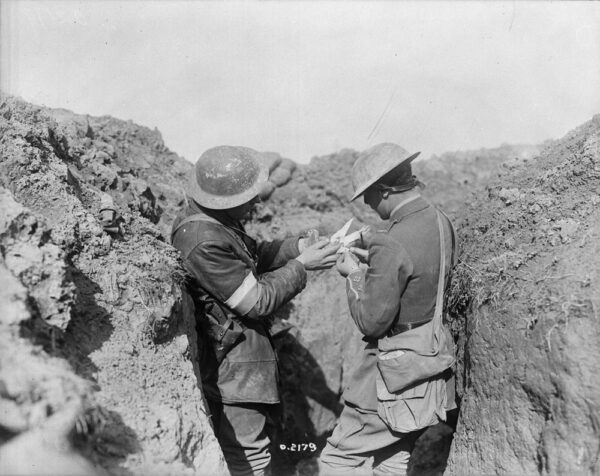
The handling and release of pigeons demands very little skill.

The bird, when taken from the box or basket, should be held gently but firmly with the thumb across its back.

The first finger just under the vent, and the remaining three fingers resting on its breast, holding the legs between the first and second fingers.

His Majesty’s Pigeon Service
The fixing of the inner portion of the message carrier found to be a simple matter.

To release the pigeon, the bird should be held as one would hold a stick, and then thrown, opening the hand immediately so as not to pull out any feathers.

Message Pad
Special message blocks (F.S. Form 197) made up in pads for 25 messages with carbon interleaved, provided, and so arranged that perforated copies torn off, leaving one sheet in the book as a record.

His Majesty’s Pigeon Service
When the message written folded up and placed in the…
Message Carrier
This is of special design and made of aluminium for lightness. The message placed in the smaller receptacle, and that in turn placed in the larger receptacle.

Feeding
A sufficient daily ration for birds making training flights is 1 oz. per head per day.

Pigeons must always be fed inside the loft this is very essential. Not understood why these pigeons being fed so.

When possible, one-third of this food given in the morning soon after daybreak, and two-thirds in the afternoon.

It’s a Mark V tank of the 10th Battalion, Tank Corps attached to the III Corps during the Battle of Amiens. © IWM (Q 9247)

Many of the chief ailments in pigeons are due to over-feeding and want of sufficient exercise. In the breeding season the ration increased by one-third.

A bath should be given the birds at least once a week during all seasons of the year. An open bath, about 2 ft. 6 in. square, and 4 in. deep, is best for the purpose.

War Diary of Carrier Pigeon Service

Lt. Arthur Charles Pollard MC
Sometimes, but not always, the men of the Signal Corps received all the credit.
For conspicuous gallantry and devotion to duty as signalling officer. He went forward with the assaulting troops and established a centre whence he maintained communication throughout the day under very heavy and continuous shelling. When communication by telephone became impossible, he substituted lamps, pigeons and runners, and displayed the most marked coolness and ability in keeping up communication under very heavy fire, thus materially assisting in the success of the operation.

Lt A C Pollard MC serving with the 7th Canadian Infantry Battalion, wounded at duty, 14 April 1917. Pollard was Seconded for Duty as an Observer with the RAF in June of 1918. Awarded the Military Cross in October 1917.
Meritorious Service
Crisp VC
Pigeon No. 498, which Skipper Thomas Crisp sent for help when attacked by a German U-boat in August 1917. Crisp killed but, despite being wounded in one wing by shrapnel, the bird delivered the message in time for help to be sent to the crew.

THE ROYAL NAVY ON THE HOME FRONT, 1914-1918 (Q 18620) Pigeon No. 498 which Skipper Crisp sent for help when attacked by submarine. Crisp killed but the bird delivered the message in time for help to be sent to the crew, although one wing wounded by shrapnel.
A Short seaplane whilst on patrol forced to land. Two pigeons dispatched, giving position of the wreck and requesting immediate help, as the machine had capsized and rapidly breaking up in the wrought sea. Aircraft dispatched, and having located the wreck, directed a destroyer to it and the crew consequently rescued. The pigeon message the first information received giving the position of the seaplane.

Valour in the presence of the enemy
Seaplane 8666 failed to return from patrol. The first news came from a pigeon message, and the crew of six saved after being on the water for three days. Another pigeon with a similar message picked up a few miles from the loft, having died from exhaustion.

Seaplane 1250 came down with engine trouble 40 miles from its base. The news came by pigeon message, and the machine found and brought back in tow.

Saving RAF Crewmen
Seaplane 1608 descended with engine trouble 30 miles from its base. The news also came by pigeon message, and the machine brought back in tow. The birds had to fly against a very strong and cold N.W. wind.

Seaplane 4511 came down on the water 45 miles out. News came from a pigeon message, and the machine picked up by a monitor just before dark.

A D.H. 6 forced to descend through engine trouble. A pigeon arrived with a message to this effect, and a destroyer directed to search for the pilot, picked up after he had been in the water an hour, his machine having sunk fifteen minutes after landing.

Seaplane N64 and Pigeon No. 376
At a Royal Air Force station tea time and a welcome hour too, when a bell rang. A pigeon had come in. A N.C.O. set down his cup of tea untasted and opened the door leading to the pigeon loft. From the corner, where it had huddled, he lifted a blue hen pigeon, 376 S.N.L. 14, very wet and bedraggled, skilfully removed a small aluminium cylinder from its right leg, slipped the bird into a pigeon basket and carried it into the mess room, and opened the message.
“Machine wrecked and breaking up, 15 miles SE. of Rocky Point. Send boat.”
Darkness had fallen, and, out at sea, two men wet and chilled still clung to a wrecked seaplane. They had little hope that their message had been delivered, or, even if it had been, that help would come in time to save them.
At last there came a sound—the sweetest music they had ever heard—the siren of a motor boat. Again and again it sounded, each time nearer; then the bewildered men arose and sent up a wild shout in answer, and a hissing bow shot towards them from the darkness. They had been in the water twelve hours.
On the top of a little basket by the fire in the mess room sat No. 376 quietly preening her damp feathers. And the next morning the British papers reported.
“Seaplane N64 lost in the North Sea, fifteen miles Southeast of Rocky Point. All the crew were saved.”
George
‘George’ a R.A.F. carrier pigeon, which carried important messages on twelve occasions and went out on 150 patrols.

Below the canister a yellowing newspaper clipping showing a photograph of ‘George’ – a R.A.F. carrier-pigeon, the frame rectangular, wooden and painted black and bears a small oval plaque with inscription reading ‘PRESENTED BY COLONEL & ALDERMAN SIR CHARLES WAKEFIELD, BART., C.B.E. LORD MAYOR OF LONDON 1915-16’
Wound Stripe
During a period of seventeen months, on one station alone, birds liberated on 80 occasions from aircraft in difficulty and often actual peril. In 45 cases the pigeons brought the first information, and successful action taken.

The message nevertheless delivered at the aerodrome.
One of the birds shot through the left eye in action, but succeeded in reaching its loft.

Le Vaillant
Le Vaillant – the pigeon used by Captain Raynal at Verdun, while besieged at Fort Vaux during the battle of Verdun, became a minor celebrity after delivering its crucial message to Pétain detailing the German siege of the fort.

Le Vaillant flew in through a terrible enemy fire and received the Croix de Guerre. Captain Raynal’s last bird, body mangled, dropped dead as it came in to deliver his message. Awarded the Legion d’Honneur, and a diploma framed in the colours of the decoration and bearing a brief and dignified citation hung at headquarters in Chantilly.
Cher Ami
On 4 October 1918, American heavy artillery started to bombard the one of their own units by accident, killing thirty men. Major Whittlesey and his men watched as bird after bird fell out of a sky torn apart by German fire. With supplies running out and casualties mounting rapidly, Major Whittlesey desperately sent out his last pigeon, Cher Ami, to the American lines with a note that simply read, “We are along the road parallel to 276.4. Our own artillery is dropping a barrage directly on us. For heaven’s sake, stop it.”

Croix de Guerre with Palm military decoration Citation
The brave bird flew straight into the German fire, dodging bullets as he went. However, his luck did not last for long. Cher Ami hit in the chest soon after takeoff, as American soldiers watched in horror as their last hope hit the ground. Against all odds though, Cher Ami got up again! Wounded but still alive, the little bird took flight again, charging head-on into wave after wave of gunfire. By the end of the trip, he covered 25 miles in roughly half an hour. He arrived at base heavily wounded, but alive.

Army medics able to save Cher Ami’s life, but his right leg barely attached to his body and blind in one eye. However, because of Cher Ami’s delivery, the artillery stopped and took up new firing coordinates away from American lines. On October 8th, one hundred and ninety-four men made it back to the American lines thanks to Cher Ami’s sacrifice.
Cher Ami made it back to the United States in the care of its trainer, Capt John Carney. On June 13th, 1919, Cher Ami died at Fort Monmouth, New Jersey. However, Cher Ami’s body preserved and presented to the American Government with honor.
Dickin Medal
The Dickin Medal instituted in 1943 to recognize the heroic feats of animals serving in wartime with the British Armed Forces and the Civil Defence Services. A bronze medal, marked with the words, “For Gallantry. We also serve,” the Dickin widely accepted as the animal-equivalent of the Victoria Cross. Fifty-four of these medals bestowed for extraordinary efforts during the Second World War; thirty-two of them went to pigeons.
- “For delivering the first message from the Normandy Beaches…”
- “For delivering an SOS from a ditched Air Crew close to the enemy coast…”
- “For bringing 38 microphotographs across the North Sea in good time although injured…”
- “Brought a message which arrived just in time to save the lives of at least 100 Allied soldiers from being bombed by their own planes.”

160 mature pigeons currently kept in the lofts, along with 80 young pigeons.
Protection of Pigeons in the Great War
More than one hundred thousand pigeons used as messengers during the Great War. In 1921, the British parliament passed a bill without opposition making it illegal to shoot birds from traps.

Clay-pigeon shooting originated in 1875.
The killing, wounding, or molesting of a homing pigeon punishable by law, with sentences ranging from a £100 fine to six months’ imprisonment.
Pigeons valued for their impeccable homing instinct, and also their speed, which made it very difficult for enemy marksmen to shoot them down.

Research
Royal Air Force. Pigeon Service Manual [1919 Great Britain].
Pigeons in the Great War by Lt.-Col. A H Osman (Alfred Henry)
CARRIER PIGEONS IN WW1 – The Royal Montreal Regiment
Pigeons in the Great War – The Regimental Rogue – By Lieutenant-Colonel A.H. Osman, O.B.E., (Late O.C. Pigeon Service, G.H.Q., Home Forces). Journal of the Royal United Service Institution, Vol. LXXII, February to November, 1927