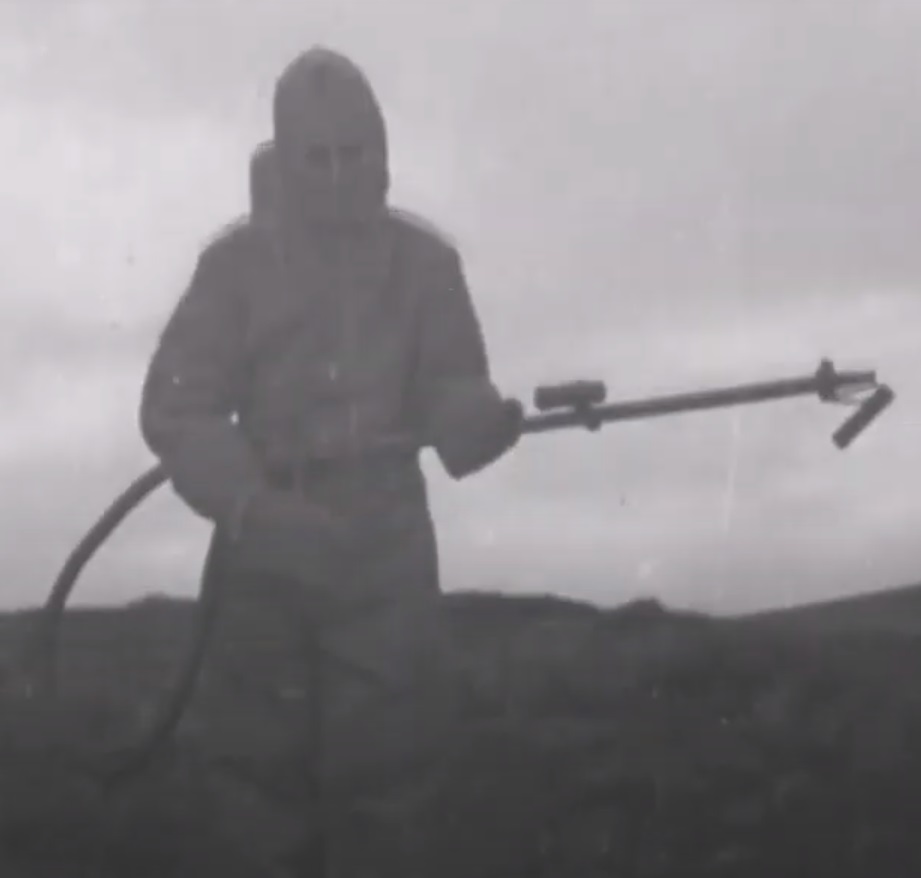
Cela brise le cœur l’histoire inédite de ce soldat, Emile Hallez, Royal 22e Régiment, grièvement blessé le 26 août 1918, lors de la Battaile de la Scarpe. Dix-sept ans d’hospitalisation jusqu’à sa mort.
Early Life
Emile Hallez born 4 March 1893 in Sainte-Hélène-de-Breakeyville. A district within the Les Chutes-de-la-Chaudière-Est borough of the city of Lévis, Quebec. Step-son of Victoria (Napoleon) Blanchette, a plumber by trade. Brother Thomas, working with the Levis Co., in Breakeyville.
Enlistment
Soldat Emile Hallez 3031287 examined in Sudbury, Ontario on 3 December 1917. At enlistment, he stood 5′ 8″ tall, with dark complexion, brown eyes, and black hair. Though Emile joined late in the Great War, he would make it overseas three months before the Armistice.

Battle of Amiens
Emile entered the field on 8 August 1918 during the Battle of Amiens. Despite Emile’s lack of experience, he rapidly proved himself capable in battle, someone his comrades could trust. Then, before his next engagement, Emile trained in the use of a new weapon, a flamethrower.
Finally, proving himself quite capable in training with the new weapon, Emile prepared to lead his platoon in the Battle of the Scarpe. Perhaps, only a moron would consider wielding such a weapon. However, no one would dare to call Soldat Emile Hallez a moron after his first month of service in the field.

Battle of the Scarpe
Leading his platoon, Emile engaged the enemy, somehow surviving unscathed, and made it to the end of the attack supporting his comrades. Then, standing in front of the final objective, a German trench, Emile suddenly looked down to see his clothes on fire.
With his right hand, he attempted to smother the flames, too late, his clothes soaked with fuel, and the flames spread. His comrades rushed to help him and suppressed the flames with a tarp which saved his life, if only for another seventeen years of agony.

Admitted with shell gas, wounds to arms and legs, gas burns, severe. Emile’s wounds are far more severe than initially recorded. His burns extend from his lower chest, entire abdomen to his thighs. Wrists and fingers also severely burned from attempting to smother the flames. His penis and scrotum severely burned.
Recovery
Admitted to No. 32 Stationary Hospital, Wimereux, 2 September 1918. On 7 September 1918, dangerously ill. Then, on 24 September 1918, listed as severely ill. Finally, removed from severely ill list, 28 September 1918.
Admitted to Glandon Park, 28 September 1918. Emile’s recovery is extremely slow. His wounds requiring constant care.
Admitted to No. 16 Canadian General Hospital, Oprington, 27 March 1919. Then, examined at No.18 Canadian General (Ontario) Hospital, 28 May 1919. But, by March of 1919, Emile’s most troublesome wounds are to his abdomen, thighs, and right hand. Finally, large ulcers in these areas, little movement possible with his right hand. At last, his scrotum and penis scars have healed.
Admitted to Queen’s Military Hospital, Kingston, feeblemindedness, burns to abdomen, 12 June 1919. Then, admitted to No.5 Canadian General Hospital, Liverpool, 17 June 1919. Finally, invalided to Canada, 30 June 1919.
Deserter
In a ridiculous error in records, Emile reported as a deserter at H.M.A.T. ARAGUAYA on 12 July 1919 and S.o.S. as a deserter at Ste-Anne-de-Bellevue Hospital in Montreal on 2 August 1919.

Authorities obviously unaware Emile is bedridden, and incapable of desertion. However, the confusion likely the ARAGUAYA had made an unscheduled port-of-call in Portland, Maine.
Veteran’s Hospital in Ste-Anne-de-Bellevue
Officially, discharged from service on 31 December 1919. To Ste-Anne-de-Bellevue Hospital for treatment, 31 December 1919. Emile’s medical condition at this time, even more disturbing. Firstly, medically categorized as a Moron.

Patient has the mentality of a boy of 12 years of age, very quiet, seldom speaks, moody disposition, sits in a chair in the corner of the hospital all alone and smiles and laughs to himself. Very timid when spoken to, and shows no evidence of violence; always takes whatever treatment given him willingly and is a good patient. Old Liquid Fire burns of lower chest, abdomen anterior surface of both thighs to knees, and right hand which is much crippled.
Veteran’s Hospital, Ste-Anne-de-Bellevue

Understandably, doctors often confused by the cause of Emile’s wounds. Mistaken for severe mustard-gas wounds on several occasions. A Liquid Fire Flamethrower, something few people could conceive, let alone comprehend.
Montreal (Notre-Dames-des-Neiges) Cemetery
Emile languished seventeen years in the Veteran’s Hospital in Ste-Anne-de-Bellevue, Quebec, until his death from an intestinal obstruction, 6 October 1935. Following so much suffering, Soldat Emile Hallez buried in Montreal (Notre-Dames-des-Neiges) Cemetery, which contains 252 Commonwealth burials of the Great War. Finally, the lack of an epitaph suggests his step-mother had pre-deceased him, and Emile had died alone. Tragically, just one of many forgotten heroes of the Great War

More
Capitaine Joseph Henri Chaballe in the Great War
Private Joseph Malouin, The Van Doos, in the Great War

Please subscribe to CEFRG to be notified by email when there are new posts. Subscription is free, and your email kept confidential.