Royal Canadian Horse Artillery

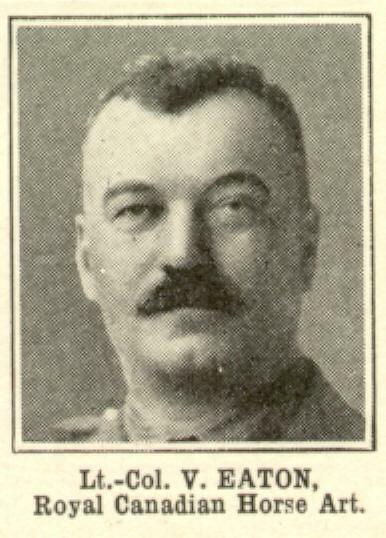
LCol Vernon Eaton keenly aware of his Eaton family heritage and proudly wore a tattoo of the family crest on his right arm. Twice he was mentioned in dispatches for gallant and distinguished service in the field.

Daniel Isaac Vernon Eaton the eldest son of James Keiller Eaton and Annie, of Truro, Nova Scotia. Husband of Myra Eaton, of 69, Grosvenor St., London, England. Born 19 September 1870 in Kingston, Ontario.

This Regular Force regiment originated in Kingston, Ontario and Quebec City, Quebec on 1 December 1898, when the ‘Royal Canadian Artillery (Field Division)’ of The Royal Canadian Artillery authorized to be formed. Redesignated: ‘Royal Canadian Field Artillery’ on 1 June 1901; ‘Royal Canadian Horse Artillery’ on 1 September 1905.
The North West Rebellion
The service of ‘A’ and ‘B’ Batteries of the Regiment during the Rebellion pre-date the formation of the Royal Canadian Horse Artillery.

South African War
The Royal Canadian Artillery (Field Division) mobilized the ‘Brigade Division, Royal Canadian Artillery’ for active service on 20 December 1899. The brigade embarked for Africa on 21 February 1900, where its batteries provided field artillery support to the Imperial forces in the eastern Transvaal, north Cape Colony, Griqualand West and with the Rhodesian Field Force. The active service brigade was disbanded on 21 January 1901.

Eaton served through South African War and for some time on General Baden Powell’s staff. At the conclusion of the war, specially recommended for the Staff College by Lord Roberts, and first officer from any of the Colonial Forces to pass through.

Subsequently, Director of Military Training for the Dominion of Canada from 1905 to 1911.

In 1916, after serving with the Royal Canadian Horse Artillery, Eaton trained a Canadian Artillery Division.

Active Service
The Royal Canadian Horse Artillery placed on active service on 6 August 1914 for instructional and camp administration duties. On 26 August 1914 it mobilized the ‘Royal Canadian Horse Artillery Brigade, CEF’, which embarked for England on 30 September 1914.

The regiment disembarked in France on 20 July 1915, where it provided mobile field artillery support as part of the ‘Canadian Cavalry Brigade, CEF’ in France and Flanders until the end of the war.
Eaton commanding 8th Brigade, Canadian Field Artillery.

Mentioned in Despatches
LCol Daniel Isaac Vernon Eaton Mentioned in Despatches for Gallant & Distinguished Service, in the Field, by Field Marshall, Commander-in-Chief, British Armies in France, 4 January 1917.

Whilst visiting the batteries at 6:15 pm on 8 April 1917, LCol Eaton wounded 8 April 1917, shrapnel abdomen. Thee OR killed. Two officers and 11 OR wounded.
Gunner Harold Lamont Longworthy, 10 Bde, CFA, killed in action on 8 April 1917, south-east of Carency. Gunner Herbert S Whitehead 301740, 10 Bde, CFA, killed in action on 8 April 1917. Both men buried at VILLERS STATION CEMETERY, VILLERS-AU-BOIS.

LCol Daniel Isaac Vernon Eaton evacuated to No. 6 Canadian Casualty Clearing Station at Barlin.
No. 6 C.C.S. occupied school buildings and an outside area in the centre of Barlin known as Cercles Catholiques, map ref 36b.K.33.a.9.5
Eaton died 11 April 1917 at No. 6 C.C.S. Buried at Barlin Communal Cemetery Extension.
Buried on the night of 12/13 April 1917, LCol Eaton in Row G at Barlin Communal Cemetery Extension.
Barlin Communal Cemetery Extension
The extension begun by French troops in October 1914 and when they moved south in March 1916 to be replaced by Commonwealth forces, used for burials by the 6th Casualty Clearing Station. In November 1917, Barlin began to be shelled and the hospital was moved back to Ruitz, but the extension was used again in March and April 1918 during the German advance on this front.

Barlin is a village about 11 kilometres south-west of Bethune on the D188, between the Bethune-Arras and Bethune-St. Pol roads, about 6.5 kilometres south-east of Bruay. The BARLIN COMMUNAL CEMETERY and EXTENSION lie to the north of the village on the D171 road to Houchin.
Please subscribe to CEFRG to be notified by email when there are new posts. Subscription is free, and your email kept confidential.