Three Times Recommended for the VC
Russian-born Soldier of the Fighting-Tenth
Corporal Nicholas Purmal DCM & Bar, wounded and invalided to England three times during the Great War. As a member of the First Contingent, Nicholas one of six Originals from Russia serving with the 10th Canadian Battalion (Canadians). Though his service record and accomplishments merited a review by the Assistant Director of Records on 25 February 1932, his story largely remains untold.

Considerations
Some might believe Corporal Nicholas Purmal one of those soldiers who stretched the truth by claiming he had been nominated not once, but three times for the Victoria Cross.
- All three actions occurred on the first day of major engagements by the Canadian Infantry.
- In all instances, Corporal Nicholas Purmal wounded on the battlefield in the face of the enemy.
- Each engagement, his wounds serious enough to require evacuation to England.
- Wounded so early in the engagements, and the super-human work of stretcher bearers, contributed to his quick recoveries.
- Any casualty with the slightest wound, left on the battlefield requiring evacuation, susceptible to septic complications of infectious diseases.
- When a soldier injured, his wounds could easily come into contact with bacteria from long-buried manure which lurked in the trenches in the farmer’s fields – often, a death sentence.
- His final action, meriting a well-documented Distinguished Conduct Medal at the Battle of Hill 70 in 1917.
- Why was Corporal Nicholas Purmal denied permission to proceed to the 10th Battalion for the fourth time, rather than continue to serve in England?

Little Plume, Alberta
Native of Novarasisk, Russia, Nicholas born 6 September 1890. Novorossiysk a port city on the Black Sea in southern Russia. Nicholls (Nicholas) Purmal 20187, a bricklayer of Little Plume, Alberta, enlisted on 22 September 1914 with the 10th Battalion. His father Henry Purmal also of Little Plume. He assigned half his pay to Mrs R L A Purmal of 28 Miranda Rd, St Johns Rd, Upper Holloway (an area in the London Borough of Islington, London).

At the time, Nicholas had served 3 years with the 21st Alberta Hussars out of Medicine Hat. Little Plume a town name that has not survived, though a church, originally built in 1919, found just south of Medicine Hat, Alberta.
Pvt Nicholls Purmal embarked for England on 3 October 1914 with the First Contingent.

Private Nicholls Purmal proceeded to France with his unit on 9 February 1915.
Second Battle of Ypres
On the night of 22/23 April 1915 at Kitchener’s Wood, in six hours of fighting the battalion had lost in killed and wounded nineteen officers and nearly six hundred N.C.O.’s and men, out of a total strength of eight hundred and sixteen. The Tenth had indeed had its baptism of blood.

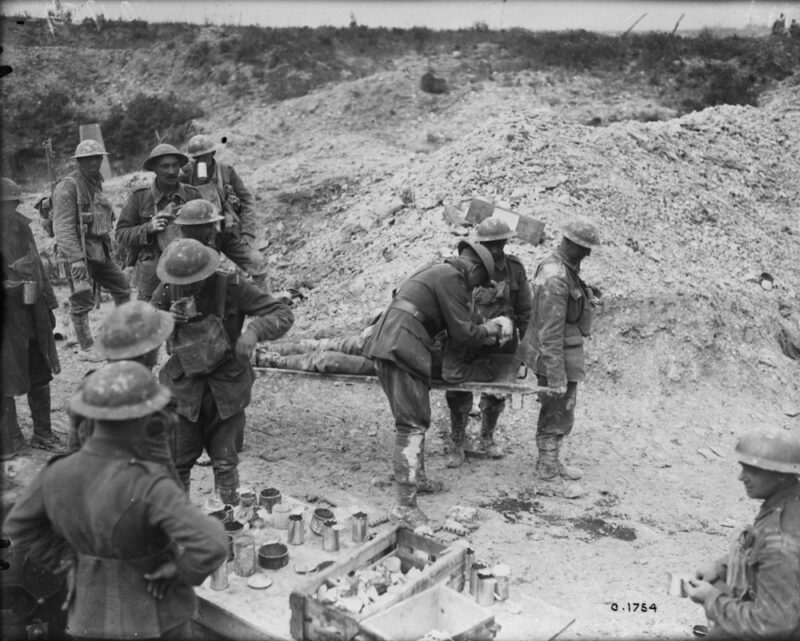
The daylight hours of April 23rd spent in organising the defences and removing the wounded, many of whom lay in the open. Attempts to bring in the sufferers met by hostile rifle fire; but despite this typically Hunnish act many rescued. Those unfortunates who lay far out had to be left to their fate. All day long the German guns pounded at the Canadian lines, attempting to crush out the defenders’ marvellous spirit of resistance by sheer weight of metal.
Second Gas Attack
The second night of ordeal had come. Ammunition exhausted, no surgical dressings or stretchers with which to ease and transport the deplorably large numbers of wounded, and the emergency rations had been eaten by the hungry men long since. No one had had any water for hours. Machine guns urgently needed to supplement the pitifully weak rifle strength, and equally necessary that telephonic communication should be established with Brigade H.Q.

An alarm reached the battalion at 3 a.m., April 24th —the Germans were about to attack. Half an hour later the enemy’s guns opened up a furious bombardment, and successive projections of gas could be seen rolling in dense waves towards the Canadian trenches some distance to the right. In the half-light of the early dawn the onlookers saw the pulsing walls of evil-looking vapour creep with grim certainty towards the flame-smeared trenches where helpless men crouched and defiantly awaited its breath of death.
Battle of Gravenstafel Ridge
A message received from Brigade H.Q. ordering the 10th Battalion to move to a position on the Gravenstafel Ridge, in support of the 8th Battalion, which was being hard pressed. Arrangements were at once made with the 16th Battalion to extend their left. When the 10th was ready to move it was broad daylight and the sun’s rim was just showing above the horizon. The only means of egress, from the front line was by way of a recently dug, shallow trough barely offering cover to prone men. It crossed a ridge exposed to German fire from three directions. Yet by skilful handling the men brought safely away without the enemy being aware of the movement.

After a tedious march the badly spent battalion, now only a hundred and fifty strong with three officers, reached support trenches on the slope of the Gravenstafel Ridge. Almost immediately an imperative call for help came from the 8th Battalion, defending the ridge to the N.E. of St. Julien. Extending into open order, the 10th Battalion scrambled up the slope, gathering many stragglers from other limits on the way, and occupied a trench to the left of that held by small parties of the 8th and 7th Battalions. The Germans seemed to be attacking all along the line, using artillery and gas unsparingly and then hurling masses of men upon the suffocating defenders. Time and time again the enemy threw his full force against the mauled trenches, but always his infantry staggered back beaten by mere handfuls of unconquerable Canadians.
Major Ormond Wounded
Captain Arthur now in command of the 10th Battalion, Major Ormond having been wounded again. The latter had displayed unusual resolution and resource in handling his sorely tried command. The gas clouds gradually drifted towards the 10th Battalion trenches. Blinding and choking the defenders, while the massed German guns sowed the ground with death-spreading high explosive and shrapnel. The battlefield was an inferno—a reeking shambles haunted with the groans of the dying.
Now only 146 men and five officers, including many stragglers from other units—left to defend a long stretch of trench, yet the thought of retreat never seemed to have occurred to them. Under Captain Lowry’s leadership they beat back several fierce attacks in the next few hours. Who shall know the bodily and mental anguish which these Canadians endured during these awful hours of struggle, when the fate of Belgium and Calais hung by the fine golden thread of their valour.

Isolated
The German guns never slackened in their efforts to blot out the Canadians, and Major Ormond records in his diary that his men were being blown out of the trench in groups, mutilated beyond recognition by the rending high explosive. Towards 6 a.m. the enemy succeeded, by a series of short rushes, in working forward on the left of the 10th Battalion with machine guns. Our rifle fire was too weak to stop him. The greater part of our position was garrisoned now only by our dead and wounded. The survivors of the 10th Battalion were isolated. The position was hopeless.
At noon a runner reached Captain Lowry with an order to withdraw. It came not a moment too soon, for the enemy was massing for a final rush. The retirement was successfully carried out under the eyes of the enemy. By 1 p.m. all that was left of the 10th Battalion was safely entrenched in the new position in time to see the last round fired by the only British battery left in action. There was no more ammunition for the guns.
First Wound Stripe
Pvt Nicholls Purmal wounded 24 April 1915. Admitted to hospital the following day with a shrapnel wound to his arm.
Private Nicholls Purmal’s wound serious enough to have him invalided to England 1 May 1915, but soon discharged on 4 May 1915. Pvt Nicholls Purmal proceeds to rejoin his unit, the 10th Battalion, in France, on 15 July 1915.

Proceeding to the Somme, Private Nicholls Purmal appointed Lance Corporal on 6 September 1916.
Battle of Flers-Courcelette
Following the successful action at Courcelette on September 15th-16th, when the 2nd Canadian Division smashed through the German lines, capturing the village
and several thousands of prisoners, the 10th Battalion warned to prepare for action. The gains to be extended. The Zollern Redoubt, Stuff Redoubt, and the Hessian trench system, protecting the German positions from the left of Courcelette, almost to Thiepval—considered by the enemy to be almost impregnable—had been marked out for attack and capture.

Zollern Trench
The advance timed to coincide with the final British assault against Thiepval, and took place in the last days of September. After several hours’ intensive bombardment of the enemy’s position, the attacking Battalions in four waves left the jumping off trench under cover of a heavy shrapnel barrage. Met by withering blasts of machine gun fire, which seemed to come from all directions at once, strewing their advance with dead and wounded.

The supporting waves filled up the gaps and the lines never even wavered, though they had to move at a walk owing to the terrible state of the ground, pulverised by shell fire. Although the Zollern trench had been reduced to tatters by our artillery, isolated groups with machine guns fought until the Canadians on top of them, and desperate hand to hand fighting ensued. Parties of the 10th Battalion remained in the trench to mop up, and many prisoners gathered in. German dead, mangled by high explosive, lay in heaps.
Hessian Trench
With hardly a pause the attacking waves surged towards the Hessian trench, a ghastly shambles of dead and maimed, pitted and smashed by shell fire—save
the deep dug-outs which hid many Huns. Five minutes with bayonet and bomb completed its capture. Red flares from the German supports notified their artillery of the Canadian advance, and their guns drenched the position with high explosive. But the Canadians had come to stay; old scores being evened up.

Small groups of the 10th, 5th and 8th, survivors of three full battalions, worked feverishly to patch up the ruined defences, anticipating the inevitable counterattack. It came, masked by an artillery barrage, and the concentrated fire of numerous machine guns enfilading from the Zollern and Stuff Redoubts. The Hessian’ trench again in German hands—but only for a few moments. Advancing through a perfect hell of fire, the 7th Battalion fell upon the enemy and annihilated his storming party. Hessian trench then consolidated and held.
On the morning of September 28th, the 10th Battalion relieved. Its trophies: Prisoners, six officers, 116 other ranks, four machine guns, a large quantity of bombs, ammunition, rifles, and equipment. Its losses were Ten officers and 320 N.C.O.’s and men.
Second Wound Stripe
Lance Corporal Nicholls Purmal wounded 27 September 1916 at the Battle of Flers-Courcelette.

LCpl Nicholls Purmal invalided to England 29 September 1916. Admitted to hospital on 30 September 1916, GSW Left Thigh. Later discharged on 17 November 1916.
Once again, LCpl Nicholls Purmal proceeded to the 10th Battalion, six months later on 3 May 1917.

Welcomed back to the Fighting-Tenth, LCpl Nicholls Purmal promoted to Corporal, 16 June 1917.
Battle of Hill 70
The taking of Hill 70 in this scheme was allotted to the 1st Canadian Division, and the 2nd Brigade was chosen for the assaulting position on the right. The 10th Battalion was to have a place of honour with the first attacking waves. At 6 a.m., August 15th, after adequate preliminary bombardments had cleared away the tangles of wire and wrecked the defences, the 10th Battalion left the jumping-off’ trench and advanced steadily in the face of heavy shelling and machine gun fire. The men moved forward in four waves hugging the barrage as closely as safety permitted, and swarmed over the German front line with irresistible dash.

As usual the machine gun crews fought to the last gasp, but the bayonets of the Canadians were irresistible, and the trench was soon cleared. A few minutes later
the reformed waves of men were trudging stolidly towards their second objective. Slightly more trouble was experienced by the 10th Battalion on this occasion. This trench had escaped, miraculously it would seem, from the effects of the barrage. The defenders proved to be in greater numbers than the Canadians. However,
this did not deter the men of the 10th Battalion, and the garrison was accounted for in very short time. The Germans surrendering with eager enthusiasm.
This should have ended the day’s fighting for the 10th Battalion, but some of the other units of the Brigade, getting into difficulties, required help. The 10th was hurried forward and assisted them in carrying several trench elements.
Third Wound Stripe & DCM
Corporal Nicholls Purmal wounded 15 August 1917. Admitted to hospital on 16 August 1917, GSW Right Arm.
Corporal Nicholas Purmal noticed a group of Germans attempting to bring a machine gun into action at the lip of a shell hole. He charged the position, but was shot through the arm before reaching the group. Slowed, but not stopped, he continued forward, tipped the gun back into the hole and forced the surrender of the officer and his surviving men.
Neglected Victory The Canadian Corps at Hill 70 – Matthew Walthert, Canadian Military History, Volume 19, Issue 1, 2010

DCM Citation
On 15/8/17, on Hill 70, this N.C.O. (Corporal Nicholas Purmal) advancing with his company, saw an enemy Machine Gun crew bringing their gun from a sap. He rushed the gun and when within a pace of it the enemy got the gun going wounding him in the right arm. He seized the gun and through it backwards down the sap, and as he was unable to shoot he took the gun crew of 6 and a German officer prisoners, afterwards conducting them to battalion Headquarters.

Cpl Nicholls Purmal invalided to England 26 August 1917. Discharged from hospital on 2 November 1917.

Cpl Nicholls Purmal posted to 21st Reserve Battalion, 2 November 1917. With a 15% disability in his arm, Nicholas would not return to the Western Front again.

DCM by Authority London Gazette, 26 November 1917 awarded to Corporal Nicholas Purmal.
Corporal Nicholas Purmal admitted to hospital on 4 March 1918 (VDG), later discharged on 8 April 1918. Six weeks later, Nicholas had a British War Bride.
Bar to DCM
Purmal’s service record notes the Bar to DCM awarded on 16 March 1918 (Pt I, O.27). The award may be recorded in the London Gazette, dated 6 February 1918.
Cpl Nicholas Purmal DCM & Bar, Granted Permission to Marry on 21 May 1918. Purmal’s wife wrote a story about her journey to Canada in the book Veterans’ Review (p.221-224), a collection of war stories from the Sunnybrook Medical Centre, where it is presumed, Nicholas passed away in 1981.

Cpl Nicholls Purmal DCM & Bar transferred from 21st Reserve Battalion to Canadian Railway Troops Depot, 16 May 1918.
Corporal Nicholas Purmal DCM & Bar, SoS OMF of C, on transfer to CEF in Canada, 5 December 1918.

Cpl Nichols Purmal SoS CEF Medically Unfit, 24 January 1919.
Victoria Cross Nominations
On behalf of Nicholas, a Mr J H Tyler wrote a second time to Secretary, Militia Council in Ottawa on 28 May 1919. The matter concerned a payment of $100 due Mr Purmal. In the letter, he wrote, “Cpl Purmal tells me what he was three times nominated for the V.C. and feels the same about this that the only reason he did not get it was on account of his birthplace.”

Note Corporal Filip Konowal earned the Victoria Cross for his actions from 22 to 24 August 1917. The first, and only, Ukrainian-born recipient of the Commonwealth’s highest award for valour.
VAC’s original service record for Corporal Nicholas Purmal notes he died on 4 February 1981. Perhaps buried at Mount Pleasant Cemetery in Toronto.
Fred Purmal
PURMAL, R. Frederick passed away at the Norfolk General Hospital on Wednesday, January 16, 2008. Mr. Fred Purmal of Simcoe (formerly Toronto) in his 83rd year. Son of the late Nicholas and Lillian Purmal. He was predeceased by brothers Vincent, James and Victor. Mr. Purmal served overseas with The Royal Canadian Air Force during W.W.II and is a member of the Royal Canadian Legion Branch 79, Simcoe.
Vincent Robert Purmal
Pilot Officer Vincent Robert Purmal, 156 (R.A.F.) Sqdn., RCAF, serving as a navigator in #156 (RCAF) Pathfinder Squadron. He was killed in action on January 3, 1944, when the Lancaster aircraft he was on, #JB 553, went missing during a raid on Berlin, Germany. He is commemorated in the Berlin War Cemetery in Germany.

Contact CEFRG
Know more about the story of Corporal Nicholas Purmal DCM & Bar? Please contact CEFRG.

