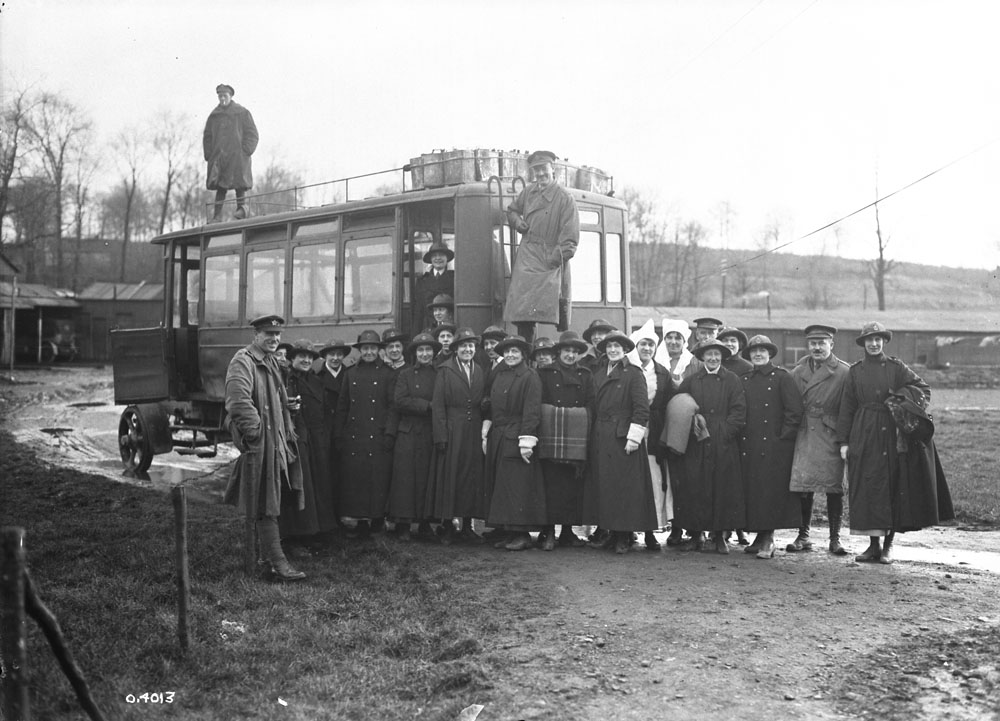
The first members of the Canadian Army Medical Corps Nursing Service attached to the British Expeditionary Force, a contingent of 20 Nurses who arrived in France on 7 November 1914 for duty with Imperial units. Peak strength of the C.A.M.C. in France 828 Nursing Sisters on 1 March 1918. With the closing of the Matron-in-Chief’s Office in London, on 30 June 1919, the Canadian Nursing Sisters Demobilization in England had ended.

Inspecting Matron
On 19 November 1917, the Army Council decided that an Inspecting Matron for the Canadian Hospitals in France should be appointed to the Staff of the Matron-in-Chief B.E.F. Matron Boulter C.A.M.C. nominated to the post. However, Boulter fell ill, and on 30 January 1918, Matron E. B. Ridley, R.R.C., C.A.M.C., arrived in France to take up the duties of Principal Matron, Canadians. Attached to the Office of the Matron-in-Chief. In spite of the fact that she was specially appointed for Inspection duties, no definite arrangement was made for a car to be placed at her disposal.
In October 1918, a question arose as to whether Miss Ridley should be taken on the staff of the Director of Medical Services, Canadian Section of General Headquarters, 1st Echelon. A letter received from the Matron-in-Chief, Canadian Expeditionary Force suggesting the transfer. But, the Canadian authorities took no further action in the matter. And then, in November 1918, authority granted by the D.M.S., for the appointment of an Assistant to the Principal Matron, Canadians. Finally, Nursing Sister E.F. Pense, C.A.M.C., of No.2 Canadian General Hospital, selected for this post.

Armistice
Following the Armistice in November 1918, the allotment for leave in France raised to permit more Canadian Sisters, many of whom were French Canadians, with no interests in England, to spend their leave in France. From the time of opening in December 1917, until it closed on 20 April 1919, many a Canadian Nurse would stay here. In January, 88 Nursing Sisters spent periods of leave at Princess Victoria’s Club in Paris – a residential Club, with every comfort. In the winter of 1918 – 1919, 110 Nursing Sisters spent time at Hotel de l’Esterel, Cannes, and another 40 nurses stayed at Casa del Mare.
The Canadian Red Cross Society, opened a Nurses’ Rest House at Boulogne on 1 April 1918. Known as, The Hotel du Nord Hostel, to those who had visited. Miss Woodford, R.R.C., TFNS., the Embarkation Sister, who up to this time had been accommodated at the Louvre Hotel, given a bedroom and an Office here. It had accommodation for about 70 persons, and members of all Services passing through on duty, or on leave, accommodated.
Mrs. Gordon Brown, V.A.D. Canadian Red Cross, appointed in charge of the Hostel, and an establishment of 13 V.A.D.s was authorized. The entire cost of rent, equipment, service etc., was borne by the Canadian Red Cross Society. This Hostel has been of the very greatest service to all Nursing Staff passing through Boulogne.
Nursing Sisters Demobilization
After Nursing Sisters Demobilization began, Canadian Headquarters in London made arrangements for parties of Canadian Matrons and Nursing sisters from the UK to come over to France to visit the battlefields. The nurses arrived in parties of 15 to 30, and accommodated at first in the Hotel du Nord, and later when that closed, at the Marine Hotel (Nurses’ Demobilization Hostel). Then, the Embarkation Sister met them, and every possible arrangement made for their comfort.
On the demobilization of Canadian units, the Nursing Staff proceeded to England in parties, to report to the Matron-in-Chief, O.M.F.C., unless definite instructions had been received as to their disposal otherwise. At long last, the first to return to England was the Canadian Foresty Corps Hospital, La Joux Vosges, on 28 January 1919.
Allied Occupation of Germany
The end of the Canadian participation in the Allied Occupation of Germany, brought about the closing of No.1 and No.2 C.C.S. at Bonn on 31 January 1919. Later, they returned to England on 6 February 1919. No.1 Canadian General Hospital, had closed at Le Treport in January. But, had returned to England on 7 March 1919. This allowed the staff plenty of time for leave, and to visit France.

On 30 March 1919, No.3 C.C.S. closed at Mons. For those who fell ill in Belgium awaiting demobilization, Boulogne, and Etaples would be their treatment hospitals. Matron-in-Chief Miss Macdonald’s final visit of inspection on the Western Front, occurred in May 1919. She was accompanied by Principal Matron E B Ridley, and authorized to visit the Army of Occupation in Germany.

No.3 Canadian General Hospital, Boulogne, returned on 19 May 1919. Later that month, on 30 May, No. 7 Canadian General Hospital, Etaples, returned to England.
Awards
In January of 1919, the C.B.E. was awarded to Principal Matron E B Ridley, R.R.C. Nursing Sisters F. M. Clark and J A Macdonald received the Medailles des Epidemies in January, 1919, for their work with a surgical team from No.4, Canadian C.C.S., attached to the Hopital St. Jean, Arras, for the benefit of French civilians, during the advance in the autumn of 1918.
The Bar to the R.R.C. awarded to Matron E. M. Wilson, No.3, Canadian Stationary Hospital, in June 1919
Nursing Sister M. H. Forbes, C.A.M.C., awarded the Medailles des Epidemies in the London Gazette of 11 July 1919, for work on behalf of the French on the Western Front.
Principal Matron Miss E. B. Ridley C.B.E., R.R.C., proceeded to England on 30 June 1919, and her branch of the Matron-in-Chief’s Office closed. Her Assistant, Miss E. F. Pense, R.R.C., left on 24 August 1919, marking the end of Nursing Sisters Demobilization in England.
Military Medal
The eight Canadian Nursing Sisters who received the Military Medal are:
- Matron E. Campbell No.1, Canadian General Hospital
- N/Sister L. Harrington No.1, Canadian General Hospital
- N/Sister L. Urquhart No.1, Canadian General Hospital
- N/Sister J. M. Williamson No.1, Canadian General Hospital
- N/Sister E. J. Thompson No.3, Canadian Stationary Hospital
- N/Sister M. Hodge No.3, Canadian Stationary Hospital
- N/Sister E. H. Hanson No.7, Canadian General Hospital
- N/Sister B. McNair No.7, Canadian General Hospital
Le Tréport
No. 2 Canadian Stationary Hospital granted the distinction of being the first of all Canadian units to place foot upon French soil. This unit, under Lieutenant-Colonel Adam Tozeland Shillington, after the inspection by Their Majesties the King and Queen two days previously, left Salisbury Plain on 6 November 1914.

No. 2 Canadian Stationary Hospital was fully-operational in Le Tréport, from 16 March 1915 until 2 March 1919.
Please subscribe to CEFRG to be notified by email when there are new posts. Subscription is free, and your email kept confidential.