Background Information
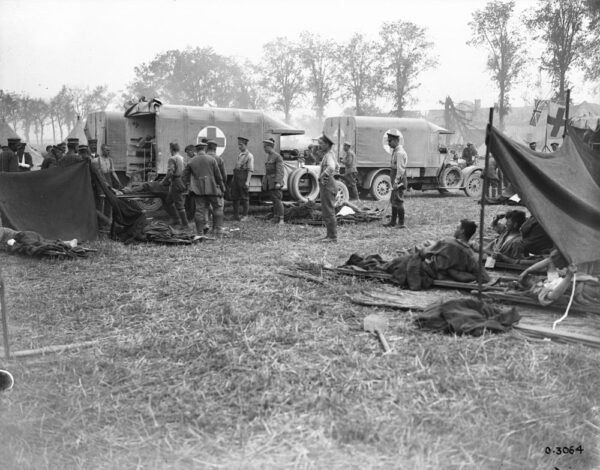
No. 1 Canadian Field Ambulance organized at Valcartier in September 1914 under the command of Lieutenant-Colonel Arthur Edward Ross. Seven times Mentioned in Despatches, LCol Ross eventually reaches the rank of Brigadier-General, serving as Director of Medical Services for the CEF.

No 1 CFA left Quebec on 30 September 1914 aboard SS MEGANTIC, and later arrived in England 14 October 1914 with a strength of 16 officers, 257 other ranks.
Halifax Boys
Post card sent from Halifax 28 Sept 1914. Private William Baker, grandfather of Greg Baker, 4th from the left. Note on top of card mentions him, Willi Baker.
First Contingent
The medical units accompanying the First Contingent the following: No.1 Canadian Field Ambulance, O/C Lieutenant-Colonel Arthur Edward Ross (of Kingston, Ontario), No.2 Canadian Field Ambulance, O/C Lieutenant-Colonel D W McPherson (of Toronto), No.3 Canadian Field Ambulance, O/C Lieutenant-Colonel W L Watt (of Winnipeg), No.1 Canadian Casualty Clearing Station, O/C Lieutenant-Colonel F S C Ford (of New Germany, N.S.), No.1 Canadian General Hospital, O/C Lieutenant-Colonel Murray MacLaren (of St John, N.B.), No.2 Canadian General Hospital, O/C Lieutenant-Colonel J W Bridges, P.A.M.C., No.1 Canadian Stationary Hospital, O/C Lieutenant-Colonel L Drum, P.A.M.C., No.2 Canadian Stationary Hospital, O/C Lieutenant-Colonel A T Shillington (Ottawa).
A Section
Captain Josias Louis Duval, Captain Hewet Donald John DuChene, Captain Raymond Meyers Gorssline, Honourable Captain Frank Arnold Davis McConnell, P A M C, Captain George Joseph Boyce, and finally, Sergeant-Major William Gordon Buswell. Later, Brigadier Raymond Myers Gorssline OStJ, DSO, MD (28 July 1885 – 1968) the 12th Canadian Surgeon General. Colonel George Joseph Boyce later awarded the DSO.
B Section
Major Robert Percy Wright, Honourable Captain Honore Beaudry, Captain Chas Robert Graham, Captain Robert Conrad Geggie, and finally, QSM John Benjamin Owens.
C Section
Captain Roy Hosmer McGibbon, Captain George Patrick Howlett, and Captain Ervin L Stone.
Demographics
A total of 782 Other Ranks and Officers in the No. 1, 2 and 3 Canadian Field Ambulance Nominal Roll.
- 311 Canadian
- 296 British
- 96 Scottish
- 33 Irish
- 23 American
- 8 Welsh
- 6 India
- 3 Newfoundlanders
- 2 Danes
- 1 Austrian
- 1 New Zealander
- 1 Galicia
- 1 Status Indian
Forty-percent of the men Canadian born.
No.1 Canadian Field Ambulance Plymouth, England
No.1 Canadian Field Ambulance arrived in Devonport Harbour, 14 October 1914, and later disembarked on 16 October 1914 at 3:30 pm and marched to Friary Station, entraining for Amesbury at 9:30 pm. with over 30 men suffering severely from Ptomaine (food) poisoning from a lunch onboard SS MEGANTIC (suspected to have been deliberate).

Bustard Camp
Bustard Camp reached at 7:30 am on 17 October 1914, and later, General Alderson visited the lines at 7 am on 21 October 1914. The whole division parades before General Campbell and General Alderson on 27 November 1914.

On 3 December 1914, Private Alfred Ernest Pearse 400450 seriously ill (double pneumonia) at Nethercourt Hospital, Ramsgate. Private Pearse died on 8 December 1914, and later buried at Ramsgate Cemetery (U.K.).

1915
First presentation of “Pork and Beans” on January 26 1915.

Morale
With a low morale in the unit (many men frequently AWOL), O/C Lieutenant-Colonel Arthur Edward Ross adopts several measures of punishment on 1 February 1915.
Major R P Wright sent to hospital on 5 February 1915, and then the unit prepares to leave Bustard the next day.
Later, embarked SS ATLANTIAN at Avonmouth at 9 pm on 7 February 1915, reaching St Nazaire on 11 February 1915, and arriving at Hazebrouck, Belgium at 2:40 pm on 13 February. By the end of February, the unit in Sailly until 12 March 1915 when Fleurbaix reached.

No.1 Canadian Field Ambulance moves to Estaires on 26/27 March 1915, later moving to Watou on 17 April 1915, and Vlamertinghe on 24 April.

Second Battle of Ypres
On the fifth day of the Second Battle of Ypres, Major Josias Louis Duval Major wounded 26 April 1915, and later died of wounds 26 August 1915, and commemorated at Hollybrook Memorial, Hampshire – the body of Major Duval lost on the HESPERIAN on his way home to St John, New Brunswick.

As the death toll mounted, a significant decision taken later in 1915 by the Imperial War Graves Commission (IWGC) – human remains would not be brought home for burial. Even when families understood that repatriation not practical in the midst of the titanic war, some deeply aggrieved that the decision held firm in peacetime.
Two days after Doctor Duval wounded, Private Edgard DeMeule 32792 died of his wounds received on 25 April (GSW both legs) and later buried at Hazebrouck Communal Cemetery.


Boulogne Eastern Cemetery
Private Adrian Brisebois 32912, another French-Canadian suffered devastating wounds to his left leg, thigh and forearm on 26 April 1915. He later succumbed to his wounds on 6 May 1915 at No.11 General Hospital, and buried at Boulogne Eastern Cemetery.
Private Joseph Fortnum 32875 died 4 May 1915, and later buried at Shorncliffe Military Cemetery – Joseph the son of Joseph and Ellen Fortnum, of Lion Farm, Portway, Burghill, Hereford, England. His shrapnel wounds later developed gangrene, a common cause of death in the Great War.

On 13 September 1915, Lt-Col A E Ross leaves the unit and assigned as ADMS, 1st Canadian Division of the Canadian Corps. Ross would be Mentioned in Despatches seven times during the war. Major Robert P Wright assumes temporary command of No. 1 CFA.
1916
Private Thomas Taylor 524683 of ‘B’ Section, accidentally killed while proceeding to the Western Front, died 2 April 1916, and later buried at Calgary Union Cemetery. Husband of Esther Elizabeth Wagner (formerly Taylor), of 129, 2nd Avenue West, Calgary, Alta.

Private Stephen Patrick McAllister 32890 (shell shock) died 5 August 1916 of a heart attack, and later buried at Sunderland (Bishopwearmouth) Cemetery.

Rheninghelst Field Sports
No.1 Canadian Field Ambulance held their own sports meet later at Rhenighelst, Belgium on 22 June 1916.
The Crowd

Officer’s Race

Hop-Step-Jump

Obstacle Race
100 Yard Dash

Running the Bases
High Jump
Shot Put

Tug of War

Battle of Flers-Courcelette
Private Walter M McNutt 32855 died 1 October 1916 (GSW Chest on 29 September 1916), and later buried at St Sever Cemetery, Rouen.

Private George William Heidt 523240 killed in action 9 October 1916, and later buried at Albert Communal Cemetery Extension.

Sir Sam Hughes forwarded a telegram to the parents of Private Heidt following his death.

Private Algie Wilson McDonald 523243 died of pneumonia 29 December 1916, and later buried at Lapugnoy Military Cemetery. Son of John and Isabel McDonald, of French River, Pictou Co., Nova Scotia.
On 5 November 1916, Major Boyce assumes command of No. 1 CFA with Lt-Col R P Wright assigned to ADMS for temporary duty. Boyce returned in command on 15 December 1916. On Christmas Day, Lt-Col Wright returned after an absence of seven weeks as ADMS, 1st Canadian Division.
1917
Major George Joseph Boyce wounded at duty on 9 April 1917 (Battle of Vimy Ridge).

On 20 June 1917, Lt-Col R P Wright to 1st Division as ADMS, Major Boyce in temporary command of No. 1 Canadian Field Ambulance.
Corporal David Alexander Black MM
Cpl David Alexander Black MM 528674 killed-in-action on 15 August 1917, and later buried at Barlin Communal Cemetery Extension.

Earlier, Corporal Black had been awarded the Military Medal for Bravery in the Field on 6 August 1917.

Pte Clarence Seymour Thomas
Private Clarence Seymour Thomas 50101 died 6 December 1917 in the Halifax Explosion after a long illness (peritonitis), and later buried at Halifax (Mount Olivet) Cemetery after being invalided to Canada. He died along with his mother and two sisters.

One of the ‘Black Sheep’ of the unit, Private Thomas had been admonished no less than five times for offenses such as being AWOL and conduct to the prejudice of good military order.
Medical Officer: “What’s the matter with you?“
Private: “I haven’t slept for four nights.“
M.O.: “You are just the man we want for night orderly. Report to the Sergt-Major.“
- The Splint Record, Publication of No. 2 Field Ambulance, December 1915
1918
Battle of Amiens

Private Joseph Rosaire Godin
Private Joseph Rosaire Godin 61361 died 8 August 1918 and later buried at Hangard Wood British Cemetery – son of Philippe Godin and Rébecca Côté, of Ste-Anne-de-la-Pérade, Mauricie, Québec. He stated being born on 25 October 1893 when he enlisted.
Rosaire sailed to England with the 22nd Battalion, but due to pneumonia, not able to serve at the front. Repatriated and released in November 1915, meanwhile, on 23 September, his brother Moïse, also serving with the 22nd, killed in Belgium shortly after his arrival in the trenches.

Son of Philippe Godin and Rébecca Côté, of Ste-Anne-de-la-Pérade, Mauricie, Québec. Three years later, on 8 August 1918, his brother Rosaire also died in action.
Once healed, Rosaire re-enlisted with the medical corps, re-sailed overseas and joined No.1 Field Ambulance at the front. On 8 August 1918, part of a group of eight stretcher-bearers working with the 2nd Battalion in Hangard Wood and killed when a shell exploded near them.
Hangard Wood British Cemetery
Pvt Gray 524308 died 8 August 1918 and Private Maloney 2114805 died 8 August 1918 and also buried at Hangard Wood British Cemetery.

Pvt Frederick James Brabrook 823242 died 12 October 1918 and later buried at Bucquoy Road Cemetery – Son of James and Elizabeth Brabrook, of 52, Savage Gardens, New Beckton, London, England, husband of Amy Brabrook, of 17, Lansdown Avenue, London, Ontario.

Private William Hinnells 522848 died from a lengthy illness 16 November 1918, and later buried in the south-west corner of Salthouse (St Nicholas) Churchyard.
Influenza
Sergeant William Edward Baker MM 26669 died from Influenza on 27 November 1918 and later buried at Nivelles Communal Cemetery.

Private Clifford Donald Ackerman 536141 died of Influenza on 3 December 1918 and later buried at Belgrade Cemetery.

Son of Charles Frederick and Mary Dail Graydon Ackerman.
The Rhine
On 13 December 1918 the Canadian troops crossed the Rhine, the 1st Division at Cologne, and the 2nd at Bonn, and immediately established the southern half of the Cologne Bridgehead.

Field ambulances still with brigades and located in suitable positions to serve all troops. Following the crossing of the Rhine, No.1 Canadian Field Ambulance moved to Wahn (Artillery Barracks).

Lt-Col George Joseph Boyce DSO commanding since 3 June 1918. ADMS 1st Canadian Division on 1 January 1919. Boyce relinquished this appointment on 24 May 1919.
1919
Private Andrew Willard Long 192129 died from Influenza on 19 January 1919 and later buried at Brussels Town Cemetery. Son of Mrs. Mary A. Long, of Montreal, Quebec.

The final casualty of No 1 CFA, Private Edouardard Badeau 32861, also died of Influenza/pneumonia on 25 January 1919 and later buried at Terlincthun British Cemetery. Son of Ferdinand and Philomene Ponlin Badeau.
Demobilization
No.1 Canadian Field Ambulance demobilized at Kingston in April 1919, and disbanded by General Order 211 of 15 November 1920. In addition, published “NYD”, “Iodine Chronicle”, “Splint Record”, “Now and Then”, with No.2 and No.3 Field Ambulance between 25 October 1915 and July 1918.
Contact CEFRG


Subscribe to CEFRG
What’s it all about?
