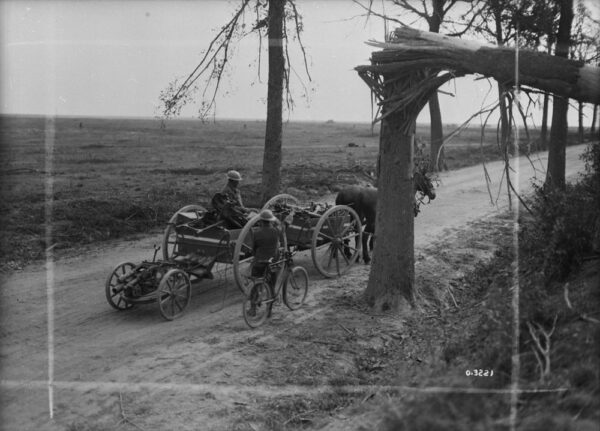
The Trench Mortar Battery a small unit organized during the Great War to employ Mortars in action. At first, each division had a trench mortar group, composed of one heavy battery and three medium batteries. Each infantry brigade had a light trench mortar battery which contained eight mortars organized into four batteries.

MIKAN No.3397870
A GHQ letter of 15 December 1915 authorized the formation of two light trench mortar batteries in each brigade. Another GHQ letter (9 September 1916) authorized that the two brigade batteries be combined, taking the brigade number for the new battery designation. The establishment apparently consisted of the officer commanding, four section officers and 60 other ranks.
Battalion and Brigade Batteries
Generally speaking, Trench Mortar Batteries organized into sections, two guns (mortars) per section and four sections per battery. These batteries existed both at the Infantry Battalion level as well as the Infantry Brigade level (though in action the guns of the battery usually attached to the infantry battalions as needed).

2-inch medium mortar
The weapon featured a 2-inch (50.8 mm) caliber barrel approximately 3 feet (90 cm) long, weighed about 105 pounds (48 kg) in firing position including the tube, baseplate, and stand, and fired 51-pound (23 kg) high-explosive bombs filled with Amatol or Ammonal at a maximum range of 570 yards (520 m), with a rate of fire of roughly one round every two minutes.
Note: X2C Battery, apparently, also bore the designation 25th Canadian Trench Mortar Battery. The war diary of the 25th, from 18 December 1915 to 31 March 1916. Z2C Battery apparently also bore the designation 53rd Canadian Trench Mortar Battery.
The Trench Mortar Battery commanded by a battery commander and four subalterns, with enough personnel to allow a five-man crew for each mortar, with one man designated as the gun commander.
CEF Trench Mortar Batteries by 1918 distributed as follows:

- Infantry Battalion: one light (3-inch Stokes Gun) battery
- Divisional troops: one heavy (9.45-inch Newton Mortar) battery and two medium (6-inch Newton Mortar) batteries.

In all, an infantry division thus had 36 mortars of all types.
Trench Mortar Batteries in 1915
2nd Canadian Divisional Trench Mortar Group
Organized at Loire, Belgium in December 1915 under the command of Captain Edwin Russell Leather. Composed of W2C (Heavy) and X2C, Y2C and Z2C (Medium) Batteries.

Lieuts. Arthur Beckingham Dewberry, Wolfred Forsyth Wurtele, Brenton F. Morse, Capt. Ronald Frank Haig, Lieuts. James Kyran Latchford, James A. McGibbon MIKAN No. 3522765
Lt Wolfred Wurtele had a sister in the CAMC. Nursing Sister Rhoda Blanche Wurtele served in England and France with No. 15 Canadian General Hospital, No. 2 C.C.C.S. and aboard HMHS ARAGUAYA. SoS of the CAMC late on 25 August 1919, Rhoda one of the last to return to Canada. Brothers Everard George Moyle Wurtele served with the 3rd Battalion, and Lt William Godfrey Wurtele with the 59th Battalion.
Captain Edwin Russell Leather originally from the 13th Field Battery, CFA.
Prior to 1 March 1916, three war diaries exist for (light) Trench Mortar Batteries, and one medium TMB (25th Bty). These diaries incomplete – missing entries from before and/or after the existing diaries.
- 14th Brigade, Trench Mortar Battery (Jan – Feb 16)
- 35th Brigade TMB (Jan – Feb 16)
- 46th Brigade, TMB (Jan – Feb 16)
- 25th Brigade, Trench Mortar Battery (Dec 15 – Mar 16)
Trench Mortar Batteries in 1916
January 1916
Commanded Lt. G H Butt, 14th Brigade, Trench Mortar Battery returned from trenches on 3 January 1916, returning to trenches on the 9th.

46th Brigade, Trench Mortar Battery initially commanded by Lieutenant W. E. McIntyre, now led led by Lt F Thompson at Wulverghem during Jan-Feb 1916.
February 1916
1st Canadian Light Trench Mortar Battery
Two batteries, designated 1/C/1 and 1/C/2, organized in Flanders in February 1916. Personnel form 1st Canadian Infantry Brigade. Amalgamated and designated 1st Canadian Light Trench Mortar Battery in June 1916. Commanded by Captain William Ewart McIntyre.

Captain W E McIntyre originally of the 23rd Reserve and 3rd Battalions. Served with 46th Trench Mortar Battery and 58th Light Mortar Battery.
14th Brigade, Trench Mortar Battery went out for rest and reorganization on 19 February 1916 at Fleitre (last entry of the war diary).
March 1916
4th Canadian Light Trench Mortar Battery
Two batteries, designated 4/C/1 and 4/C/2, organized in France in March 1916. Personnel from 4th Canadian Infantry Brigade. Amalgamated and designated 4th Canadian Light Trench Mortar Battery in July 1916. Commanded by Captain Alfred S. Morrison. Reorganized on 20 March 1916 with 1 Officer, 24 men, and four 3.7″ mortars.
Captain Morrison attached to the 39th Battalion on 17 November 1916. MiD, and SoS on being declared permanently unfit by Medical Board in Canada on 20 March 1917.
2nd Canadian Light Trench Mortar Battery
Two batteries, designated 2/C/1 and 2/C/2, organized in France in March 1916. Personnel from 2nd Canadian Infantry Brigade. Amalgamated and designated 2nd Canadian Light Trench Mortar Battery in June 1916. Commanded by Captain G. Costigan.
1st Canadian Divisional Trench Mortar Group
Organized at Neuve Eglise, Belgium in March 1916 under the command of Captain C. S. Hanson. Composed of VIC (Heavy) Battery and XIC, YIC and ZIC (Medium) Batteries.

Driver Richard John Ashburne, 53rd (Z2C) Trench Mortar Bty., 31 March 1916,(BAILLEUL COMMUNAL CEMETERY EXTENSION, NORD). Dvr Ashburne killed in the Dia Gellia communication trench, reported Lt A M Thurston, 53rd (Z2C) Trench Mortar Bty., 2nd Canadian Division.

MIKAN No. 3395179
6th Brigade, Light Trench Mortar Battery
Lt R Pouncey and 22 men detailed for Stokes Gun instruction at Brulooze on 6 March 1916. Battery organized on 12th March, with 1 Officer, 1 Batman, and 21 men. Fired several rounds on 15 March 1916.
7th Brigade, Light Trench Mortar Battery
7-C-1 Trench Mortar Battery assembles for first time on 20 March 1916, Lt Richardson commanding.
5th Brigade, Light Trench Mortar Battery
5-C-1 ordered to report for to Lt Leather 2nd Division Trench Mortar Group for reorganization on 21 March 1916. An Officer of the 24th Bn (Captain R M Fair), and NCOs and men from the 24th, 25th and 26th, along with the Trench Mortar Group made up the battery.

On 30 March 1916, several men of the battery arrested for drunkenness in a barn near Locre. The arrested men remanded to Lt Watson, the OC of the 5th Brigade Machine Gun Coy.
9th Brigade, Light Trench Mortar Battery
The battery consisted of C-9-1 and C-9-2 batteries, formed from Officer’s, NCOs, and men from the 43rd, 52nd, 58th, and 60th Battalions at Meteren. War diaries from March to September 1916, with Captain John E Ryerson in command.

Regrettable that Captain Henry James Horan not aware of the necessity of rendering a war diary, in ignorance of orders issued 7 February 1916. A synoptical war diary submitted at the end of March 1916.
53rd Brigade, Trench Mortar Battery
Commanded by Lt Arnold Monroe Thurston, and attached to the 2nd Canadian Division. Only the war diaries for the month of March 1916 exist.
April 1916
At Rheninghelst on 12 April 1916, 6th Brigade, Light Trench Mortar Battery reorganized as 6/C/2 Trench Mortar Battery, composed of 2 Officers, 1 Sergeant, 4 Corporals, 16 Gunners, and 2 Batmen.
3rd Canadian Light Trench Mortar Battery
Two batteries, designated 3/C/1 and 3/C/2, organized in France in April 1916. Personnel from 3rd Canadian Infantry Brigade. Amalgamated and designated 3rd Canadian Light Trench Mortar Battery in June 1916. Personnel to be composed of Lt J S Williams, A/Temp Lt J W Keith and 20 men.
May 1916
Captain E R Leather, 2nd Canadian Divisional Trench Mortar Group, awarded the Military Cross on 31 May 1916.
3rd Canadian Divisional Trench Mortar Group
Organized near Sanctuary Wood in May 1916 under the command of Captain H. O. Bennatt. Composed of V3C (Heavy) Battery and X3C, Y3C and Z3C (Medium) Batteries
June 1916
8th Brigade, Trench Mortar Battery war diary begins 1 June 1916. Reorganization and consolidation of the battery on 13 June 1916, now to be known as 8th Canadian Infantry Trench Mortar Battery. Captain B M Beckwith in command.
Gunner Herron, 3rd Trench Mortar Bty. and Lt Harold Louis Hull, 1st Trench Mortar Bty., 3 June 1916 (PERTH CEMETERY (CHINA WALL) and YPRES (MENIN GATE) MEMORIAL, respectively).

Lt H L Hull the son of the Hon. H. C. Hull, formerly of Johannesburg, now of Muizenberg, Cape Province; husband of Louise Hull, of Muizenberg. Born at Kimberley; educated at St. Andrew’s College, Grahamstown, Repton School, England, and McGill University, where he Graduated in Engineering. Joined 1st Canadian Contingent at outbreak of War.
Lt Arnold Monroe Thurston, 2nd Div. Ammunition Col., seconded to 2nd Trench Mortar Bty., killed in action 26 June 1916 (RENINGHELST NEW MILITARY CEMETERY). Son of Willard Hadley Thurston and Kate Gaudin (his wife), of Flesherton, Ontario. Thurston killed in a trench along with his batman, Gnr Coull 90029 after returning from an observation post.
9th Brigade, Light Trench Mortar Battery reorganized and consolidated on 20 June 1916. Captain H J Horan returning to his unit with Lt John E Ryerson taking command. To be known in future as 9th Canadian Trench Mortar Battery.
July 1916
Lt John Lockhart Godwin, att’d Z/1/C Trench Mortar Battery killed in action 8 July 1916 (RENINGHELST NEW MILITARY CEMETERY).

Reninghelst New Military Cemetery, 23 April 2015, CEFRG.ca
V, W, X, Y, Z Trench Mortar Batteries, 1st and 2nd Divisions
Lt William Sinclair Tuck in command of V, W, X, Y, Z Trench Mortar Batteries, 1st and 2nd Divisions while Captain Allen invalided to England, 10 July 1916.

Specialist training of trench mortar officers and men carried out at schools, organised one per Army in France.


Schools
- First Army – located at Saint-Venant (and had originally been I Corps Trench Mortar School).
- Second Army – at Berthen (certainly by spring 1915) but later Leulinghem (by mid-1917).
- Third Army – at Saint-Pol-sur-Ternoise

Total casualties in July 1916 1 killed, 1 Officer shell shocked.
August 1916
Disposition of the stokes mortars at night of the 8th Brigade, Trench Mortar Battery. Blue marks the German Trenches.


5th Brigade, Trench Mortar Battery fired 120 Stokes Bombs in retaliation for 14 Rum Jars, 75 Fishtails, and 2 minenwerfers on 2 August 1916 on the Veerstraat Front. Casualties 1 killed, 1 wounded. Lt Fontaine and Lt Holmes return to their battalions, not being suitable for Trench Mortar Work. Lt La’Coste from the 22nd Battalion joins instead. The following day, one gun fires on O.7.b.1.1 to register, and the Germans retaliated heavily.

On 24 August 1916, whilst attached to the Trench Mortar Battery, Gunner W C Charles of the 2nd D.A.C. killed when the enemy obtained a direct hit on the emplacement where he was at duty.

Att’d 5th Canadian Div. T.M. Battery.
RIDGE WOOD MILITARY CEMETERY
SON OF WILLIAM ROBERT AND MARY MARTHA MARGARET RIDDELL, OF 55, HUNTLEY ST., TORONTO, ONTARIO.
September 1916
Captain Henry James Horan, 52nd Battalion, killed in action, 16 September 1916 (VIMY MEMORIAL). Horan formerly the OC of 9th Brigade, Light Trench Mortar Battery.

October 1916
Lahore Battery Trench Mortar Group (V, X, Y, Z Batteries)
At Colincamps on 1 October 1916, Lahore Battery Trench Mortars attached to the V Corps. British Captain Edgar Cecil Robertson Haddow in command. War diaries begin under the Reserve Divisional Trench Mortar Group. By the 6th, transferred to the VIII Corps. By the end of the month, firing on the German Front by X/L Battery in the BULLY-GRENAY SECTOR.

11th Brigade, Light Trench Mortar Battery. War diaries exist for October 1916 and June 1917.
11th Brigade, Trench Mortar Battery assisted in the capture of REGINA TRENCH on 21 October 1918. On 30 October 1916, when in Colincamps, in the vicinity of Serre, Lt W H Gordon instantly killed by a shell which struck the road in front of him.

2nd D.A.C.
COURCELLES-AU-BOIS COMMUNAL CEMETERY EXTENSION
NEPHEW OF WILLIAM SINCLAIR DAVIS, OF OAKVILLE, ONTARIO, CANADA.
The same fate must have befell Captain William Sinclair Tuck, buried beside Lt Gordon. CoD records do not exist beyond ‘SIMS’ alphabetically.

2nd Trench Mortar Bty
December 1916
Lt Harold Gladstone Murray att’d to the 1st Divisional Trench Mortar Brigade in March of 1916. He commanded X Battery on the Somme, then transferred to the Royal Flying Corps with No. 12 Squadron as an Observer.

Key feature: Land N Dranoutre, Locre-Dranoutre Road
While on photography patrol on 16 December 1916, his machine attacked by three enemy planes. He managed to shoot one of the enemy down, but his machine badly damaged, and crashed shortly after returning over friendly lines.

1st Canadian Div. Trench Mortar Bty.
VESNES-LE-COMTE COMMUNAL CEMETERY EXTENSION
SON OF ALEXANDER. G. AND SARAH FRANCES DE N. MURRAY, OF FORT FRANCES, ONTARIO. HON. GRADUATE TORONTO UNIVERSITY. BORN AT TORONTO.
5th Canadian Trench Mortar Group
Organized at Whitley in December 1916 under the command of Captain W. H. Abbott. Composed of V5C (Heavy) Battery and X5C, Y5C and Z5C (Medium) Batteries. In February 1917:
- V Heavy Battery led by Lt Newton and Lt Birnie with 17 OR.
- X Medium Battery led by Lt McEachern, Lt Waddington and 20 OR.
- Y Medium Battery led by Lt Short, Lt McClenachan and 20 OR.
- Z Medium Battery led by Lt Robinson and 20 OR.
Lt Blayney Edmund Scott MC DFC
Lieutenant Blayney Edmund Scott joined the Trench Mortar Battery on 22 November 1916. He had already served as a Trooper with 2nd CMR.Tried by FGCM in the field on 9 May 1917 and sentenced to be severely reprimanded. Awarded the MC on 18 October 1917. Seconded for Duty with the RFC on 24 January 1918.

With No. 55 Squadron, RAF from May 1918 as a Second Lieutenant Observer. Awarded the Distinguished Fly Cross on 3 August 1918.

Wounded the following month, he would relinquish his commission in January of 1919. He sailed to Canada in February 1919 and tragic circumstances upon his arrival at Banff, Alberta would lead to his death in November of 1919.
Trench Mortar Battery in 1917

February 1917
On 15 February 1917, 5th Canadian Divisional Trench Mortar Group sent Lt S H Short to the Royal Flying Corps, Lt Wilson transferred to 15th Brigade along with Lt Robinson. Lt D S Strayner joined from D.A.C., as did Lt D McCutcheon from the 14th Brigade.
Larger mortars sometimes used for cutting barbed wire, especially where field artillery could not be used, either because of the danger of hitting British troops or where the effect of the fire could not be observed.

Experience on the Somme revealed that use of Stokes mortars in an offensive close-support role had been limited by the reluctance of some commanders to sacrifice rifle strength to provide parties required to carry the ammunition which the weapons so quickly consumed.

March 1917
X, Y and Z Batteries of 5th Canadian Divisional Trench Mortar Group in quarantine for mumps. By the end of the month all ranks confined to camp preparing for mobilization.
April 1917
On 1 April 1917, 4th Canadian Divisional Artillery changed to 5th Canadian Divisional Artillery.


Trophies
The Canadian Corps captured thousands of enemy machine-guns, artillery pieces, and other items during the war. These war trophies tangible representations of victory and valuable personal souvenirs. Hundreds came back to Canada with the returning troops.

Official reports always noted proudly the number of prisoners and guns captured as tangible examples of victory. Proof of military success or validations of pre-battle intelligence reports. They could also influence promotions, reputations, and the granting of honours and awards.

Controller of War Trophies
At war’s end, Sir Arthur Doughty, the Dominion Archivist, named Controller of War Trophies and charged with gathering trophies and bringing them back to Canada. While many Canadian trophies sent to the Imperial War Museum, thousands returned to Ottawa. In early 1920, the government’s official collection consisted of 516 guns, 304 trench mortars, 3,500 light and heavy machine-guns, and 44 aircraft.

Purple patches issued to all ranks of the 5th Canadian Divisional Artillery on 28 April 1917.
May 1917
Col J M Almond CMG Director of Chaplain Services preached on 13 May 1917. When war broke out in 1914 a South African episode either forgiven or forgotten; Almond one of the first chaplains accepted at the training camp in Valcartier for the Canadian contingent.

In November of 1916, General Richard Ernest William Turner had recalled Almond from the front, appointed him director of the CCS, which took effect on 15 Feb. 1917, and promoted him honorary colonel on 23 August.

More on Trophies
Note the German POW below persuaded to enlighten the Canadian Field Artillery Officer. A similar scene behind the German lines with a captured gun of the CFA never happened in the Great War.

Sir Arthur Currie quite proud the Canadian Field Artillery never lost a gun to the German Army during the entire war. The ammunition parks crowded with German artillery testament to this rather odd dichotomy.

Pride
Initial plans for a national war museum to house this collection, the official war art, and other artifacts delayed or ignored by successive governments. The collection remained with the Dominion Archives which was soon sending pieces of it across Canada in response to requests from communities, veterans groups, schools, and military units.

Cities or military bases often displayed large war trophies in central parks or in or near prominent buildings, and sometimes included them with local memorials.


Acquired in the burst of patriotic enthusiasm that marked the immediate post-war period, many gradually fell into disrepair.

The Public Archives collection slowly transferred to the Canadian War Museum, which reopened in 1942, decades after it had closed in the late nineteenth century. Most of the Museum’s current collection of Great War enemy guns, mortars, machine-guns, and small-arms comes from the official war trophy program.

Smaller collections also survive in military and civil museums across Canada, and on official memorials or in civic buildings.
June 1917
Gnr William Lindsay Hutton 1261189 SoS as a deserter. Apprehended on 16 June 1917, Hutton would spend six months at Wandsworth Detention Barracks. In December he joined the 1st Canadian Divisional Train in France. With the 13th Brigade in March 1919, once again, SoS as a deserter. He would return to Montreal aboard SATIVIAN on 25 July 1919.

The Lahore Mortar Battery (Reserve Divisional Trench Mortar Group) last diary entry of 30 June 1917 records 11 Officers and 113 OR with the unit. Much of the unit likely becomes the 4th Canadian Divisional Trench Mortar Group.
July 1917
4th Canadian Divisional Trench Mortar Group
Organized in France in July 1917 under the command of Captain G. H. Davidson. Composed of V4C (Heavy) Battery and X4C, Y4C and Z4C (Medium) Batteries.

11th Brigade, Trench Mortar Battery records two war diary entries, 8 & 12 June 1917. The battery in action on the Angres, Vimy & Givenchy Front. Commanded by Lt A Black.

Trench mortars, and in particular lighter models, played an important part in the final year of the war. During this phase, the German spring offensives introduced a new, aggressive form of warfare in which elite, well-equipped stormtroopers broke holes in the Allied lines and brought a new war of mobility. Trench mortars among the weapons that allowed them to do this, by providing supporting fire that could move forward with the infantry.

Light trench mortars became popular and versatile tools fielded by armies across the globe throughout the 20th century. While many of the techniques of the Great War would soon be abandoned, this was a weapon that would have a lasting impact.
August 1917


September 1917


German 240 Millimetre Albrecht Trench Mortar
The Albrecht mortar unusual for its wood construction, reinforced by a metal liner, wires, and bands. Using a hand wheel that adjusted the elevation, the mortar locked in position by tightening nuts on the frame. Accuracy very low and the range limited from 50 to 550 metres.
October 1917
5th Canadian Divisional Trench Mortar Group attached to 4th C.D.A. for duty, 10 October 1917.
Bombardier Sidney Herbert Walpole, 3rd Trench Mortar Bty., 25 October 1917 (VLAMERTINGHE NEW MILITARY CEMETERY). Son of William Herbert and Eliza Jane Walpole, of Vancouver, British Columbia. Brother of Private William Walpole who died on April 17, 1921 while serving with the Canadian Infantry (British Columbia Regiment).

Sucrerie Cemetery, Ablain-St. Nazaire
November 1917
Gunner Orville George Moyer, 3rd Trench Mortar Bty., 3 November 1917 (VLAMERTINGHE NEW MILITARY CEMETERY). Son of C. D. Moyer and Mary L. Wilkerson (formerly Moyer). Native of Columbus, Indiana, U.S.A.

1st Trench Mortar Bty.
OXFORD ROAD CEMETERY
SON OF EMMA C. NEWSON, OF 566, 42ND AVENUE, SAN FRANCISCO, CALIFORNIA, U.S.A., AND THE LATE HERBERT NEWSON. BORN AT TORONTO, CANADA.
Gunner C R Newson, 1st Trench Mortar Bty., 4 November 1917 (OXFORD ROAD CEMETERY).
Gunner Horace Booth, 2nd Trench Mortar Bty., 20 November 1917 (LIJSSENTHOEK MILITARY CEMETERY). Horace died of a shrapnel wound to the head at No. 2 Casualty Clearing Station.

Gunner George Elmer Wain, 5th Trench Mortar Bty., 21 November 1917 (LOOS BRITISH CEMETERY).
December 1917
Gunner Robert Maurice Hill, 5th Heavy Trench Mortar Bty., 19 December 1917 (NOEUX-LES-MINES COMMUNAL CEMETERY EXTENSION). Son of Alexander and Rachel Wain, of Tara, Ontario. A graduate B.A., Toronto University.

Trench Mortar Batteries in 1918
January 1918
Gunner Reginald Lavenbein, 3rd Trench Mortar Bty. 16 January 1918 (NOEUX-LES-MINES COMMUNAL CEMETERY EXTENSION). Son of Theodore and Mary Lavenbein, of Hamilton, Ontario. Native of England. Reginald’s brother Harry, also with the battery wounded.
February 1918
Gunner Greig and Bombardier Allan Cyril Walker, 5th Canadian Light Trench Mortar Bty., 6 February 1918 (BULLY-GRENAY COMMUNAL CEMETERY, BRITISH EXTENSION).
ML 9.45 inch Heavy Trench Mortar
The British 9.45-inch Mark I Mortar evolved in June, 1916, on the model of the French 240 mm. mortar, drawings of which had been borrowed in September, 1915, by Mr. Lloyd George, who took a keen personal interest in its adoption by the British Army. Sir John French recommended its copying at the end of October, 1915.

The Mark I had a rather short barrel with a maximum range of 1,150 yards. It fired a vaned bomb of steel weighing between 150 and 154 Ibs. and commonly called the ” Flying Pig.” The Mark II a longer type supplied to the Russian Government. Screw jacks used for tightening the bed in its seating in the pit. Bomb, Mark I, demolished a length of 30 feet of trench work, destroyed dugouts not heavily protected and, in compact clayey earth, make a crater 10 feet deep and 30 feet across.
March 1918
Gunner’s Bird, Longmuir and Corporal Hammond, 3rd Trench Mortar Bty., 12 March 1918 (LA TARGETTE BRITISH CEMETERY, NEUVILLE-ST. VAAST).
Private Gunnar Richardson, 12th Light Trench Mortar Bty., 21 March 1918 (VIMY MEMORIAL). Gunnar one of very few mortar-men listed on Vimy.
Driver William Ernest Hoad, Bombardier James Alexander Coburn, and Sergeant Heaps MM, 3rd Trench Mortar Bty., 30 March 1918 (LA TARGETTE BRITISH CEMETERY, NEUVILLE-ST. VAAST).
April 1918
Bbdr John Branion, 3rd Div. Trench Mortar Bty., 9 April 1918 (LA TARGETTE BRITISH CEMETERY, NEUVILLE-ST. VAAST).
Gunner Edward Sherburne Blanchard, 4th Trench Mortar Bty., 24 April 1918 (LA TARGETTE BRITISH CEMETERY, NEUVILLE-ST. VAAST).
Bombardier Leslie Victor Bland, 5th Trench Mortar Bty., 28 April 1918 (LA TARGETTE BRITISH CEMETERY, NEUVILLE-ST. VAAST).
May 1918
Gunner Peter Thomas Talbot, Can. Trench Mortar Bty., 23 May 1918 (AUBIGNY COMMUNAL CEMETERY EXTENSION).


June 1918
Much of the Canadian Corps spent the month in training, with plenty of sports competitions held, especially on Dominion Day at Tinques.

July 1918
Gunner John Alexander Wallace, 5th Div. Trench Mortar Bty., 23 July 1918 (LIGNY-ST. FLOCHEL BRITISH CEMETERY, AVERDOINGT).
Coporal Hatton, Y/1 Trench Mortar Bty., 25 July 1918 (ANZIN-ST. AUBIN BRITISH CEMETERY).
August 1918
Gunner Hammerton, 1st Div. Trench Mortar Bty., 3 August 1918, (LIGNY-ST. FLOCHEL BRITISH CEMETERY, AVERDOINGT).
Gunner McGillivray, 4th Trench Mortar Bty., 8 August 1918 (MEZIERES COMMUNAL CEMETERY EXTENSION).
Acting Bombardier Knight, 1st Canadian Div. Trench Mortar Bty., 28 August 1918 (ACHICOURT ROAD CEMETERY, ACHICOURT).


September 1918
Gunner Edward Code, 4th Canadian Div. Trench Mortar Bty. and Gunner Francis William Darragh, 5th Canadian Div. Trench Mortar Battery, 2 September 1918 (DURY MILL BRITISH CEMETERY and DURY CRUCIFIX CEMETERY, respectively).

Corporal Nelson MM, 5th Canadian Div. Trench Mortar Bty. and Gunner William Charles Oxland, 1st Div. Trench Mortar Bty., 3 September 1918 (LIGNY-ST. FLOCHEL BRITISH CEMETERY, AVERDOINGT).

Bombardier Jolley, 5th Trench Mortar Bty., 7 September 1918 (DURY MILL BRITISH CEMETERY).
Gunner William Arnold McElwain, 5th Trench Mortar Bty., 8 September 1918 (AUBIGNY COMMUNAL CEMETERY EXTENSION).

Driver Blais, 2nd Div. Trench Mortar Bty., 14 September 1918 (ST. SEVER CEMETERY EXTENSION, ROUEN).
IKO 24cm Schwerer Flugelminenwerfer
The IKO 24 cm Schwerer Flugelminenwerfer the standard German heavy mortar in the last half of the Great War.

3397948
The mortar fired a projectile stabilized by four large vanes or wings (“Flugel” in German). The German Army General Headquarters reserve included 13 battalions equipped with heavy mortars (schwerer minenwerfer). These battalions were assigned to reinforce the artillery on various fronts for significant offensive operations. Each regiment equipped with 24 heavy mortars.

The captured mortar well-preserved and rests at the Royal Canadian Artillery Museum.
Bbdr James Stuart Muir, 4th Trench Mortar Bty., 27 September 1918 (VIMY MEMORIAL).
Corporal Sackler, 4th Trench Mortar Bty., 28 September 1918 (BUCQUOY ROAD CEMETERY, FICHEUX).
Pvt George William Birt, 10th Light Trench Mortar Bty., 29 September 1918 (TERLINCTHUN BRITISH CEMETERY, WIMILLE).
October 1918
5th Canadian Light Mortar Battery in the Tilloy Sector 4-10 October 1918.


Gnr Jones, 4th Trench Mortar Bty., 8 October 1918 (ETAPLES MILITARY CEMETERY).
LCpl Morris Carter, 2nd Light Trench Mortar Bty., DCM MM, 24 October 1918 (TERLINCTHUN BRITISH CEMETERY, WIMILLE).
minenwerfer
German minenwerfer (mine throwers or trench mortars) used as infantry weapons and not part of the artillery. They could be disassembled into more easily-carried loads and set up in a narrow trench. Their short range meant they had to be placed close to the front lines where ammunition re-supply sometimes became a problem. Germany produced minenwerfer in calibers ranging from 76 millimetres to 250 millimetres.

This 76 millimetre mortar captured by the 3 Canadian Trench Mortar Battery and returned to Canada as a war trophy.

November 1918


At Jemappes, Belgium, the 3rd Canadian Divisional Trench Mortar Group disbanded on 13 November 1918.
On 14 November 1918, 5th Canadian Divisional Trench Mortar Group broken up among the 13th and 14th Brigades, CFA.
5th Canadian Light Mortar Battery disbanded in the afternoon on 16 November 1918.
In Onnaing, Belgium, the 1st Canadian Divisional Trench Mortar Group disbanded on 17 November 1918.
The Officer’s and men of the Trench Mortar Batteries absorbed by units in the Canadian Field Artillery. Many of these men would therefore participate in the March to the Rhine, even if they had belonged to a 3rd or 4th Division Brigade, which remained in Belgium and some parts of eastern France.

1919
Edwin Russell Leather MC
Captain Edwin Russell Leather MC, 2nd Canadian Divisional Trench Mortar Group, retired in the British Isles, 19 February 1919.
Blayney Edmund Scott MC DFC
Lieutenant Blayney Edmund Scott MC DFC died in Victoria on 9 October 1919. Son of Henry J. and Gertrude Eva Scott, of 1036, Craigdaroch Rd., Victoria, British Columbia. Buried at Victoria (Ross Bay) Cemetery. Blaney had returned to Canada on crutches, and disembarking the train at Banff caught in a blizzard and suffered bad frostbite to his hands and feet. His Death Card at VAC does not reveal a cause of death.
W E McIntyre
Captain W E McIntyre, 1st Canadian Divisional Trench Mortar Group, twice Mentioned in Despatches. On 6 May 1918 he began serving with the British Military Mission, United States of America. He died 13 February 1967 in Crowborough, Sussex, England.
John Arthurs McGibbon, Esq., K.C.
John Arthurs McGibbon, Esq., K.C., Oshawa, Ont.; became a Judge of the County Court of the Counties of Victoria and Haliburton, in the Province of Ontario, and a Local Judge of the High Court of Justice for Ontario.
Arthur Beckingham Dewberry
Arthur Beckingham Dewberry died on 21 April 1983, in Massachusetts, United States, at the age of 94.
Contact CEFRG


