CEFRG.ca

Category: Units Great War

Investigating the Canadian Expeditionary Force – CEF units of the Great War a daunting task.  The CEF constantly evolving in the Great War, becoming larger as the war progressed.  The CEF initially patterned on the structure of the British Expeditionary Force (BEF).  However, in January of 1917, the Canadian Corps adopted it’s own structure. A massive re-alignment of the Corps implemented.  The structure at the battalion-level very successful in subsequent campaigns. But, the integrity of the Canadian Corps severely damaged in Canada’s Last Hundred Days. Had a fifth division been added, the Canadian Corps would have become the Canadian Army. However, Canada’s losses in the final phase of the war not sustainable. The proposed fifth division used for reinforcements.

Battle Order

Colonel G.W.L. Nicholson’s Canadian Expeditionary Force, 1914-1919 first published by the Department of National Defence in 1962 as the official history of the Canadian Army’s involvement in the Great War. The appendices of this text worth their weight in gold, particularly the battle maps, and the Battle Order as of November 1918. This snapshot-in-time reveals the hierarchy of the CEF at the end of the war.  Attempting to define the hierarchy at any other time of the war, not nearly as difficult knowing who belonged to a unit after the Nominal Roll. Nicholson’s Battle Order the best way to understand the CEF units of the Great War.

Library and Archives Canada

Library and Archives Canada holds multiple records and files for the Great War (1914–1918), mostly for the Canadian Expeditionary Force (CEF). Necessary to consider all of these records together in order to fully understand the Canadian contribution to this war. To research a specific unit, LAC provides dozens of .pdf files on unit of the Great War such as Artillery, Medical Corps, Engineers, transport units, the Forestry Corps, the Railway Troops, Cavalry, Cyclists, Ammunition Columns, Labour battalions and the Veterinary Corps.

  • The Women’s Royal Air Force (WRAF) in the Great War

    The Women’s Royal Air Force (WRAF) in the Great War

    Creation of the WRAF

    The Women’s Royal Air Force created on 1 April 1918. 32,000 WRAFs proved a major asset to the RAF. Providing mechanics and skilled workers to ensure more RAF pilots saw front line service in the Great War. Essentially, the WRAF became the backbone of the Royal Air Force (RAF), also created on 1 April 1918.

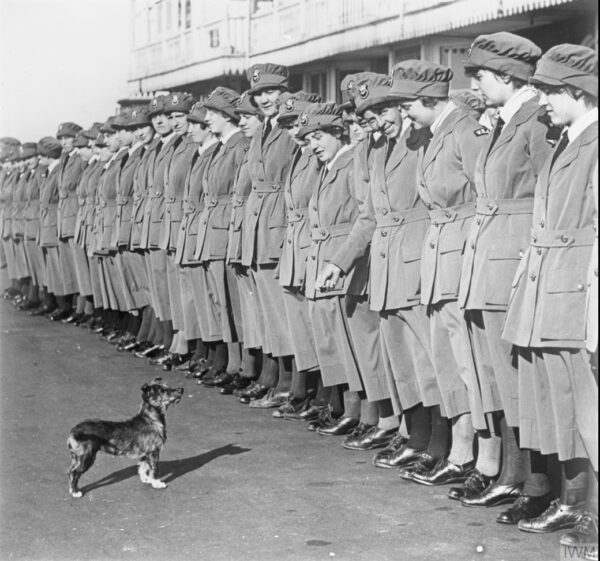
    WRAF © IWM Q 27519
    Members of the Women’s Royal Air Force (WRAF) playing with a little dog while awaiting for inspection. © IWM Q 27519

    With the decision to merge the RFC and RNAS to form the Royal Air Force (RAF), concerns raised about the loss of their specialized female workforce.

    Members of the RAF and the WRAF pose for a light-hearted portrait

    The need for a separate women’s air service led to the formation of the WRAF on 1 April 1918.

    Air Mechanics of the Women's Royal Air Force (WRAF) working on the fuselage of an Avro 504 aircraft during early 1919. The Women's Royal Air Force (WRAF) created on 1 April 1918 and became the backbone of the Royal Air Force (RAF), also created 1 April 1918.
    Air Mechanics of the Women’s Royal Air Force (WRAF) working on the fuselage of an Avro 504 aircraft during early 1919. © IWM Q 27255

    Employment

    The majority of women employed as clerks, with shorthand typists the most highly paid of all airwomen.

    Male and female MT drivers in the WRAF and RAF, Number One School of Navigation and Bomb-dropping, Stonehenge in 1918.

    Women allocated to the Household section worked the longest hours, for the lowest pay.

    The Technical section covered a wide range of highly-skilled trades, including tinsmiths, fitters and welders.

    RAF Corporal giving instructions on engine theory to WRAF motor transport drivers. 1918 Q 72641

    By 1920 over 50 trades open to women including tailoring, photography, catering, pigeon keeping and driving.

    A member of the Women’s Royal Air Force (WRAF) working on the propellor of an Airco DH9A in 1918

    The work of these women helped release men for combat. In addition, they proved the equal of men in the workplace.

    A portrait of Miss Charlotte Noel. She was appointed Women’s Royal Naval Service (WRNS) Divisional Director for Devonport on 18th February 1918. She transferred to the Women’s Royal Air Force (WRAF) on 30th October 1918.

    Training

    WRAF recruits on initial training out on a route march at Uxbridge
    Newly enlisted WRAFs on initial stage of their training routine – Physical Training exercise, Uxbridge

    Civilian enrolment swelled WRAF numbers on RAF bases in Britain.

    Dame Helen Gwynne-Vaughan

    Served as Commandant of WRAF from September 1918 to December 1919. Given the powers of a Brigadier she began the task of re-organisation. In a short space of time she revised the Standing Orders, overhauled the administrative system, opened and equipped Berridge House in Hampstead for the training of officers, authorised the new blue uniform and introduced military protocol.

    The First Chief Controller, Qmaac in France, Dame Helen Gwynne-vaughan, DBE, GBE
    William Orpen
    IWM_ART_003048

    Mona Chalmers Watson, Chief Controller of the WAAC in London, had selected Gwynne-Vaughan as her deputy. Watson resigned in 1918 when one of her sons fell ill following surgery.

    Cologne, Germany

    On 24 March 1919, the first group of WRAFs arrived in France to begin their overseas service. A decision made to send a contingent to Germany.

    The third contingent of the Women’s Royal Air Force (WRAF) arrives at Boulogne from England

    Ladies of the Rhine

    Their purpose to assist the army of occupation and to replace men demobilised from the forces. Based in Cologne, employed as domestics, clerks, telephonists, nurses and drivers and became known as the ‘Ladies of the Rhine’. Dedicated and diligent, they also helped raise RAF morale by staging sports days and dances.

    General Plumer takes the salute on the bridge at Cologne where 1st Canadian Division crossed the Rhine,13 December 1918. John Pollands Garvin. MIKAN No. 3522442
    Lt.-Col. Dick Worrall leads the 14th Battalion as General Plumer takes the salute on the bridge at Cologne where 1st Canadian Division crossed the Rhine, 13 December 1918. MIKAN No. 3522442

    The WRAF assisted in the Allied Occupation of Germany, which had begun on 13 December 1918. Dedicated and diligent, they also helped raise RAF morale by staging sports days and dances.

    WRAF waitresses serving drinks in an Officers billiard room at Uxbridge. © IWM Q 72686

    The order came to finally close down the WRAF contingent on the Rhine in August 1919.

    RAF sections, unwilling to lose their airwomen, delayed the disbandment until the last possible moment.

    WRAF © IWM (Q 7643)
    Women of the Women’s Royal Air Force on the Embankment in Cologne © IWM (Q 7643)
    Group photograph of men of the Royal Flying Corps (RFC) and members of the Women’s Royal Air Force (WRAF). Photo Corporal George Arthur Duke Sadler © IWM Q 104199

    Subscribe

    Please subscribe to CEFRG to be notified by email when there are new posts. Subscription is free, and your email kept confidential.

    CONTACT CEFRG

    ← Back

    Thank you for your response. ✨