Le Tréport
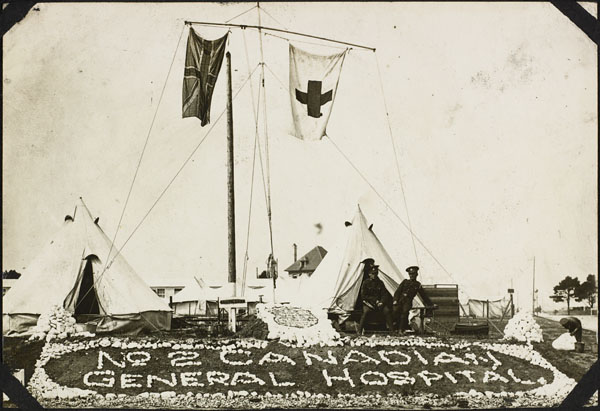
No.2 Canadian General Hospital stationed at Le Tréport on the coast of Normandy from March 1915 to March 1919 in the Great War.

Hospital Centre
During the Great War, Le Tréport an important hospital centre. No.3 General Hospital (Imperial) established in November 1914. No.3 stationed in the old hotel on the cliffs, next to No.2 Canadian General Hospital which arrived in March 1915.
No.16 General Hospital (Imperial) arrived in February 1915, and No.3 Convalescent Depot (Imperial) arrived June 1915 joined by Lady Murray’s B.R.C.S. Hospital later in July 1916.

These hospitals contained a total of nearly 10,000 beds. No.47 General Hospital arrived in March 1917 and later that year, a divisional rest camp and a tank training depot also established in the neighbourhood.
Le Treport Military Cemetery
The cemetery, one of the first three Commission cemeteries to be built following the Great War, designed by Sir Reginald Blomfield. Blomfield given the opportunity to design three experimental sites, including and Louvencourt Military Cemetery and Forceville Communal Cemetery and Extension.
Organization of No.2 Canadian General Hospital
No. 2 organized at Valcartier in September 1914 under the command of Lieutenant-Colonel James Whiteside Bridges. Bridges had been responsible for military medical services in the Montreal area since 1910.
Lt-Col Wallace Arthur Scott joined on 25 September 1914, followed by Lt-Col Robert Dawson Clark, two days later. Major’s John Thomas Clarke, Robert Lorne Gardner, Chas Willson Farran Gorell, William Pearson Dillon all from the CAMC. Major Perry Gladstone Goldsmith of the Canadian Militia.
Captains
- George Rowe Philip
- Fred Scollard McKay
- Cole Edward Cooper Cole
- Percival Keith Menzies
- Jas Douglas Morgan
- John Campbell Calhoun
- William Bethune
- Norman Victor Leslie
- William Howard Tytler
- Stayner Ellis
- Fred K Sypher Burke
- William Lewis Colqohoun MacBeth
- Neil McLeod
- Ronald Herbert Nicholls
- Frederick William Bruce Kelly
- Frederick Halland MacKay
The Surgeon-Dentist Fred K Wm Bruce Kelley, and the unit’s Chaplain the Reverend Brinley Abbott. Sergeant-Major;s James Matheson Wallace and Arthur Leonard George Wiltshire.
Nursing Sisters
- Matron Edith C Rayside
- Matron Helena Elizabeth Dulmage
- Matron Myra Moffat Goodeve
- Matron Frederica Wilson
- Murney May Pugh (Captain Thomas Pugh)
- Meta Margaret Parker
- Kathleen Little
- Lillias Adelaide Morden
- Thomson
- Viola Gertrude Beers

England
No.2 Canadian General Hospital left Quebec on 30 September 1914 aboard FRANCONIA and VIRGINIAN with the first contingent.
Arrived later in England on 15 October 1914 with a strength of 25 officers and 136 other ranks. Nursing sister Alice Thompson had a chance to visit Clovelly.
Nursing Sister Alice Thompson

West Down, North Camp
No.2 Canadian General Hospital opened a Camp Hospital on 19 October 1914 with only 20 beds supplied – needed 40. Lord Roberts reviewed the troops on 24 October at 11 am.

First casualty
The following day, Private William Ogden 21506, 7th Battalion, admitted with a bullet wound from region of right kidney through abdomen. Patient in bad shape. No operation attempted. Pte Ogden died at 11 pm on 25 October 1914.

Post mortem examination showed that operation would not have had any chance of prolonging life. Later, an enquiry determined his death to be accidental.
Orcheston St. Mary Churchyard
Aged 49, William the husband of Edith Ogden, of Middleton, Manchester, United Kingdom. Corporal Ogden buried at Orcheston St. Mary Churchyard.
Corporal Ogden joined by Private Douglas Kirkpatrick Benham (heart failure) of the 16th Battalion on 16 November 1914. They remain the only casualties buried at Orcheston St. Mary Churchyard.
Nursing Sister Alice Edith Isaacson

Nursing Sister Alice Edith Isaacson later transferred to No. 2 Canadian General Hospital, Le Treport, on 7 October 1916.
26 November 1914
Orders received to send fourteen Officers to France, via Southampton, leaving Salisbury at 10:40 am tomorrow. By the end of the first week of December, Officers of No.2 Canadian General Hospital assigned to the following Imperial units.
- No.7 Stationary Hospital
- Major H L Gardner
- No.14 Stationary Hospital
- Major Perry Goldsmith
- No.11 General Hospital
- LtCol R D Rudolf
- Captain Cole Cole
- Captain W L C MacBeth
- No.13 General Hospital
- LtCol W A Scott
- Captain G R Philip
- Captain N MacLeoid
- Captain W Bethune
- No.14 General Hospital
- Captain W R Titler
- Captain P K Menzies
- Captain N V Leslie
LtCol J W Bridges returned to Salisbury Camp on 8 December 1914, and dined with the 13th Battalion (Royal Highlanders of Montreal) on the 9th.

Troops began to entrain for France on 7 February 1915. No.2 Canadian Field Ambulance entrained the following day. The rest of the unit held back on 24 February until properly equipped. Finally, pm 13 March 1915, the remainder of the unit boards at Southampton.
Le Tréport, March 1915 – 2 March 1919

The Nursing Staff, with Matron E. C. Rayside in charge, arrived on 18 March 1915. By 31 March 1915, 500 beds ready.

No.2 Canadian General Hospital (1040 beds) fully established at Le Treport on 8 April 1915. On 16 April 1915, 55 Nursing Sisters moved from the Hotel Calais to their tents in the camp. On the 19th, the cook, Corporal Sutherland sent to Abbeville for Court-Martial (drunk on duty).

25 April 1915
Standing by practically all day expecting Hospital train which did not arrive until 11 PM. Admitted 164 cases, among them 20 stretcher cases, and many Canadians from the heavy fighting around Ypres.

29 April 1915
Hospital visited by Matron-in-Chief of the Canadians, Miss Margaret Clothilde MacDonald. MacDonald made at least ten trips to the Western Front, almost as often as the King!
Canadian Nursing Sister Margaret Clothilde MacDonald the first woman to be given a ‘Major’ military rank in the British Empire and awarded the Royal Red Cross (1916) and the Florence Nightingale Medal (1918).

Visits of Matron-In-Chief MacDonald
- In November, 1914, on her first visit to the B.E.F.
- In April, 1915, on a visit of Inspection to Canadian Units.
- In September, 1915, on a visit of Inspection to all Canadian Units.
- In November, 1915, when she stayed several days at Headquarters with the object of getting a better insight into all office routine and the official procedure to be adopted when transferring Nurses, etc.
- In July, 1916, on a visit of Inspection to all Canadian Units.
- In July, 1917, accompanied by Matron Rayside, C.A.M.C. for Inspection duty.
- In November, 1917, on inspection duty, and to attend a Conference of Overseas Matrons in Chief, held at Abbeville.
- Funeral of Nursing Sister Margaret Lowe, May 1918.
- In July, 1918, on inspection duty to all Canadian units. Miss Ridley, R.R.C. Principal Matron, accompanied her on her tour.
- In May, 1919, on a final visit of inspection. Again accompanied by Miss Ridley and they were authorized to visit the Army of Occupation in Germany.
Funeral of Nursing Sister Margaret Lowe
Matron Margaret MacDonald on left with crossed straps.

4 May 1915
Major William Pearson Dillon, one of our leading Surgeons, met with an accident this morning by losing his footing and falling over the cliff. He dropped about 20 feet and rolled 150 more down a very steep incline.

The Major picked up unconscious and showing symptoms of fracture at the base of the brain. Trephining for de-compression was performed without anaesthetic. He still remained in a very bad shape.

Conducted our first funeral from this hospital, and it was a double one. Pte Jas Wall and Pte Herbert Hazel, both Imperial men. Major Dillon died at 8 pm. Weather, showery and warmer, some thunder.

An enquiry later determined Dillon’s death accidental. He had fallen while seeking a pathway along the cliffs into town. However, LCol Bridges of the opinion he had suffered a seizure which precipitated the fall.
6 May 1915


23 June 1915
Private George Eric Austin 2358, 10th Battalion, King’s Liverpool Regiment had arrived in France on 1 November 1914.

1 July 1915
Group of night sisters posed with their rain hats and oil lamps in Le Treport, France. No. 2 Canadian General Hospital. MIKAN No. 3607160

The night staff, 1 July 1915
All kinds of sports in the afternoon including two games of Baseball, winding up with a very excellent Minstrel show at night. The up-patients and also many laying patients able to attend.
14 August 1915
Completed four months since taking first patients, the totals as follows.
- 5943 Total Admissions of which 543 were Canadians
- 5234 Total Discharges of which 499 were Canadians
- 709 Patients Present of which 44 are Canadians
The contractor has begun to build our winter quarters.

Postcard from Murney Pugh

Le Treport, France, Oct. 12-15 Dear [?], These are some of the nurses outside our mess tent. We have had it very very busy the past two weeks, after the big advance all along the line. We had very badly wounded, but they are transferred to England as soon as they are able to be moved again. These men are so fine even the very badly wounded are so good seem happy, and are all so cheerful and bright and some very funny ones. Write soon. Lovingly Murn
Back of postcard from Murney Pugh
7 December 1915
Act of Courage
“298. Act of Courage.” The Inspector General of Communications wishes to express his appreciation pf the prompt and courageous conduct of No. 50973, Pte Dalton McEwen, CAMC, at Le Treport, on 29 August 1915. A French soldier had been bathing and, owing to the rough state of the sea was on the point of being drowned when Private McEwen dashed into the sea, fully dressed, and succeeded in bringing the unconscious man safely to land. A record of the above will be made in the Regimental Conduct Sheet of Private McEwen, in accordance with Para 1919 (XIV) King’s Regulations.”
Extract from Routine Orders by Lt-Gen Sir F T Clayton, dated 3 November 1915.
Private Dalton McEwen
Pte D McEwen 50973 would give Private Juno Charles Johnson a run for the money in the black sheep department. Already AWOL a half dozen times, breaking out of barracks, and creating a disturbance in the lines after lights out. All instances below following his Act of Courage.
- Having an untidy kit – 3 Days CB.
- Being in town during prohibited hours, improperly dressed – 3 Days Pay and 14 Days CB.
- Neglecting to obey an order – 2 Days CB.
- Absent from Parade – 7 Days F.P. No.2.
- Making a false statement to an NCO – 7Days F.P. No.2
- Not complying with an order – 14 Days F.P. No.2.
- Conduct to the prejudice of good order and military discipline – 28 Days F.P. No.2.
- V.D.S. on leave to England in October 1917.
- AWOL – 10 days CB.
- AWOL – 14 Days CB.
- Absent from Roll Call – 3 Days CB.
- Absent from Roll Call – 3 Days F.P. No.1.
- Absent from Roll Call – Forfeits 2 days pay.
- Absent from Roll Call – Forfeits 2 days pay.
- V.D.S. on leave to England in December 1917 – stoppage of pay while in hospital.
- V.D.S. at Etaples in March 1918.
- V.D.S. at Bramshott in March 1919.
- Scabies at Bramshott in May 1919.

Discipline
Given their locations behind the lines and having easy access to alcohol and women the simple reason why the most undisciplined troops of the CEF not among the infantry, but among Officer’s and Other Ranks in the CAMC.

9 December 1915
Another fall from the cliffs (Major Dillon previously killed 4 May 1915).

A Canadian soldier, a patient in the Convalescent Depot, fell over the cliff – 370 feet – receiving injuries which will probably not prove fatal.

1916
6 January 1916
Mentioned in Despatches
A list of Officers and Men Mentioned in Despatches came out the other day.
- Colonel Bridges
- Matron Rayside
- Staff-Sergeant Hogg
29 February 1916
News received that Captain Cole Edward Cooper Cole, formerly of this unit, and now with the PPCLI, while returning from the trenches, shot through the chest.

Major Cole Edward Cooper Cole
- Brought to the notice of the Secretary of State for War for valuable services rendered in connection with the War, 27 March 1919.
- To be an Officer of The Order of The British Empire, London Gazette No. 31377, 3 June 1919.
- Employed as a Part Time Medical Officer from 28-4-20 to 17-11-20.
15 March 1916
The funeral of a VAD sister who died at No.3 General Hospital took place this afternoon. All Officers not on duty attended.

June 1916
Private Juno Charles Johnson
BLACK Sheep
Every unit has it’s bad sheep. For No.2 Canadian General Hospital that was surely the electro-therapist, Private Juno Carlton Johnson 34626.
- Not complying with orders, 3 days CB, 22 April 1915.
- Absent from camp without pass, 7 days stoppage of pay, 5 July 1915.
- Being in town without a pass, stoppage of 3 days pay, 3 December 1915.
- Neglect of duty, deprived 3 days pay, 14 days CB, 9 December 1915.
- Under arrest pending investigation, 18 March 1916.
Pte Johnson admitted to Military Prison at Rouen on 23 April 1916 awaiting trial. Found guilty of forging a document. Pte Johnson had presented a cheque for 2 pounds, as one of 12 pounds. Sentenced to two years Hard Labour.

Rheumatism would shorten Juno’s sentence, and he continued duty with No.10 Canadian Field Ambulance. Trouble with his heart in October 1917 sent him back to England, and he was discharged in Canada on 22 July 1918.
23 December 1916
Court Martial upon Captain Aime Lamontange (No.6 Canadian General Hospital), who while temporarily attached to this Hospital, charged with AWOL and Being unfit for duty through Alcoholism. The court assembled at Dieppe. On 5 April 1917 the court rendered their sentence – Dismissed from His Majesty’s Service. Lamontange returned to Canada per SS OLYMPIC on 10 July 1917.
25 December 1916
A Christmas dinner of turkey supplied by the Canadian Red Cross Society to all patients. Unfortunately, a shortage of plum pudding. All wards lavishly decorated with mistletoe.
1917
Nursing sisters Thomson, Beers and Isaacson are having tea in the sisters’ quarters at the No. 2 Canadian General Hospital.

24 May 1917
Nursing Sister Murney May Pugh SoS on proceeding to England on 24 May 1917. NS Pugh continued her service at Granville Special Hospital, and several other units in the UK. She proceeded to Canada on 24 March 1919.

2 July 1917
Dominion Day Sports held on 2 July in 1917.

The event held at the golf links and a Concert in the evening with a Nigger Minstrel Show.

The Base Commandant and many officers visited from a distance.

12 July 1917
Visit of Lady Emily Perley to the Hotel de Ville, Le Tréport, France.

14 July 1917
The nurses attended another funeral at Le Treport Military Cemetery on 14 July 1917.
17 August 1917
Captain Ruy Gascia Cargues du Casvallo, Portuguese Officer reported for duty. Two days later, Professor Karaffa Kosbutt of Russia visited to inspect the hospital.
30 August 1917
Sir George Perley, Minister of Militia for Canada visited the hospital, and continued to No.16 General Hospital.

Later in September, Sir George Perley visited Canadians on Vimy Ridge.

30 Months of Work
Death rate to date, following 30 months of service at No.2 Canadian General Hospital, a little over 3/4 of 1 percent.

7 October 1917
A very heavy gale blew during the night and a number of tents down.

25 October 17
Arrangements being made to for Memorial Services at both cemeteries.
Mont Huon Military Cemetery, Le Treport
1918
1 July 1918
Dominion Day Sports
Dominion Day sports event held at No.2 Canadian General Hospital, Le Treport, 1 July 1918. Images captured by one of the BEF official photographers, Lt John Warwick Brooke.
Sir Edward Patrick Morris
The following day, official photographer Lt Brooke captured several images of Sir Edward Patrick Morris, Prime Minister of Newfoundland, visiting the Tank Corps Gunnery School in nearby Merlimont.
Armistice
In November 1918, authority was granted by the D.M.S. Canadians, for the appointment of an Assistant to the Principal Matron, Canadians, and Nursing Sister E. F. Pense C.A.M.C. from No.2 Canadian General Hospital was selected for this post.
26 November 1918
Princess Mary inspects Red Cross nurses and Voluntary Aid Detachment workers at Le Treport, 26th November 1918. Princess Mary had begun a nursing course at the Great Ormond Street Hospital, working two days a week in the Alexandra Ward earlier in 1918, eventually supporting the Voluntary Aid Detachment, the Women’s Land Army, and the Girl Guides.
Princess Mary served as honorary president of the British Girl Guide Association from 1920 until her death in 1965.
1919
March to the Rhine and the Allied Occupation of Germany
By March 1919, the hospitals had been closed and Le Treport became the headquarters of the 68th Division, which re-formed there before going the March to the Rhine and the Allied Occupation of Germany. The divisional supply depot closed in June 1919.

