One-Two-Three
A cemetery companion to “One-Two-Three – The Story of the 123rd Overseas Battalion, CEF” by Dan Mowat (ISBN: 192782205X). 123rd Battalion (Royal Grenadiers) although formed as an infantry battalion made its mark as a Pioneer Battalion. The officers and men of the 123rd became unsung heroes to the 3rd Canadian Division.

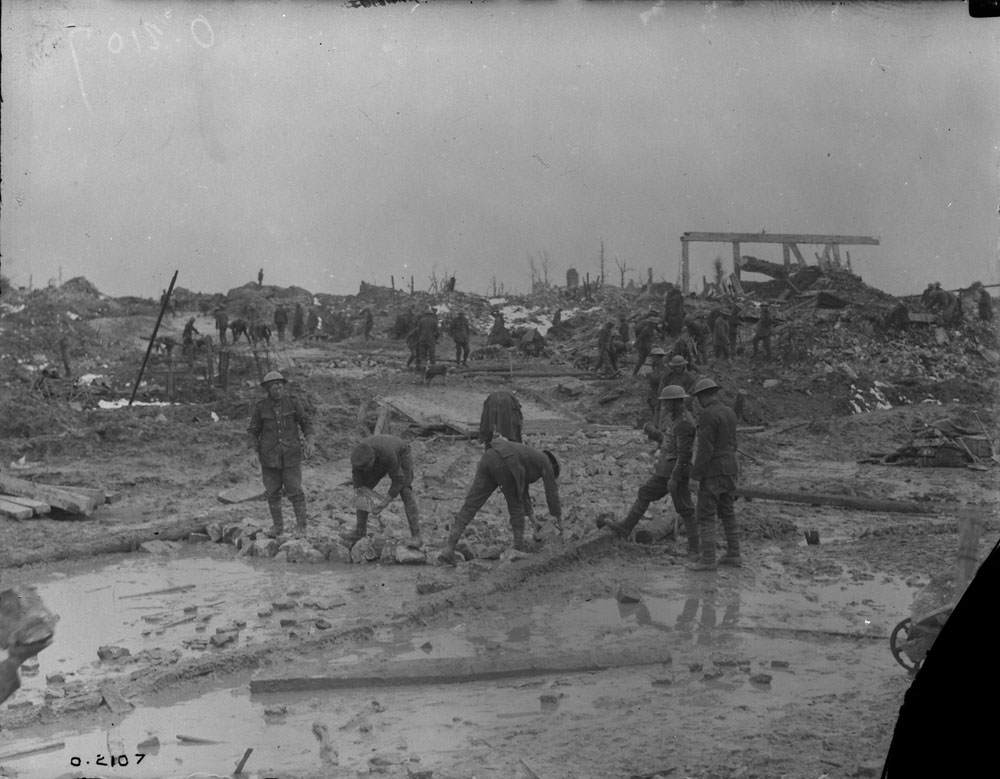
Pioneer Battalions worked in conjunction with the Engineers, “and continually in the Forward Area: the work in the back area being left to Labour units and Entrenching battalions. The work is varied but consists of consolidating positions captured by the infantry, tunnelling, mining, wiring, railroad work, deep dugout work and laying out, building and keeping trenches in repair.”

Organization of the 123rd Battalion

123rd Battalion (Royal Grenadiers) organized in November 1915 under the command of Lieutenant-Colonel Walter Bernard Kingsmill. Mobilized at Toronto and recruited in Toronto.

“Top row”: Pte Jack Radford; Pte George Walter Willey; Pte Harold Henry Barron; L/Cpl. R.R. Macintosh; L/Cpl. John Morrison; Pte. Hugh Percy Harrison
“Centre row”: Cpl. Arthur John Cockfield, Sergt. John Oscar Barron (brother of Pte Harold Henry Barron; Lieut. Thomas Percival Mackenzie; Sergt. Charles Alexander Johnson
“Front row”: L./Cpl. George Blackwell Latimer, Pte. John McGee; L/Cpl. William Davey Barron, Pte Stanley Sturgess


123rd Battalion (Royal Grenadiers) embarked from Halifax 9 August 1916 aboard CAMERONIA and METAGAMA.


The 123rd disembarked England 18 August 1916, with a strength of 32 officers, 960 other ranks.

Continuation of the 123rd Battalion (Royal Grenadiers)
The unit broken up and ceased to exist on 30 May 1918. 344 other ranks transferred to 7th Battalion, CE; 279 other ranks transferred to 8th Battalion CE; and 274 other ranks transferred to 9th Battalion, CE.


The 123rd Battalion arrived in France on 10 March 1917 as a pioneer battalion, and later reinforced by 3rd Canadian Reserve Battalion.
123rd Bn (Royal Grenadiers) in France and Belgium
The first battlefield casualty of the 123rd Battalion (Royal Grenadiers) occurred on the eve of the Battle of Vimy Ridge. What follows are the burials, battlefields, and cemeteries in Belgium and France of the 123rd Battalion (Royal Grenadiers) in the Great War.

Ecoivres Military Cemetery, Mont-St. Eloi
Mont St Eloi a village in the Department of the Pas-de-Calais, 8 kilometres north-west of Arras. The village stands on high ground overlooking the battlefields of Vimy and Souchez and the main Bethune-Arras road, and the ruined towers that rise from it used as an observation post during the French attacks at Neuville-St Vaast and Givenchy in May 1915.

Écoivres a hamlet lying at the foot of the hill, to the south-west and about 1.5 kilometres from Mont St Eloi on the Arras-St Pol line.

Pte George Robert Helm 8622272, 123rd Battalion (Royal Grenadiers), died 7 April 1917, the first battlefield casualty of the 123rd. One the previous night, he was with ‘A’ Company constructing a plank road west of Neuville-Saint-Vaast when instantly killed by shell fire.

George Helm
His entire Company attended the funeral at Écoivres. He was Just 27 years old.

Pte Helm laid to rest at Ecoivres Military Cemetery, Mont-St. Eloi, 1415 hours on 7 April 1917.

Work on the plank road discontinued and the battalion shifted to the Arras-Lens Road.

Private Frederick Grant 138293, 123rd Battalion (Royal Grenadiers), killed in action near Avion (Vimy) while working with ‘D’ Company on 18 June 1917. Husband of Sarah Margaret Grant.

The following night, the CO spent time in the evening with Colonel Agar Adamson and officers of the PPCLI.

Aubigny Communal Cemetery Extension
Before March, 1916, Aubigny in the area of the French Tenth Army, and 327 French soldiers buried in the Extension to the West of Plot IV. From March 1916 to the Armistice, Aubigny held by Commonwealth troops and burials made in the Extension until September 1918. The 42nd Casualty Clearing Station buried in it during the whole period, the 30th in 1916 and 1917, the 24th and 1st Canadian in 1917 (during the capture of Vimy Ridge by the Canadian Corps) and the 57th in 1918.

Two men from April 1917, and one from March 1918 lie buried at Aubigny Communal Cemetery Extension. Pte’s James McKean 862910 and William Sherman 766487, 14 April 1917. Pte Sherman attached to 14th M.G. Coy.

On March 25 1918, four men wounded by artillery fire. Pte James Fletcher Sloane 766069 (SON OF JAMES AND MARY SLOANE, OF MELANCTHON, ONTARIO) died of his wounds on 26 March 1918.
Ste. Catherine British Cemetery
On 22 April 1917, ‘B’ and ‘C’ Companies of 123rd Battalion (Royal Grenadiers) performing maintenance work on the crossroads at Les Tilleuls. It was at this location where construction of the the Canadian Artillery Artillery Memorial begun later in September, 1917.

The position suddenly came under heavy shell fire, and Pte Robert Lewis 862171 killed and Pte John Wright 766744 succumbed to his wounds the next day. Both men buried on 24 April 1917 near the Arians ammunition dump, but their remains later moved to the beautiful Ste. Catherine British Cemetery, very much hidden in the backyards of a street in the village of Ste. Catherine.

Pte John Alfred Wright 766744, 123rd Battalion (Royal Grenadiers) died 23 April 1917 (SON OF JOHN AND HANNAH WRIGHT, OF WEST HILL, ONTARIO; HUSBAND OF FLORENCE M. WRIGHT, OF WOODBRIDGE, ONTARIO.).

On 24 April 1917, ‘B’ Company continuing work north of Thelus when shells fell again and Lance Corporal Achilles Herbert Hearn 784559 killed (HUSBAND OF MARY IRENE HEARN, OF CARLISLE, ONTARIO.). James McKean 862910 died the following day (Aubigny Communal Cemetery).

Etaples Military Cemetery
The area around Etaples the scene of immense concentrations of Commonwealth reinforcement camps and hospitals. Remote from attack, except from aircraft, and accessible by railway from both the northern or the southern battlefields. In 1917, 100,000 troops camped among the sand dunes and the hospitals, which included eleven general, one stationary, four Red Cross hospitals and a convalescent depot, could deal with 22,000 wounded or sick.
Private William George Sims 766491, 123rd Battalion (Royal Grenadiers) succumbed to his wounds on 30 April 1917 (Plot XVIII. F. 4A.).

Pte Adam Robertson 862397, 123rd Battalion (Royal Grenadiers) died 9 November 1917 (XXX. K. 19.).

La Targette British Cemetery, Neuville-St. Vaast
La Targette British Cemetery, formerly known as Aux-Rietz Military Cemetery, begun at the end of April 1917 and used by field ambulances and fighting units until September 1918.

Nearly a third of the graves have an artillery connection; in March-April 1917, the artillery of the 2nd Canadian and 5th Divisions, and certain heavy artillery units, had their headquarters in a deep cave at Aux-Rietz.


Sergeant John Morrison 430014 killed in action working near Farbus on 23 May 1917 (Son of Norman and Catherine Morrison, of 18, North Dell, Ness, Stornoway, Scotland.).


La Chaudiere Military Cemetery, Vimy
The cemetery made at the foot of the ridge, on the north-eastern side, next to a house which had contained a camouflaged German gun position. Initially known as Vimy Canadian Cemetery No.1.

Pioneer Robert Magill 862717 killed-in-action 27 June 1917 and later buried at La Chaudiere Military Cemetery (Next of kin his aunt Mrs Katherine Higgins, Toronto).

Fosse No. 10 Communal Cemetery Extension, Sains-en-Gohelle
The Extension is on the South side of the Communal Cemetery. Begun in April, 1916 and used continuously (chiefly by Field Ambulances) until October 1918.

Lance Corporal James Goff MM 430002 died of wounds 9 August 1917 at No. 4 CFA (SON OF ANNE GOFF, OF 35, KELLY ST., GREENOCK, SCOTLAND, AND THE LATE THOMAS GOFF.).
Aix-Noulette Communal Cemetery Extension
The Cemetery Extension begun by French troops early in 1915, and the two French plots are next to the Communal Cemetery. It was taken over by the 1st and 2nd Divisions in February, 1916, and used by fighting units and Field Ambulances until October, 1918.

Pte James Graham Ross 862556 buried at Aix-Noulette Communal Cemetery Extension (killed-in-action 30 August 1917). Son of Alexander and Mary Ross, of Edgar Avenue, Yonge St., Richmond Hill, York Co., Ontario. Born at Belfast, Ireland.

Noeux-Les Mines
Noeux-les-Mines a town 6 kilometres south of Bethune on the main road to Arras.

Nigel Cartwright – The grave in the photo that the Officers are paying their respects to is of top scoring Australian ace (47 victories), Captain Robert Alexander Little DSO* and DSC*. He was killed during the late evening of the 27th May 1918 piloting Sopwith Camel D3416 whilst attacking a German Gotha. Hit by a single bullet that passed through both thighs he crashed in a field near the village of Noeux. Little was discovered at 5am the next morning by a wandering policeman, having bled to death from his wounds.
Little originally buried in the village cemetery at Noeux but was later moved to Wavans British Cemetery where another great ace rests, Major James Thomas Byford McCudden. Also, in the photo of the lineup of Camels and pilots of No.203 Squadron at Filescamp Farm the machine nearest the camera is Collishaw’s D3417. The circle after the squadron marking was his personal insignia. Londoner Capt Leonard Henry Rochford, also flew this machine, scoring 2 victories with it out of his final tally of 29.
Noeux-Les Mines Communal Cemetery
The Communal Cemetery on the northern side of the town on the south-east of the road to Labourse. The Extension is on the west side of the Communal Cemetery. The COMMUNAL CEMETERY at Noeux-les-Mines was used by the Commonwealth forces (in succession to the French) from June 1915 to August 1917. The earlier burials were carried out by units and field ambulances but in April 1917, the 7th Casualty Clearing Station began to use the cemetery.

Private George James Broomfield 414971 died of wounds 10 July 1917 at No. 7 CCS. George Birton had enlisted under an assumed name.
Noeux-Les Mines Communal Cemetery Extension
The EXTENSION begun in August 1917 and used until December 1918, chiefly by the 6th and 7th Casualty Clearing Stations.

Private Frederick Nicholas Judge 766613 died 31 August 1917. Son of William and Sarah Judge, of England; husband of Gertrude H. A. Marks (formerly Judge), of 53, Reid St., Toronto.

Ypres Reservoir Cemetery
From October 1914 to the autumn of 1918, Ypres (now Ieper) was at the centre of a salient held by Commonwealth (and for some months by French) forces. From April 1915, it was bombarded and destroyed more completely than any other town of its size on the Western Front, but even so certain buildings remained distinguishable.

The ruins of the cathedral and the cloth hall stood together in the middle of the city, part of the infantry barracks stood in an angle of the south walls and the prison, reservoir and water tower were together at the western gate.

Three cemeteries made near the western gate: two between the prison and the reservoir, both now removed into the third, and the third on the north side of the prison. The third was called at first the “Cemetery North of the Prison,” later “Ypres Reservoir North Cemetery, and now Ypres Reservoir Cemetery.

Blackest Day of the 123rd Battalion (Royal Grenadiers)
21 October 1917
Around noon on the 21st, just as the Battalion was arriving at their new billets, a fresh barrage of German shelling came raining down. No. 12 Platoon, ‘C’ Company suffered terribly with a direct hit that killed twenty men and wounded fifteen others. It was a black day for the 123rd Battalion and the CEF. Twenty casualties of 21 October 1917 buried at Ypres Reservoir Cemetery. Pioneer Calder 766781 added on 11 November 1917.

Arthur Francis Bowden
Arthur Francis Bowden 154843, 123rd Battalion (Royal Grenadiers).

Son of Mr. A. F. J. and Mrs. H. Bowden, of 32, Portland St., Exeter, England.


Michael Lynagh
Sapper Alexander McDonald 503377, 2nd Tunnelling Coy, Canadian Engineers (Michael Lynagh served as Sapper McDonald). Michael the son of Patrick and Jessie Lynagh, of 15, Queen St., Govan, Glasgow, Scotland.

James Alexander Bruce Calder
James Alexander Bruce Calder 766781. Son of George and Jessie Ann Calder, of Toronto, Ontario.


Frank Davidson McMurdy
Private Frank Davidson McMurdy 862357, 123rd Battalion (Royal Grenadiers).


Daniel McLean
Private Daniel Mclean 863111, 123rd Battalion (Royal Grenadiers).


Robert Frederick Slocombe
Robert Frederick Slocombe 863063. Son of John and Louisa Slocombe, of 65, Church Rd., Redfield, Bristol, England.

Joseph Clifford Clarke
Pioneer Joseph Clifford Clarke 150844, 123rd Battalion (Royal Grenadiers).


Leonard James Saunders
Pioneer Leonard James Saunders 766696, 123rd Battalion (Royal Grenadiers).


Stuart Frederick Kerrigan
Stuart Frederick Kerrigan 863188. Son of James Kerrigan and Margaret Kerrigan (nee Mulhall). Brother of Lance Corporal Charles Kerrigan, who died on April 24, 1915, while serving with the Canadian Infantry (Central Ontario Regiment).


Arthur Edwin Wood
Pioneer Arthur Edwin Wood 863084, 123rd Battalion (Royal Grenadiers).


Clive Shaw
Pioneer Clive Shaw 853597, 123rd Battalion (Royal Grenadiers).

Donald Ross
Donald Ross 862739. Son of Angus and Lena Ross, of North Bay, Ontario. Born 26 September 1896 in Gravenhurst, Ontario. Attested on 28 February 1916 joining the 123rd Canadian Pioneer Battalion (Canadian Infantry).

Pte Ross is also commemorated on a memorial in Magnetawan, Ontario having made the supreme sacrifice.
Walter Tobias
Pioneer Walter Tobias 802670, 123rd Battalion (Royal Grenadiers).

Tobias had been a Chief (1904-1913) in the Delaware Nation at Moraviantown, Orford Township, Ontario. He and Joseph Rettemonier had replanked Noah Creek Bridge. Walter and his wife had eleven children, with three sons serving in the war (Walter was 52 years of age when he attested). Sons Albert Tobias 2250906, Alfred Tobias 3138470 and Corporal Robert Reuben Tobias MM 803097.


Chief Walter Tobias


The artifacts above graciously supplied by Walter’s great-grandson Tobi Tobias.
William Maxim Bunce
Pioneer William Maxim Bunce 463602, 123rd Battalion (Royal Grenadiers).

Earle Allan Packham
Pioneer Earle A Packham 784528, 123rd Battalion (Royal Grenadiers).

Frederick Harvey Miles
Frederick Harvey Miles 862657. Son of Mr. and Mrs. A. Miles, of Lyng, Norfolk, England; husband of Elsie Ella Miles, of 231, Earlscourt Avenue, Toronto, Ontario.


James George McKinstry
Cpl James George McKinstry 767062, 123rd Battalion (Royal Grenadiers).


Harry Lyffyt
Corporal Harry Lyffyt 853645, 123rd Battalion (Royal Grenadiers).


Frederick Henry Lewis
Pioneer Frederick Henry Lewis 766622, 123rd Battalion (Royal Grenadiers).


Thomas Milne Jolly
Sergeant Thomas Milne Jolly 766611, 123rd Battalion (Royal Grenadiers).


John Rogers
John Rogers 862851,123rd Battalion (Royal Grenadiers). Son of Edward and Henrietta Rogers, of Bristol, England; husband of Alice Amelia Rogers, of 8, Albermarle Avenue, Toronto, Ontario.


George Basil Munn
George Basil Munn 863004, 123rd Battalion (Royal Grenadiers). Son of Mr. and Mrs. Fred Munn, of Toronto, Ontario.


Howard Bell
Howard Bell 853267, 123rd Battalion (Royal Grenadiers). Son of Andrew and Lavina Bell, of Waverley, Ontario.

Edward Gwilliam
Pioneer Edward Gwilliam 430296, 123rd Battalion (Royal Grenadiers).

White House Cemetery, St. Jean-les-Ypres
White House Cemetery begun in March 1915 and used until April 1918 by units holding this part of the line. It then comprised most of the present Plots I and II; but after the Armistice these Plots completed, and III and IV added, when graves brought in from the battlefields around Ypres (now Ieper) and from a number of small burial grounds.

Six casualties of the Second Battle of Passchendaele lie buried at White House Cemetery. Pte Maher 409342 killed in action on 30 October 1917.
On 4 November 1917, Pte Symons 739487 and Private Kenneth Baker Watson 442840 (HUSBAND OF LUTIE D. WATSON, OF 228, ADAM AVENUE, HUNTINGTON, WEST VIRGINIA, U.S.A. ENLISTED AUG., 1915 IN 54TH (KOOTENAY) BN. AT VERNON, BRITISH COLUMBIA. BORN IN NEW BRUNSWICK.)

On 10 November 1917, Pte Hoskinson 863106 and Edgar Gideon Wicksey 767112 (SON OF GIDEON AND MARY ANN WICKSEY, OF CHELTENHAM, ENGLAND; HUSBAND OF RACHEL KIDD (FORMERLY WICKSEY NEE TOMLINSON), OF 14, FRENCH AVENUE, TORONTO, ONTARIO.).

Finally on 11 November 1917, Private George Williamson 862227, “A” Coy. 123rd Bn (SON OF WILLIAM GEORGE AND M. A. WILLIAMSON, OF 305, GLEBEHOLME BOULEVARD, TORONTO.).
Dochy Farm New British Cemetery
Dochy Farm, which had become a German strong point, taken by the 2nd/5th Bn. Lincolnshire Regiment on 26 September 1917, in the Battle of Polygon Wood. The cemetery made after the Armistice when isolated graves brought in from the battlefields of Boesinghe, St. Julien, Frezenberg and Passchendaele.

Lance Corporal Sidney Walpole Huson 430856 died 21 October 1917 (SON OF WILLIAM WALTER WALPOLE HUSON, OF GAZELEY, SUFFOLK; HUSBAND OF CATHERINE ELIZA HUSON, OF 54, WINDSOR RD., WEST FINCHLEY, LONDON, ENGLAND. EDUCATED AT EAST ANGLIAN SCHOOL, BURY ST. EDMUND’S.).
Lijssenthoek Military Cemetery
Lijssenthoek situated on the main communication line between the Allied military bases in the rear and the Ypres battlefields. Close to the Front, but out of the extreme range of most German field artillery, it became a natural place to establish casualty clearing stations. The cemetery first used by the French 15th Hopital D’Evacuation and in June 1915, it began to be used by casualty clearing stations of the Commonwealth forces.

Pte William Bell 430338 buried at Lijssenthoek Military Cemetery on 21 October 1917. He was one of the 21 casualties from the Blackest Day of the 123rd Battalion, along with Pte Joseph Albert Brandon – he succumbed to his wounds the following day.
Oxford Road Cemetery
The OXFORD ROAD CEMETERY is located to the North East of the town of Ieper. Plot I the original Oxford Road Cemetery and used by the units fighting on this front from August 1917 to April 1918. In October 1917, another cemetery, known as Oxford Road Cemetery No.2, started close by and now forms Plot V of the cemetery as it appears today.

Private Henry Wilks 669872 died 6 November 1917.

Maroc British Cemetery, Grenay
Three men buried at Maroc British Cemetery during January of 1918. Enemy aeroplanes flew over positions held by the 123rd on 21 April 1918 killing Pte William Arthur Bull 767181 (HUSBAND OF KATHLEEN T. BULL, OF 951, DOVERCOURT RD., TORONTO, ONTARIO.). Pte Charles Roy Thomas succumbed to his wounds the following day (Lapugnoy Military Cemetery).

Pioneers William Henry Brennan 766135 and Albert Leon Cleverdon 766162 (SON OF ROBERT AND KATE CLEVERDON, OF 36, MALVERN AVENUE, TORONTO.) died on 3 January 1918. Pte Brennan had served eight years with the 10th Royal Grenadiers prior to attesting with the 123rd Battalion. Pte Cleverdon the eldest of four brothers serving, his younger brother Ernest died of Influenza in February 1919.

Pioneer Godfrey Girling 180620 killed-in-action at Osler Dump on 10 January 1918.

Lapugnoy Military Cemetery
Lapugnoy a village 6 kilometres west of Bethune. The first burials made in Plot I of the cemetery in September 1915, but it was most heavily used during the Battle of Arras, which began in April 1917. The dead brought to the cemetery from casualty clearing stations, chiefly the 18th and the 23rd at Lapugnoy and Lozinghem, but between May and August 1918 the cemetery used by fighting units.

Sapper William Stanley Rodgers 784824 died 5 January 1918 (SON OF JANE RODGERS, OF DUNDAS, ONTARIO. NATIVE OF STRABANE, ONTARIO.). Severely wounded in the neck by machine gun fire on 4 January 1918.

Pte Charles Roy Thomas died 9 May 1918 (SON OF WALTER AND SARAH THOMAS, OF PORT CREDIT, ONTARIO.).
Longuenesse (St. Omer) Souvenir Cemetery
St. Omer the General Headquarters of the British Expeditionary Force from October 1914 to March 1916. Lord Roberts died there in November 1914. The town a considerable hospital centre with the 4th, 10th, 7th Canadian, 9th Canadian and New Zealand Stationary Hospitals, the 7th, 58th (Scottish) and 59th (Northern) General Hospitals, and the 17th, 18th and 1st and 2nd Australian Casualty Clearing Stations all stationed there at some time during the war. St. Omer also suffered air raids in November 1917 and May 1918, with serious loss of life.

The cemetery takes its names from the triangular cemetery of the St. Omer garrison, properly called the Souvenir Cemetery (Cimetiere du Souvenir Francais) which is located next to the War Cemetery. Corporal Herbert Forrest Anderson 104104 died 1 February 1918 at 9th Canadian Stationary Hospital (SON OF WILLIAM AND ELLEN ANDERSON, OF KINBURN, ONTARIO.). Herbert had been wounded on 4 January 1918.

Pernes British Cemetery
The cemetery not begun until April 1918 when the 1st and 4th Canadian Casualty Clearing Stations came to Pernes, driven back by the German advance. In May, the 6th and 22nd Clearing Stations arrived and in August, joined by the 13th. Almost all the burials made by these units, but a few of the graves brought into the cemetery after the Armistice (Graves 2 to 13 in Plot VI, Row C, brought from the small British Cemeteries of Anvin and Wavrans).

Pioneer William Henry Wilson 104732 died 25 April 1918 (SON OF WALTER AND HANNAH WILSON, OF ARCHIVE, SASKATCHEWAN. BORN AT PATELEY BRIDIE, YORKS, ENGLAND.).

Pernes-en-Artois a small town in the Department of the Pas-de-Calais on the main road from Lillers to St Pol. The PERNES BRITISH CEMETERY nearly one kilometre west of the town on the road to Sains-les-Pernes.
123rd Overseas Battalion Disbanded
On 30 May 1918, 14 officers and 330 Other Ranks of 123rd Battalion (Royal Grenadiers) transferred to form the 8th CE Battalion, and 15 officers, 301 OR to 9th CE Battalion.

Bourlon Wood Cemetery
On its South-East side, stretching nearly to Fontaine-Notre Dame, is Bourlon Wood, and the village and the wood the scene of desperate fighting in the Battle of Cambrai 1917 and in 1918 when the wood and village ultimately retaken by the 3rd Canadian and 4th Canadian Divisions on the 27th September 1918. Bourlon Wood Cemetery made by the Canadian Corps Burial Officer in October 1918.

Formerly of 123rd Battalion, Cpl Thomas Stuart Palmer 501003, “D” Coy. 9th Bn., died 1 October 1918 (SON OF THOMAS STUART PALMER; HUSBAND OF ETHEL GEORGIE PALMER, OF 4, COVERDALE RD., BRONDESBURY, LONDON, ENGLAND.).

Seaford Cemetery
The 10th Canadian Stationary Hospital at Seaford in November, 1916-January, 1917, and the place then became one of the main Canadian Training Centres. Also formerly of the 123rd, Sapper Howard Newton Jenkins 2007219, “C” Coy. 8th Bn., died of Influenza 23 February 1919 (SON OF DR. HUGH JENKINS AND MARY LENA JENKINS, OF PRESTON, IOWA, U.S.A.).

Seaford Cemetery contains 253 burials of the Great War, almost all are in four of the plots on the North side, and a War Cross erected on that side, close to the Chapel.

Subscribe


