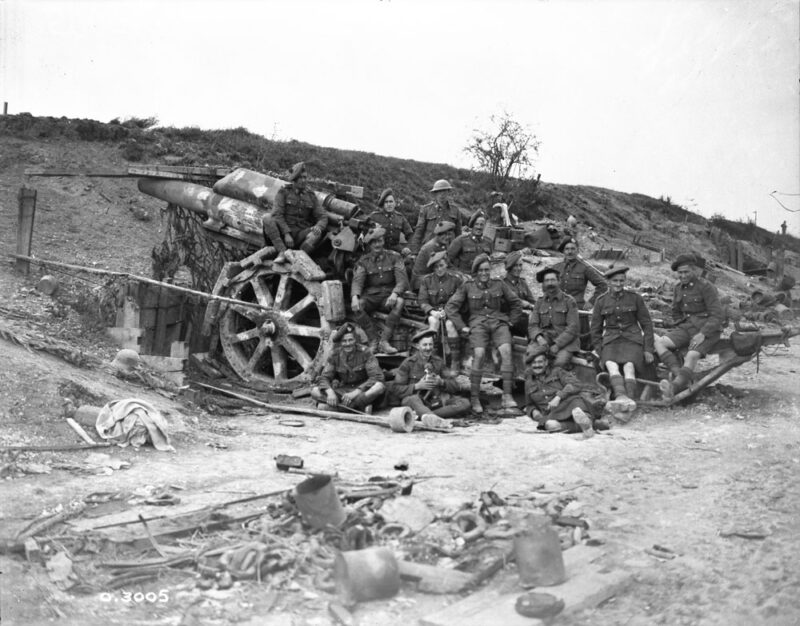
Fifth Royal Highlanders of Canada
Black Watch
Before the Great War the Fifth Royal Highlanders of Canada affiliated with the Black Watch. On the outbreak of hostilities a battalion of the Fifth mobilised at Montreal in August, 1914. By the 20th of the month 1,004 recruits accepted, and on that day the battalion entrained for Valcartier. When a division for overseas organised, the battalion became the 13th (Royal Highlanders of Canada) Battalion. Commanded by Lieutenant-Colonel Frederick Oscar Warren Loomis.

The 13th embarked Quebec on 25 September 1914 aboard ALAUNIA. The Royal Highlanders of Canada later disembarked in England on 16 October 1914, with a strength of 45 officers, 1110 other ranks.

West Down South
West Down South, where the Royal Highlanders of Canada found themselves, a great contrast to Valcartier.
“Mud and rain,” “rain and mud”, “more rain and more mud.” These phrases run like a refrain through all the letters and diaries dealing with the time. “This is a God-forsaken hole and we are getting pretty sick of it. It is raining again to-day. Nothing but rain, mud and then more rain.”

This extract from a letter, dated October 25th, shows that the Contingent treated to bad weather almost from the start. On November 5th another correspondent refers to the subject again. “It has rained now for nineteen consecutive days and Winnipeg in the old days would be put to shame if it could see the mud here. It is making everyone miserable and hindering all work.”
Prior to the cerebro-spinal meningitis outbreak, the 13th suffered their first casualty in late 1914, an unfortunate accident.
Private Samuel Herbert Smith
Private Samuel Herbert Smith 24768, Amesbury Cemetery, died 29 October 1914. Husband of Naomi Catherine Smith, of Newport, Monmouthshire, Wales. He had been AWOL with four other men, when killed in the afternoon by falling off a motor car and fracturing his skull between Salisbury and Bustard Camp. Formerly employed at the Chelsea Hotel, Montreal before joining the 1st contingent.
During the cerebro-spinal meningitis outbreak, in January 1915, the 13th suffered three more casualties.
- Pte Gardner 24357 (WALTHAMSTOW (QUEEN’S ROAD) CEMETERY)
- Private William Goodyear 24133 (BULFORD CHURCH CEMETERY)
- Pte Frederick Williamson McGuinness 24618 (NETHERAVON (ALL SAINTS) CHURCHYARD)
- Pte John William Penfold 24037 (WESTERHAM (ST. MARY) CHURCHYARD)
Following a miserable time in England, the 13th Battalion disembarked in France on 16 February 1915. With the 1st Canadian Division, 3rd Infantry Brigade. Later reinforced by 20th Canadian Reserve Battalion.
Over to France and into Action (10-3-15 to 10-4-15)
Early on the morning of 11 February 1915, the men of the 13th Battalion discovered Avonmouth their destination. When this port reached, somewhat before dawn, they immediately detrained and started to board the SS NOVIAN, awaiting them. Later, embarkation of men, horses and wagons smartly carried out, after which the men allowed some sleep. In addition to the 31 officers and 1,002 men of the 13th, the NOVIAN carried the Divisional Ammunition Column, with its complement of over 200 horses.

SS NOVIAN
In company with other transports and under the protection of destroyers. The NOVIAN sailed at dawn on 12 February 1915 course towards the Lizard and the Bay of Biscay. The decision to change course and proceed out to sea was wise and seaman-like. But, its necessity unfortunate from the point of view of the troops. Finally, sea-sickness, that scourge of the ocean, had laid hold on these latter and, being no respecter of persons. Having its way with officers and men alike.
Seasickness
Down in the crowded holds the scene one to beggar description. Nine tenths of the men ill, desperately ill, and no one could help them in their misery. In the dining saloon, where the officers quartered, matters only relatively better. One company commander, returning from a tour on deck, found his berth occupied by a very miserable subaltern. His distress had driven him to seek some refuge other than the crowded floor of the dining saloon. Pitying his junior’s condition, the company commander waived possession of the berth for several hours. But, at last he himself fell a victim and forced to claim his right. The holds in an awful condition, but the men quite too sick to care.
Deserters
During the voyage two men of the 13th, who had deserted from the camp fat Larkhill, turned up as stowaways on the boat. How they learned from what port and on what boat the Battalion would sail a puzzle. Even the officers of the Battalion in ignorance of these details when the unit marched from Salisburv Plain. A court of enquiry held on board ship decided.

As a punishment for desertion, handed over to the military authorities in France. Accordingly held under close arrest until France reached and then handed over to the A.M.L.O. The latter, however, promptly handed them back again, assuring the Battalion not interested in what he called its private affairs. This action on the part of the A.M.L.O. viewed by the stowaways with ill concealed delight.
St. Nazaire
As soon as the vessel docked, preparations to unload the horses and wagons began. But, just at this moment the stevedores of St. Nazaire, who had general charge of the arrangements, went on something resembling a strike. Nothing deterred, the Highlanders promptly undertook the work themselves.

Following on the heels of a strong advance party, under the command of Capt. William H. Clark-Kennedy the Battalion disembarked from Novian and lined up on the dock for the march through the streets of St. Nazaire to the railway station. Before giving the order to march, Lieut.-Col. Loomis called for three cheers for Captain McCormack. The officers of the Novian who, throughout the unexpectedly prolonged voyage, had done all that lay in their power to make things as comfortable as possible for both officers and men. In spite of sea-sickness, these efforts on the part of the sailor officers not unappreciated by the Highlanders. And, the cheers given with a right good will.
Entraining for Belgium
Seven o’clock in the evening found the Battalion at St. Nazaire Station, entraining for the long journey to the front. For two days and two nights the train crept on its way. With occasional brief stops to give the troops a chance to get some food and to stretch their legs. This latter arrangement almost as necessary as food. The cars of the typical box variety, known to fame as “40 hommes, 8 chevaux,” and allowed no space for even the most limited exercise. The route lay through Nantes, Rouen, Boulogne, Calais and St. Omer. Thence to Hazebrouck, reached at 6.30 p.m. on February 19th. The men stiff and sore after the journey. But, detrained smartly and started off without delay on a seven mile march to Flêtre.

At Caestre Capt. Clark-Kennedy met the Battalion and the march to Flêtre continued under his guidance. The front, that legendary region of unspoken hopes and fears, now within sight and hearing. On reaching Flêtre billets secured and the men turned in with as little delay as possible. Four days and five nights spent at Flêtre, the men occupied in preparing themselves for the trenches.
Canon Scott
On February 20th the Battalion inspected at Caestre by the Commander-in-Chief, Field-Marshal Sir John French. In the little speech that customarily follows such events, expressed himself as well pleased with the Battalion’s general showing. On the following day the 13th, in company with the 14th Royal Montreal Regiment, paraded for Divine Service in a field just near Flêtre Church, Canon Scott, from Quebec, officiating.

First Battlefield Casualty
February 24th arranged that two companies of the Royal Highlanders should go into the line that same night for their first tour of instruction with the Buffs. In accordance with these arrangements, No. 1 Company, under Major Douglas Rykert McCuaig and No. 2 Company, under Capt. Robert Harry Jamieson, paraded at 6.15 and 6.30 p.m. respectively and proceeded into the line. Guided by men of the 16th Brigade provided for the purpose. During this movement the Battalion suffered its first casualty, Private George William Eadle (CITE BONJEAN MILITARY CEMETERY, ARMENTIERES), of No. 2 Coy., being caught by a burst of fire and instantly killed.

Hinges
On the night of the May 31st the Highlanders relieved by the 2nd Gordons, of the 20th British Brigade. Relief completed about 2 a.m. The 13th then proceeded to Hinges via Bethuue and the tow path of the La Bassee Canal. Five days spent in the billets and bivouacs of Hinges, during which platoon drills and company route marches frequent. Lieuts. Peerless and Mingo joined the Battalion during this period, while commissions granted to Private N. M. MacLean, Corp. B. AI. Giveen, Private Eagle and Private F. J. Rowan.

LCol Loomis
On June 5th Lieut.-Col. Loomis and other officers reconnoitred a reserve position at Givenchy, north of the Canal. The following day, the Highlanders took over from the 5th Canadian Battallion. June 7th and 8th spent in this position and on the 9th the Battalion moved up and relieved the Royal Montreal Regiment in the front line. The following afternoon officers of No. 2 Coy., in support, interested to observe the Prince of Wales passing their position and making his way forward.

Accompanied by a worried staff officer obviously remonstrating against any further advance. All protests fell on deaf ears. Apparently, as the last No. 2 Coy. saw of the pair when they disappeared up a communication trench towards the line.
Quiet Tour
This tour lasted three days and comparatively quiet, though not entirely devoid of incident. They had their barbed wire cut by our artillery. So all night we kept up a fairly heavy fire to keep them from repairing it. This seemed to annoy them. So they sent out a bombing party to a sap head and threw a few bombs at us.

We replied with a machine gun and they went back. Then they turned a trench mortar on us and also gave us a little shelling. As well as rifle and machine gun fire. Altogether during an hour they used every implement of warfare. Bar the bayonet and gas, and they didn’t hit a man. It was really quite fun.”
Essars
On the night of the 10th, the 4th Canadian Battalion relieved the 13th and the latter proceeded to billets in Essars. It rained during the relief and for a day after. For the ten following days, during which the Battalion remained in billets, the weather consistently “fine and clear.” On June 15th orders received to “stand to.” Ready to move at short notice, as the 1st Canadian Infantry Brigade was attacking at Givenchy and support might be required. Later this order cancelled and the men resumed their work.

Route marching, company training and battalion drill kept all ranks busy from dawn till dusk. Route marches popular for once, however, as they invariably ended with a swim in the Canal. Following this interval of training, the Highlanders moved up on June 22nd. Relieved the 10th Canadian Battalion in the front line and support, in Givenchy sub-section B3. This tour proved to be short—only two days—but during the forty-eight hours considerable activity of a minor character prevailed.
Lieutenant Richard Eagle
The enemy used trench mortars, rifle grenades and hand bombs with some effect. While the 13th snipers enjoyed unusually profitable shooting patrol sent out to explore a vacant German trench encountered opposition, Lt Richard Eagle, in command, and two of his scouts being wounded. Altogether 2 men killed and 5 wounded during the tour. On completion of the tour, the 13th relieved by the 2nd and 6th Gordon’s and proceeded to familiar billets in Essars. Where two days spent, chiefly in washing, cleaning and repairing equipment and in physical drill.

Following the conclusion of the action at Givenchy, the Canadian Division turned once more towards the north. Leaving Essars at 10.55 p.m. on June 26th. The 13th Battalion marched steadily all night and arrived at Neuf Berquin at half past four in the morning. Rain fell most of the night and the march not particularly agreeable, but good time made. Rain fell again during the continuation of the march that same evening. But this time the distance shorter and billets at La Becque, near Bailleul, reached by 11 o’clock. These the same billets that the Battalion had occupied when refitting after the Second Battle of Ypres. Two days spent here and on the 30th a move made to billets one mile N.W. of Steenwerck.
Dominion Day
July 1st, being Dominion Day, a half holiday. A football match organized between the two halves of the Regiment, while in addition a programme of sports run off. Anyone strong in leg, arm or wind ‘had a chance to distinguish himself in these. As the events included such varied items as throwing the cricket ball, kicking the football, sprints, dashes, putting the shot and a tug-of-war. On July 2nd routine resumed, varied, however, by a bathing parade to Bailleul. The next day Lieut.-Col. Loomis, Major Buchanan, the Company Commanders, Signalling and Machine Gun Officers reconnoitred a position which the Battalion to occupy from Ploegsteert Wood (facing Warreton) to Wulverghem (opposite Messines).

On July 5th the Royal Highlanders of Canada relieved the 1st Canadian Battalion in support, one man of the Machine Gun Section killed by shellfire at Hyde Park Corner, while going up. At 8 p.m. on the 9th the 13th Battalion completed relief of the 14th Battalion in the front line. One hour later two mines exploded by the Canadian Engineers and a troublesome German post destroyed.

The Second Battle of Ypres (10-4-15 to 5-5-15)
Tower of Ypres, a little slept your glory
Lips again are busy with your name
Ypres again is famous in our story
Ypres of Flanders, wrapt in blood and flame.
– EVERARD OWEN.

On the night of Wednesday, April 21st, the 13th Battalion moved up into the line and took over a series of breastwork trenches from the 14th Battalion, Royal Montreal Regiment. Apart from an unusually severe shelling of Ypres during the afternoon, nothing had indicated that behind the German lines a blow being prepared such as had never fallen in civilized warfare.
The Canadian Division held a line, 4250 yards in length, extending in a north-westerly direction from, the Ypres-Roulers Railway to a point some fifty yards beyond the Ypres-Poelcappelle Road. The extreme left of this line held by the 13th Battalion. Beyond the 13th to the left French coloured troops (Turcos).
Companies
No. 1 Coy
No. 1 Coy., under Major Douglas Rykert McCuaig, who had with him Capt. Lionel Ward Whitehead, Capt. Herbert Fraser Walker, Lieut. Melville Greenshields and Lieut. Charles Bruce Pitblado, held the left of the 13th front, from the point where it joined the Turcos to a point some 150 yards to the right of the Poelcappelle Road, making approximately 200 yards in all.
No. 2 Coy
The next section of the Battalion front held by No. 2 Coy., under Capt. Robert Harry Jamieson, whose officers Captain Kenneth Meikle Perry, Lieut. Ian M. Rae Sinclair, Lieut. Alan Worthington, Lieut. Alistair McDougall Fisher and Lieut. Ernest Marmaduke Sellon. This section separated from that held by No. 1 Coy. by an open gap nearly 100 yards long, through which ran a small stream.
No 4 Coy
The third, and right, section of the front held by No. 4 Coy., under Capt. William Hew Clark-Kennedy, with whom Capt. Gerald Lees, Lieut. W. Stewart M. MacTier and Lieut. Stanley Bagg Lindsay.

No. 3 Coy
No. 3 Coy. in support, two platoons in trenches about 400 yards to the rear of No. 1 Coy’s, position and two platoons at Battalion Headquarters in St. Julien. With the former Major Edward Cuthbert Norsworthy, O.C. the Firing Line, Capt. Guy Melfort Drummond and Capt Charles John Smith, while with the platoons in St. Julien, Major Victor Carl Buchanan, Capt. Thomas Sydney Morrisey, Lieut. Clarence Norman McCuaig and Lieut. F. S. Molson. Lieut. James Gordon Ross commanded the Machine Gun Section.
Flimsy Trenches
Dawn breaking on the 22nd revealed to the men that, in spite of work hard done by the 14th and by themselves, the trenches holding rather flimsily constructed. Except for the gap already mentioned, there was a continuous parapet of sandbags, but this too thin to be bullet proof and chiefly useful as a screen from view. Practically no parados, few traverses existed and no shell proof dugouts at all, this last condition being accounted for by the fact that any attempt to dig down frustrated by the presence a few inches below the surface of water and hastily buried bodies.
About 3 p.m., however, these peaceful conditions changed and the Germans prepared to launch the blow which the previous inactivity had served to mask. The opening of their great attack heralded by a terrific bombardment of the Canadian line and of the French line to the left. In so far as the 13th concerned, this fell with particular severity, not on the front line, but on the trenches immediately to the rear, where Major Norsworthy and the two platoons of No. 3 Coy. in support. After suffering severely, Norsworthy notified Major McCuaig, of No. 1 Coy., that to avoid unnecessary losses, withdrawing his men a short distance.
Chlorine Gas
After two hours of heavy shelling, the Germans launched a great wave of chlorine gas.

Rolling across the open fields this gasping horror fell with all its force on the trenches, of the Turcos to the Canadians left. Elements of the 13th also received a whiff of this hellish brew, but the poor Turcos suffered its full effects. Blinded and choking they fell in agony and perished miserably. Those who escaped the first discharge waited for no more. A horrible green death, against which courage availed a man nothing, had fallen upon their comrades and they themselves had barely escaped.
Following the wave of gas, the Germans had launched a series of attacks and these had penetrated through the broken French lines on a front several miles in width. Continuing his investigations, McCuaig found that a remnant of the Algerians (Turcos) holding a breastwork, running back at right angles from their original trenches, and exchanging a brisk fire with the Germans-, who had occupied a parallel hedge.
About 6 p.m. a salvo from a battery in the rear made four direct hits on the Highlanders trenches, causing a dozen or more casualties. The Germans had swung in towards the Canadians flank and making some progress in the general direction of St. Julien. This brought the enemy into contact with Major Norsworthy and the two platoons of No. 3 Coy. in support, or rather the remnant of these platoons, which had suffered severely in the opening bombardment.
Frederick Fisher VC
The 10th (St. Catharines) Battery with four 18-pounder artillery guns was in the gap and kept up heavy fire on the advancing Germans, forcing some to dig in or withdraw. When the battery commander realized he was about to be overrun, he requested infantry support. Sixty soldiers, plus a Colt machine gun under Fisher, were sent.
Fisher worked his way forward with his machine-gun crew to an isolated building that covered the area where the Germans were digging in. He opened fire and stopped the enemy advance in the area, although the rest of his four-man team was cut down. This action likely saved the 10th Battery’s guns, which were able to withdraw by 11 pm. It also resulted in the award of the Victoria Cross to Fisher — the first Canadian to earn the VC in the war.

Fisher fought throughout the next day with his machine gun, but killed instantly by a shot through the heart. Body not recovered for burial.
Second Gas Attack
Dawn on April 24th found the men of the 13th Battalion in the position to which they had retired the night before. Soon after daybreak the Germans again used gas which fell with particular severity on the trenches of the 15th Battalion to the right, and followed this with another intense bombardment, wrecking the shallow trenches that had been dug and causing further losses.
At this stage of the struggle that Capt. Gerald Lees killed and Capt. L. W. Whitehead fatally wounded. Roth these officers had displayed resource and courage and their loss to the Battalion a heavy one. At this time Lieut. C. B. Pitblado displayed the greatest gallantry in carrying back Capt. Whitehead, who had been mortally wounded in the head and out of his senses. Being hit in the knee himself, Pitblado compelled to abandon Whitehead, by this time quite unconscious.
Following the arrival of the British, the 13th spent the night in reserve trenches south of Wieltje, withdrawing about a mile early on the morning of the 25th to near Potijze.
Casualties
Unless otherwise noted, the overwhelming majority of men Missing, their bodies never recovered, or their graves later lost, and therefore named on the Menin Gate Memorial.

22 April 1915
- Major Norsworthy (Tyne Cot Cemetery)
- Captain Lionel Ward
- Lt Guy Melfort Drummond (Tyne Cot Cemetery)
- Sergeant William Graham Scott
- Armstrong
- Calvert, John Cyril
- Clarke, Edwin
- Dickenson, Edwin
- Dixon, Thomas C
- Goodwin, James Edward
- Hawley, Carlton B
- Murdock, John Albert
- Southgate, Lionel Ward

23 April 1915
- Sergeant John Henry Thomson (Poelcapelle British Cemetery)
- LCpl Richard Whetter
- LCpl Clement Oswald Yates
- Ames
- Hollands, John Rupert Weigall
- Scott, William Henry
24 April 1915
Over 100 casualties fell on 24 April 1915. Only ten bodies recovered, or died of their wounds that day.
- Cpl Hugh MacFarlane (Perth Cemetery (China Wall))
- LCpl Charles Maltby (Perth Cemetery (China Wall))
- McCahaon, Charles Percival (Perth Cemetery (China Wall))
- Courchaine (PoW at Roeselare Communal Cemetery)
- Gallagher, John Walter (Poelcapelle British Cemetery)
- MacDonald, Richard Falconer (Niederzwehren Cemetery, Kassel)
- Mellowes, William Oscar (Poelcapelle British Cemetery)
- Melluish, William Alfred (Poelcapelle British Cemetery)
- Russell, David Moffatt (PoW at Roeselare Communal Cemetery)

Festubert, Givenchy and Ploegsteert (5-5-15 to 12-8-15)
On leaving the Ypres Salient, the 13th marched to billets south of Bailleul., Accompanying the Royal Highlanders on this march “Flora Macdonald,” a goat, “found” near the position of some Indian troops in the Salient and adopted forthwith as the Regiment s official mascot.

Battalion in need of repair
Settling down in billets, the 13th had an opportunity to realize how much the Battalion had suffered in the recent battle. Twelve officers had gone down, while casualties in the ranks totalled 454. In other words the unit had lost very nearly half its fighting strength. Two of the four company commanders casualties and the promotion of Major Buchanan to succeed Major Norsworthy as Second-in-command meant that No. 3 Coy. also deprived of its wonted leader. Lieut-Col. Looinis started to rebuild his unit without a moment’s delay.
Promotion from the ranks given to Corp. J. D. Macpherson, Private S. V. Brittan, Private B. H. Rust and Private H. R. Powell of these, the first three had been wounded in the battle of Ypres where all had rendered conspicuous service. Lieut. Powell immediately assumed his new duties as a subaltern with No. 2 Coy.
Battle of Festubert
On the 17th the 13th occupied reserve trenches at Le Touret. These muddy ditches shelled to some extent during the few hours that the 13th in them, but no particular damage resulted and the Battalion moved back to spend the night in billets in Essars.

On 20 May 1915, the 13th advanced from Indian Village at 7 p.m., Lieut. C. M. Maxwell wounded by shell fire before the advance began. In this engagement the companies of the 13th commanded respectively by Capts. K. M. Perry, Ernest Marmaduke Sellon, Stanley Bagg Lindsay and W. H. Clark-Kennedy, all of whom had taken part in the previous engagement at Ypres.
Rue de L’Epinette

Capt. Sellon severely wounded about midnight and Lieut. Powell killed. At first Powell merely reported missing, as no one could be found who had actually seen him fall, or positively identified his body. Lieut. Mathewson also reported killed, but this soon found to be a mistake.

All day on May 21st the enemy kept the Orchard under heavy fire, wounding Lieut. A. M. Fisher, of No. 3 Coy. and inflicting considerable losses to the rank and file. May 22nd a fine day with a blazing hot sun, which proved trying to the men lying out with little shelter. No. 2 Coy. suffered particularly, as they had no water at all. Late that night, after two exceedingly trying days and nights, the 13th relieved by the 3rd Battalion.
Royal Highlanders of Canada Casualties
Nearly all the casualties listed on the VIMY MEMORIAL, rather than the MENIN GATE as these men fell in France, not Belgium.
- Lt Haynes Robert Powell
- Sgt Robert Key
- Sgt Thomas James Selby Hillyer
- Sergeant James Harland Piche
- Cpl Antony Boulich
- Cpl Herbert John Knight
- Lance Corporal William Gracey (WIMEREUX COMMUNAL CEMETERY)
- Cpl Taylor
- 33 Other Ranks
Givenchy
Following an interval of training, the Highlanders moved up on June 22nd and relieved the 10th Canadian Battalion in the front line and support, in Givenchy sub-section B3. This tour proved to be short only two days but during the forty-eight hours considerable activity of a minor character prevailed.

Altogether 2 men killed and 5 wounded during the tour. On completion of the tour, the 13th relieved by the 2nd and 6th Gordons and proceeded to familiar billets in Essars, where two days spent, chiefly in washing, cleaning and repairing- equipment and in physical drill.
- Private Lester Benson (VIMY MEMORIAL)
- Private Harry Stracey (VIMY MEMORIAL)
Ploegsteert Wood
On 3 July 1915, Lieut-Col. Loomis, Major Buchanan, the Company Commanders, Signalling and Machine Gun Officers reconnoitred a position which the Battalion to occupy from Ploegsteert Wood (facing Warreton) to Wulverghem (opposite Messines). On July 5th the Royal Highlanders relieved the 1st Canadian Battalion in support, one man of the Machine Gun Section being killed by shellfire at Hyde Park Corner, while going up.
![Hyde Park Corner. Hill 63 [Messines]](https://i0.wp.com/cefrg.ca/wp-content/uploads/2020/09/3329042-a004478-v8.jpg?resize=1000%2C789&ssl=1)
At 8 p.m. on the 9th the 13th Battalion completed relief of the 14th Battalion in the front line. One hour later two mines exploded by the Canadian Engineers and a troublesome German post destroyed. During this tour Lieut. Hugh Wallis, commissioned from the ranks of the Canadian Scottish, posted to the 13th Battalion. One killed and ten wounded represented the total casualties of the five days.
- Private Thomas Albert Morgan (STRAND MILITARY CEMETERY)

Messines (12-8-15 to 17-3-16)
The road that runs up to Messines
Is double-locked with gates of fire,
Barred with high ramparts, and between
The unbridged river, and the wire.
But we shall go up to Messines
Even thro that fire-defended gate,
Over and thro all else between
And give the highway back its state.
J. E. STEWART.
August 15th, 1915, the 13th Battalion relieved the 10th Battalion and Canadian Cavalry Brigade in Trenches 135, 136 and 137, with headquarters at La Plus Douce Farm. This series of trenches destined to see a great deal of the Royal Highlanders of Canada during the months that lay ahead.

Relieved by the 14th Battalion on the night of August 29th, the Highlanders proceeded to Bulford Camp (Kortepyp Huts), near Neuve Eglise. Here on September 2nd General Plumer, commanding the 2nd Army Corps, inspected the Battalion.
New Commander
At this time the announcement that Lieut.-Gen. E. A. H. Alderson had assumed command of the Canadian Army Corps signified to the men of the Canadian Division that a second Canadian Division had arrived in France. Simultaneously announced that Brig.-Gen. A. W. Currie, C.B., of the 2nd Brigade, had been promoted to Major-General to succeed General Alderson in command of what had hitherto been known in the field as the Canadian Division and would in future be referred to as the 1st.
Ploegsteert
At 4.30 p.m. on the 26th they marched to Ploegsteert, “standing to” all day on the 27th and moving into the line at 7.30 that night to relieve the 6th Buffs, of the 35th British Brigade, proceeding south to take part in the new battle. With almost clock-like regularity, then, the 13th during the months that followed spent four days in and four days out of the line. When in, they occupied the trenches already mentioned; when out, billeted at Courte Dreve, Red Lodge, or Kortepyp Huts. In the line, Battalion H.Q. was at Plus Douce Farm; two companies occupied the fire trenches, one was in support at Stinking Farm and one in Battalion Reserve at Plus Douce Farm, or Fletcher’s Field.

Downed German Plane
On October 26th an aerial battle over the front line resulted in a German plane being brought down in rear of No. 4 Coy s, position The pilot of this plane was dead, but an observer, severely wounded, made prisoner and taken to Brigade H.Q. Capt. Gilbert Donald McGibbon, of No. 4 Coy., secured a trigger camera from the captured machine, which, by one of those queer strokes of fate, also found to carry a Colt machine gun, belonging to the 14th Battalion and captured at Ypres. Following the landing of this machine the
Germans shelled the wreck with high explosive, to destroy the plane and inflict casualties amongst any who might attempt to salvage it.
Routine
During November the routine already described continued. When out of the line, working parties called for even more frequently and practically the whole Battalion, including officers, out night after night. The nature of the soil and the steady rain rendered the work particularly exhausting, but it was urgent and could not be delayed, no matter how badly the men needed rest.

During the period that the 42nd undergoing training by the 13th a most regrettable incident occurred when Capt. Leon Curry (42nd) and Capt C. H. Crowdy (13th) killed by a trench mortar bomb which fell in the bay of their trench. The funeral of these two officers held in Armentieres some few days later. Both Battalions out of the line at the time and joined, with their pipe bands, in according the dead officers full military honours.
Major V C Buchanan takes Command
Towards the end of the month, during the absence on leave of Brig.-Gen. Leckie, Lieut.-Col. Loomis assumed command of the 3rd Brigade, Major Buchanan taking over the 13th for the period of the Colonel s absence. On the 1st of January, 1916, Lieut.-Col. F. O. W. Loomis, D.S.O., officially relinquished his command of the battalion, on taking over a higher appointment, and handed it over to Major V. C. Buchanan.

For some months the time spent in training, when the battalion out of the trenches, and in patrols and raids when in the trenches. No action of importance in which the battalion took part until June arrived, and with it the struggles around Mount Sorrel and Sanctuary Wood.
Hill 60, the Bluff and Mount Sorrel (17-3-16 to 31-5-16)
In lonely watches night by night
Great visions burst upon my sight
For down the stretches of the sky
The hosts of dead go marching by.
Dear Christ, who reign st above the flood
Of human tears and human blood,
A weary road these men have trod,
O house them in the home of God!
– FREDERICK GEORGE SCOTT.
Soon after arrival the 2nd Division became involved in an engagement, as dour and bitterly fought as any that had marked the war up to this time. It lasted for a month, during which the contesting lines swayed backward and forward, in and out of a series of mine craters at St. Eloi. Thousands of men died in this battle and their mortal remains swallowed up in the wreckage, ruin and indescribable mud.

In the end the 2nd Division blasted out of the positions it had held with such extraordinary tenacity, but these so shattered and devastated that the enemy found it well nigh impossible to occupy them. The Craters, there fore, became for the most part a No Man’s Land, the last resting place of many brave men and the haunt of occasional prowling patrols. For the second time the Salient had given the men from Canada a bloody welcome.
Pollock Trench
On April 19th, late in the afternoon, the enemy opened a heavy trench mortar bombardment of the Pollock, the Bean and other trenches in the same vicinity, also of the Crater, with the result that communication between Nos. 1 and 4 Companies severed almost at once. At 7.45 p.m., after firing a large number of green signal rockets and after about fifteen minutes of extraordinary quiet, the trench mortar bombardment of the Pollock and the Bean superseded by an intense artillery bombardment of the whole front. Simultaneously the enemy opened a heavy fire on the front of the 2nd Division to the south.

Investigation showed that the Battalion’s heaviest losses had occurred in the Pollock and the Bean during the trench mortar bombardment early in the evening. The dead and wounded of No. 4 Coy. strewn along these trenches, battered beyond all recognition. Buried in the ruins of his concrete dugout Capt. G. D. McGibbon (VLAMERTINGHE MILITARY CEMETERY), the Company Commander, who died shortly after being released from the wreckage which pinned him down.
During the remainder of the tour the front “active,” but no repetition of the hurricane bombardment of the 19th.
The June Show 1916 (31-5-16 to 13-6-16)
In lonely watches night by night
Great visions burst upon my sight
For down the stretches of the sky
The hosts of dead go marching by.
Dear Christ, who reign st above the flood
Of human tears and human blood,
A weary road these men have trod,
O house them in the home of God!
– FREDERICK GEORGE SCOTT.
Mount Sorrel
This time the attack struck the 3rd Canadian Division occupying the line from Bellewaarde Beek to Mount Sorrel. Sharp at 8 a.m. on June 2nd, the bombardment heralding the attack began. For months the intensity of artillery fire had been increasing, until even a small attack at this time preceded by shelling that would have been considered phenomenal a year before.

Along the whole Bellewaarde Beek-Sanctuary Wood Hill 62, Hill 61 Armagh Wood Mount Sorrel front, the Canadian line simply obliterated. Major-General Mercer, commanding the 3rd Division, killed and Brigadier-General Victor Williams, of the 8th Brigade, made prisoner.

Far back of the front, at Patricia Lines, the 13th Battalion enjoying a sports day when the “stand to” order received. This arrived late in the afternoon and followed before long by orders for the Battalion to proceed without delay to support an attack by the 14th and 15th Battalions.
Zillebeke Trench
The Battalion did not come under enemy fire until it reached the bridge across the Ypres-Comines Canal. Here shrapnel bursting with great regularity. Unable to await a pause in this shelling, the Highlanders pushed through. Impossible to go through without casualties, however, and no miracle occurred to save the 13th from losses. Caught by a particularly heavy burst, Lieut. D. R. M. McLean severely wounded, while the Bombing Section suffered casualties to almost 50% of its personnel.

After passing this unpleasant spot, the Battalion advanced as rapidly as the shelling and congestion of traffic allowed, until Zillebeke Trench reached. In this trench, which ran along the shore of Zillebeke Lake, the 13th got badly mixed up with the 14th and 15th, whose attack the 13th and 16th to support. Streams of wounded, making their way to the rear, added to the congestion until it almost impossible to move.
Counter-attack
The counter-attack which now took place had originally been, planned for 2 a.m., but, owing to the impossibility of getting the at tacking troops into position, the hour for the assault had been postponed until 7.10 a.m. On the right the 7th Battalion, with the 10th in close support, to advance and retake the ground from Mount Sorrel to Observatory Ridge.

In the centre the 15th and 14th Battalions, supported respectively by the 16th and 13th to recapture Hill 62. On the left, and not in immediate contact with these attacks, the 49th and 60th Battalions, with the 52nd in close support, to retake the front from Hill 62 to a point where the Royal Canadian Regiment still held its original position near Hooge.
3 June 1916
All day on June 3rd the 13th Battalion worked hard digging trenches. Rations eaten cold, as fires would have betrayed the position and invited unwelcome shelling. At dusk a general move forward made, No. 1 Coy. moving up to the rear of Maple Copse, No. 2 Coy. to Zillebeke Village, and No. 4 Coy. to Valley Cottages. No. 3 Coy. remained in support at Manor Farm.

Casualties
These company moves carried out under a heavy enemy barrage, which caused some 40 or 50 casualties. Included amongst the wounded Capt. John Jeffrey MC, an officer who, first as Regimental Sergeant-Major and then with commissioned rank, had rendered valuable service during the whole period of the Battalions career in France.

Capt. E. W. Waud also wounded at this time, as was Lieut. W. E. Macfarlane, who had suffered previously in the Battalions April engagement at the Bluff. Capt. J. O. Hastings, who had been the Battalion’s Transport Officer from the beginning, also a casualty on this night. While bringing the ration wagons up through the enemy barrage, his horse killed under him and he himself severely wounded.
Captain Melville Greenshields
Previous to this the Battalion had suffered a severe loss when a shell burst among a group of four officers, on a reconnaissance in the front line, and killed Capt. Melville Greenshields, an original officer, who had been wounded at Second Ypres and who, throughout the whole campaign, had rendered untiring and efficient service. The same shell wounded Capt. W. F. Peterman, who had barely recovered from a previous wound received at the Bluff, in April.

LtCol V C Buchanan DSO
All ranks of the Battalion pleased at news received during the day (4th June) that the Commanding Officer Lieut-Col. V. C. Buchanan, had been awarded the D.S.O. This item the one bright spot in a bleak and decidedly unpleasant day.
A counter-attack, planned for June 8th, postponed and at night the 22nd French-Canadian Battalion relieved the 13th, the latter proceeding to Dickebusch Village, whence busses conveyed the weary men to “I” Camp, near Reninghelst. Casualties during the tour amounted to 7 officers and 125 men, a heavy list considering the fact that the Battalion had not taken part in the actual assault.
13 June 1916
An assault timed for 1.30 a.m. on June 13th and the honour of carrying it out assigned to the 1st Canadian Division, under Major-General A. W. Currie. Climbing over the top at the zero hour, 1.30 a.m., the four waves of the Royal Highlanders of Canada began their advance. Major K. M. Perry, commanding the first two waves, became a casualty just as he was leading the attack into the first line of German trenches. On learning of this Major George Eric McCuaig, in command of the third and fourth waves, handed these over and took Perry’s place.

Sergt.-Major Frank Ableson, of No. 1 Coy., after having been wounded, attacked by an unwounded German, who attempted to seize his rifle. In the struggle that followed Ableson suffered over thirty knife wounds. When discovered by the second wave of the attack, bleeding from his head, arms, body and legs, but in spite of these injuries the German had quite failed to wrest the rifle from his determined grasp.

Lt B M Giveen
Lt Butler Mildmay Giveen, the Battalion Bombing Officer, found that an enemy machine gun holding up the advance. Realizing that this obstacle must be cleared away at all costs, Giveen led an attack against it. When most of the at tackers had become casualties, he persisted in the attack himself and eventually silenced the gun. It would be a great pleasure to record that this gallant officer survived to enjoy the honour that his daring piece of work would almost certainly have brought him. Unfortunately he fell, riddled with bullets, in the very moment of his victory (HOOGE CRATER CEMETERY).

Meanwhile, at different points, other officers and men falling fast, as the advance pushed to its final objective. Lt Robert Joseph Selbie wounded in the arm, but carried on until killed (HOOGE CRATER CEMETERY); Lieut. J. G. Walker (LIJSSENTHOEK MILITARY CEMETERY) killed while bravely advancing against a machine gun, as was Lieut. A. D. Prosser ((HOOGE CRATER CEMETERY)). Lieut. Stanley Victor Brittan (LIJSSENTHOEK MILITARY CEMETERY), who had received his commission as a reward for very fine work in 1915, also killed, after rendering strikingly whole hearted service.
Casualties
Victories, however, not won without loss and in the 13th the losses severe, though not out of proportion to the results achieved. In addition to the casualties already mentioned, Lt. Thomas Brehaut Saunders (LIJSSENTHOEK MILITARY CEMETERY) killed while employed in the hazardous task of blocking the forward communication trenches, and at different points Lt’s. W. J. Anderson, A. G. C. Macdermot and H. H. Heal wounded.

Other ranks casualties amounted to approximately 300, of whom 67 killed and 32 missing, presumed killed, the balance being listed as wounded.
Sanctuary Wood Verbrandenmolen and Watten (13-6-16 to 31-8-16)
Following the successful counter-attack of June 13th and the strenuous day in the front line that followed, the Royal Highlanders of Canada relieved at night by the 2nd Canadian Battalion and, on the morning of June 14th, marched back to a point where busses waiting to convey them to Patricia Lines.

Sanctuary Wood
From Dominion Lines the Battalion moved up on the night of June 24th and relieved the 7th Canadian Battalion in Trenches 53 to 58 inclusive. These in the Sanctuary Wood sector and still showed signs of the two battles which had swept over them earlier in the month. Sanctuary Wood by this time a wood in name only. Such trees as stood riven and leafless, while their fallen branches added to the maze of wire and trenches beneath.

The first two days of the Battalion’s tour in this area comparatively uneventful, but at 4 a.m. on June 27th the enemy loosed one of those heavy and concentrated “shoots” for which this part of the line famous. Guns of all calibres and heavy trench mortars used and caused great damage to the Highlanders front line and support.

Lt Charles Joseph Roche (LIJSSENTHOEK MILITARY CEMETERY) killed, and some 26 of the rank and file. Other casualties included Captain N. M. MacLean, Lieut. A. H. Follett, Lieut. W. S. Brown, Lieut. I. P. Falkner and 46 other ranks wounded. One man listed as “missing.” Late on the night of June 29th the 10th Canadian Battalion took over the Sanctuary Wood front and the 13th withdrew to huts near Busseboom.
Railway Dugouts
On taking over from the 2nd Battalion, the 13th Headquarters occupied Railway Dugouts; Nos. 1 and 3 Companies occupied Woodcote House, No. 2 took over Battersea Farm, while No. 4 moved into Sunken Road. All details in Railway Dugouts.

Four days spent in these locations, where, owing to enemy observation, necessary for the men to move in daylight with considerable caution. Intermittent shelling caused a few casualties and Lieut. G. V. Gwatkin suffered the loss of two fingers from the accidental explosion of a grenade. Large working parties the chief feature of the tour.
Hill 60
At night on July 14th the Battalion moved forward to relieve the Royal Montreal Regiment in the Verbrandenmolen Sector of the front line. This position on the right of the Railway Cutting by Hill 60 and the trenches in very fair condition.

Back of the front line possible to move about in the. open, owing to the protection afforded by abundant foliage.
Verbrandenmolen
Using the high ground of Verbrandenmolen, the Highlanders “straffed” the enemy trenches in an effort to comply with orders that every German grenade to be returned in the ratio of six for one. In the duel the 13th freely admit that the Hun carried off the honours. In some way he marked down most of the emplacements from which grenades could be fired and in consequence so difficult to use these that the six to one ratio pretty well in his favour.

Refusing to accept the Hun superiority in rifle grenades as in any way indicative of the general situation, the Canadians shifted their tactics and brought into play a number of Trench Mortars and Stokes guns, which broke down the enemy trenches in several places and tore large gaps in his wire.
18 July 1916
At 8 o clock on the night of July 18th the enemy opened a severe Trench Mortar bombardment on the Hill 60 Sector across the Railway Cutting and on the front line of the 13th. About 8.45 p.m. rifle grenades added to the bombardment and the enemy artillery also joined in.

On the right of the line Capt. B. H. Rust, commanding No. 3 Coy., an officer whose career had been a distinguished one, received a terrible wound in the thigh, from which he died in the Dressing Station soon afterwards. In the centre the shelling heavy, but not so severe as on the left, where Capt. J. H. Lovett had with drawn the majority of his men from the front line.

Casualties
- Captain Benjamin Henry Rust (LIJSSENTHOEK MILITARY CEMETERY)
- Pte Thomas Adams (RAILWAY DUGOUTS BURIAL GROUND (TRANSPORT FARM))
- Pte Robert Hugh Askin (all others at RAILWAY DUGOUTS)
- Private George B Bethune
- Private Edge
- Pte Gaitens
- Pte Ernest Williams Isaacs
- Private Robert Kenna
- Pte Harold James Moorcroft
- Private Sutherland
- Private Thompson
- Pte Tuckfield
- Pte Vernon

Private Dunn
The trenches on this front terribly broken up and Company Headquarters completely destroyed by a heavy trench mortar shell, which scored a direct hit. The lives of Capt. Lovett and a signaller saved by the vigilance of a runner, Private Dunn, who saw the torpedo coming and gave a warning which enabled the pair to escape.
LClp Johnson a Russian in the 13th
One small party entered a trench from which the 16th had been withdrawn and started to cross the stone arch over the Cutting. The members of this party revealed by the light of a flare and seen to be wearing flat caps with Red Cross brassards. Challenged by Lance-Corp. Johnson, a Russian in the 13th ranks, they made some guttural answer to which Johnson, suspecting a trick, replied with a bomb. The Germans promptly returned the compliment, whereupon the Lance-Corporal and his party drove them back across the bridge, their retreat being hastened by a machine gun which opened on them from a distance.
Casualties
Casualties, considering the intensity of the bombardment, not abnormal, nevertheless, far away in Canada, fifteen homes would receive the Government telegram telling of the death of a Highlander in action, while to thirty-eight others would be sent the less dreaded notice of wounds received. Following this engagement the 13th remained in the line for some 24 hours, at the end of which the 8th Canadian Battalion relieved, the 13th reaching billets at Devonshire Lines at 4 a.m. on the 20th.

Later on this date the officers attended the funeral of Capt. B. H. Rust, buried in the cemetery at Poperinghe. Deep regret felt by all ranks at the loss of this brave officer, and the service, conducted by Canon Scott, a touching one. Afterwards Lieut.-Col. Buchanan and other officers walked around the cemetery where scores of 13th Battalion graves gave striking proof of the sacrifices the Regiment had made in helping to hold the famous Salient.
The Somme (31-8-16 to 9-8-16)
Burned from the ore’s rejected dross,
The iron whitens in the heat.
With plangent strokes of pain and loss
The hammers on the iron beat.
Searched by the fire, through death and dole
We feel the iron in our soul.
– LAURENCE BINYON.
The Germans christened the battle “The Blood Bath of the Somme” and this phrase, ugly and horrible though it be, conveys more vividly than any other a true impression of the titanic struggle. No unit came out of the Somme unscathed; few came out unshattered.
Tara Hill
Arriving at the Somme, the 1st Canadian Division soon in action, relieving the 4th Australian Division at Tara Hill on September 4th. Previous to the actual exchange of divisional command, however, units of the 1st Canadian Division thrown into the battle under Australian direction, amongst these being the
13th Battalion, Royal Highlanders.

La Boisselle
Leaving Harponville, the 13th proceeded on the morning of September 1st and, marching via Warloy, reached an area, known as “The Brickfields,” near Albert, where the Battalion to pass the night. At 2 p.m. the company commanders received orders from Lieut.-Col. Buchanan to reconnoitre the area around la Boisselle, paying particular attention to the Chalk Pits and to the roads and means of communication between la Boisselle and Pozieres.

Key feature: La Boiselle.
Fourth Army Front: vertical aerial reconnaissance of the La Boisselle salient prior to the Battle of Albert, (Battle of the Somme). ‘Mash Valley’ is at the top with the Albert-Bapaume road running diagonally to top right. The results of heavy mine fighting in 1915 can be seen in the ‘Glory Hole’, the no-man’s land between the British and German lines.
Albert
Passing through Albert, where the leaning statue of the Virgin stood out as a blacker shadow in the blackness of the sky, the Battalion proceeded to la Boisselle, as support to the 4th Australian Division. In spite of the fact that the area had previously been reconnoitred, darkness and the absence of all landmarks made the task of finding the proper trenches unusually difficult and the move not completed till about 1 a.m.

Mouquet Farm
In the morning, at about 5 o clock, all the artillery in the area opened up in support of an Australian attack on a locality known as Mouquet Farm. Immediately behind the 13th, as if to lend an Imperial aspect to the affair, some South African heavy batteries, whose guns roared with right good will. Thus the Australians attacked with British troops not far away on their flank, with Canadians in support and with South Africans helping to lay down the barrage.

Moocow Farm
In spite of this array, the attack not a success, though at first it appeared to be. Much later, when Mouquet Farm finally captured, an explanation of the disaster that overtook the attackers on this and other occasions forthcoming. It appeared that the Germans had a large tunnel leading into the farm from a point well to the rear. When an attack captured and swept past the farm, the enemy, making use of this inconspicuous tunnel, would pour out and with bombs, rifles and machine guns take the attackers in rear.

Owing to the fact that the companies of the 13th acted during the ensuing engagement almost as independent units, it is necessary at this point to leave the Battalion for a time and to follow the career, first of No. 1 Coy. and then of No. 2.
No. 1 Coy
Major Lovett led No. 1 forward and heard from Gen. Glasstorch that the enemy, having cut off and practically annihilated the first waves of the Australian attack, had counter-attacked and made a considerable breach in the front line. This gap Lovett ordered to cover and guides furnished to lead him to its neighbourhood. Each man of No. 1 Coy. supplied with two bombs at a dump and entry made into the trenches to the left of the Australian headquarters, overlooking Pozieres.

Lovett decided to advance overland, rushing small parties from shell hole to shell hole and leaving a
guide at intervals to direct those still to follow. After a great deal of difficulty a gun put out of action and the Company, continuing its advance, reached the Australian front line trench. The left of this trench occupied by the enemy, but the right flank connected up with another Australian unit.
No. 2 Coy
In the meantime No. 2 Coy. of the 13th, under Major J. D. Macpherson, had also been ordered forward. Advancing some time after Lovett, Macpherson led his men in artillery formation up to Pozieres. Leaving the men to draw bombs from the dump, he reported to the Australian O.C. and ordered by the latter to take his men into neighbouring trenches and “stand by.” Heavy shelling could be heard forward at this time, but not many shells struck nearby. Macpherson informed that No. 1 Coy. had been in Pozieres and had been sent forward.

Proceeding forward again, Macpherson soon found No. 1 Coy. in the Australian front line trench, and, after a consultation with Lovett, decided that Macpherson should bring up No. 2 Coy. and establish a line on Lovett s left, endeavouring at the same time to discover which of the very contradictory reports regarding the ownership of Mouquet Farm correct.
Red Cross Flag
At 6 o clock in the morning a Red Cross flag appeared between the lines on No. 1 Coy s, front and German stretcher bearers began to carry in their wounded. These bearers unmolested by the Canadians, who took advantage of the situation to remove some of their own casualties. During this “armistice,” Major Lovett noticed that several wounded Germans, eluding their own bearers, slipped into his trench and surrendered. This suggested to him that the morale of the German troops opposite him might not be of the highest order and that an attempt to induce them to surrender might be worth while.
Accordingly, as soon as the Red Cross Flag withdrawn, Lovett and an Australian sergeant advanced to a position half way between the lines and tried to induce the Germans to come out. A measure of success seemed to be rewarding this move until a German officer appeared and promptly opened, fire, his example being immediately followed by all his men. With a crash of rifle fire from their trenches, the Royal Highlanders endeavoured to drive the Germans under cover and give the daring negotiators a
chance to escape. In this effort the men of No. 1 Coy only partially successful. Lovett got in, but the Australian sergeant shot and instantly killed.
Baths
September 8th, the first day in billets after a strenuous tour, spent in resting and cleaning equipment. On the 9th the 3rd Canadian Brigade moved to Warloy, the 13th Battalion parading at 9 a.m. and reaching the new billets a few minutes before 1 o clock.

In the afternoon the baths at Rue de Guise allotted to the men, who paraded in parties of 25 under an officer or N.C.O. On the 10th the Brigade moved to Herissart, a short distance covered in a march of about an hour and a half. The next day the Brigade continued its march to the Rest Area at Montrelet-Bonneville.
The Tank
On the night of September 14th the Battalion ordered to “stand to,” as an operation of some importance being conducted by units of the 2nd and 3rd Canadian Divisions. This attack, wherein the British “Tanks”
made their first appearance, a success, and support from the 1st Division not needed.

On the morrow the 13th paraded and moved to tents in the Vicogne area, proceeding from that point on the 16th and billeting in Harponville, whence, as on the occasion of the Battalion s first visit a fortnight earlier, the roar of the great Somme battle distinctly audible.
Courcelette
The following day spent in preparing for the trenches and at night the Battalion moved up to relieve the 2nd Canadian Battalion in front of Courcelette. During the two days that followed artillery fire on both sides heavy, while sniping and rifle fire, if anything, a little below normal. Courcelette bombarded almost ceaselessly by the enemy, some parties of the 13th being caught while coming through the village and losing several men.

Meanwhile the trenches of the 13th subjected to a severe shelling, which caused numerous casualties, not only to the Royal Highlanders of Canada, but to the wounded from the attack, with whom the trenches by this time crowded. Prisoners captured by the 14th and 15th added to the congestion, but made use of in evacuating casualties. Shelling continued all day and showed little sign of diminishing at nightfall.
Whiskey
On this occasion Lieut.-Col. Buchanan had his headquarters in a dugout in Courcelette and had with him Major W. F. Peterman and Capt. C. C. Green, these officers acting respectively as Second-in-command and Adjutant during the absence on leave of Major G. E. McCuaig and Lieut. C. D. Craig. Having dumped the rations, Lieut. Tudball reported to Major Peterman, who approved of a suggestion that the ration party should remain at headquarters till the barrage on the road back had become less severe. During the
interval that followed Lieut.-Col. Buchanan noticed that Tudball showed signs of exhaustion and gave the latter a drink of whiskey. Some time later, the barrage having eased a little, the ration party withdrew.
Lt Tudball
Meanwhile to Lieut. Tudball had fallen the sad task of conveying to Albert for burial the bodies of Lieut.-Col. Buchanan, Major Peterman, Capt. Green and Lieut. G. N. Sale, the last named having fallen in action during the progress of the tour.

With heavy hearts officers and men attended the funeral, which took place in Albert on the morning of the 28th.

While all ranks shared in the sorrow and regret caused by the death of a beloved commanding officer, the sense of personal loss accentuated in the case of those veterans, few in number by this time, who had sailed from Canada with the First Canadian Contingent almost exactly two years before.

To them Col. Buchanan had been more than a good commanding officer.

They had served under him in times of peril and trusted and looked up to him in a manner that bore testimony, more eloquent than words, to the very definite affection that existed between them.
Winter of 1916-1917 (9-10-16 to 1-3-17)
Out here the dogs of war run loose,
Their whipper-in is Death;
Across the spoilt and battered fields
We hear their sobbing breath.
The fields where grew the living corn
Are heavy with our dead
;
Yet still the fields at home are green
Though here the grass is red.
– M. A. BELL.
On October 10th, the first day in billets after the Regina Trench disaster, the morning spent in resting and cleaning equipment, while in the afternoon a muster roll call held to check the lists of killed, wounded and missing.
On the following day reveille sounded at 5 a.m., breakfast at 5.30 and at 8.15 the Battalion, strengthened by a draft which had joined the previous day, moved off to Vadencourt, reaching billets shortly before 1 p.m.
Two days spent with Headquarters at Vadencourt, the time being occupied in squad drill, musketry practice, bayonet fighting and practice of companies in the attack, these manoeuvres being carried out at the Training Area, north of Contay, which could be reached from Vadencourt in an easy half hour’s march.
Vimy Ridge
Moving into the line on October 27th, the 13th Canadian Battalion relieved the 13th Battalion, Middlesex Regiment, in an area bounded by Gobron Trench and Vincent Street. This position on Vimy Ridge, which had been the scene of bitter fighting by the French in the previous year and destined to be the setting for a great Canadian triumph in the spring that lay ahead.

The ruins of Souchez and Ablain St. Nazaire overlooked from Battalion Headquarters, situated in Zouave Valley, where, owing to the protection afforded by the steep sides of the Ridge, comparatively safe to move about in the open even at mid-day.

On October 30th a small draft joined the Battalion, the majority of these being veterans of previous engagements now recovered from wounds. A day or so later a draft of officers arrived, among these being Major K. M. Perry, D.S.O. and Lieut. W. G. Hamilton, M.C., both of whom had recovered from wounds received in the Sanctuary Wood battle of the previous June. On rejoining the Battalion, Major Perry became Second-in-Command, while Lieut. Hamilton took over his old post of Battalion Machine Gun Officer. Amongst other wounded officers who rejoined at, or about, this time, Capt. I. M. R. Sinclair and Lieuts. W. E. Macfarlane, N. M. MacLean, W. S. M. MacTier and W. H. D. Bennett.
Cabaret Rouge
At noon on November 3rd the 14th Battalion took over the front and the 13th moved to reserve positions at Cabaret Rouge and Berthonval Wood. A week spent in reserve, during which the weather bad for the most part and a great deal of trouble caused by sudden freshets, which flooded some dugouts and floated their contents away.

Camblain L’Abbe
The terrain surrounding the positions exceedingly bleak and bare and pitted with innumerable shell holes, which bore silent testimony to the strenuous times of the previous year. After a week in reserve, the 13th Battalion relieved by the 1st Battalion on the afternoon of November 10th and proceeded to
billets at Camblain L’Abbe.

On November 12th the companies paraded and proceeded to the Divisional Gas School at Maisnil-Bouche to be fitted with a new type of box respirator. During the afternoon the Battalion moved back about a mile from Camblain L’Abbe to Cambligneul. On this date there appeared in orders the following promotion: Major G. E. McCuaig, Second-in-command of the 13th Canadian Battalion, Royal Highlanders of Canada, is promoted Lieut.-Colonel, vice Lieut-Col. V. C. Buchanan, D.S.O. (killed 27-9-16).
Cambligneul
For nearly a week the 13th remained at Cambligneul, large parties attending courses of instruction in the use of Stokes Guns, Lewis Guns, bombs and so forth. These courses, held at the Divisional Schools at Maisnil-Bouche.

During this week at Cambligneul that the Battalion abandoned as its official head dress the Glengarry, with the Black Watch badge, and substituted for it the Balmoral bonnet, with the famous Red Hackle. This change no ordinary alteration of uniform, but represented a distinct milestone in the history of the Regiment, as the Red Hackle an honour highly prized.
Carency
On the morning of November 18th the Battalion moved up and relieved the 8th Canadian Battalion in Brigade Support, in the Carency Sector. Here four days spent, with working parties busy the greater part of the time building dugouts, repairing trenches and carrying materials up to the front line.

On November 22nd the Battalion moved forward from support and relieved the 14th Battalion, occupying the front line from Gobron Trench (exclusive) to Gabriel Trench (inclusive). These trenches situated to the left of those on Vimy Ridge that the Battalion occupied during the previous tour.
- Lance Corporal Henry Martin Docherty (VILLERS STATION CEMETERY, VILLERS-AU-BOIS)
- Private Donald Sinclair (VIMY MEMORIAL)
In all, the casualties of the 13th for the tour 2 killed and 5 wounded, amongst the latter being Lieut. H. H. Heal, who had rejoined the Battalion after recovering from wounds received in the previous June.
December
Patrols active on the night of December 3rd, encountering and dispersing several enemy patrols and working parties. As a result of these little expeditions much information obtained concerning the state of the enemy’s trenches and dispositions. Casualties for the tour amounted to 20 in all, 7 men being killed,
9 wounded and 4 missing, presumed killed.
- Pte Milton O Clarke (VILLERS STATION CEMETERY, VILLERS-AU-BOIS)
- Pvt Walter Clitheroe (VIMY MEMORIAL)
- Pvt John Edward Cole (VIMY MEMORIAL)
- Sergeant John C Cory (VILLERS STATION CEMETERY, VILLERS-AU-BOIS)
- Private Herlihy (VILLERS STATION CEMETERY, VILLERS-AU-BOIS)
- Private Hodgson (VILLERS STATION CEMETERY, VILLERS-AU-BOIS)
- Pte James Daniel Stanley James (VIMY MEMORIAL)
- Pvt Herbert Wright Baldwin Meredith (VIMY MEMORIAL)
- CSM George Redhead (VILLERS STATION CEMETERY, VILLERS-AU-BOIS)
- Pvt Henry Spain (VILLERS STATION CEMETERY, VILLERS-AU-BOIS)
- Pvt Robert Stanley Winlow (VIMY MEMORIAL)
Snow fell heavily on the morning of the 12th, changing later to rain, so that the roads in many places knee deep in mud and disagreeable for marching. Unfortunately this day had been selected for the Battalion to move forward, a plan which could not very well be changed on account of inclement weather. Accordingly, the men paraded in the morning and relieved the 7th Canadian Battalion in the Berthonval Section at about 2 p.m.

Zouave Valley
After four days in reserve, the 13th Battalion took over a section of the front line, relieving the 14th R.M.R. on the morning of December 17th. About 3 o clock in the afternoon confirmation of the increased enemy artillery fire obtained when the vicinity of Battalion Headquarters, in Zouave Valley, heavily shelled with whizz-bangs and 5.9 s, while at the same time the front and support trenches bombarded by a choice assortment of Minenwerfers and rifle grenades.

Considering the rather severe bombardments that took place during this tour, the Highlanders casualties by no means heavy. Lieut. H. B. Hebron wounded and four other ranks killed, while three other ranks wounded, a total of eight in all.
- Private Halls (VILLERS STATION CEMETERY, VILLERS-AU-BOIS)
- Pvt Archie MacDonald (VILLERS STATION CEMETERY, VILLERS-AU-BOIS)
- Pvt Sylvester John Macey (ECOIVRES MILITARY CEMETERY, MONT-ST. ELOI)
- Pte Arthur Morby (BRUAY COMMUNAL CEMETERY EXTENSION)
Following the completion of this tour, the 13th Battalion moved back to Cambligneul, whence, on the following day, December 22nd, the 3rd Brigade marched out to Corps Reserve, the Royal Highlanders taking up quarters in Ruitz, a small village close to the mining town of Bruay.
Christmas
As a matter of fact Christmas not a holiday in the strict sense of the word, as a stiff routine of training
carried out from 6.45 a.m. until 4 p.m. All who desired, however, privileged to attend the celebration of Holy Communion at 8.30 a.m., while in the evening, turkey, a tot of rum and a generous issue of beer proved that someone had not forgotten what kind of fare the day expected to bring.

January 1917
For nearly three weeks after New Year the Royal Highlanders of Canada remained at Ruitz, the companies training rigorously and the officers, in addition to taking part in the training, attending a series of lectures on such varied subjects as, “Great Britain’s Part in the War”, “Courts Martial,” “Co-operation with the Engineers” and “Engineer and Pioneer Services.”

On January 20th the period of training at Ruitz came to an end and the 3rd Canadian Brigade relieved the 2nd Canadian Brigade in the left Calonne Sector, the 13th Battalion occupying reserve billets at Bully Grenay.

As a precaution against the unexpected, however, troops wore steel helmets and box respirators at all times. In this town the 13th Battalion spent four agreeable and comparatively uneventful days.

Maroc
On the morning of January 25th, the 13th Battalion moved up and took over front line trenches, No. 1 Coy., or “A” Coy., according to the system of naming the companies adopted at this time, occupying the position from the Double Grassier to Treize Alley and “B” Coy. that from Treize Alley to Trench 238. The other companies in support at Maroc.

Double Grassier
This front had certain topographical peculiarities, chief among these being the Double Grassier, a huge slag heap, about 30 feet high, which ran at right angles to the front line. The flat top of the Grassier about 20 feet wide, and here both sides had established posts, so close together that a button could easily be tossed across the No Man’s Land that intervened.

Half way through this five day tour the companies in the line and those in reserve exchanged places, so that on the 30th, when the Battalion relieved and proceeded to Calonne, all had shared equally in whatever advantages, or disadvantages, the front and reserve positions offered. Casualties numbered six, 1 killed and 5 wounded.

On February 5th the 13th Battalion again took over the line at the Double Grassier, this time for a six day tour. The tour chiefly distinguished by the fact that for the first time in its history the Battalion came out of the line without having incurred a single casualty.
Sniper
On February 17th the Battalion again took over the Double Grassier and Treize Alley front. On the 21st one of the Highlanders sentries picked off by an enemy sniper. No idea could be gained as to where this sniper had fired from, but later in the day the battalion on the left reported that their snipers had seen him and that he had paid the penalty. In addition to the loss of the sentry, the Battalion, during the course of the tour, had a total of 5 men wounded.

Pte William John Watt (MAROC BRITISH CEMETERY, GRENAY). Son of James and Annie Watt, of 2717, Asquith St., Victoria, British Columbia. Native of Biggar, Saskatchewan.
Work Parties
Strenuous working parties a feature of the next six days, these numbering in strength from 250 to 500 men. Several parties carried material for the 255th Tunnelling Company very exhausting work under such weather conditions. The chief incident of the tour occurred on the night of March 1st, when the 14th and 15th Battalions, which the 13th supporting, raided the enemy lines, bombed some dugouts and captured several prisoners.
Vimy Ridge (1-3-17 to 10-4-17)
England, our mother, we, thy sons, are young;
Our exultation this day cannot be
Bounded as thine;
Though henceforth we shall lift a higher head
Because of Vimy and its glorious dead.
– ALFRED GORDON.
On March 2nd the 13th Battalion, Royal Highlanders of Canada, left Calonne and moved to Bully Grenay. At about 4 o clock on the afternoon of March 4th, the 13th reached billets at Bois des Alleux, about a mile and a half from the town of Mont. St. Eloy. Finally, on the night of the 6th the Battalion moved up to
relieve the 20th Canadian Battalion in Brigade support.

Maison Blanche
The companies of the 13th took over a position at Maison Blanche, not far from Neuville St. Vaast. Six days spent at Maison Blanche, the troops busily employed on working parties. Some of these assisted the 185th Tunnelling Company.
Following the six days at Maison Blanche, the Battalion moved up on March 12th and relieved the Canadian Scottish (16th Battalion) in trenches opposite the Argyll and Paris groups of mine craters, “A”
and “D” Companies occupying the left and right front, with “C” and “B” in left and right support. This position held by the 13th for the regulation six days, the tour proving by no means uneventful.
German plane with red wings
Apart from a raid and the activity of the Canadian artillery during the days that followed, the chief feature of the tour provided by the air pilots, who continued their ceaseless fight for supremacy. One German plane with red wings and body conspicuous and rather disconcertingly successful. It seems probable,
though by no means certain, that this plane piloted by Captain Baron von Richthofen, the German ace, a thorn in the side of the Allied Air Forces for a long time and shot down by a Canadian pilot some months later.

Ecoivres Military Cemetery
By March 18th, when the tour in the front line terminated, three men of the 13th had been killed and ten wounded. In addition to these, Major W. E. Macfarlane, M.C. had received his third wound of the war, but on this occasion his injury not serious and did not keep him away from duty for long.
- Private Ainslie (ECOIVRES MILITARY CEMETERY, MONT-ST. ELOI)
- Pte Cunningham (ECOIVRES MILITARY CEMETERY, MONT-ST. ELOI)
- Pte William Henry Graham (ECOIVRES MILITARY CEMETERY, MONT-ST. ELOI)

On March 24th the enemy shelled the town of Mont St. Eloy and the neighbouring camps, causing losses to personnel and destroying a number of horses. This shelling repeated on the 25th and came so close
to the Bois des Alleux Huts, Lieut-Col. McCuaig ordered the men to scatter. In spite of this precaution, two men killed, but because of it, heavier losses undoubtedly avoided.
- Pte Dennis Patrick Praught. Son of George Praught and Bridget (Fogarty) Praught, of Earnscliffe, Prince Edward Island.
- Pte Thomas Michael Donovan. Son of Thomas and Ida S. Donovan, of Cape Breton; husband of Mary Donovan, of 198, Maynard St., Halifax, Nova Scotia.
Raid
During the ten days at Bois des Alleux, one party, composed of Major I. M. R. Sinclair, Lieut. G. H. Hogarth, Lieut. W. D. C. Christie and sixty-seven other ranks, took no part in the general training, but devoted themselves to preparations for a raid on the enemy’s trenches. On the morning of the 28th the 13th Battalion left Bois des Alleux and proceeded to Estree-Cauchie, the raiding party separating from the main body and moving up to Brigade H.Q.

Late at night the party moved up and in readiness when the artillery opened fire, shortly before dawn. The barrage perfect and the raiders got through the enemy wire with little difficulty. Leaping into the German front trench and making their way into the support line, the Highlanders quickly disposed of such opposition encountered and blew up several dugouts with large tubes of explosives brought over for the purpose.
Lt Hogarth Wounded
Everything went well and all objectives had been attained when, at the end of fifteen minutes, the recall signal set off. A number of the enemy had been accounted for, several dugouts had been blown up, identifications had been secured and the Highlanders themselves had escaped with a casualty list of two men wounded, this including an injury to Lieut. Hogarth which did not compel him to leave duty. For their work in this well executed little operation, Major Sinclair and his men warmly commended by General Currie.
Rehearsal
It is probable that in the history of war up to this time no troops ever rehearsed their parts as thoroughly as those about to take part in the Battle of Vimy Ridge. At Estree-Cauchie the 13th Battalion found a whole area laid out to resemble the German positions in every particular that was possible.
On April 4th Lieut. C. D. Craig, acting in his capacity as Adjutant, issued, in its amended and final form, the operation order covering the Battalion’s part in the coming battle. Much to the disappointment of the 13th, this confirmed the announcement that the Battalion not to form part of the first wave of the attack, but to advance in close support, consolidating the positions gained, ready to render assistance should this be required and per forming a variety of necessary services.
United States Declares War on Germany
At 4 p.m. on April 5th the Royal Highlanders left the training area at Estree-Cauchie and moved forward to the huts in the Bois des Alleux. Momentary interest in the outside world aroused by the announcement that the United States had declared war on Germany.

On April 6th stripes of different colours painted on the men’s haversacks, so that the waves of the attack could be recognized at a glance and proper distances maintained. Everyone pleased with this arrangement, except the men of the third wave, whose distinguishing stripe yellow.
Captain Edwin Ernest Graham
The Regimental Chaplain, and later Major Edwin Ernest Graham MC, DSO, wounded 2-10-18 (GWS right heel). Died in Valley, Colchester County, Nova Scotia in 1934 from a stroke.
Last touches put to the preparations on April 8th and at 5.45 p.m. the Battalion paraded ready to move into the line. Before the order to march given Lieut.-Col. McCuaig inspected the men and immediately afterwards ranks broken to form a semi-circle around the padre, Capt. E. E. Graham, who held a short service of intercession for the success of the undertaking.

No disaster such as this overtook the 13th, although at one point “B” Coy., under Capt. MacTier, encountered an enemy barrage which threatened to prove serious. All during the delay caused by this shelling, the Regimental Chaplain, Capt. E. E. Graham, experiencing his first tour in the line, exhibited a fine disregard for his own safety, moving about and encouraging the men in a manner that won their respect and admiration.
Zero Hour
With the first thunder of the guns, which opened fire at 5.30 a.m., the four Canadian Divisions and the British Divisions on the flank went over the top. Following closely in the wake of the 14th Battalion, however, the men of the 13th pushed steadily forward. Still fairly dark, direction not hard to maintain, for the German trenches marked by the flashes of hundreds of bursting shells.

As the barrage moved back, the waves of the 14th and 13th advanced, crossing the German front line trenches, almost completely obliterated. Here the 13th paused, in accordance with instructions, to allow the waves of the 14th to get well ahead.
Captain W S M MacTier
Continuing their advance toward the German support line a few minutes later, the Highlanders came under heavy machine gun fire, which caused numerous casualties. One of the first to fall Capt. W. S. M. MacTier, commanding “B” Coy., whose thigh badly shattered. This was MacTier’s second appearance on the casualty list, he having suffered previously in the spring of 1915. His injury on this second occasion proved serious and incapacitated him for several years.
Further to the right, Lieut. D. S. Grieve, a gallant officer, who had won his commission in June of the previous year, struck and killed, while many N.C.O s. and men also fell. “B” Coy. most unfortunate in this respect, losing 17 N.C.O.’s of whom nine killed, among these being Sergt. T. Goodwin, an “original,” who had rendered splendid service and regarded as one of the most efficient N.C.O s. in the Battalion. Even earlier than this Major N M MacLean, commanding “D” Coy, had suffered his second wound of the war.
Casualties
All day the 13th remained in this position, the men busy with the thousand and one tasks that fell to their lot, while Battalion Headquarters and the Signalling and Intelligence Sections worked at top speed transmitting to Brigade the messages that arrived back from the front line.

In addition to the casualties mentioned in the text Major I. M. R. Sinclair, commanding “A” Coy. and Capt. A. R. Gibson, commanding “C” Coy. wounded during the Vimy engagement, as was Lieut. D. H. Burrows. This Major Sinclair’s third appearance on the casualty list.
- Sergeant Bellamy (NINE ELMS MILITARY CEMETERY, THELUS)
- Pte Robert Henry Brown (QUATRE-VENTS MILITARY CEMETERY, ESTREE-CAUCHY)
- Pte Dingwall (NINE ELMS MILITARY CEMETERY, THELUS)
- Private Dusang (NINE ELMS MILITARY CEMETERY, THELUS)
- Lt David Clark Grieve (ECOIVRES MILITARY CEMETERY, MONT-ST. ELOI)
- Sgt Leonard A Oliver (NINE ELMS MILITARY CEMETERY, THELUS)
- Pte Frederick Gerald Smith (ECOIVRES MILITARY CEMETERY, MONT-ST. ELOI)
- Sgt Remington George Vickery (ZIVY CRATER, THELUS)
In addition, twenty-five Royal Highlanders named on VIMY MEMORIAL.

Giessen Camp
“The place is well drained, the water is excellent, the sanitary conditions are good too, the sleeping accommodations are ample,” wrote Private Simmons, a Canadian POW in Giessen.
The Giessen camp for Allied Prisoners of War, near Frankfurt, was well ordered and sanitary. As well as a church it boasted a makeshift artists’ studio for the inmates to use, where Drouart, a French officer with the Allied French Army, painted scenes of camp life. This painting shows French PoWs – their distinctive blue coats and red trousers standing out against the snow – mingling with British, Canadian and other Allied prisoners.

This painting was executed on the lid of a ration box and it bears the name of the recipient on the reverse, Lewis Renateau 24314 (PoW 24-4-15) of the 13th Canadian Infantry Battalion, Black Watch (Royal Highlanders of Canada). The contents of the box are also listed, as ‘Margarine / Potted / Meat / Biscuits / Prunes / Cherries / Camp Pie / Golden Syrup / Lemonade Powder /Service Rations/Cocoa/Milk/Sugar’. Pvt Renateau returned to England on 12 December 1918.
Thelus, Farbus, Arleux and Fresnoy (10-4-17 to 15-07-17)
Boom of thunder and lightning flash
The torn earth rocks to the barrage crash;
The bullets whine and the bullets sing
From the mad machine-guns chattering;
Black smoke rolling across the mud,
Trenches plastered with flesh and blood.
– CROSBIE GARSTIN.
April 10th found the 13th Battalion at work improving the Black Line, or Zwolfer Weg. Burial and salvage parties busy all this time and the clearing of the battlefield, as the area allotted to the 13th concerned, completed during the day. At 5 p.m. on the 10th, the Royal Highlanders of Canada moved back from Neuberger Haus to a point in the Old British Front Line, with Headquarters at Poste de Lille.
Mills Bomb
All afternoon on the 13th the Battalion “stood to,” ready to move, but orders did not arrive until nearly 9 p.m. As the companies moving off in obedience to these belated instructions, an unfortunate incident occurred when someone kicked a Mills bomb which lay concealed in the mud. This exploded and wounded nine or ten men, among these being Major K. M. Perry, D.S.O., wounded in the neck, Capt. G. R. Johnson, the attached Medical Officer, wounded in the leg, Lieut. H. H. Chanter, slightly wounded for the second time, the Signalling Sergeant, struck in the back and a Pioneer, who suffered injuries from which he died in hospital two days later.

Farbus Wood
After the casualties of this accident had been attended to, the companies of the 13th marched off, via the Corduroy Road, to the Lens-Arras Road and thence overland, past the famous Nine Elms, to a support position in the Blue Line, south-east of the ruins of Thelus village and behind Farbus Wood.

In the Blue Line the Battalion spent two uncomfortable days. Shelling on both sides brisk and, although casualties not heavy, scarcely a moment when the German shell fire not distinctly threatening.

Willerval
At this point the front line ran along the Sunken Road, near Willerval, and consisted of shallow pits providing a bare minimum of shelter. As the German artillery had the line of the road ranged to perfection, the next three days extremely unpleasant and casualties mounted to a considerable total.
After being relieved on April 18th, the Royal Highlanders moved back to a comparatively quiet spot in Farbus Wood. Here three days spent, the men keenly enjoying the fact that nearby a battery of captured German guns in action against its former masters.

The Canadian Artillerymen who manned these guns also seemed to delight in their task, each shell being entrusted with blood curdling messages to deliver in the German trenches.
73rd Battalion (Royal Highlanders of Canada)
At this time the 73rd Battalion, Royal Highlanders of Canada, of the 4th Canadian Division, passed out of existence, the personnel drafted to the 13th and 42nd Battalions. This reorganization caused by the fact Montreal over-represented by battalions at the front in proportion to the total of her enlistments and
ability to maintain reinforcements.

Arleux
On the afternoon of April 28th, Brigade advised that the village of Arleux had been captured and ordered the 13th forward into support. Major Perry led the main body forward to a position in the Bois de la Ville, stopping at the Nine Elms en route, where Lieut. Renahan distributed bombs, sandbags and ground flares .Some time after arriving at Bois de la Ville, the Battalion moved forward again and relieved the 5th Battalion (Western Cavalry), in the front line.

All day on the 29th and again on the 30th, the companies of the 13th subjected to heavy shelling, but, while this unpleasant for all, “D” Coy., owing to its exposed position, and “B” Coy. in support got much the worst of it. In “D” Coy. casualties numerous, while, as a result of concussion, such men otherwise uninjured, dazed and shaken almost beyond endurance, this condition being accentuated by the fact that no food or water could be sent through to them.
Corps Reserve
After relief by the 1st Brigade, the 13th moved back to the Red Line of the Vimy Battle, Battalion HQ in a dugout, called “Wittelsberger,” or “Wittelsbacher” Haus. After holding this new position for 24 hours, during which time the artillery on both sides displayed activity, the 13th relieved by the 1st Devons of the 95th British Infantry Brigade.
Following the termination of the Vimy battles, the 3rd Canadian Brigade withdrawn for nearly a month to Corps Reserve.
Sports
Sports took up the men’s time when not employed in drilling and training. Baseball games between companies and platoons numerous, while the Battalion football team practised faithfully and indulged in several contests with success, bowing, however, to a team from the 15th Battalion after a game that was a thriller from start to finish.

On May 13th battalions of the 3rd Canadian Infantry Brigade attended a special service of thanksgiving for the victory granted to Canadian arms at Vimy Ridge. This service, though simple, most impressive and attended by the Army Commander, General Home, and many other officers of high rank, who had taken part in the operations.
Transport Lines Competition
For the next five days the 13th remained in a reserve position not far from Vimy Station, whence parties fared forth nightly to work in or near the front line. The chief event of this period a competition at the Transport Lines between the four battalions of the 3rd Brigade, in which prizes offered for the best Cook-
Kitchen, Water-Cart, Limber and Pack Cob. Great rejoicing in the Battalion when found that the 13th had won first prize in all four classes, Lieut. Johnston, the Transport Officer, and his men receiving warm congratulations.
After the tour near Vimy Station, the Royal Highlanders of Canada moved back, under shell fire that killed two men, and spent a fortnight in Brigade Reserve, first at Paynesley and later at Fraser Camp, near Mont. St. Eloy. On June 25th the Battalion moved forward and at night took over the same section of front as had been held early in the month. A week spent in the front line, the tour being marked by two events of some importance.
Chinese Attack
The first of these occurred on June 28th, when the Battalion staged a “Chinese attack,” with the object of diverting the enemy’s attention from another part of the line where more serious operations contemplated. To carry out the “Chinese” attack, the men of the 13th built a jumping off trench in front of their own line, knowing full well that this work would not escape the attention of the vigilant Hun. Dummy figures then secretly placed in the trench and strings with which to work them run back to the front line.

Camouflage
At the moment of the “attack” these strings jerked, the dummies bobbing around in response and the trench, from a distance, looking as if crowded with eager troops awaiting the signal to go over the top. Half a minute later a smoke barrage hid the dummies from view, lest some German observer with powerful glasses, or unusually quick intuition, should penetrate the deception and give the whole show away. The appearance of the dummies a few seconds in advance of the smoke would, it was hoped, be taken by the Germans as a failure on the part of the Canadians to synchronize things properly.

The ruse worked well on this occasion and the German artillery, quick to answer their infantry’s S.O.S., concentrated on the poor dummies and blew them out of existence. The danger in an “attack” of this sort lies in the fact that the enemy does not confine his attention to the dummy trench, but shells the whole area, including the front line and communication trenches. Knowing this, the Royal Highlanders took the obvious precautions and escaped without losses, while the Canadian artillery, seeing that the Hun had swallowed the bait, shelled his lines heavily in the hope of catching troops whom he might rush up to meet the threatened assault.
Saskatchewan Road
On the night of July 3rd, “B” Coy., part of “A” and “C” Companies and Battalion Headquarters relieved by the 3rd Canadian Battalion, command of those sections which remained in the line passing temporarily to the 16th Battalion, Canadian Scottish. On the evening of July 8th, after dusk, the 13th Battalion moved up and relieved the 16th Canadian Battalion, in the support area around Saskatchewan Road. This position had been reconnoitred by parties of the 13th on the previous day, the officers and N.C.O’s. of “A” Coy. having had a miraculous escape when a salvo of field gun shells landed amongst them and exploded without causing a single casualty.
Hill 70 (16-07-17 to 12-11-17)
No easy hopes or lies
Shall bring us to our goal,
But iron sacrifice
Of body, will, and soul.
– RUDYARD KIPLING.
On July 20th Lieut.-Col. McCuaig and a group of officers went forward to reconnoitre trenches on the slight rise just to the east of the village of Loos. This was Hill 70, famous as the tragic spot where the Territorial Highland Regiments had suffered such disastrous losses in the autumn of 1915.

As secrecy important element in the plan for the capture of Hill 70, the officers of the 13th on returning from the reconnaissance made no mention of what was in the wind even to the most trusted of their N.C.O.’s. Relief occurred on the afternoon and night of July 22nd, the Highlanders reaching their destination, which proved to be Noeux-les-Mines, early on the morning of the 23rd.

Training
From the 24th of July until the end of the month the 13th Battalion trained intensively, devoting every effort to perfecting the moves to be undertaken in the coming operations. First of all a party of officers and N.C.O s. visited the area at Aix-Noulette where, as had been the case during the preparations for the Battle of Vimy Ridge, a facsimile of the enemy s trenches had been taped out.

Sir Arthur Currie
Meanwhile changes in the higher command of the Canadian Corps had taken place. Sir Julian Byng, in recognition of his striking success at Vimy Ridge, had been promoted to the command of the Third Army. His place as Corps Commander had been taken by Lieut. Gen. A. W. Currie, a Canadian born civilian soldier, whose distinguished record throughout the whole war clearly entitled him to this post of importance and honour.

In turn, General Currie’s position as Commander of the 1st Canadian Division had passed to Major-Gen. A. C. Macdonell, C.B., C.M.G., D.S.O., whom the troops had known as a Brigade Commander and news of whose appointment to higher rank received with universal satisfaction.
Village Line
The Royal Highlanders of Canada vacated the camp on August 2nd and moved up into the forward area, “C” and “D” Companies and Battalion Headquarters taking over billets at les Brebis, whilst “A” and “B” Companies proceeded to support positions in the Village Line.

On August 10th the Royal Highlanders of Canada moved back to Barlin, spent two days there and returned to les Brebis on August 13th, Headquarters moving up to Meath Trench after dark, “C” Coy. to forward trenches and “B” Coy. to the Village Line.
The Attack
So far as the 13th Battalion concerned, orders called for an attack in two stages, with objectives named respectively the Blue Line and the Green Line. The Blue Line to be attacked by two companies, “D” Coy. on the right and “B” Coy. on the left. During this stage of the operation “A” Coy. to act in support of the whole front, while “C” Coy. to mop up and carry supplies. After the capture of the Blue Line “A” Coy. ordered to replace “B” Coy. on the left front of the attack and await the lifting of the barrage. When this occurred “A” and “D” Companies to advance against the final, or Green, objective.

Some idea of the immense quantities of stores that the Battalion to use in the attack can be gathered from the tables attached to the Operation Order. From these lists one picks items such as the following:
- 66,000 rounds of rifle ammunition.
- 700 rounds of pistol ammunition.
- 1,500 rounds of blank cartridges to propel rifle grenades.
- 4,100 bombs.
- 870 Very lights.
- 666 ground flares.
- 334 shovels.
- 134 picks.
- 6,750 sandbags.
- 135 sheets of corrugated iron.
- 135 long screw pickets.
- 400 short screw pickets.
- 14 infantry foot bridges.
- 14 trench ladders.
- 70 coils of barbed wire.
- 7 steel shelters.
Assembly
Assembly complete by 2.40 o clock on the morning of the 15th, an hour and three quarters before the attack due. Taking advantage of this, Lieut.-Col. McCuaig called a conference of his company commanders to make certain that each had thoroughly grasped the details of his task. “A” Coy. to be led by Major I. M, R. Sinclair, “B” by Major F. S. Mathewson, “C” by Capt. H. D. Ives and “D” by Capt. W. H. D. Bennett.
About 3.55 a.m. Lieut.-Col. McCuaig and several other officers moved out into No Man’s Land and lay down to await the zero hour. The strictest silence maintained during this move, nevertheless a vague warning of approaching disaster seemed to permeate the enemy lines. Thus, at 4.20 a.m., two double red signal lights blazed suddenly in the German lines, followed a minute or two later by a rocket, which soared up into the blackness of the might and burst into a shower of golden rain. Exactly what these signals meant the Highlanders never knew, for half a minute after the rocket had gone up the Canadian machine gun barrage started and five seconds later the air torn and split as the artillery joined in.
First Objective
With “D” Coy. on the right, “B” on the left and “A” in close support, the waves of the Royal Highlanders of Canada started for their first objective. On reaching the German front line system, the Royal Highlanders picked up some 25 prisoners and swept forward without serious opposition, reaching their first objective, the Blue Line, on scheduled time and just as the grey light of early dawn changed to the full white light of day.
All day on, the 16th, “A” and “D” Companies held the new front, suffering considerably from shell fire and exhaustion. “D” Coy. in a particularly bad way and “A” only relatively better, while “B” Coy. in the Blue Line and “C” Coy. and H.Q. in the old German front line harassed sharply by persistent shelling. Rest quite impossible, of course, and the strength of all ranks taxed to the limit.

Burying the Dead
During the night the Battalion Chaplain, Capt. E. E. Graham, arrived in the Green Line and said that he had come forward to bury the dead, as the 13th was to be relieved before morning. A rather sharp barrage was falling at the moment, but if the work was to be done it must be done immediately and all agreed that it behoved them to give their dead such burial as was possible, rather than leave the task to strangers. Accordingly all bodies that could be found were collected and buried in several large shell holes, the padre noting with care the identity of each individual and the location of his grave. When this task was finished, Capt. Graham removed his steel helmet and recited the lines of the burial service, a small group of officers and men standing motionless and bare-headed while he did so. Thus, in the soil they had captured, with enemy shells still bursting overhead, but with their own Regiment as mourners, the men of the 13th Royal Highlanders who died in the Green Line were left sleeping with Hill 70 well behind them.

The Missing
Note that of 60 deaths in the 13th during the first four days of the campaign, less than a handful found in cemeteries like ST. MARY’S A.D.S. CEMETERY, HAISNES, indicative of a wounded soldier recovered from the battlefield. Some have been recovered over the past century, but 46 names still listed on VIMY MEMORIAL. Records therefore reveal these men buried by Chaplain Graham have never been recovered and identified from these shell craters. At one time, several Memorial Crosses placed in Dud Corner Cemetery – these no longer exist.
Passchendaele (16-8-17 to 12-11-17)
British soldier, once again
You are marshalled on the plain
By our fathers blood renowned:
You are treading sacred ground !
Harken, harken as you pass,
To the voices in the grass !
LORD GOKEIL.
After dusk on the night of September 22nd, the 13th relieved by the 9th Battalion of the Norfolk Regiment. Quiet prevailed during the movement and the Highlanders reached billets in the Coupigny Huts without incurring losses. Casualties during the whole tour 2 killed and 16 wounded. All morning on the 23rd the Battalion Transport was busy moving stores and equipment from Sains-en-Gohelle to Gauchin-Legal, the Battalion proper marching to the latter place during the after noon. Here the Highlanders spent twelve days, carrying out a programme of training, with special classes for N.C.O.’s, directed by Lieut. Carstairs, Battalion Sergt.-Major Butler, Sergt.-Major Evans and Sergt. Stone.

On October 4th the Battalion paraded at 1 p.m. and marched from Gauchin-Legal, via Estree-Cauchie, to familiar huts at Chateau de la Haie. Next morning the Battalion moved again, marching to Souchez Huts in Zouave Valley. Fuel scarce and dry clothing almost unobtainable, so without regret the Battalion received orders to hand over the area to the 15th Battalion on the night of October 10th. This relief was accomplished without incident.
Bellevue Spur
Early on the morning of October 26th the first stage of the operations against Passchendaele began, when, in conjunction with a British and French offensive, the 3rd and 4th Canadian Divisions advanced against the Bellevue Spur. While the Royal Highlanders took no part in the actual attack, necessity involved in its ramifications. At 2 a.m. on the 26th a working party, consisting of practically every available man in the unit, reported at Spree Dump and there obtained materials to relay and repair a corduroy road, the sole route by which supplies could be sent into the forward area.

At dawn on October 31st the second stage of the battle for Passchendaele began and the Canadian line was pushed forward for 1200 yards on a front of 3000 yards. Men died by the score to capture a miserable concrete “pill box,” only to have their comrades find that somewhere in the awful mud ahead lay other “pill boxes” which resolutely blocked the way to victory.
Casualties
Early on the morning of November 1st shelling became troublesome, two men killed and two wounded when a 5.9 scored a direct hit on a shallow dugout in “C” Coy’s, area. Shortly after 2 o clock in the afternoon the Battalion left the position at Wieltje and moved up, via No. 5 Infantry Track, to Pommern Castle, which, despite its aristocratic name, was only a captured “pill box.” Shelling brisk during this move and the Battalion suffered 10 casualties, a sergeant being killed and nine other ranks severely wounded.

On November 6th the final stage of the operation under taken. By this time the weary 3rd and 4th Divisions had been replaced by the 1st and 2nd Divisions and it was these fresh troops who swept over the crest of the Ridge, through Passchendaele itself and down the slopes beyond. While the 13th Battalion was not used in any of the actual assaults at Passchendaele, the work of the unit throughout the whole series of operations was arduous in the extreme and was not accomplished without losses.
Withdrawal
Starting at 12.30 p.m. on November 11th the companies of the 13th moved away from St. Jean, followed Infantry Track No. 6 to the bank of the Ypres Canal, thence through Ypres itself to the Station. Several narrow escapes experienced in passing through the town, as the enemy shelling the ruins with persistence. No actual misadventures occurred, however, and the Battalion entrained at 2.30 p.m., reaching Derby Camp, near Brandhoek, before dark.

Third Winter in France (12-11-17 to 20-3-18)
But No Man s Land is a goblin sight
When patrols crawl over at dead o night.
When the “rapid,”
like fireflies in the dark,
Flits down the parapet spark by spark,
And you drop for cover to keep your head
With your face on the breast of the four months dead.
JAMES H. KNIGHT-ADKIN.
Noon on November 12th the Royal Highlanders climbed into a long line of motor busses which whirled them to Merville, passing through Ouderdom and Bailleul on the way. At Merville the men got out and marched some two kilometres to Neuf Berquin, reaching this spot at about 6 p.m. Returning to Merville on the following” morning, the men again took busses and enjoyed a two hour run to Bethune, where they remain over night.

Hersin-Coupigny
Another bus journey took place on November 14th, the route on this occasion passing through Noeux-les-Mines and Bracquemont and terminating at Noulette Huts, in the Hersin-Coupigny area. Two days spent in this position and at 4.30 p.m. on November 16th the Battalion moved up to relieve the 2/Sth South Staffordshire Regiment in support, Headquarters, with “A” and “D” Companies, being stationed in Red Trench, “C” Coy. at Givenchy-en-Gohelle and “B” Coy. in a trench across the Lens-Arras Road.

Relief completed about 1 a.m. Moving up again twenty-four hours later, the 13th took over the right front line, Avion-Lens Sector, from the 2/6 South Staffordshire Regiment, “C” and “B” Companies occupying the front line proper, with “D” Coy. in support and “A” Coy. in reserve.
Minenwerfer

On the 24th of November “D” Coy. had 3 men killed and 1 wounded by a Minenwerfer which struck in the front line. With a total of 14 killed, this day was the most unfortunate the Battalion had experienced for some time. On November 27th the baths at Carency allotted to the 13th and the men also received a change of underclothing.

Following the bathing parade all N.C.O s. and men marched to the Q.M. Stores and exchanged the kilt and hose tops for trousers and puttees in preparation for the winter.
Green Crassier
One foggy morning the mist lifted momentarily and disclosed a party of 12 Germans at work on a slag heap, known as the Green Grassier. “D” Company s gunners promptly opened fire on these individuals, killing one outright and apparently wounding several others. Later a sniper picked off a Hun who was firing from a window in a ruined building and still later another party of Germans was discovered on the Green Grassier, two being killed without a doubt and three others wounded, according to the claim of the Highlanders machine gun crew.

Christmas Day
At 8.45 p.m. on December 23rd the 13th relieved by the P.P.C.L.I. and moved back to billets in Gouy Servins. Here the Royal Highlanders celebrated their fourth Christmas on active service and their third in France. Christmas Day, so far as the weather concerned, typical of many the men had passed at home in Canada. Snow had fallen a day or two before and this, combined with bright sunshine and sharp frost, rendered the whole countryside very clean looking and attractive.

On account of the cold weather and to distinguish the day, an issue of rum served to the men first thing in the morning. After breakfast voluntary church parades held and Holy Communion celebrated for all who desired to attend. For the Roman Catholics Mass was celebrated in the Village Church.
New Year
Owing to a thaw, the billets at Gouy Servins became uninhabitable and the 13th moved to Petit Servins for New Year. Lieut-Col. Perry rejoined the Battalion on the day this move occurred and took over the command which had been held in his absence by Major Jeffery. During January the Battalion remained in billets behind the lines and carried out a programme of training. The first week of the New Year was spent at Petit Servins, the period from the 7th to 23rd at Houdain and the final week at Bracquemont.

On January 12th all ranks pleased by the announcement that the Battalion Chaplain, Hon. Capt. E. E. Graham, and Capt. A. S. Plante had been awarded the Military Cross, while Major F. S. Mathewson and Sergt.-Major Butler had been Mentioned in Despatches” for valuable services rendered. Two days later announced that the Distinguished Conduct Medal had been awarded to Company Sergt.-Major Evans, “B” Coy., whose work had been of an extremely creditable nature.
Special Operation Order
On the night of January 31st the 13th Battalion relieved the 8th Canadian Battalion, which was acting as Brigade Reserve, in the Hill 70 Sector. On the night of February 7th the Royal Highlanders relieved the Royal Montreal Regiment in the Right Sub-Section, Hill 70 Sector, of the front line. During the tour in the front line the 13th Battalion, in conjunction with the 14th Battalion, planned a raid on the enemy’s trenches, the object being, as stated in the Special Operation Order, “to secure identifications, to kill Huns and to destroy dugouts and gun emplacements.”

During the night of February 12th Lieut. P. E. Corbett and a party from the Battalion Intelligence Section laid guiding tapes for the raiding party to a gap in the enemy wire, which had been cut by the Canadian Trench Mortars. Then, at 3 a.m. on the 13th, all watches having been synchronized most carefully, the raiders moved forward on their dangerous mission.
Projector Gas Attack
During the next three days the Royal Highlanders suffered some 10 casualties, while, on the evening of the 15th, the enemy made a projector gas attack, which involved the right company and necessitated the wearing of respirators, but failed to do serious damage.
Afterwards Lieut. M. L. Brady, with one other rank, went out and found a wounded Hun caught on the wire and abandoned by his comrades. This individual was brought in a prisoner. With Major Jeffery in command during the temporary absence of Lieut.-Col. Perry, the Battalion moved forward on February 25th and relieved the 8th Canadian Battalion in Brigade Support in the Cite St. Emile Section.
Summer time came into effect during the tour and all watches advanced one hour. On the night of March 13th the 38th Canadian Battalion relieved the Highlanders, who retired to reserve, “A” and “D” Companies to billets in Boyeffles, “B” and “C” Companies and Battalion Headquarters to Petit Sains and Sains-en-Gohelle. On the 20th of March the week in this district, came to an end and the 13th moved to familiar billets in Bracquemont, where they relieved the 4th Canadian Battalion as Divisional Reserve.
Anxious Days (20-3-18 to 7-5-18)
What of the fight? Or well or ill,
Whatever chance our hearts are sure;
Our fathers strength is with us still
Through good or evil to endure.
Our spirit, though the storm may lower,
Burns brighter under darkening skies,
Knowing that at the appointed hour
The glory of the dawn shall rise.
CLAUDE E. C. H. BURTON.
(“Touchstone”)
On March 21st, 1918, the Germans attacked on a 50-mile front from Arras to la Fere. When the first great German drive began on March 21st, the 13th Battalion, Royal Highlanders of Canada, in billets at Bracquemont. Two days later the Battalion moved to Fosse 10 and there experienced the first effect of the distant battle, when a warning message received from Brigade stating that the Battalion to hold itself in readiness to move at one hour’s notice on receipt of the order, “stand to.”
At 10.30 o clock on the following night, March 25th, a priority message received ordering the Battalion to “stand to” from 5.30 a.m. on March 26th. Early on the morning of the 27th, however, the Battalion paraded and marched to Chateau de la Haie, near Gouy Servins. At 11 p.m. definite orders received and at midnight the whole Battalion drawn up in the grounds of the Chateau, awaiting busses, which did not arrive till 1.30 a.m.
Ronville Caves
At 2 o’clock on the following morning the men roused from sleep and at 3.30 a.m., after a hurried breakfast, the Battalion moved to Arras, Headquarters, with “C” and “D” Companies, billeting in the Grande Place, while “A” and “B” Companies occupied a section of the famous Ronville Caves and passed temporarily under the command of the 16th Canadian Battalion.
In these underground passages, hewn out of the chalk and extending for miles, the Battalion remained for five days, together with a trench mortar battery and a machine gun unit, also using the Caves as a temporary home. At 8.45 p.m. on April 5th the Royal Highlanders of Canada left the Ronville Caves and relieved the 2nd Canadian Battalion in Brigade Reserve near Beaurains. Right at the exit from the Caves the Battalion suffered a severe loss, when a 5.9 shell burst on the cobbled pavement in the midst of a platoon of “C” Coy., killing ten men, wounding twenty-one severely and leaving but two uninjured.

Casualties
Amongst the dead Capt. E. W. Waud, who had been wounded in June, 1916, and who, on recovering from his injuries, had returned to the Battalion and rendered devoted service. Together with those killed by the same shell, Capt. Waud laid to rest in the Military Cemetery at Duisans, all officers and men of the Battalion’s rear details attending the burial to pay their regretful respects.
- Captain Edward Wilkes Waud
- Private J Bailey
- Corporal C A Brown
- Pvt L Bulger
- Pvt A Dumas
- Private T E Gordon
- Pte W K Hape
- Cpl George William Morris
- Pte D Ross
- Corporal J Rowley
- Pte Arthur Samuel Wilson
LCol Cyrus Peck DSO
On the morning of April 7th the rear details of the 13th, 14th, 15th and 16th Battalions organized into a special emergency attacking battalion, under the command of Lieut.-Col. C. W. Peck, D.S.O. Dawn on April 9th, the anniversary of the Battle of Vimy Ridge, found the Highlanders front blanketed in heavy mist.

Later in the day Lieut. Christie, aided by the mist, made a daylight reconnaissance across No Man s Land, entered the enemy line and, discovering a vacant post stocked with captured British bombs and German stick grenades, de-detonated these and restored them to their positions, with a view to attacking the post when occupied and possibly capturing, or killing, the garrison, who would be horrified to find their bombs worthless.

General Macdonell
During this tour stringent orders issued to the troops to be on guard against German spies masquerading in British uniforms. One day Maj.-Gen. A. C. Macdonell entered a dugout in the front line and asked some questions of a canny Scot, who had joined the Battalion a few days before and who did not know the Divisional Commander by sight.

Spy
If these lines ever meet General Macdonell’s eyes he will learn, possibly for the first time, that he was suspected of being a spy on this occasion and that for over a quarter of an hour he was continually covered by the canny Scot’s concealed revolver. On the night of April 13th the Royal Highlanders of Canada relieved by the 2nd Canadian Battalion and moved back to billets in St. Aubin. Shelling occurred during the relief and one man of No. 3 Platoon killed, seven others severely wounded, brought the casualty list for the whole tour up to a total of 39 all ranks, 10 having been killed and 29 wounded.

Private Andrew Joseph MacEachern 712580 (ST. NICOLAS BRITISH CEMETERY). Son of Hugh and Annie Campbell MacEachern, of East Point, Prince Edward Island; husband of Mary C. MacEachern, of 171, Sydney St., Charlottetown, Prince Edward Island, Canada.
Flora
An incident of this period a quarrel between “Flora MacDonald,” the Battalion goat, and her masters of the pipe band. The pride of “Flora’s” life to march and counter-march with the pipers, and her skill in wheeling at the exact moment when a turn required the envy and admiration of all units whose mascots could not be trained to do likewise.

“Flora” got well smeared with tar one day and bitterly resented the efforts of the pipers to clean her coat, so much so that for the first time in her three years service she utterly refused to parade, though obviously yearning for her accustomed place at the head of the column. How the quarrel adjusted no one knows, but eventually her heart softened by some skilled philanderer and the incident of the tar forgotten.
Royal Montreal Regiment
On the morning of April 28th the 13th Battalion acted as support to a highly successful raiding operation, carried out by the Royal Montreal Regiment and the Canadian Scottish. Sir Arthur Currie, the Canadian Corps Commander, complimented the two battalions concerned and stated that this had proved one of the most successful minor operations in some time.

Well on in the morning of 6th May, the Battalion relieved by the 13th Battalion, Royal Scots, and retired to billets in a single large house in Arras. Shelling of Arras that day caused no little anxiety, owing to the fact that one large shell striking the house in which the whole Battalion billeted might easily bring about losses approximating those of a major engagement. In consequence, with relief that the Battalion, during the afternoon, moved out of Arras to familiar billets in St. Aubin.
G. H. Q. Reserve and Arras (7-5-18 to 3-8-18)
Light green of grass and richer green of bush
Slope upwards to the darkest green of fir
How still !
How deathly still !
And yet the hush
Shivers and trembles with some subtle stir,
“Behold all Europe writhing on the rack,
The sins of fathers grinding down the sons,
How long, O Lord!”
He sends no answer back,
But still I hear the mutter of the guns.
SIR ARTHUR CONAN DOYLE.
On May 6th, 1918, the Canadian Corps went into G.H.Q. Reserve, consequently almost three months before the Royal Highlanders of Canada saw more fighting. During the first two weeks of this period the Battalion remained at St. Aubin, where, on the 7th of the month, announced that the Military Cross had been awarded to Lieut. Arthur Norman Sclater and the Military Medal to Lance-Corp. E. Hest, for the services that they had rendered in the brilliant patrolling operations at Feuchy-Fampoux during the early part of April.

On May 13th Major K. M. Perry, D.S.O., who had acted as Commanding Officer during the absence of Lieut.-Col. McCuaig in the winter and who, since the latter’s return, had served as Second-in-Command, left the Royal Highlanders of Canada to assume command of the 87th Battalion, Canadian Grenadier Guards. Perry received assurances that he would be allowed to return to the 13th if the command once again became vacant. One month after McCuaig promoted to brigadier general in October 1918, Perry resumed command of the 13th.
Izel-lez-Hameau
On May 19th the Royal Highlanders said farewell to St. Aubin and moved to Izel-lez-Hameau. Special training in the attack a feature of the five days spent at this spot. On several occasions Brigade manoeuvres held and one night the Brigade bivouacked in a wood near the Avesnes-le-Comte-Frevent Road. One morning further manoeuvres carried out with the assistance of contact aeroplanes.

After five days at Izel-lez-Hameau the 13th moved to Bailleul-aux-Cornailles. Anti-typhoid inoculation marked the first day at this spot, while on the second day, a Sunday, the men permitted to rest. On the 29th of the month Brigade manoeuvres carried out, the 15th Battalion acting on the defensive, while the other three units practised the attack in liaison with contact aeroplanes and tanks.
No. 3 Canadian Casualty Clearing Station
Inter-company baseball and football games numerous during this period and on several occasions the Battalion engaged in contests with other units with varying degrees of success. On the evening of June 8th the officers of the 13th entertained the Matron and Nursing Sisters of No. 3 Canadian Casualty Clearing Station at dinner.

A large marquee erected for the occasion and the services of the Battalion Concert Party retained to provide a cabaret for the guests. After dinner the whole company proceeded to the local chateau, where the floor of the Battalion Orderly Room had been prepared for dancing. If the guests enjoyed the party as much as the officers, and they claimed to have done so, there is no doubt they will long remember the evening- as one of the most agreeable spent in France.
Concert Parties

On June 16th the Royal Highlanders of Canada left Bailleul-aux-Cornailles and moved to Anzin. Here the unit continued its programme of training, while the men in their spare time again able to enjoy swimming in the River Scarpe. Organized aquatic sports held on one occasion, with prizes for swimming races, fancy diving, high diving and all the other items of a regulation meet. On June 17th the 1st Canadian Division held a sports day at Tinques, at which the 13th officers “indoor” baseball team won their match, advancing a step in the eliminations for the Corps championship.

Influenza
From the 24th to the 26th of the month, inclusive, and on several other occasions the Battalion rose at 5.30 a.m. and proceeded to Ariane Dump on the Lens-Bethune Road to work on the construction of reserve trenches. Influenza became prevalent at this time and a number of men quarantined in consequence.
Having delivered two mighty blows against the British and having fallen short of the tremendous victory of which he dreamed, the enemy, on May 27th, shifted his point of attack and struck hard at the French front between Soissons and Rheims, following this a fortnight later by a drive on the front between Noyon and Montdidier.

Reveille sounded at 4.45 o clock on the morning of June 30th and at 7 a.m. the Battalion moved off, passing through Mont St. Eloy, Camblain-l’Abbe and Cambligneul and completing the 18 kilometres to Caucourt by 11 a.m. Influenza had increased to such an extent by this date that fully a quarter of the Battalion s strength made the move to Caucourt in ambulances.
Dominion Day
By the 1st of July the United States had landed nearly 1,000,000 men in France; many of these lines of communication troops and many others not ready to take their place in the line. Dominion Day, July 1st, also a holiday on which all men who desired permitted to attend the Corps sports at Tinques.

Practically the whole Battalion personnel availed themselves of this privilege, and few missed the splendid entertainment. In a field be tween the Arras-St. Pol Road and the Railway a huge arena had been prepared, with grandstands and pavilions on the one side and a hill which formed a natural grandstand on the other.

On the day following the Corps sports the 3rd Canadian Infantry Brigade reviewed at Bethonsart by the Corps Commander, accompanied by Sir Robert Borden. Following the review, Sir Robert addressed the troops, who afterward marched past and tendered him the salute while on the way to billets.

Extensive manoeuvres took place on the 8th of the month under the supervision of the Corps, Divisional and Brigade Commanders. On the completion of these operations, Sir Arthur Currie addressed the troops and informed them quietly that the days of training coming to an end and that before long the Canadian Corps once more going into battle.
Canon Scott
On the evening of July 8th Canon Scott, Chaplain of the 1st Canadian Division, and an old friend of the 13th, paid the Battalion a visit and lectured to a large number of the men who gathered in a field for the purpose. The Canon told about a visit to Rome, where his British uniform had received a tumultuous welcome, both for its own sake and by reason of the fact that some of the populace took his small party to be the advance guard of a large force.

The story of his adventures on this trip was full of interest for the men of the 13th, who, when he had concluded his tale, expressed their appreciation by spontaneous and long continued applause. At 5 p.m. on July 13th the Royal Highlanders of Canada paraded at Caucourt and marched to “Y” Camp, near Etrun. From this point a party of 9 officers and 400 other ranks moved off for work near Maroeuil on the following day, while the rest of the Battalion remained in camp, attending Divine Service in the morning and playing games in the afternoon.
Arras
On the 18th, the Royal Highlanders of Canada paraded in battle order and proceeded to relieve the 19th Canadian Battalion in Arras. This city reached about 9.30 p.m. and the men deeply interested to note that it had suffered much damage since their visit in the spring. Two nights later a 5.9 shell crashed into a house where the officers of “B” and “D” Companies sleeping, but, apart from a rude awakening for the officers in question, no harm done.

Soon discovered that Arras, while convenient in many ways, not an entirely desirable place to billet a reserve battalion and accordingly the Royal Highlanders of Canada, on July 22nd, moved out of the city and proceeded to an area west of Beaurains. On the night of July 26th the 13th Battalion moved forward and relieved the Royal Montreal Regiment in the Telegraph Hill sector of the front line.

Llandovery Castle
The Sinking of Llandovery Castle in the Great War. At ten minutes to one on the morning of July 28th, 9 officers and 150 other ranks of the Canadian Scottish, on the Royal Highlanders immediate left, raided the enemy’s trenches for the purpose of obtaining identifications and inflicting casualties. This operation called the “Llandovery Castle Raid” and planned, not only for the purposes already mentioned, but also as a reprisal against the Germans for the black and unspeakable crime of sinking His Majesty s Hospital Ship, “Llandovery Castle,” together with many Canadian Nursing Sisters.

On the whole the tour in the front line passed uneventfully. Enemy shelling intermittent and casualties negligible. Early on the morning of August 2nd the Royal Highlanders of Canada relieved by the 2nd and 16th Battalions of the London Regiment and moved back to Dainville, whence, after a few hours sleep, the men conveyed by light railway to Lattre St. Ouentin.

Here details received of an air raid on Izel-lez-Hameau on the night of July 31st, as a result of which Private Walter Howard Hutchinson (AUBIGNY COMMUNAL CEMETERY EXTENSION), of the Battalion Concert Party, had been killed and a fellow actor, Private J. P Allen, wounded. The remainder of the party, who had just given an entertainment, badly shaken up, but not otherwise injured.

The Battle of Amiens (3-8-18 to 21-8-18)
E’en now their vanguard gathers,
E’en now we face the fray-
As Thou didst help our fathers,
Help Thou our hosts to-day !
RUDYARD KIPLING.
In many ways the Battle of Amiens, as the engagement named, the greatest surprise attack of the war. As early as July 20th Sir Arthur Currie informed of the operation and notified that, for the occasion, the Canadian Corps would be attached to the Fourth British Army, under General Sir Henry Rawlinson.
News allowed to leak out that the Corps going north to Flanders, and two battalions, the 27th, of the 2nd Division, and the 4th C.M.R.’s, of the 3rd Division, actually put into the line on the Kemmel front, where care taken to see that the enemy identified them. Lest the German Intelligence system had developed unusual stupidity, two Canadian Casualty Clearing Stations also moved north, and a Buzzer Section of the Signal Corps, to send messages which the enemy could pick up and decipher without too great difficulty.
Boves
Returning to billets after an interesting morning’s work, the men of the Royal Highlanders of Canada rested until 8.30 p.m., when, in disagreeable weather, the Battalion marched about 10 kilometres to a point where ensued a long and tedious wait for busses. At midnight, the men boarded the busses and travelled all night, debussing at 7.30 a.m. on the 6th and marching some 9 kilometres to Boves, a roundabout route being necessary to avoid crossing the sky line of a ridge, which was under enemy observation.

Boves proved to be a medium sized town and in fairly good condition, though evacuated by the civilian population. Comfortable billets secured by the Royal Highlanders of Canada in the rue Victor Hugo, where the tired and hungry men immediately provided with a hot meal by the Battalion Field Kitchens, which had preceded them.
Hangard Wood
The 13th Canadian Battalion will capture Hangard Wood West, all of Hangard Wood East and Creates
Trench. The Battalion will consolidate on the Green Line. The advance of the Royal Highlanders into the line on the night of August 6th-7th not entirely uneventful.

Low flying aeroplanes used in an attempt, apparently successful, to drown the noise, for the Germans gave no sign that it had reached them, though they did shell to some extent, particularly at Taza Alley, where the burst of a 5.9 caused the Battalion its first losses, Lieut. C. E. Hyde (HANGARD WOOD BRITISH CEMETERY) being instantly killed and two other ranks wounded.
Zero Hour
At 2 a.m. Battalion Headquarters moved up into the front line to a quarry in Hangard Wood West and reported to Brigade that all in order. Throughout the night the German artillery active. Possibly they suspected a relief, but more probably victims of that vague uneasiness by which some sixth sense so often conveys a warning to those in imminent danger.

At 4.20 a.m. the barrage opened and immediately the men of the Canadian Corps, together with the Australians on their left, started out on their great adventure, while the French to the right began the shelling which preceded their attack.
Friendly Fire
Very tragically, the first losses amongst the Royal Highlanders of Canadas caused by one of the supporting guns firing short, this being accounted for by the fact that, in order to keep the secret of the attack, many of the batteries had not been permitted to register on their targets before “zero.”

Some thirty casualties occurred from this cause, Capt. Campbell, the Battalion Medical Officer, and Capt. Boules, attached Machine Gun Officer, wounded and Capt. N. M. MacLean, who had twice previously suffered wounds and whose career with the Battalion had been a distinguished one, being instantly killed.
Casualties
In clearing Hangard Wood the 13th ran up against several machine gun nests, which caused serious trouble. Lieut. A. N. Sclater, M.C., killed whilst attacking these, as was Lieut. E. Creighton, while Capt. R. L. Calder, Lieut. N. A. McLean, Lieut. R. H. Morewood and Lieut. M. L. Brady wounded. Lieut. Brady set a fine example of courage and endurance on this occasion, suffering three distinct wounds before he would admit himself hors-de-combat.

Private J B Croak VC
A splendid piece of work of this nature performed by Private John Bernard Croak of “A” Coy., who, single handed, attacked a machine gun nest in Ring Copse, silenced the gun with a well directed bomb from the scanty supply available and took the whole crew prisoners. Shortly after this Croak severely wounded in the right arm, but his fighting blood thoroughly up and he refused point blank to retire from the line. In the course of the advance that followed, his platoon encountered another strong point, from which several machine guns firing with disastrous effect.

With no bombs available, Croak organized a rush and the first to reach the objective. Once at grips with the enemy, the little party of Royal Highlanders overcame all resistance. A moment of fierce work with the bayonet and all was over, three machine guns and several prisoners falling into the attackers hands. Very unfortunately, Private Croak again wounded, this time fatally, in the moment before the last resistance was over come. He died within a few minutes.

Trophies
Having surmounted the obstacles presented by the machine gun nests in Hangard Wood, the attack of the 13th swept victoriously forward, capturing prisoners, killing those who resisted and taking several batteries of enemy guns.

The list of these, compiled when the engagement over, presented a gratifying total, comprising as it did, four 3-inch field guns, four 4.1-inch guns, four 4.1-inch howitzers, four 5.9-inch howitzers, three 8-inch howitzers, four 3-inch light trench mortars, four 6-}4-inch medium trench mortars and thirty-one machine guns.
Return of the Cavalry
By 8 o clock in the morning the assault of the 3rd Brigade had penetrated 5,000 yards into the German positions and had reached its objective, the so-called Green Line. Halting at this point in accordance with orders, the 13th Battalion consolidated and reformed its ranks, while the Infantry of the 2nd Canadian Brigade passed through to carry the attack on. Then, wonder of wonders, up from the rear in jingling array came squadron after squadron of British Cavalry.

Long before night had fallen it was clear that the Battle of Amiens had resulted in a great victory. At the close of the day’s operations the troops engaged had completed an advance of between six and seven miles; ten thousand prisoners had been captured, nearly one hundred and fifty guns had been taken, while booty, consisting of vast stores of ammunition and supplies of all kinds, had fallen into the victors hands.

Parvillers
At 3.30 p.m. on the 15th orders received the Battalion would proceed forward at night to relieve the Sister Unit, the 42nd Royal Highlanders of Canada, which, under the command of Lieut.-Col. R. L. H. Ewing, had been engaged in a dashing and highly successful, but costly, series of operations near Parvillers.

Private Kamal Khan
The night of the 18th and early morning of the 19th spent by the Royal Highlanders in connecting up and otherwise strengthening the series of posts established after the capture of la Chavatte. About 10.30 o’clock in the morning Lieut. H. H. Chanter advanced with a patrol up the continuation of Sottises Alley and drove off the garrison of a German post.
Returning to this same spot at about 5 p.m., accompanied by Private Kamal Khan, a Gurkha, who by some queer turn of fate had enlisted in the Canadian Forces and been forwarded to the Royal Highlanders in a draft, Lieut. Chanter entered the post and discovered that the enemy had once more forgotten their packs. From three, which he and Kamal Khan brought back and which forwarded at once to Brigade, identification of the 56th German R.I.R. secured.
Sikh Soldiers of the CEF
Kamal Khan had served 3 years, 8 months with 52nd Sikhs prior to the war. “Sikh” and “Gurkha” refer to two distinct groups with strong military traditions in the Indian subcontinent.

Sikhs a religious and cultural group primarily from the Punjab region of India and Pakistan, known for their strong, organized military under rulers like Maharaja Ranjit Singh. Gorkhas, originating from Nepal, renowned for their service in the British Indian Army and later the British Army.
5th Canadian Divisional Artillery
During the period under review the 13th Battalion supported by the 5th Canadian Divisional Artillery, which had been formed in England some time previous to this, but which had never before the Battle of Amiens taken part as a unit in any great engagement. The Royal Highlanders have stated in their official
records that the support received at this time was well up to the high standard which the work of the other Divisional Artilleries had led them to expect.

Note the 5th CDA entered France on 22 August 1917, too late for Second Battle of Passchendaele, and remained in the VIMY SECTOR. The 61st Battery fired in support of the PPCLI at La Chavette on 15 August 1918.
The Second Battles of Arras (21-8-18 to 14-8-18)
But hark!
a heavy sound breaks in once more,
As if the clouds its echoes would repeat :
And nearer, clearer, deadlier than before,
Arm!
Arm! it is it is the cannon s opening roar,
BYRON.
The Canadian Corps withdrawn from the scene of its triumph at Amiens, the task placed before it nothing less than the smashing of the immensely strong Hindenburg line in front of Arras.
The four main systems of defence consisted of the following lines:
- (1) The old German front line system east of Monchy-le-Preux.
- (2) The Fresnes-Rouvroy Line.
- (3) The Drocourt-Queant Line.
- (4) The Canal du Nord Line.
LCol W H Clark-Kennedy
Renewing the attack at 4.55 a.m. on August 27th, the 2nd and 3rd Divisions pushed doggedly forward, the former capturing Cherisy and crossing the Sensee River, while the latter captured the Bois du Vert and the Bois du Sart and drove its assault to the outskirts of Haucourt, Remy, Boiry Notre-Dame and Pelves.

During the bitter fighting on this and the following day Lieut.-Col. W. H. Clark-Kennedy, an original officer of the 13th Battalion and at the time Commanding Officer of the 24th Battalion, Victoria Rifles of Canada, led his unit with a display of personal bravery that aroused the admiration of all who witnessed it and won a well deserved V.C.
29 August 1918
With “A” and “D” Companies in the front line and “B” and “C” in close support, the 13th Battalion spent the 29th of August in definitely locating the line held and in consolidating the area. Four other ranks killed by shell-fire during the day and seven wounded. The Battalion Medical Officer, Capt. H. A. Cochrane, also wounded, but remained on duty, while Major E. E. Graham, M.C., the Battalion Chaplain, together with his batman, gave a splendid exhibition of courage and devotion by carrying to the Regimental Aid Post, under heavy fire, a number of men of the 22nd Battalion who had been wounded in the fighting of the previous day.

DQL Line
Then, at 4.50 a.m. on September 1st, the 14th Royal Montreal Regiment and the 15th (48th Highlanders), Toronto, in conjunction with units of the 171st British Brigade on the right and the 2nd Canadian Brigade on the left, advanced the line of the 3rd Canadian Brigade, completing preparations for the assault on the Drocourt-Queant Line. During the advance of the 14th and 15th Battalions on September 1st, the 13th and 16th Battalions followed in close support.
When the Royal Highlanders of Canada on its front had smashed the Drocourt-Queant Line and had reached the Drocourt-Queant Support, the 14th Battalion to “leap-frog” the 13th and drive the attack through the village of Cagnicourt and against the Buissy Switch Line, the 13th following in close support and mopping up where necessary.
Zero Hour
Late on the night of September 1st, the companies moved up into their jumping off positions. Little shelling on this occasion and the night clear, consequently assembly reported complete at 2 a.m. on September 2nd. Three hours later the blast of the rolling barrage struck the German trenches and in its wake the companies of the Royal Highlanders moved forward.

At 8 a.m. the 14th Battalion passed through the Royal Highlanders of Canada and advanced against the village of Cagnicourt, followed closely by the companies of the 13th. This stage of the advance was hotly contested and both battalions suffered severely.

About 3 p.m. orders received for the attack to be pushed against the Buissy Switch Line. Accordingly, the troops moved forward between the woods and drove their assault up a long communication trench, known as Queer Street. Heavy fire was encountered during this move and eventually the attack brought to a standstill, but fresh troops took over the assault and carried the operation to a successful conclusion.
Royal Highlanders of Canada Casualties
The Canadian Corps, assisted by the splendid 4th British Division, the first of the Allied Armies to breach the supposedly impregnable Hindenburg system of defence which, once broken, crumbled rapidly before the hammer strokes subsequently launched against it.

On the debit side of the account a casualty list of approximately 230. Lieut. Otto Bertel Krenchel MC, DCM had been killed (Son of Apothecary Krenchel and Anna Krenchel, of St. Thomas Alle 311, Copenhagen, Denmark.), together with 32 other ranks. While Major W. E. Macfarlane, M.C., Lieuts. W. D. C. Christie, J. B. Beddome, H. Newman, H. H. Chanter, I. L. Ibbotson, S. T. Barratt, H. G. Lawton and approximately 150 other ranks had been wounded. Of the officers who appeared on this list, Major Macfarlane and Lieut. Chanter had each suffered wounds on three previous occasions.

General Tuxford
After two fairly quiet days in the Drocourt-Queant support position, the Royal Highlanders of Canada marched back to a point near Cherisy on the afternoon of September 4th and proceeded thence by bus to Dainville, where they remained for a fortnight.

On September 12th the Battalion received a visit from Sir Arthur Currie, accompanied by Brig.-Gen. G. S. Tuxford. Both these expressed themselves as satisfied with what they saw of the Highlanders training and congratulated the unit on its general bearing during the march past. Two days later Lieut.-Col. G. E. McCuaig, C.M.G., D.S.O., left the 13th Battalion to assume command of the 4th Canadian Infantry Brigade.

Brigadier-General George Stuart Tuxford awarded the DSO for actions during the battle of Canal du Nord on 27 September 1918.

The Canal du Nord (14-9-18 to 29-9-18)
The roll of honour stretched from sea to sea,
The loyal lands that bred them
The gallant souls that led them
The deaths they died that Britons might be free.
From St. James Budget.
On September 15th Sir Arthur Currie received the details of the large operations by the Third and Fourth British Armies, in which the Canadian Corps to co-operate by crossing the Canal du Nord and capturing Bourlon Wood and the high ground to the northeast of it, to protect the left flank of the attack.
Gamble
This attack, was fraught with difficulties. The assembly of the attacking troops in an extremely congested area, known by the enemy to be the only one available, was very dangerous.
With the exception of the 2nd Canadian Division, which would be in Corps Reserve at the time of attack, every resource of the Canadians was to be crowded in that narrow space.
Sir Arthur Currie
On September 19th the companies of the 13th marched from Dainville to Tilloy. Following Church Service, information received by wire that “His Majesty the King has awarded the Victoria Cross to Corp. H. J. Good and to the late Private J. B. Croak,” these awards having been won in the Hangard Wood
operation already described. The deep gratification of the Battalion in this signal honour marred only by regret that Private Croak had not lived to enjoy the reward so bravely earned.

Crossing the Canal
Little difficulty encountered in crossing the Canal itself, which was quite dry, but once the far bank was reached machine gun fire became severe and reorganizations had to be hurriedly carried out in consequence. Even with the delay cut to a minimum, the Battalion suffered considerably during the halt, amongst the casualties being several tried and experienced N.C.O.’s.

Bourlon
In reporting on the capture of the village, Major Sinclair of the 13th wrote as follows: “The Commanding Officer wishes to express the admiration of all ranks of this Battalion at the magnificent way in which the Manchesters attack went for ward. In spite of very heavy fire, the whole battalion behaved as if carrying out a field day practice.”

Casualties
All this had not been accomplished without paying a price. In addition to the officer casualties already mentioned, Capt. H. A. Johnston, M.C., had been wounded, as had Lieuts. D. C. McEachran, C. L. Cantley, K. G. Blackader, M.C. and L. C. Drummond, M.C., while Capt. A. G. C. Macdermot and Lieut. R. A. C. Young had been wounded, but able to remain at duty.

Amongst the other ranks 33 had been killed, 8 missing, and 169 had been wounded. Together with the losses in the Arras battle, this brought the Battalion’s casualty list for the month of September up to a total of 24 officers and 432 other ranks.
The Beginning of the End (28-9-18 to 10-10-18)
Stand fast and forget not the sign that is given,
Of the years and the wars that are done,
The token that all who are born of the blood
Should in heart and in blood be one,
SWINBURNE.
Already the attack across the Canal du Nord and the capture of Bourlon Wood had resulted in a direct
threat to Cambrai, and, as possession of that city was vital to him, the enemy was defending it with the courage born of despair.
At 6 p.m. on September 30th the 13th Battalion moved forward from Divisional Reserve into Divisional Support. At 7 p.m. Major I. M. R. Sinclair, M.C., the Commanding Officer, summoned to a conference at Brigade Headquarters and informed the Battalion would attack before daylight on the following morning.

The barrage, as was only to be expected considering the hasty arrangements, had at least one battery firing short, and the Highlanders suffered a few casualties from this cause at the very beginning. Lieut. A. P. Nason killed in effecting the capture of a machine gun nest, which was defending the railway embankment northwest of Blecourt, and, as all the company officers became casualties, Regimental Sergt.-Major F. Butler took command.
Dangerous enemy in retreat
Shortly after day had broken and just when it appeared that the attack of the 3rd Brigade had been an entire success, Major Sinclair received a report from Capt. Appleby, O.C. the 13th front line, that the enemy had appeared in large numbers on his left flank and firing heavily with rifles and machine guns; also that a field battery had come into action against him and was firing at close range from the direction of Abancourt.

Major Sinclair ordered Appleby to withdraw from the exposed hillside where he found himself to a sunken road which provided good shelter and was well situated to protect the flank and rear of the forward battalions. “C” Coy. sent forward at this juncture to reinforce Appleby’s weakened line.

By 9 a.m. the situation had become serious, and Major Sinclair reported by pigeon that the ground on the left must be attacked by reinforcements, or the 3rd Brigade was in danger of being badly cut up.
Casualties
In the 13th Battalion casualties had been particularly severe amongst the officers and N.C.O.’s. In addition to Capt. Arthur George Cecil MacDermot (SANCOURT BRITISH CEMETERY) and Lieut. Alex Painter Nason (SANCOURT BRITISH CEMETERY), killed, Capt. C. D. Llwyd, M.C. (VIMY MEMORIAL) and Lieut. J. S. Reaume (CANADA CEMETERY, TILLOY-LES-CAMBRAI) wounded and missing.

While Lieuts. R. A. C. Young, L. E. Wells and H. H. Hobbs had been wounded, as had the Battalion Chaplain, Major E. E. Graham, M.C., an officer who, from the time he joined the Highlanders just before the Battle of Vimy Ridge, had played a courageous part in every engagement where the unit had seen fighting. Lieut. L. Armstrong had also been wounded, but was able to remain on duty.

Amongst the other ranks 14 had been killed, 61 wounded and 7 missing. For some time hope was entertained that Capt. Llwyd and Lieut. Reaume had survived. Both had served the Battalion faithfully and well, and it was with great reluctance that the Highlanders considered the possibility that they had been killed. Eventually, however, Lieut. Reaume’s body found and given burial. Capt. Llwyd’s body was not found, and his name was added to the roll of that gallant company who are listed simply as “missing.”
The Last of the Fighting (10-10-18 to 11-11-18)
Following the operation at Sailly-en-Ostrevent on October 10th, the 13th Battalion held the line for the remainder of the day, expecting an enemy counter-attack, or at least prepared to meet, a counter-attack if one should develop. The Hun, however, made no move against the Highlanders’ front. Pleased enough to have retained his position in the northern extension of the Drocourt-Queant Line.

Late at night the 13th relieved by the 16th and moved back to old trenches near Monchy-le-Preux. Here the men rested during the morning that followed, but at 4.10 p.m. “B” and “C” Companies ordered forward to the position they had vacated the night before. On further orders received, the remainder of the Battalion also moved forward, arriving in the old position at 7 p.m. The 16th Battalion, meanwhile, had advanced their line almost to Noyelle-sous-Bellonne.
Major Sinclair
At 2.15 a.m. on October 12th a message received from Brigade, which stated that the 15th and 16th Battalions to attack at 6 a.m. and that the 13th Battalion would advance in close support. With no time in which to prepare written orders, Major Sinclair gave his company commanders, Capt. Appleby, Capt. Atkinson, Major J. D. Alacpherson and Lieut. Stowell, verbal orders over the telephone. Assembly positions in the Drocourt-Queant Line. On reaching these each company commander given a map marked with the boundaries and dispositions. At 6 a.m. the 15th and the 16th Battalions started forward and the 13th followed according to instructions. No opposition encountered by the forward battalions for some time, but at last the Canal de la Sensée, in front of Ferin, reached and here the retreating Hun had evidently decided to make a stand.
Eterpigny
While the 15th and 16th Battalions tested out the Hun line, the companies of the 13th dug in as support. During the afternoon the 4th Canadian Battalion took over the support position and the Royal Highlanders of Canada moved back to an area near Eterpigny. Through some error no billets available at this spot and, as a cold rain fell heavily, an uncomfortable night followed. October 13th spent by the troops in locating suitable billets and in resting. On the following morning the men bathed at St. Rohart Factory, near Vis-en-Artois, and paraded for pay in the afternoon, Lieut. A. T. Howard officiating as Paymaster in the absence of Capt. Appleton, who was on leave.

Three more days spent at Eterpigny, officers and men drilling hard to take advantage of the short period before called on again to move up into the line.
Honours
During this period there appeared a list of honours for conspicuous gallantry in the Cagnicourt operations of September 2nd. Five officers named in this list. Major W. E. Macfarlane a Bar to his Military Cross, while the Military Cross awarded to Capt. H. A. J. Cochrane (Medical Officer) and to Lieuts. F. S. Stowell, J. B. Beddome and D. L. Carstairs. The Distinguished Conduct Medal granted to Regimental Sergt.-Major T. Sim, Coy. Sergt.-Major A. Watson, Sergt, T, Imrie, Sergt, A, Fernie, Sergt. J. Dickie and to Private C Raine.

On October 18th the Royal Highlanders of Canada paraded at 7.45 a.m, in heavy marching order and proceeded, via Etaing, Lecluse and Tortequenne, to Estrées. The roads muddy and congested with traffic, nevertheless Estrées reached about noon and dinner promptly served. Billets here satisfactory, but the Highlanders only a few hours in occupation when orders received to move again. This time a two hour march brought the men to Roccourt, where they settled down for the night.
Somain
In accordance with Operation Order No. 213, the Royal Highlanders of Canada move forward early on the morning of October 19th and advance in support of the 14th Battalion, Royal Montreal Regiment, which was pursuing the retiring Hun. No opposition encountered, and at 10 a.m, “C” Coy,, on the left front, reported Bruille les Marchiennes clear of the enemy. Battalion Headquarters passed through Somain at 1 p.m.

The advance of the Canadian Corps had by this time brought the troops far back of the “War Zone” to which they had become accustomed and into a district where the capture of a town or village did not mean the occupation of a few evil smelling cellars with a mass of debris overhead, but implied the liberation of territory almost untouched by shell fire and the freeing of French civilians who had spent weary years in virtual captivity.
Vive la France
The men of the 13th Battalion will never forget the scenes in Somain on the 19th of October. Old men and women crowded about them, eager to press on them gifts of food and flowers and cups of coffee, while every once in a while from some heart overflowing with emotion would arise a shout of “Vive la France!” At this the townspeople look fearfully around, forgetful for the fraction of a second that the iron heel of the invader definitely lifted, then with full remembrance would come tears of thanksgiving, more shouts of “Vive la France !” and blessings on the heads of the brave Canadian troops who had effected the town’s deliverance.
Hornaing
The Highlanders, however, could not delay their advance to take much part in the rejoicings. Fritz on the run, but only continued and relentless pressure would keep him moving. Accordingly the advance not allowed to halt, and by 3.15 p.m. Battalion Headquarters established near Hornaing. At this point Lieut.-Col. Worrall, of the 14th Battalion, advised Lieut.-Col. Perry that the 14th and 16th Battalions would halt for the night on the line they had reached, joining up with the 1st Canadian Infantry Brigade on their left. As the 4th Canadian Division had not come up on the right, the 13th Battalion placed for the night to form a defensive flank.
Captain Ruston
At 7 o’clock on the morning of October 20th the 13th Battalion passed through the 14th Battalion on the right of the 3rd Brigade front, the 15th Battalion passing through the 16th Battalion on the left. The advance of the Brigade then continued. Forty minutes later Capt. A. W. Ruston, O.C. “B” Coy., on the right flank, reported that his men had passed through the village of Wallers. Two or three machine guns offering some opposition to his further advance. Lieut.-Col. Perry rode through Wallers at 10 a.m., in order to keep closely in touch with the progress of the advance.
At 10.50 a.m. “C” Coy., on the left front, came under heavy machine gun fire and also under the fire of field guns at short range, whereupon the Colonel returned to Battalion Headquarters and reported to Brigade that his companies temporarily held up. It appeared at this time that the advance of the 3rd Brigade had momentarily outstripped that of the 4th Division on the right. Accordingly a halt was made and cyclist patrols despatched to discover just how the situation lay.
Casualties
During the day the Battalion suffered several casualties. The majority of these not serious, but to the regret of those with whom he had come in contact and of those who had known him personally in other spheres, Lieut. W. Stewart, who had joined the Battalion less than a fortnight before, killed in action. By nightfall the 13th was in touch with the 15th on the left flank and the 54th Battalion, of the 4th Canadian Division, on the right.
Preparations accordingly made for continuing the advance on the morrow. At 4 o’clock on the morning of the 21st Lieut.-Col. Perry issued an operation order with instructions for the day’s advance. “A” and “D” Companies to carry out the move, with “B” Coy. in support and “C” Coy. in reserve. The 14th and 16th Battalions to pass through the 13th and 15th when the advance had progressed a specified distance. Emphasis given to the order that the advance was to be carried out only if the opposition was slight.
Lt Kerry
Officers instructed to see that heavy casualties avoided. Shortly after this order distributed, Lieut. J. Kerry took a patrol forward and, returning at 7 a.m., reported that the village of Aremberg evacuated by the enemy. The advance of the 13th was to have begun at 9 a.m., but at 7.30 a.m., Brigade telephoned and instructed the Battalion to move forthwith. By 10 o’clock “A” Coy. had reached its objective and some time later Battalion Headquarters advanced to near Aremberg.
The March to the Rhine (11-11-18 to 4-1-19)
On November 12th all doubt as to what the Battalion would do in the immediate future set at rest when it became known that the Canadian Corps, (consisting, as arranged later, of the 1st and 2nd Canadian Divisions), was to join in the long march of the British Army to the Rhine.
In accordance with Operation Order No, 218, the Royal Highlanders of Canada paraded in battle order at 7.30 a.m. on November 13th. March to the Aubry-la Sentinelle area, reached some few hours later. On the following day the route lay along the northern outskirts of Valenciennes, thence, via the Afons Road, to Quiévrain and Elouges, this latter point reached about 3.45 p.m.
Quaregnon
November 15th fine and cool and the Royal Highlanders of Canada, parading at 9 a.m., reached Quaregnon in three and a half hours without difficulty, though the roads congested by hundreds of civilians who, with all their worldly goods on small push carts, returning to the homes whence the Hun had driven them. No move made by the Highlanders on November 16th and 17th. On the former date some reorganizations carried out. a number of men attached to Battalion Headquarters returned to duty with the companies, and the Trench Mortar Section disbanded, its personnel also returning to duty with the companies.
On Sunday, November 17th, Divine Service held at 10 a.m. for the main body of the Battalion, the Roman Catholic party, under Capt. R. L. Calder, M.C, having proceeded to the celebration of Mass in the local church an hour earlier, in the afternoon the Pipe Band of the 13th proceeded to Jemappes to take part in a special liberation celebration. The following morning cold and wet, nevertheless the Battalion paraded at 6.25 o’clock and moved forward, crossing the Armistice Line at 11 a.m., halting for lunch north of the Jurbise-Soignies Railway and completing a 15 mile march to Chaussie- Notre-Dame-Louvignies by 2.30 p.m.
Chaussée-Notre-Dame-Louvignies
Being the first British troops to enter Chaussée-Notre-Dame-Louvignies, the men of the 13th received an enthusiastic welcome. Two days spent here, and on the morning of November 21st the advance continued. Marching at 7.40 a.m., the Highlanders passed through Soignies, a large town where the inhabitants lined the streets and cheered the Canadians vociferously. Braine-le-Comte was the next town en route, after which came a stretch of wooded and hilly country most attractive. Ronquières passed through and finally, after a march of about 26 kilometres, the Battalion reached Nivelles. Finally, “A” Coy. proceeded beyond the town that night to mount guard over a large dump of enemy war material.
The men of the other companies, in spite of the fatigue of the day’s march, joined the civilians in a celebration in the Town Square which lasted far into the night. Then, the next two days spent at Nivelles, the troops resting on November 22nd and parading in full marching order for inspection by the Commanding Officer on the 23rd. Several parties of officers took the opportunity to visit the historic battlefield of Waterloo, only a few kilometres away.
Nivelles
Reveille sounded at 4 o’clock on the morning of November 24th and three hours later the Battalion, with “C” Coy. acting as vanguard, moved forward. At the first halt outside Nivelles the company pipers brought together. They march thereafter as a full band in the centre of the column. Then, at 10 a.m., Bonaire reached and the companies settle down in billets, the vanguard, under command of Major J. D. Macpherson, M.C, proceeding forward and establishing examining posts on all roads leading into the Brigade area. Finally, five miles all the men asked to march on November 25th. Accordingly, the start not made until 2 p.m.
Roads muddy, and the weather disagreeable, but good time made and Mellery reached in due course. Here the Battalion remained on November 26th, the companies spending the morning in light training. Mounting the guard in the afternoon provided the civilian population with a spectacle which they enjoyed keenly, the Pipe Band arousing many favourable comments. With a long march of 35 kilometres ahead of them, the men of the 13th rose early on November 27th and got away soon after daylight. A drizzling rain and cold wind made the morning’s march anything but agreeable and spoiled the pleasure of the mid-day halt. Consequently a tired and “fed up” Battalion arrived at Waret la Chaussée at 6 p.m.
An Army Marches on it’s Stomach
If the march on November 27th was disagreeable, that on the following day was more so. Great difficulty experienced in keeping the forward troops supplied with rations, but on this date, for the first time, rations definitely failed to appear. Accordingly, at 8.20 a.m. the troops marched without any breakfast. Rain fell heavily during the day, but in spite of this the inhabitants of Petit Waret turned out en masse to cheer the Battalion through the town.
Meanwhile, the 61st Field Battery left the barn at the Abbaye at 7 a.m., and fail to extinguish their morning kitchen fire. The barn burns to the ground. Never rebuilt.

After a march of 15 kilometres, the hungry troops reached Couthuin at 1.30 p.m., hoping that in some mysterious way rations would have arrived before them. Visions of a hot meal faded during the afternoon, but just when hope abandoned and the troops preparing to go supper less and blanket less to bed, supplies arrived and the men received their first meal of the day. Orders issued for a short move to Bas Oha on November 29th, but, owing to continued difficulty in bringing forward rations, this move postponed until the morning of the 30th.
Bas Oha
At Bas Oha, a beautiful little village on the banks of the Meuse, the 13th Battalion remained for two days. Then, on December 2nd, the Royal Highlanders of Canada crossed the Meuse at Huy and, after a march of 23 kilometres through mountainous and heavily I, wooded country, reached Jenneret at half past three in the afternoon. Fine weather prevailed on December 3rd when the Battalion, in battle order, continued the march at 11.15 a.m. Ten kilometres the distance set for the day and billets at Hamoir reached, shortly after 1.30 p.m. The march on December 4th provided an entirely different set of conditions, as the weather bad. The roads ankle deep in mud, and the distance covered 28 kilometres. Starting at 8.45 a.m.. the men toiled up the long hill leading to Pilot and slogged steadily along until 10 kilometres left behind, when a halt made for dinner.
Resuming the march, the Battalion reeled off 18 kilometres in three and a half hours, a very creditable performance considering the heavy and ploughed-up condition of the roads. At Basse Bodeux and Haute Bodetix, the destinations on December 4th, the Battalion rested on the day that followed. The difficulty in connection with rations overcome by this time and the troops served full meals at the regular hours. Tobacco supplies short, however, as the Y.M.C.A. and similar canteens where the men wont to augment their rations, unable to keep pace with the forward battalions.
Petit-Thier
On December 6th a march of 22 kilometres accomplished to the village of Petit Thier. This brought the Royal Highlanders of Canada to within a few miles of the German border and well with in that section of Belgium where German influence had, even before the war, been paramount. The difference was noticeable.in all the little towns and villages through which the Battalion passed. Above the public buildings and over many of the private houses the Belgian flag floated in the breeze, but in the streets no demonstrations of enthusiasm and no shouts of warm hearted greeting.
Instead the townspeople polite, with that frigid and studied courtesy which might well conceal intense dislike. Accordingly, it was no surprise to the Canadians to find on the village notice boards a warning to the inhabitants from Sir Douglas Haig that all acts of hostility against His Majesty’s Forces, or any wanton destruction of roads, railways or telegraphs, would be regarded as a serious offense punishable by death.
German Border
On the morning of December 7th, considerable excitement pre vailed amongst officers and men of the 13th, for the day’s march would carry them over the German border. Extra pains taken to see that the Battalion was at its smartest, with the result that, when the men paraded in full marching order at 9 a.m., a critical inspection would not have disclosed much amiss.

On reaching the Frontier, at Poteau, at 9.30 a.m., the Band of the Royal Highlanders of Canada swang to the right and played the Battalion across the Line to the stirring tune of “Blue Bonnets over the Border.” For all ranks the moment held a deep significance. Almost it seemed as if marching by their sides those gallant officers and men, a full battalion of them, who, at the sacrifice of their lives had helped to bring this hour about.
Awards
Continuing the march, the 13th passed through the villages of Recht and Amel, where children with close cropped heads stared curiously from the roadsides, their elders keeping discreetly out of sight and contenting themselves with a view of the troops through half closed doors and windows. Eventually, after a march of 18 kilometres, the men of the 13th billeted in Moderscheid. Very appropriately, the entry of the Battalion into German territory marked by the appearance in orders of a list of honours won during the great battles of the autumn.

In this list Lieut.- Col. K. M. Perry awarded a Bar to his Distinguished Service Order, while the Distinguished Service Order granted to Major I. M. R. Sinclair, M.C. and to Capt. H. A. Johnston, Af.C. The Military Cross awarded to Lieuts. W. F. McGovern and R. H. Hebden, while Private W. Trumper received a Bar to his Military Medal. The Distinguished Conduct Medal granted to Lance- Corp. J. Junor, who had previously won the Military Medal, and the Military Afedal awarded to Lance-Sergt. J. T. McGuire, Private G. M, Kelly, Private H. G. Wills and Private F, Borden.
Moderscheid
After a day of rest at Moderscheid, the men of the 13th Battalion rose early on December 9th and prepared to march to Hellenthal. Civilian horses and wagons requisitioned to carry the men’s packs and the 29 kilometre march swung off in six and a half hours. The marching of the men was splendid on this occasion. All ranks feeling the stimulus of marching through enemy country and being anxious to furnish the inhabitants with ocular proof that the Canadian Corps was very different to the German troops who, from the littered appearance of the roadsides, had apparently retreated through the district shortly before the Canadians arrived.

Continuing the move on December 10th, the Royal Highlanders of Canada passed through Sistig, Kail and Roggendorf, completing a march of 29 kilometres to Schaven and Gehn about 3 p.m. No rest given to the men on the following day, but instead orders called for another 30 kilometres march to Pingsdorf.
Clean and polish
En route the Battalion marched past the 1st Canadian Divisional Commander, who requested the Colonel to convey to all ranks of the Battalion his pride and satisfaction in the showing they had made. At the same time the Colonel announced that the Battalion would proceed to the outskirts of Cologne on the following morning, would have the afternoon to clean and polish equipment and would then, on the next day, take part in the march of the British Army across the Rhine. Finally, in accordance with this arrangement the Royal Highlanders of Canada paraded on the morning of December 12th and march to Rodenkirchen, a suburb of Cologne. In this neighborhood the whole 3rd Canadian Infantry Brigade assembled.
The afternoon given over to what in Army parlance known as spit and polish. The men being anxious that every button, every buckle and every bit of leather equipment should be shining for the great event of the morrow. December 13th dawned wet and unpromising, nevertheless the men early astir and at 8.20 a.m., with the Band leading, and with H.Q., “C”, “B”‘, “A” and “D” Companies and the Transport following in the order named, the Battalion marched towards Cologne. On entering the City, bayonets fixed and the march continued at the “slope.”
Crossing the Rhine
The 3rd Canadian Brigade had the honour of leading the 1st Division across the Rhine and, on the toss of a coin, the distinction of heading the Brigade fell to the 14th Battalion, Royal Montreal Regiment, the 15th Battalion (48th Highlanders), of Toronto, the 16th Battalion, Canadian Scottish, and the 13th Battalion, Royal Highlanders of Canada, following in the order named. It was exactly 9.56 a.m. when Lieut.-Col. Perry led the 13th Battalion onto the New or Southern, Bridge, the men marching splendidly behind the Band to the familiar tune of “Blue Bonnets over the Border.”

At the east side of the Bridge Major-Gen. A. C Macdonell, accompanied by Brig,-Gen. G. S. Tuxford and their respective Staffs and escorted by a squadron of the Canadian Light Horse, took the Battalion’s salute. General Sir H. Plumer, Commanding the Second Army, arrived at the saluting point during the march past of the Battalion and expressed himself as well pleased with the troops’ appearance and bearing. Thus, on December 13th, exactly a month from the day when the concentration for the march started, the 13th Battalion, Royal Highlanders of Canada, reached and crossed the Rhine.
Decorations
Once across the Rhine, the various units of the Canadian Corps, to hold the Right Section of the Cologne-Bonn Bridgehead, unfixed bayonets and marched “at ease” to the towns and villages where billets arranged for them. In the case of the 13th Battalion the village of Lleumar the destination selected. Comfortable billets secured at this spot and the men settled down almost at once to the ordinary routine of life in peaceful surroundings.
Immediately after the arrival of the Battalion a further list of decorations for gallantry in the field posted. Lieut. J. E. Christie awarded a Bar to his Military Cross, Capt. E. Appleby, who had won the Military Medal while serving in the ranks, received the Military Cross, while the splendid work of Regimental Sergeant-Major F. Butler rewarded by the bestowal of the Military Cross and a Bar to his Distinguished Conduct Medal. Later in the month the Military Cross awarded to Capt. R. E. Heaslip, Lieut. W. E. Dunning and Lieut. J. R. Ferguson.
German marks
On December 15th the men of the Battalion paid in German marks for the first time, it being announced that the rate of exchange for the occasion would be on the basis of 5 marks worth 2/8d, or 3.50 francs. On the following day “A” Coy. proceeded to Cologne to mount guard over enemy war material, while the other companies lined the road through the village to welcome the Commander-in-Chief, Sir Douglas Haig. Something of a ceremony made of this event.
Sir Douglas, accompanied by the Canadian Corps Commander, Sir Arthur Currie, and by Major-Gen. A. C Afacdonell, G.O.C. the 1st Canadian Division, alighting from his automobile, greeting Brig.-Gen. Tuxford and Lieut.-Col. Perry and, with his whole entourage, passing through the Battalion lines on foot. During his progress, greeted by such a roar of cheers that the strains of the Pipe Band, playing “Highland Laddie,” almost drowned out. Afterwards Sir Douglas expressed himself as being much gratified by the warmth of his reception.
Rath
Battalion Headquarters moved to a large hotel in Rath on the morning of December 18th, and on the 21st “B” Coy. proceeded to Cologne to relieve “A” Coy. guarding enemy war material. Then, Divine Service held on the parade ground on the 22nd, and on the 24th the Battalion inspected by Major-Gen. Macdonell, who took the opportunity to wish the men “a very Merry Christmas.” On this same date the Royal Highlanders of Canada welcomed back to duty Major F. S. Mathewson, Major W. E. Macfarlane, and Capt. H. A. Johnston, all of whom had recovered from their wounds and injuries.
Snow fell during the night of December 24th and Christmas day dawned with a white mantle covering the whole countryside. Holy Communion celebrated at 10 a.m. for those who desired to attend, while the morning also marked by a football game against a team from the 16th Battalion. The slippery field militated against good play, but spectators and players enjoyed the fun, the 16th winning the game by a considerable margin.
Christmas Dinner
Although turkeys and similar luxuries not available, the Battalion cooks displayed commendable ingenuity in their important task and served a Christmas dinner unanimously voted excellent. According to established custom, Lieut.-Col. Perry, escorted by his Piper and accompanied by Major Sinclair and Lieut. Smith, his Second-in-Command and Adjutant, visited the Company while dinner in progress to wish the men good luck. Everywhere his arrival greeted with much enthusiasm. Two quiet days followed the Christmas celebrations, then, on December 28th, the Battalion moved by train, “A”, “B” and “D” Companies to Loope, “C” Coy. to Vilkerath and Headquarters to an old chateau in Ehreshoven.
New Year’s Eve
New Year’s Eve celebrated in keeping with the traditions of a Highland battalion. The officers entertained a number of friends, while the men formed parties of their own and passed the night in suitable revelry. As the bell of the ancient chateau pealed out the Old Year, voices heard singing, enthusiastically, even if a little off key, the time honoured greeting, “A Guid New Year to Ane and A’,” while the pipers struck up a tune to bid the New Year welcome.

Prince Arthur of Connaught
With the advent of 1919, the Royal Highlanders of Canada prepared for the ceremony of receiving Regimental Colours. Then, His Royal Highness Prince Arthur of Connaught consented to present these, and the ceremony took place on January 4th in one of the fields of the Castle at Ehreshoven. Prince Arthur, who was accompanied by Major-Gen. Sir A. C MacDonell and Brig.-Gen. G. S. Tuxford, inspected the Battalion, drawn up waiting for his arrival. Major Creegan, Chaplain of the 1st Canadian Division, then blessed the Colours, after which Prince Arthur, with traditional ceremony, handed them to the Battalion for safe keeping.

Prince of the Royal House of Windsor
The presentation over, the 13th Battalion shared with the 14th Battalion, the rare distinction of receiving colours by a Prince of the Royal House of Windsor on enemy soil. Prince Arthur referred to the great honour for a battalion to receive colours in such a manner. He mentioned that he had been attached to the Canadian Corps Staff for over two years and was in consequence thoroughly aware of the striking services the 13th had rendered. He then recalled his first visit to the Battalion, at Salisbury Plain, in 1915, and concluded by stating that if the men carried with them into civilian life the same determination and the same spirit displayed throughout the war, he had no fear for the future of Canada.

Back from Germany and Home to Canada (4-1-19 to 20-4-19)
Presentation of Colours
The presentation of Colours by H.R.H. Prince Arthur of Connaught marked the end of the Battalion’s stay in Germany. Parading on the following morning, January 5th, the Royal Highlanders of Canada marched to Bensburg. Entraining at that point at 2.50 p.m., crossing back over the Rhine at 4 p.m. Then, passing the night on the train and arriving at Huy, Belgium, early on the morning of the 6th. From Huy the Battalion marched a short distance to the village of Wanze. Billets taken over from the 10th Queen’s R.W. Surrey Regiment. These billets being in a friendly country. The order which had prevailed in Germany that officers and men must go armed at all times cancelled. Simultaneously announced Regimental censorship of letters no longer be considered necessary.
Wanze
With the arrival of the Battalion at Wanze, educational classes, under the supervision of Capt. J. B. Beddome, M.C, made a daily feature of the men’s routine. Many of the latter had been on active service for several years. They felt their chances of success in civilian life enhanced if defects in their elementary education could be remedied. Every effort made to help these men, courses provided in subjects that would almost certainly prove useful. Capt. Beddome also instituted classes for those who thought that a knowledge of the French language would help them, while fluent. J. M. Moyes taught drawing and similar subjects to those whose tastes lay in that direction.
To provide diversion for the men in the evenings Capt. Walker appointed “O.C. Entertainments” and drew up a programme which included dances, concerts and similar forms of amusement. To many of these the men permitted to bring the demoiselles of the village. Most of whom had picked up the “new” dances. All of whom seemed anxious to make the stay of the Canadians as agreeable as possible. To fill the off-duty hours of daylight an inter-company football league formed. Several organizations of a like character brought into being. These serving in some degree to occupy the attention of the men. And, to keep them interested during the long wait that of necessity ensued before they could be returned to Canada.
Liège
On February 3rd, a Composite Company, including in its ranks picked men from every section of the Battalion, entrained at Huy. They proceeded to Liège to take part in a great review. The salute on this occasion taken by Lieut.-Gen. Jacques, K.C.M.G., of the Belgian Army, who afterwards expressed to Major-Gen. Sir A. C Macdonell, IC.C.B., C.Af.G., D.S.O., G.O.C, the 1st Canadian Division, his pride in having had this honour. General Jacques stated that in his opinion the march past of the troops was “magnificent.”
Somewhat later in the month the Composite Company, which was under the command of Major J. D. Macpherson, M.C, paraded together with the Pipe Band and Colour Party. Then, proceeded to Huy, where an inspection of the Canadian Corps held by Lieut.-Gen. Orth, K.CAf.G., Chief of the Belgian Mission at British G.H.Q. General Orth, who was accompanied by many of the senior Canadian officers, took the opportunity to present the Belgian Croix de Guerre to a number of men who had won this decoration in the field. Amongst these was Sergt. D. K. Miller, of the 13th Battalion.
Married Men Return
On the afternoon of February 22nd the first definite step towards demobilization taken. A party of married men, whose dependents in the Old Country wished to return to Canada with them, said good-bye to the Battalion and proceeded to England. On the following day Major I. M. R. Sinclair, D.S.O., M.C, assumed command of the Battalion in place of Lieut.-Col. K.- M. Perry, D.S.O., who was leaving to attend the Staff College at Camberley.
Meanwhile the Transport, which had been a source of pride to the Battalion, being broken up. The horses taken over by representatives of the Belgian Government and the wagons turned in to the Ordnance Corps. By the 25th of the month all that remained was the Afedical Officer’s cart and one rather dilapidated G.S. wagon. Another step towards demobilization taken when Major J. D. Macpherson, M.C, Major F. S. Mathewson and Capt. A. W. Appleton appointed to audit all Regimental accounts.
Farewell Dance
To bid good-bye to the maidens of Wanze and Huy and in acknowledgment of all the hospitality that the troops had received during their stay, a “farewell” dance was given by the Royal Highlanders of Canada on the evening of March 4th. As several previous “farewell” dances had been given, some of the guests skeptical about this being the very last. But, such it proved, for soon afterwards definite orders received. The Battalion, plus “E” Coy. composed of several small groups from other units in the 1st Division, would entrain at left for Havre on March 8th.

Le Havre
This move duly took place and at 9.30 a.m. the train pulled out of the station. Splendid rationing arrangements met with during the whole of the journey to Havre. Le Havre reached at noon on March 10th. In spite of good food and several issues of rum, the men found the trip long and wearisome. Only while passing through the devastated zone of France and the scenes of their own exploits near Arras and at St. Eloi much in which interested.
On arrival at Havre the Royal Highlanders of Canada moved into huts at the Docks Rest Camp. Here a tiresome week spent. Baths, medical inspections and fumigations occupying a part of the time. While rifle inspections, light drills and a certain number of fatigues filled the balance. Commissariat arrangements excellent at this camp. Recreation for the troops was provided by several cinema theatres and concert parties.
Return to England
At 8 p.m. on Sunday, March 16th, the Royal Highlanders of Canada embarked on the S.S. “Lorina” and sailed for England. In contrast to the crossing in 1915, the Channel on this occasion was quite smooth. Few suffered more than minor qualms of sea-sickness. At 6 a.m. on March 17th the “Lorina” docked at Weymouth. The 13th Battalion, after 49 months of foreign service, found itself once more on British soil.
Entraining at 9 a.m. the Royal Highlanders of Canada conveyed to Liphook, whence they marched to Bramshott Camp. A distance of about two miles. Baths secured for the men on March 18th. All clothing, blankets and bedding put through what, without equivocation and with no attempt at romance, frankly called a “steam de-lousing process.” A change of underclothes also provided. Men clean and comfortable and ready to go on leave.

Twenty-two officers and 505 other ranks granted leave on March 21st. And, on the following day the number of men in camp reduced to 98, when 140 other ranks also went on leave. By the 25th of the month 5 officers and 12 other ranks alone remained on duty. But, this represented low water mark. On the 26th, several individuals whose finances unable to stand the strain of extended leave reported back.
Measles
Meanwhile medical examination and the preparation of documents for demobilization progressed apace. As regards the former, 26 officers and 652 men examined and their condition recorded before the month came to an end. Light drills, sports and the completing of the vast number of demobilization forms filled the time of officers and men during the first week of April. Early in the second week the Battalion paraded and a special alphabetical muster roll prepared to assist the process of embarkation for Canada which was now imminent.

At the last moment a case of measles broke out in the Pipe Band. The result that the Pipe-Major and 25 other ranks isolated and forced to abandon the expectation of accompanying the Battalion when it sailed. This was a great disappointment. Not only to those left behind, but to all ranks, who had eagerly looked forward to marching through the streets of Montreal with their own band to lead them.
Liphook Station
Shortly after midnight of April 9th breakfast served to the men. At 1.30 a.m. on April 10th the Battalion marched to Liphook Station. At 3.30 a.m. the train pulled out and at 1 p.m. reached Liverpool, where the Battalion embarked on the S.S. “Carmania.” Major-Gen. Sir A. C Macdonell, the 1st Divisional Com mander, and Brig.-Gen. G. S. Tuxford, G.O.C. the 3rd Brigade, both at the dock to bid the troops good-bye. In addition to the 13th, which embarked with a strength of 33 officers and 694 other ranks, the “Carmania” carried the 5th, 7th, l0th and 14th Battalions.
SS CARMANIA
On the whole the voyage that followed was eventless. Sports and concerts arranged at frequent intervals. While life boat drills and other minor fatigues took up a certain amount of time. The Y.M.C.A., in addition to taking an active part in the organization of amusements, distributed books and magazines most acceptable. During the voyage more work done on documents and pay books. Every man’s account closed by calculating the exact sum that would be due him on arrival in Montreal. In addition to this medical examinations made in some cases. And, where necessary, changes made in medical history sheets, bringing these up to date. By hard work along these lines the possibility of an enforced stay in barracks removed. Finally, the Battalion prepared for immediate demobilization on reaching Montreal.

Halifax
At 7 p.m. on April 18th the “Carmania” docked at Pier No. 2 in Halifax. By 9 p.m. the 13th Battalion, the first unit off the boat, had boarded a train,—not the 8 chevaux 40 hommes variety—and was on its way westward. April 19th spent en route. Then, on the morning of Easter Sunday, the 20th, devoted to “spit and polish” in preparation for the march in Montreal. At 2 p.m. the train pulled into Place Viger Station and the 13th Battalion had arrived home. Inside the station the troops welcomed by a Guard of Honour. Pipe and brass bands and by many officers of the 5th and 42nd Royal Highlanders. The latter unit having returned to Canada and demobilized some weeks before.
Montreal
The greeting extended to the 13th and 14th Battalions inside the station, for all its warmth and cordiality, as nothing to the fervour of the demonstration accorded to them during their march through the streets. Then, having saluted the Colours, the men of the 13th, marching with fixed bayonets and wearing with pride the Red Llackle in their bonnets, led the way along Craig St. and across the Champ de Mars, where Afajor-Gen. E. W. Wilson took the salute.
From the Champ de Mars the 13th and 14th proceeded to St. James St., along St. James to Victoria Square and up Beaver Hall Hill to St. Catherine St., the whole route being lined with thousands upon thousands of citizens. Finally, by a great roar of cheering, welcomed the men home, and paid tribute to the record they had gained in France.
When St. Catherine St. reached a turn to the left was made. Then, the 13th found itself retracing a part of the route followed when leaving for the war on that August night, almost five years before. Just as on that occasion, the crowd became denser as Peel St. approached. The roar of cheering became deafening. But, this time the Battalion swung north instead of south and halted at the door of the Peel St. Barracks. Here someone with a sense of the dramatic had suspended a banner. “The End of the Trail.”
The End of the Trail
Passing beneath this banner the men entered the barracks and drawn up for their last parade. Major I. M. R. Sinclair, D.S.O., D.F.C., who had sailed from Canada with the original Battalion as a subaltern, in command, while the companies commanded respectively by Capt. A. W. Ruston, Major F. S. Mathewson, Major J. D. Macpherson, M.C, and Major W. E. MacFarlane, M.C, all members of the original Battalion who by reason of their work in France had at one time or another been promoted from the ranks.

Solemnly the men saluted the Colours and awaited the word to dismiss. When this given the 13th Battalion, Royal Highlanders of Canada, passed out of official existence, until December 1st, 1920. Then, the Canadian Militia reorganized and the right to carry the title, “13th Battalion, C.E.F.” given to the 1st Battalion, Royal Highlanders of Canada.
Their Name Liveth For Ever More
Those who served in the 13th ranks and still live share with the reorganized 1st Battalion of the parent Regiment the guardianship of a priceless heritage. And, an enviable tradition of duty faithfully performed. As for those who served and, serving, died, “THEÎR NAME LIVETH FOR EVER MORE.”


