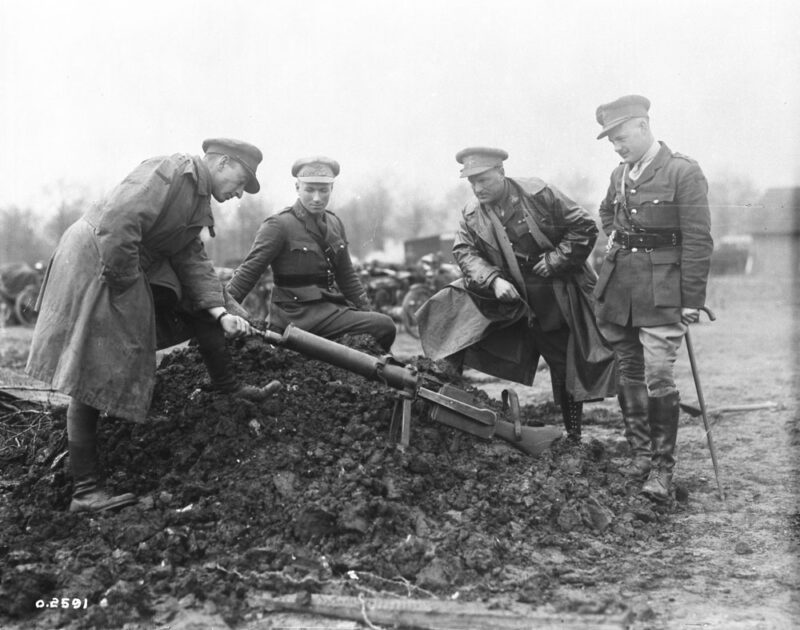
The Yukon Motor Machine Gun Battery formed in 1914, consisting of 50 volunteers from the Yukon Territory assembled by ‘Klondike Joe’ Boyle. Renamed from Boyle’s Machine Gun Draft, the unit finally sent to France in 1916, where it served with the 4th Canadian Division and fought in major battles like the Somme, Vimy Ridge, Passchendaele, and participated in the Allied Occupation of Germany.

This the story of the Yukon Machine Gun Detachment, a.k.a. Yukon Motor Machine Gun Battery, 1st Canadian Motor Machine Gun Brigade, 2nd Canadian Motor Machine Gun Brigade, and it’s two unsung heroes of the Great War – Joseph Whiteside Boyle and Henry ‘The Swede’ Frederick Victor Meurling.
Original Yukon Machine Gun Detachment
The original unit funded by mining entrepreneur Joseph Whiteside Boyle in October 1914. A native of Woodstock, Ontario, Boyle came to the Yukon during the gold rush and made a huge fortune. A former professional boxer, in 1914 the Yukon’s richest citizen and a great patriot.

With the notable exception of 5′ 4″ Harry Lobley, the original detachment filled with very tall lumbermen, miners and RNWMP Officers. The vast majority over 5′ 10″ on their attestation papers. The Yukon Machine Gun Company left Dawson City by steamer on 10 October 1914, bound for Victoria, B.C.

After a week’s stay in Victoria, on 30 October the unit disembarked in Vancouver where it spent the next eight months. At Hastings Park in that city, the battery attached to Tobin’s Tigers – the 29th Canadian Infantry Battalion, mobilizing at the park for service overseas.

J. W. Boyle’s Yukon Machine Gun Detachment
Nearly all of Boyle’s 49 originals identified, save those in bold below. Cook, Kingston, Jennings, Hoskins, Fitzgerald, Tully and Fenwick not on the Nominal Roll of 26 May 1915, though Falconer still with the unit. Ryley and Gill crossed out on the Nominal Roll.

Back Row Yukon Motor Machine Gun Battery
Left to right, back to front: Joseph Alexander Brown 2715/107085, Thomas F Stewart 132224, George Bransby Trites 2702/107588, John MacDonell 2690/107448, Charles John Ryley 2699, B Taylor 2704, William Aldcroft 2707/107067, Richard Babb 2666/107120, Harold Addison Ponder 2769/107496, William Kenneth Currie 2672/107169.
Third Row Yukon Motor Machine Gun Battery
Pte William Jack Frame 2678/107233, Corporal Ernest Laurence Peppard 2695/107498, John Douglas Ross 2497/107524, Cook, George Gill 2680, John Gentry 2679/107259, Neil MacCuish 2689/107399, Sgt Frank McAlpine 2688, Harry Lobley 2687 (youngest), Truman Avery Morton Haney 2664/107317, Arthur Reginald McKinley 2692/107400
Second Row Yukon Motor Machine Gun Battery
Thomas Kelsey 2684, Samuel George Waddell 107647, Aubrey Ernest Forrest 2679/107232, Frank Woodhouse Morgan 107451, Robert Arthur Small 2700/107572, Henry Horace Jones 2683/107346, Jerome Edelstan 2673/107208, Private Robert George Ellis 2674/107204 (ALBERT COMMUNAL CEMETERY EXTENSION), Kingston, Thomas McCaw 2691, Sgt William Black 2661, F J Peterson 2697, Fenwick.
Front Row Yukon Motor Machine Gun Battery
Hoskins, William Daniel Young 2706/107652, Felix Boutin 2668/107123, P Falconer 2675, Fredrick Charles Akers 2665, Fitzgerald, Jennings, Captain Stanley Knott DC, QMS James A McKinnon 2659, Anthony Tully, Acting Sergeant Major Harold Strong 2658/107570, Sgt Robert Morton 2663/107452, Sgt M. Anthony Blaikie 2667/107121 (PARGNY BRITISH CEMETERY), Frank Devine Johnstone 2448/107342, Frederick Turner 2701/107589
Some of these men would attest with the 2nd Canadian Mounted Rifles, like Pte Harold Addison Ponder.
Yukon Motor Machine Gun Battery Undesirables
Private Harry Lobley 2687 attested with 2nd CMR on 4 November 1914 in Victoria. At 5′ 4″ tall, Harry the shortest in the original detachment. He was discharged as ‘undesirable’ on 16 April 1915.

Private Thomas McCaw 2691 attested with 2nd CMR on 10 November 1914 in Victoria. He too discharged as ‘undesirable’ on 16 April 1915.
Private George Gill SoS ‘Misconduct’ on 27 May 1915 in Vancouver. Private Thomas Kelsey, at 40 years of age, also SoS in May.
Rejected
The following men did not attest in Victoria with the 2nd CMR, and their identity remains unknown to CEFRG:
- Cook
- Kingston
- Fenwick
- Hoskins
Sir Sam Hughes
On 20 November 1914, Sir Sam Hughes authorized formation of the third of the three mobile machine gun units and the second to be motorized. The gift of a number of wealthy Montreal businessmen, the unit was to be named after Prime Minister Robert Borden. To be composed of six officers and fifty-four rank and file, to operate six armoured cars made by Packard.

Armoured Autocar, 1st Canadian Motor Machine Gun Brigade, Citadel, Arras, 1918. This is one of eight such vehicles that Raymond Brutinel took overseas in October 1914. Note the Vickers machine guns, which the unit received to replace their originally issued Colts, in August 1916
Yukon Motor Machine Gun Battery in 1915
The 2nd Canadian Mounted Rifles Regiment (2CMR) also in Vancouver and slated to go overseas soon. Hughes and Boyle arranged for the Yukoners to be incorporated into 2CMR as its machine gun section, even though it was twice the allotted size. The unit’s existing machine gun section would be carried as supernumeraries. The new arrivals would retain their Yukon identity and would resume their independent status upon arrival in England.
The Yukoners joined 2CMR on 1 April. However thrown together the arrangement was, it seemed to work fairly well, at least for the Yukoners. An officer put in charge, and they managed to gain some training on 2CMR’s Colt machine guns. They did, however, give up wearing the uniform with which Boyle had outfitted them and instead adopted that worn by 2CMR
Yukon Motor Machine Gun Battery Captain Stanley Knott DC at 44 years of age, resigned his commission on 30 April 1915.
Nominal Roll 26 May 1915

Lt George Norman Worlsey 107599 would enter France with the 3rd Divisional Signal Company in September of 1915 after relinquishing his appointment. He returned to England in and became A/Sgt with OTC Command.
Pvt Fredrick Charles Akers 2665 SoS as Medically Unfit on 27 May 1915 in Vancouver.

When the Yukoners left Montreal for England on 12 June 1915 aboard SS MEGANTIC, as part of 2CMR, they did so without their horses, which they would never see again. Also, while they had machine guns, these the property of 2CMR.
Uniforms
The detachment found that it had to relinquish the machine guns the men had been using for the past three months, quite properly reclaimed by 2CMR. They also gave up wearing 2CMR’s uniform. Instead of re-donning the uniforms provided for them by Boyle, however, much to their distress, and at the insistence of the commanding officer at Shorncliffe, the Yukoners attired in the standard uniform of the Canadian infantry. This meant surrendering their mackinaws, Mexican saddles, Colt pistols, and Stetson hats, put into stores, never to re-emerge.
“Mr. Boyle seems to have raised a small unit of sixty [sic] and thinks that they are entitled to every sort of consideration. I have told Mr. Macfarlane [sic] that we simply cannot and will not treat them as a separate unit.” – Acting Major General J.W Carson, to Brigadier General J.C. MacDougall, the commanding officer at Shorncliffe
MacDougall’s solution to attach the Yukoners to the much larger Eaton Motor Machine Gun Brigade, while allowing them to retain the title of “Boyle’s Battery.” The men of Boyle’s detachment spent the next seven months attached to the Eatons, and it was not a happy alliance.
Pvt Jerome Edelstan SoS at Shorncliffe on 24 August 1915. Jerome taking a Commission in the RFC,
Pvt Frank Devine Johnstone embarked for France with 2nd CMR on 22 September 1915. He returned nine months later with Neuresthania (shell shock). Lt Richard Haking Parkinson SoS on 24 September 1915 on transfer to the British Imperial Army.
A/Cpl Frank McAlpine reprimanded for not obeying an order, 4 November 1915.
Pvt George Bransby Trites transferred to the 6th Howitzer Brigade, CFA on 31 December 1915.
1916
Pvt John MacDonell transferred to the 4th Battalion, CMR on 2 January 1916. Private John Douglas Ross appointed a Commission in the British Army on 8 January 1916.
Discipline
In January 1916 the unit at last furnished with a couple of officers, lieutenants F.A. Hale and C. Usborne. They came from the Eatons, however, so unpopular and could not maintain discipline. Acting Sergeant Major Harold Strong, with five years of service in the NWMP and two years in South Africa behind him, seems to have been the leader.
Sergeants Robert Morton and William Black also had influence. Morton a former NWMP constable and miner. Black, who identified his civilian occupation as forest ranger, the brother of the Yukon commissioner, George Black, and had also served in South Africa. The long-time quartermaster sergeant of the unit, James A. McKinnon, who seems to have taken special umbrage over the union with the Eatons, another figure of authority.
Sgt James A McKinnon
Sgt McKinnon hampered by the fact that, in November 1915, he was broken in rank for drunkenness and transferred to the Veterinary Corps for his sins. He blamed this lapse on the stresses incurred by his efforts to separate the Yukoners from the Eatons, however, and continued to press for his reinstatement.
Yukon Motor Machine Gun Battery
In June of 1916, renamed the Yukon Motor Machine Gun Battery, but still remained training in the operation of machine guns, going on marches, undertake other training, and waiting. Captain H.F. Meurling took command. Meurling had been appointed a Lieutenant in Sherbrooke, Quebec on 25 May 1915 with 5th CMR.

Captain Henry Frederick Victor Meurling
Born in 1875 in Sweden, Meurling trained as a civil engineer and served as an officer in the Swedish navy. He later served for a time with Belgian forces in the Congo before immigrating to Canada in about 1909. Settling in Nelson, British Columbia, he worked as an engineer for the federal government on Columbia River related water projects. He enlisted on 31 May 1915, at Sherbrooke, Quebec, in the 5th Canadian Mounted Rifles.
Once in England Captain Meurling taken on as a machine gun instructor at the Canadian Military School in Shorncliffe.
Meurling on Strong and Morton
Boyle and MacFarlane thought highly of these men and believed them all to be more than capable of becoming officers. The consummate professional, Captain Henry Frederick Victor Meurling, who took command of the unit in June 1916, held a different assessment. In his view, Black the only one who “had the slightest conception of military discipline.”

As is clear in numerous vituperative letters he wrote to Boyle, Meurling felt threatened by this cabal of non-commissioned officers and insisted upon appointing his own officers. Against his better judgement, however, persuaded by Boyle and others to make Strong a lieutenant.
Gasbags
Both Strong and Morton proved to be major disappointments in the Battle of the Somme in November, and Meurling retrospectively outraged over the pressure that had been brought to bear on him to promote them. “Please ask all the old Yukoners of their opinion of Mr. Strong and Sergt. Morton now when they have been under fire,” fumed Meurling in a letter to Boyle. No longer, he insisted, would he allow “any ‘gasbags’ work the ropes for their own benefit at the expense of those men who did the work.”
Nor did he have much use for McKinnon, who, he was convinced, continued to machinate behind his back. In the end, he promoted Black to the position of lieutenant that had been left vacant by Strong’s prolonged departure from the Somme, due, he claimed, to myalgia. (It should be noted, though, that McKinnon did later succeed in rejoining the unit as a lieutenant and apparently gave it good service to the end of the war).
Lyman Munger Purdy
On 9 June 1916, at 9:00 in the evening, the steamer Casca pulled away from the Dawson dock and headed up the Yukon River for Whitehorse, carrying the first and largest contingent, 120 men, that had thus far left Dawson to go to the defence of the Empire. Young Lyman Munger Purdy among those departing.

Martha Black
George Black officially adopted Lyman that October, in Victoria, and the teenager went to war as Lyman Munger Black. At the 1916 Dominion Day celebrations in Dawson’s Minto Park, George Black still recovering appendix surgery so Martha stepped in to speak in his place, implying her intention to go overseas with her husband and son. She added:
“The Great War is a woman’s war as well as a man’s war. When peace comes the articles of peace will affect the women quite as vitally as they will affect the men, so that while we, because of our very sex, are not called upon to bear arms in a physical sense, yet we are daily called upon to bear the brunt of many a battle.”
The George Black contingent, including George and Martha Black, departed on 9 October aboard the steamer Casca. Martha was the only female passenger.
Instructor L/Cpl Joseph Alexander Brown had proceeded overseas with 2nd CMR in September 1915. He suffered a SW of the left forearm on 2 July 1916. Evacuated to England, Joe would return to Canada as an Instructor in October of 1917 until March of 1918, having never served in France with his original unit.
Inspection
On 7 August 1916, the whole of the 4th Canadian Division inspected by Rt Hon Lloyd George, Major-General Sir Sam Hughes on Hankley Common.

Belgium
On July 12th, 1916, the Borden Motor Machine Gun Battery and the Eaton Motor Machine Gun Battery attached to the 1st C.M.M.G. Brigade for Tactics.
On 12th August 1916, the unit embarked aboard SS NIRVANA, only leaving on the 15th, disembarking at Le Havre on the 16th. Equipped with motorcycles, machine guns, and the requisite number of trucks, the unit proceeded to the front as the motor machine gun battery of the 2nd Canadian Division. The officer’s proceeding with the unit:
- Captain H F V Meurling, Officer Commanding
- Lt R D Harkness
- Lt W C Nicholson
- Lt H H Strong
Finally, nearly two years after the men volunteered, the men stationed near the front. From then on, their wish for action more than fulfilled. Their strength had by then dwindled to thirty-five, however, owing to the departure of men seeking more attractive employment in other units.

Later attached to the 1st Canadian Motor Machine Gun Brigade at Abeele, Belgium on 19 August 1916, and from this date the Motor Machine Gun Units of the Canadian Corps, though administratively self-contained, normally kept together under the single Tactical Command of the Officer Commanding the 1st C.M.M.G. Brigade.
Major General Samuel Benfield Steele
No doubt under pressure from Boyle, Hughes remained an influential backer of its continued existence. In addition, the unit had an influential backer in England, Major General Samuel Benfield Steele, an old friend of Boyle’s from the Yukon, who had come to England in May 1915 as commander of the 2nd Canadian Division.
Sam Hughes further complicated the Canadian command situation in England by appointing Steele commander of all Canadian troops in that country, not apparently concerned that in this role his responsibilities conflicted with those of Carson in London and MacDougall at Shorncliffe.
Yukon Motor Machine Gun Battery
On 7 May MacDougall made a point of informing Hughes that the decision had been taken to make the Yukons the motor machine gun battery for the 4th Division. The unit was now officially titled the Yukon Motor Machine Gun Battery.
One of Captain Henry Frederick Victor Meurling‘s first moves was to dispense with the services of Lieutenants Hale and Usborne, and arrange for the appointment of two men in their place who had served under him previously and whom he knew to be bright and capable. At his urging, Sergeant W.G. Nicholson and Corporal R.D. Harkness, then serving at the front, awarded commissions as lieutenants and brought to England to join the Yukons.
To bring the unit’s required strength up to fifty-four, additional personnel began to arrive almost immediately, mostly from the 82nd, 87th, and 89th battalions and from the Canadian Army Service Corps.
Half of the originals
Of the original forty-six Yukoners who had come overseas, a total of twenty-seven, or just over half, remained. Twenty-five non-Yukoners had come in, both to replace those who had left and to bring the unit up to the required strength of a motor machine gun battery.
Comparing the two groups makes for some interesting contrasts. The average age of the first, or original Yukon group, was older than the CEF as a whole – 26 years on enlistment. The average age of these original Yukoners 33, the oldest 42, the youngest 22. The second group, or the later arrivals, more in line with the CEF average, the oldest 27, the youngest 18, the average age 24.

E Battery, 1st C.M.M.G. Brigade
Now known as E Battery, 1st Canadian Motor Machine Gun Brigade from 24 August 1916.
Ypres Salient
Upon their arrival at the front in the Ypres Salient in July, the Yukons issued with Vickers machine guns, which meant that, unlike the other three motor machine gun units that had come earlier, they never had to use the problematic Colt in action. They entered the line in early September, and the reports in the War Diary show that they immediately began to practice the tactics favoured by Meurling.

Comines Canal
The Yukon Battery took over gun emplacements in the Right-sector to the left of the Comines Canal on 2 September 1916.

At Machine Gun Farm from 5 to 23 September 1916. Preparations made to move to the Somme in early October. Proceeded to Contay attached to 1st CMMG brigade on 5 October 1916.
Sgt Robert Morton wounded (GSW back) on 14 October 1916. He returned to duty before midnight.
Privates McKinley and Blair wounded on first day of attack, 15 October 1916. Operation called off the next day, and once again battery attached to 4th Canadian Division.

In October, they were engaged in combat at Courcelette, in the Somme Valley. The village of Courcelette was a major tactical objective during the Somme Offensive, which lasted from July 1 until November18 of 1916.
Pvt Arthur Reginald McKinley wounded (left leg, gas poisoning) 18 October 1916. He returned to the unit on 23 November 1916.
The Somme
The nature of the fighting – a more or less “running fight” with the M/Guns never retiring until outflanked – made it impossible for the officer to communicate with guns not In his immediate neighbourhood and the comparative [sic] large targets presented by the crews of more than two guns retiring simultaneously caused, where tried, large casualties. – An assessment of operations on the Somme by Captain H. Meurling
Operation, delayed several times, finally takes place on 21 October 1916. Captain Meurling given command of all machine guns in the 4th Division on 30 October 1916 for pending attack.

Reporting on the action of battle, Captain Harry Meurling, the commanding officer, noted that they had expended more than a half million rounds of ammunition during one battle (90,000 in the first 20 minutes of the attack). He also singled out Privates H.A. McCallum and R.V. Cummer, who, as scouts and messengers, operated under dangerous conditions. They both received the Military Medal for their bravery.
Cpl Truman Avery Morton Haney admitted to No. 9 Field Ambulance on 15 October 1916(GWS arm), and discharged the following day.

Canadians who have been helping to push the Huns, having their wounds attended to at an advanced dressing station. Possibly No. 9 CFA. MIKAN No. 3395840
M. Anthony Blaikie’s MM
Blaikie having shown leadership qualities was promoted in the field to Corporal on 14th June and then Sergeant on 30th November. He was a well-respected NCO in every sense of the word and highly admired by his men.
It was in November when Blaikie earned the Military Medal, MM, for the hard fighting near Courcelette.
“107121 Blaikie, Anthony, Sgt., Canadian Machine Gun Service, London Gazette 22nd January 1917 – For conspicuous good work and devotion to duty near Courcelette from the 13th to the 19th November 1916 when the machine gun group under the O.C. of the Yukon Motor Machine Gun Battery were in action practically day and night. During the action of 18th November 1916, his belt filling machine was destroyed, he at once organized belt filling by hand and through his cool and efficient manner under heavy shell fire he succeeded in keeping his men working to the utmost and supplying badly needed ammunition.”
Sgt Frank McAlpine gassed during the attack on 21 October 1916 and evacuated to England. Driver Henry Horace Jones reported missing on 21 October 1916 (VIMY MEMORIAL). Brother of Lieutenant Trafford Jones (RENINGHELST NEW MILITARY CEMETERY), who died while serving with the Canadian Army Service Corps.
Death of Private Robert George Ellis

Pte Robert George Ellis 2674/107204 (ALBERT COMMUNAL CEMETERY EXTENSION) killed by shrapnel from an enemy shell in the trenches near Courcelette on 14 November 1916.

Stewart’s MM
Stewart, Thomas F., Sgt., 132224, Canadian Motor Machine Gun Service, LG 22/01/17 – For conspicuous good work and devotion to duty near Courcelette from the 13th to the 19th November, 1916 when the machine gun group under the O.C. Yukon Motor Machine Gun Battery were in action practically day and night. On the 18th November 1916 under intense bombardment he supervised his guns and ammunition supply in a most efficient manner although on several occasions his belt filling place was blown in.
Walker’s MM
Walker, Harry George, Pte., 107649, Canadian Motor Machine Gun Service, LG 22/01/17 – For conspicuous good work and devotion to duty near Courcelette from the 13th to the 19th November, 1916, when the machine gun group under the O.C. Yukon Motor Machine Gun Batt ery were in action practically day and night. On the 18th November, a shell blew in his machine gun emplacement, he repaired same, and continued firing, when another shell tore off the right handle and side roller, he made temporary repair and continued firing.
A/Cpl Aubrey Ernest Forrest admitted to No. 26 General Hospital on 23 November 1916 (infected finger). He returned to his unit on 12 December 1916. During his absence, he had been promoted to Sergeant. By the end of the year, Battery Sergeant Major (Warrant Officer Class II).
The battery left the Somme from Albert to Frevent on 30 November 1916.

Pvt Samuel George Waddell returns from hospital (VDG) and soon AWOL in December of 1916. Following 168 hours of detention, he is once again AWOL in January, and absent from Roll Call following another detention.
Medals
Military Cross
Captain Meurling decorated with the Military Cross on 13 December 1916.
Military Medal
Only Sgt McAlpine not in attendance during the medal presentation as he had proceeded to England to train for a commission.
- Sgt Blaikie
- Cpl Peppard
- Cpl Roulston
- Pte Walker
- Pte McCallum
- Pvt Cummer
- Sgt McAlpine
Peppard’s MM
Peppard, Ernest Laurence, Pte., 107498, Canadian Motor Machine Gun Service, LG 22/01/17 – For conspicuous good work and devotion to duty near Courcelette from the 13th to the 19th November, 1916 when the machine gun group under the O.C. Yukon Motor Machine Gun Battery were in action practically day and night. On numerous occasions and especially during the action of November 18th he kept his gun working in a most efficient manner under very heavy shell fire and very trying circumstances (Fig. 59).
Blaikie’s MM
Blaikie, Anthony, Sgt., 107121 Canadian Machine Gun Service, LG 22/01/17—For conspicuous good work and devotion to duty near Courcelett e from the 13th to the 19th November, 1916 when the machine gun group under the O.C. of the Yukon Motor Machine Gun Battery were in action practically day and night. During the action of November 18th 1916, his belt filling machine was destroyed, he at once organized belt filling by hand and through his cool and efficient manner under heavy shell fi re he succeeded in keeping his men working to the utmost and supplying badly needed ammunition.
Captain Meurling’s MC Citation
For conspicuous gallantry in action. He commanded a group of machine guns with great courage and skill throughout the ‘ action, materially assisting in the success of the operations. – L.G. 10 Jan 1917
Pvt John Gentry developed T.B. in the field during December and transferred to CCAC Shoreham on 28 December 1916. He returned to Canada, and following 71 days in hospital, SoS as Overage on 10 May 1918.
Points on Machine Gun Firing
On 12 November 1916, Appendix VIII in the Yukon Motor Machine Gun Battery diary written by Captain Meurling MC demonstrates his supreme knowledge in machine-gun warfare .


1917
Lt Strong admitted to Miss Pollock’s Hospital on 30 December 1916. Note Strong a Boer War Veteran, and had served almost five years with the RNWMP. Discharged on 8 January 1917 (rheumatism), he was approved for two months General service at home.

Throughout the winter of 1916 and 1917, they remained close to the front where, if they weren’t in combat, were constantly drilling, receiving instruction with machine guns, packing ammunition into gun belts, doing trench work and cleaning weapons and equipment.
Under constant bombardment, they suffered from shrapnel wounds, exploding shells and gas attacks. During combat at the Somme, one officer was even overcome by the smoke emitted by the machine gun in his emplacement, and had to be hospitalized.
Pvt Robert Arthur Small promoted Corporal on 2 January 1917 in the field. Sgt Frank McAlpine awarded the Military Medal at Crowboro on 31 January 1917.
McAlpine’s MM
McAlpine, Frank, Sgt., 107398, Canadian Motor Machine Gun Service, LG 22/01/17 – For conspicuous good work and devotion to duty near Courcelette from the 13th to the 19th November, 1916 when the machine gun group under the O.C. Yukon Motor Machine Gun Batt ery were in action practically day and night. On the 18th November, he was knocked down by a shell and badly shaken but continued to look after his guns ammunition supply in a most effi cient manner
Capt. H.F.V. MEURLING, M.C. admitted to No. 4 CFA (Influenza) on 7 February 1917 and later discharged to duty on the 11th.
Sgt Frank McAlpine MM promoted to Temp. Lieut. at Crowboro, 14 February 1917. Lt F McAlpine MM‘s health declines during the summer of 1917, preventing his return to the unit.
Private William Jack Frame wounded 22 February 1917. Severe GSW to his left elbow. He would be invalided to Canada on 16 December 1916. Pvt H T Henderson 86427(AIX-NOULETTE COMMUNAL CEMETERY EXTENSION) killed on this day, and Lt Harkness badly shocked.
Major E H HOUGHTON MC had been brought in as D.M.G.O. from the First Division, to succeed Capt. H.F.V. MEURLING, M.C.,(admitted at Le Touquet on 20 March 1917). Fatigue caught up with the Commander after returning to early following a bout with Influenza. Meurling discharged on 5 April 1917.
Pte F Boutin wounded by shell fire in the face on 7 April 1917.
Vimy
The Yukon Battery saw action at the Battle of Vimy Ridge. Private Herbert Maxwell Lawless MM, a Mountie who had at one time been stationed at Gold Run Creek, near Granville, killed near Givenchy by shrapnel at his gun emplacement (CABARET-ROUGE BRITISH CEMETERY, SOUCHEZ).

Lawless’ MM
Lawless, Herbert Maxwell, Pte., 107379, Canadian Machine Gun Service, LG 26/04/17—For conspicuous gallantry during a raid on the enemy’s trenches near Souchez on February 22, 1917. An enemy trench mortar shell landed amongst the crew of his gun, killing one, wounding three and burying himself and his Offi cer. He rendered most valuable assistance after recovering from the shock, by helping in moving guns, material and wounded.
On 11 April 1917, Sgt Robert Morton promoted to Lieutenant.
A month later, Private Gilbert killed by shrapnel while taking the village of Fresnoy. The fighting on the line continuous through June July and August. Captain Meurling noted that more than three million rounds of ammunition expended during the month of August. By now, Lieutenant William Black MC, brother Commissioner George Black, had been awarded the Military Cross for gallantry in battle.
On 24 April 1917, Private Neil MacCuish admitted at St Omer (GSW left arm). He would be discharged in July at Epsom.
Captain Meurling reported sick in June of 1917, complaining of pain in left side of abdomen. He is also troubled by chronic tonsillitis.
Pvt Samuel George Waddell, the bad-boy of the unit, granted permission to marry (at public expense) on 12 July 1917.
Captain Meurling had a ‘touch of gas’ on 4 August 1917. Captain Meurling admitted to hospital for the third time in 1917 (appendicitis slight) on 18 August 1917. His appendix removed on 22 August 1917, and one months rest prescribed.
Lt R D Harkness MC on Court Martial at Hersin Coupigny, 31 August 1917. The next Canadian to be Shot at Dawn was Pvt Dimitro Sinizki on 22 October 1917. This may have been his FGCM.

BSM Aubrey Ernest Forrest attached to the 35th (British) Division at Roisel Field on 13 September 1917. He returned to the unit by the end of the month. Captain Meurling also returned (appendicitis) on 20 September 1917.
Passchendaele
Batteries 6 and 7, under the control of Capt. MEURLING M.C., O.C. Yukon M.M.G. Battery, heavily shelled, 6 November 1917. Suffering 23 Casualties. These 2 Batteries expended 44,000 Rounds S.A.A. during the Attack Barrage, No. 8 Battery (3rd and 13th Companies) had 1 Gun destroyed early in the day, but, within 30 minutes, this Gun replaced from the Advanced Armourer’s Depot. A 2nd Gun destroyed in the evening, similarly replaced.

Pvt Felix Boutin suffered a GSW to his jaw on 7 November 1917. Evacuated to England, he would return to Canada in early 1919. Cpl Roy Van Horn Cummer later awarded the Military Medal for acting as a runner between batteries at Bellevue Spur.

The month of September kept the Yukon battery occupied with anti-aircraft duties, then during an operation near Passchendaele on November 10th, a shell hit and buried Lieutenant Black and five other men. It took some time to dig them out. At one point while buried, Black could hear the diggers discussing whether it was worth excavating for any more survivors (or bodies).
Martha Black, his sister-in-law, said that he had nightmares for the rest of his life from what he experienced that day. His replacement was a young Lieutenant Lyman Munger Black, his nephew.
Blaikie’s DCM
Sgt M. Anthony Blaikie’s second medal of bravery the Distinguished Conduct Medal, DCM, for Passchendaele and awarded 15th December 1917.
“107121 Blaikie, Anthony, Sgt. MM, Canadian Machine Gun Corps, London Gazette 28th March 1918 – For conspicuous gallantry and devotion to duty when in command of four machine guns, his officer and other NCO’s being casualties. Under very heavy shelling in the open he repaired slightly damaged guns and kept them in action, and helped and dressed wounded.”
The Allied forces eventually claimed victory at the Battle of Passchendaele, but the campaign, which lasted four months, claimed a quarter of a million casualties and missing. 15,600 of those casualties in the CEF.
Russian Front
By this time in the war, the Germans were suffering unsustainable losses. The withdrawal of Russia from the eastern front allowed the Germans to deploy more troops to their western Front. Germany embarked on a final offensive in March of 1918, hoping to break through the Allied lines before American troops started to flood the battlefront.

Private E B Mowat, 24 March 1918
The Yukon men stepped into the breach, displaying tremendous coolness under terrible conditions. On the evening of March 24, 1918, in the heat of battle, Captain Meurling sent a Yukoner, Private E.B. Mowat, as far forward as circumstances would allow in an car filled with rations to re-provision the machine gun emplacements of the Yukon battery.

Private Mowat proceeded at full speed along the road, passed the gun line, and turned round in No Man’s Land, where he called to the boys to come and unload the cart. At once the Yukon men clustered round it and soon had it unloaded in full sight of the enemy and with machine gun bullets flying thick in the air. They divided up the rations and shared them with famished infantrymen in their sector, who hadn’t received rations for six days.
- Pvt Frank Stanley Durrant
- Pvt John Harding
- Pte Frank Harper
- Pvt John Gordon Lovie
- Cpl Homere Joliat MM (ST. PIERRE CEMETERY, AMIENS)

At the age of 19 years Black awarded the Military Cross for bravery in stemming a German cavalry charge. A soldier, who was eyewitness, described how this action took place.
“During the night the infantry fell back without warning the machine gunners. At dawn we saw the enemy cavalry advancing four abreast, only 200 yards away. We opened up with the guns, point blank, with devastating effect. We held them up and stuck to it until the enemy opened up on both our flanks. It was getting hot under the collar so we hastily retreated about a quarter of a mile for a better position.
While retreating two Yukoners fell, Sergeant Blaikie and Private Fisher. Lyman stopped to see if he could help them, but Blaikie was dead and Fisher, who was dying, urged him to save himself. As the Huns were right on our heels he had to run for it. He then remounted the one remaining gun and opened up on them. For 12 days he was fighting like this, and how he ever came through without a scratch is a marvel.”
Each of these battles took its toll on the brave men of the Yukon Company. The ranks thinned by deaths and injuries. Some simply lost in the craters of No-Man’s Land (the four men above on VIMY MEMORIAL, save Cpl Joliat).

General FOCH Appointed to Command Allied Forces
On this day, the 26th March, the Governments of France and Great Britain decided to place the supreme control of the operations of the French and British forces in France and Belgium in the hands of General Foch, who accordingly assumed control.

Captain Harkness Evacuated
Capt. MEURLING sent forward to Lieut. CAMPBELL at WARVILLERS all the Drivers and Cooks he could spare, together with a few Infantry Stragglers he had collected. A supply of Ammunition was also sent up. These Reinforcements reached WARVILLERS just in time to help a small force of Infantry, who had been rallied by Lieut. CAMPBELL, to repel another German Attack and eventually check the enemy Advance at this point.
Capt. HARKNESS, who acted with conspicuous gallantry since his Battery first went into Action on March 24th, and who was called “CANADA” by all the Infantrymen with whom he had co-operated, evacuated to hospital.

With nightfall enemy activity decreased considerably and during the night March 27th/28th, the French 133rd Division relieved the Twentieth Division. All the Officers, N.C.O.s and Men needed a well earned rest. In his report on these Operations Capt. MEURLING writes:-
“Everybody at once went to bed, as no man had had any rest since the morning of the 22nd – with the exception of two hours on the morning of the 24th and two hours on the morning of the 26th.”
17th Canadian Machine Gun Company
Yukon Infantry Company reorganized at Witley on 9 February 1917 as 17th Canadian Machine Gun Company. Commanded by Major T.C. Bamfield.
The former Boyle Company eventually melded with other units, including the 17th Canadian Machine Gun Company, which contained Captain George Black and many other Yukon volunteers, to form the 2nd Motor Machine Gun Brigade. At the time of this merger, only nine names of the original 50 who had signed up in Dawson City and Vancouver remained.

Four years before, the Boyle volunteers eager to enter the field of battle. It took them nearly a year to reach England, and another year to reach the battle fields of France, but once they arrived there, they were engaged in one major battle after another: Courcelette, Vimy Ridge, Passchendaele, the German offensive of March, 1918, Amiens, and Canal du Nord.
Witley Camp
Martha Black visited Witley Camp on 10 July 1917. One of Martha’s tasks while in England to administer the Yukon Comfort Fund—money that had been raised by the ladies of the IODE to aid the Yukon men while overseas.

John Chambers and Harold Butler described the scene pictured below.
“Well, she sat down to the gun, laid it on the target, tapped it into correct position, and first burst, down goes all the ranging plates; second, taps the gun onto the target and blazes away 75 times and puts 64 on the bull. I never saw anything like it for a beginner. She seemed to be right at home.” – John Chambers

“Last week we marched to Aldershot, to the ranges where all the big machine targets are. We enjoyed a pleasant surprise when Mrs. Black arrived on the ranges, and, when through shooting, Mrs. Black, like a real machine gun No. 1, sat herself down behind the gun and let go, and made a very high score. “- Harold Butler
Sgt William Aldcroft granted permission to marry on 6 October 1917. On 12 December 1917 he is Mentioned in Despatches.
The enemy shelling the position heavily day and night, Private G Lucas killed on 6 November 1917. Following several incidents where he left hospital, Lt Frank McAlpine MM invalided to Canada under escort from Seaford on 26 November 1917. Medical Board notes his condition greatly aggravated by Military Service. Paralysis at times, early stages of dementia.
Small’s MM
Small, Robert Arthur., Cpl., 107572, Canadian Machine Gun Corps, LG 19/11/17 – On 9th Aug 1917 during a raid on enemy’s trenches was in charge of 2 machine guns. Three of his gun numbers became casualties, he organized his gun crews with himself acting as No 1, rectifying stoppages under heavy shell fire, regardless of his own safety, thus enabling fi re to be maintained until the completion of the operation.
Corporal Robert Arthur Small awarded the MM on 12 December 1917 in the field, along with Private William Kenneth Currie.

Currie’s MM
Currie, William Kenneth, Pte., 107169, Canadian Machine Gun Corps, LG 19/11/17—On August 9th 1917, during a raid on the enemy’s trenches, when two guns were destroyed by shell fi re, he doubled the rate of fi re of his gun and kept it in action although compelled to make extensive repairs under very heavy shell fi re, which necessitated his greatly exposing himself. At all times he showed the greatest contempt for his own personal safety.
On 16 December 1917, Pvt Harry George Walker 107649 SoS as a Deserter from 9 October 1917.
1918
Private Neil MacCuish granted permission to marry at public expense on 2 January 1918. Neil had been discharged from hospital at Epsom in July 1917 and never returned to the battery. Bath Parade and issue of new underwear on 8 January 1918 (men would usually change into the freshly-washed underwear from the previous unit on Bath Parade).

Captain Meurling proceeded on 14 days leave to Rome on 12 February 1918, returning on the last day of the month.
Corporal Robert Arthur Small MM invalided to Canada on 16 March 1918 from Liverpool.
MC Action of Lt Lyman Black
The German offensive had the Allied forces retreating for a period of time. The Yukon Machine Gun Battery was called into service to bolster the crumbling defensive line. In one engagement with the enemy, a young Lieutenant Lyman Black held the line almost single handed, after Sergeant Blaikie, who was assisting, was shot and killed at his side. Reports after the encounter state that he mowed down large numbers of Germans and repelled their advance.
In Martha Black’s autobiography, My Ninety Years, a soldier who was an eyewitness describes how this action took place:
During the night the infantry fell back without warning the machine gunners. At dawn we saw the enemy cavalry advancing four abreast, only 200 yards away. We opened up with the guns, point blank, with devastating effect. We held them up and stuck to it until the enemy opened up on both our fl anks. It was gett ing hot under the collar so we hastily retreated about a quarter of a mile for a bett er position.
While retreating two Yukoners fell, Sergeant Blaikie and Private Fisher. Lyman stopped to see if he could help them, but Blaikie was dead and Fisher, who was dying, urged him to save himself. As the Huns were right on our heels he had to run for it. He then remounted the one remaining gun and opened up on them. For 12 days he was fighting like this, and how he ever came through without a scratch is a marvel.
Martha Black was at the investiture of her son’s Military Cross at Buckingham Palace. Martha even got to chat briefly with King George V.

Death of Sgt M. Anthony Blaikie DCM MM
Sgt M. Anthony Blaikie DCM MM killed in action, 24 March 1918. His body, and that of Pte P Fisher 175166 recovered outside Nesle, and later reburied at Purgny.

Long-time friend of Blaikie, Martha Black who was living in England to be closer to her husband and son who were also overseas, took time to take pen and paper to hand to send a personal condolence letter to Anthony’s father. Martha described Anthony’s death as told to her by her husband, now Captain George Black, who was with the same unit as Blaikie.

of the war employed as defence counsel for soldiers facing courts marshal
offences. There was a mutiny of about 25 soldiers in which he and a fellow officer managed to get 20 a full acquittal and four light sentences. One, a serving
Russian charged with hitting an officer over the head with a two by four, deported back to Russia.
Letter
“April 20th, 1918
Dear Mr. Blaikie,
Because your son, Sgt. Blaikie, was such a good friend of my husbands, of my son’s, of my brother in law’s and, in fact, of our entire family’s I feel that I would like to write you a few words of sympathy in your present grief.
Sgt. Blaikie has been a family friend for so many years, we knew him so well and admired him so sincerely that in his loss we have all felt a personal touch.
Your son fell while with my boy (Lt) Lyman and I am going to quote just a few words from my husband’s last letter in which he speaks of Sgt. Blaikie’s death …
23 March 1918
March 23rd, Orders to move received at about 2A.M., pulled out at daylight, travelled about sixty five miles, – received orders to go into the line, moving up until encountering advancing enemy. Mounted guns right in the open on the surface and went at ‘em.
Stood them off all day, during the night Infantry fell back without warning machine guns. Our first intimation that infantry had left was when we saw the Boche advancing at about two hundred yards away, in fours, we opened up with our two machine guns point blank and mowed them down in swaths, held them up and stuck it till enemy opened up from both flanks with machine guns and a whizz bang battery out in front and put one of our guns out of action. Then we withdrew about a quarter of a mile to a better position.

While retiring Sgt. Blaikie killed (PARGNY BRITISH CEMETERY) and Pte. Fisher mortally wounded (PARGNY BRITISH CEMETERY). Lyman stopped long enough to turn poor Blaikie over and found him to be dead, a bullet hitting him in the head, probably killing him instantly, had no time to take either his papers or personal effects. Spoke to Fisher, found him shot through the stomach and dying, the brave man urged Lyman to leave him as he knew he was all in, Lyman said good bye to him and promised to send a stretcher if possible, as the Hun was right on him he had to run for it.
Killed Instantly
If it is any consolation, and it must be, your dear son was taken instantly, without one moment of pain. Sgt. Blaikie has left a memory with all his friends that is an inspiration, we admired him, we respected him as a man, and we loved him as a friend, and because my own dear sons are doing what he was doing, my heart and sympathies go out to you and your wife in this sad hour.
If there is any way in which I can be of any help to you and yours, please do not hesitate to call upon me. With sincere regards and sorrow for you in your sorrow, I am,
Very Sincerely Yours,
Martha Munger Black

Lyman Black’s MC
Black, Lyman Munger, Lt. Canadian Machine Gun Corps, LG 07/26/18, CG 08/31/18, P847—For conspicuous gallantry and devotion to duty. When the enemy was rapidly advancing, he handled his motor machine guns with great daring, time after time checking the enemy’s advance and giving the tired infantry time to reorganize. On another occasion he rushed his machine guns up to hostile cavalry, causing them enormous casualties.
William Black’s MC
Black, William, T/Lt., Canadian Machine Gun Corps, LG 08/16/17, CG 10/13/17, P1163—For conspicuous gallantry and devotion to duty. During an att ack upon an enemy position he gave invaluable assistance to the infantry, working in an exposed position and directing his machine gun fi re upon enemy reinforcements. Though under heavy fi re he personally worked his guns and attended to the wounded, setting a fine example of courage and energy throughout.
German Spring Offensive
In the afternoon of March 22nd, 1918, when the 1st C.M.M.G. Bde. received Instructions to move the following morning to the FIFTH ARMY Area, 4 of the Motor Batteries on the VIMY RIDGE and the remaining Battery in Camp at VERDREL.

The 1st C.M.M.G. Brigade commanded by Lieut.-Col. WALKER, D.S.O., M.C., who, up to March 17th, 1918, had been in charge of the Machine Gun Squadron of the Canadian Corps Cavalry. Lieut.-Col. WALKER’s Command consisted of the following Units:-
- “A” Battery, 1st C.M.M.G. Brigade, 8 Vickers Guns, mounted on 4 Armoured Cars.
- “B” Battery, 1st C.M.M.G. Brigade, 8 Vickers Guns, mounted on 4 Armoured Cars.
- “C” Battery, Borden M.M.G. Battery, 8 Vickers guns, carried in light Box Cars.
- “D” Battery, Eaton M.M.G. Battery, 8 Vickers guns, carried in light Box Cars.
- “E” Battery, Yukon M.M.G. Battery, 8 Vickers guns, carried in light Box Cars.

Roye
Immediately after the arrival of the Motor Machine Gunners at VILLERS-BRETONNEUX (4.00 P.M.), the Eaton and Yukon Batteries, under Capt. MEURLING, M.C., detailed to report to the G.O.C., XVIII Corps, at ROYE.

At 9.30 P.M., March 23rd, the Eaton and Yukon Batteries reported to the XVIII Corps H.Q., at ROYE. After the Officers and Men had had a hot meal, Capt. MEURLING was instructed to take his Group to NESLE, where it would come under the Orders of the Twentieth Division. Owing to the great confusion on the Roads caused by numerous disorganised Lines of Traffic running in both direction, the 2 Batteries were delayed on the way and did not reach NESLE until 2.00 A.M., March 24th. Billeting arrangements were made, and after insuring that the Guns, Transport and all other equipment was ready for immediate Action, the Men were allowed to retire.

Capt. MEURLING detailed 4 Machine Guns of the Yukon Battery, under Lieut. BABB, M.C., to report to the 60th Inf. Brigade Headquarters at BACQUENCOURT and the remaining 4 Guns, under Lieut. VOSBURGH, were to cover an Artillery Brigade N.-W. of NESLE. Capt. HARKNESS, M.C., in charge of the 8 Guns of the Eaton battery, was to support the 183rd Brigade in its Counter-attack near BETHENCOURT.
Captain Babb taken Prisoner
When Lieut. BABB reported to BACQUENCOURT at 10.45 A.M. the Situation on the 60th Infantry Brigade Front not clear. The enemy exerting a continual pressure in an endeavour to break through towards NESLE from the direction of HAM.

Shortly after, the Thirtieth Division, on the right, began to retire and the Right Flank of the 60th Brigade exposed. In view of the Situation on the Right and the excessive pressure of the enemy at VOYENNES and BETHENCOURT, the Infantry began to fall back to the Line of the LIBERMONT CANAL – MESNIL – St. NICAISE. No warning of this move given to the Motor Machine Gunners operating on the 60th Brigade Front. Noticing the retirement of the Infantry, Lieut. BABB immediately rushed ahead to get in touch with his forward Gun Crew. Unfortunately, he was severely wounded and taken Prisoner before he reached his Man. The Gun destroyed and all the members of the Crew became Casualties.
Babb’s MC
Babb, Richard, Lt. Canadian Machine Gun Corps, LG 04/25/18, CG 06/01/18, P4198—For conspicuous gallantry and devotion to duty. When all the officers of two machine gun batteries except himself had become casualties he took charge of the sixteen guns and kept them working and the men steady under very heavy shelling.
Evening of 24 March 1918
Captain Richard Babb MC became a PoW on 24 March 1918. Early in the evening, Capt. MEURLING ordered Lieut. VOSBURGH to join Capt. HARKNESS and reinforce the 18rd Brigade, which was then operating in the vicinity of MAISNIL – ST. NICAISE. Also taken prisoner Private Frederick Turner.
In the evening of March 24th, unconfirmed reports of an Advance by enemy Cavalry received at Twentieth Division Headquarters. At the request of Divisional Headquarters, Capt. MEURLING manned 2 reserve Vickers Guns with Batmen and Cooks and mounted them on the NESLE-ROYE Road, N. of BETHONVILLERS. Battery S.M. FOREST (Yukon Battery) placed in command of the 2 Guns, but no Action developed as the report about the German Cavalry proved untrustworthy.
Action of 25 March 1918
During the morning of March 25th, NESLE was reported to have fallen and at 12.45 P.M. enemy Troops had forced the LIBERMONT CANAL at BREUIL. Capt. HARKNESS‘ account of the Action in the morning of March 25th is in part as follows:-
“We managed to make 2 good Guns out of the 4 and placed them in the line under Lieut. BLACK to assist the Infantry. Lieut. VOSBURGH and his Detachment had not reported; they evidently withdrew through MANICOURT and later reported to Capt. MEURLING in ROYE. He had suffered 4 Casualties out of 8 Gunners. The 1 Eaton Battery Gun was badly damaged in the German Attack delivered in the early morning. Battery S.M. HERSEY, D.C.M., reported “Missing, believed killed” and 2 Other Ranks, wounded; Corporal McKENNA, who was with this Gun, returned badly wounded bringing with him the Lock of the Gun. Lieut. BLACK reported 6 casualties out of the 10 Other Ranks in Action under him.
“With the exception of some scattered shelling, the situation remained comparatively quiet until Noon. Lieut. BLACK carried out harassing fire on the approaches to NESLE. The 2 repaired Guns went out of Action.”XIX Corps Front; April 4th
Capt. MEURLING detailed the Machine Guns of his 2 Batteries to take up positions E. and N.-E. and N. of VILLERS-BRETONNEUX and to cover all approaches to the Town. 4 Guns of the Yukon Battery under Lieut. L.M. BLACK dug in Front of the Town. The remaining 4 Guns of the Yukon battery and the 8 Guns of the Eaton Battery, under Lieut. CAMPBELL, were to occupy Positions on the Left.

At this time the enemy heavily shelling our Positions astride the AMIENS-WARFUSEE Road. While going forward to take up their Positions, Lieut. CAMPBELL’s Detachment suffered many Casualties from this Shelling: 4 Other Ranks killed and 26, wounded. There were sufficient Gunners left to man only 2 Guns which were placed in Positions to the Left of VILLERS-BRETONNEUX. Lieut. PEEBLES was in charge of these 2 Guns.
Char-a-banc Cars
During this Bombardment, an enemy Shell exploded and set on fire a Motor Machine Gun Brigade 3-ton Lorry, full of S.A.A. (Bulk and in Belts) being unloaded by the gun Crews of the Eaton and Yukon Batteries prior to their going to forward Positions from the Eastern outskirts of VILLERSBRETONNEUX. Two Char-a-banc Cars (Men’s Transport) standing close to the burning Lorry were in grave danger of being set on fire too; but, in spite of the great risk he was taking in approaching the burning lorry and Ammunition, Private WEGG, a member of the Motor Machine Gun Crews, voluntarily went forward and drove both the Charabanc Cars away into safety.
Capt. MEURLING ordered the Borden Battery to Fire with all their Guns on enemy Positions at a range of 2,500 yds. It was later reported that this Machine Gun Fire broke up a large body of the enemy who were, perhaps, concentrating for an Attack.

Pvt Arthur Reginald McKinley wounded 8 April 1918 (GSW leg). Invalided to England, he would return to Canada per SS OLYMPIC in 17 January 1919 from the Casualty Depot.
Pvt Harry George Walker‘s sentence commuted to 90 days, and he returns to the unit on 16 April 1918.

Pvt Samuel George Waddell
In May of 1918, Pvt Samuel George Waddell (myalgia) invalided once again England (previously in May of 1917). He would not return to the unit, and would become the last original to return to Canada in September of 1919.

Lt Lyman M Black MC and BSM Aubrey Ernest Forrest awarded the DCM on 4 May 1918.

Forrest’s DCM
Forrest, Anthony Edward, Battery Sgt Major, 107232, Canadian Machine Gun Corps, LG 03/09/18, CG 19/10/18, P1441A – For conspicuous gallantry and devotion to duty. After his offi cer had been killed he took command of the motor machine guns and in severe fi ghting checked the enemy’s advance. He engaged hostile cavalry at close range and when covering the withdrawal of the infantry and almost surrounded, fought his way out, with the loss of only two guns, after causing enormous casualties. Amended CG May 10, 1918, P18 Supplementary.
Private William Kenneth Currie MM appointed A/Cpl on 29 May 1918.
2nd Motor Machine Gun Brigade
2nd Motor Machine Gun Brigade formed on June 15, 1918. Yukon and Eaton Motor Machine Gun Batteries transferred from 1st Motor Machine Gun Brigade, making up “A” and “B” Batteries; “C”, “D” and “E” Battery formed by personnel from 17th and 19th Canadian Machine Gun Company. Within 1st Motor Machine Gun Brigade a new “D” and “E” Battery formed by personnel from 18th Canadian Machine Gun Company.

Corporal Robert Arthur Small MM developed nephritis while on leave in Canada, and SoS in Halifax on 8 July 1918.
Inter-Battery Sports Meet held 3 August 1918, including a 100-yard dash with gun, tripod, ammunition box, air case, mounting and laying box at finish.

Battle of Amiens
Built on a two-ton truck chassis, the armoured car has 5mm of armour at the front and 3mm in the rear. With its solid rubber tires and its 22-horsepower engine, it could reach speeds of 30-40 kilometres per hour on roads, but it had very limited cross-country capability. Its twin Vickers machine-guns could each spew 450 bullets a minute.

This armoured car manufactured by the Autocar Company.

BSM Aubrey Ernest Forrest DCM suffered GSW to his abdomen on 8 August 1918. Admitted to No. 5 CCS where he died 12 days later. Interred at the local British cemetery (62E.D.19.c.2.6).

Pvt Albert Farmer MC wounded 9 August 1918 and evacuated to England where he died of his wounds on 3 September 1918.

Buried in the Basingstoke (Worting Road) Cemetery. He was the son of George A. and Anne Farmer, of Palmer, Saskatchewan. His MC now in possession of an online medal auctioneer.

Pvt (A/Cpl) Robert George Mitchell, wounded at Passchendaele, showed great courage and devotion to duty on 10 August 1918. Pvt Harry George Walker suffered a GSW to his leg and admitted to No. 12 General Hospital, Rouen on 11 August 1918 (discharged on 17 September 1918).

Sgt Truman Avery Morton Haney appointed BSM (replacing BSM Forrest) on 10 August 1918. Mentioned in Despatches on 24 September 1918. He would relinquish this rank on 9 October 1918 to proceed on course to the RAF.
List of Decorations – Battle of Amiens
Military Cross
- Lt J D Seton
- Lt W H Roberts
Military Medal
- Sgt R N Morrison 693
- Pte (A/Sgt) A C Bole 907440
- Pte T Doherty 107191
- Pvt H F Drew 911306
- Pte B Halliday 174493
- Pte H McCorkell 150156
- Pvt N D M Turp 1924264
Major Meurling MC granted 10 days leave to Paris on 20 August 1918.
Ryley’s MC
Ryley, Charles John Sheffield, Lt., 4th Battalion Canadian Machine Gun Corps (former Boyle’s Yukon Machine Gun Detachment) LG 30/07/19, CG 20/09/19, P20 Supplement – During the operations against Bourlon Wood on September 27, 1918, he led his men with great courage and coolness through to the final objective. He got his guns into action against large parties of the enemy on the flanks, and killed the horses of a battery of field artillery, which resulted in their capture by our troops. During this period his guns were under heavy fi re, and his battery suffered severe casualties, but his good judgment and courage were a splendid example to his men.
Corporal Ernest Laurence Peppard (def. left knee) SoS on on 24 September 1918. Posted to the Machine Gun Depot at Seaford on 23 November 1918. Lieutenant Samuel Gordon Rennie killed-in-action on 27 September 1918 (VIMY MEMORIAL). Son of James and Maria D. Rennie; husband of Flossie Edna Brookes Gillard (formerly Rennie), of Beaverlodge, Alberta.
Medals
- Pte Edgerton William Hall awarded the Military Medal on 24 September 1918 for actions on Amiens-Roye Road, 10 August 1918. He was continually under shellfire and showed great gallantry and devotion to duty.
- Sgt Stephen George Mallindine awarded the Military Medal on 24 September 1918 for actions at JIGSAW WOOD on 29 August 1918.
- Lt Francis Arthur Landrain Mentioned in Despatches, 24 September 1918.
- Lt Alexander Hugh Wilie awarded the Military Cross for actions on the ARRAS-CAMBRAI ROAD under constant fire, 2-4 September 1918.
Lessons
“The difficulty in noticing Very Light or Parachute signals in the day time unless a smoke bomb fired to burst high in the air, first draws attention to signal being sent up.” – LtCol Meurling

Lt Robert Morton, serving with the 29th Battalion, died of wounds, 19 October 1918 (Plot B, B.240. BARNES (EAST SHEEN) CEMETERY).Son of James and Jessie Morton, of Newcastle-on-Tyne.
Medals
- Corporal James Mackie Kerr MM 859072 awarded the Distinguished Conduct Medal.
- Pte Charles James Alfier 174906 awarded the Distinguished Conduct Medal.
- Outside a village an enemy shell destroyed his motorcycle. With both his legs blown off, and a shrapnel wound to his chest, he managed to pass his message to another runner before fainting. He later came to and joked, “got a good Blighty at at last”. Charles succumbed to his wounds on 25 October 1918 (ST. SEVER CEMETERY EXTENSION, ROUEN).
- Captain Frederick William Thompson recommended for the Military Cross for action son 10/11 October 1918.
- Pvt Henry Earl Casey 2595857 awarded the Military Medal
- Captain Richard Chapman MC recommended for Bar to MC.
- Lt Ernest Bradshaw Smith awarded the Military Cross.
- Captain Richard Chapman Weldon MC recommended for Bar to MC.
- Captain George Hamilton May recommended for Mention.

Mentions
- Pte Richard Worden Garthside 2115910
- Pvt Rothwell Charles Garnett 2004328
- Pvt Roy Clifford Murd 2004640
- Lt Robert Murray MM
- Lt Norman Allen Watt
- Sgt (A/BSM) Alexander John Mulcahy 107449
- Sgt (A/Train SM) Robert Nathaniel Morrison MM 695
- Cpl Hert Halliday MM 174495
- Sgt Leslie Creighton MM 5640
- Sgt Edmond Rondo Fish 111174
- Pvt Hollis Edward Drew 910952
- Pte Samuel Ewart Thomson 270576
- Pvt Arthur George Westmacott 829354
- Pvt Henry Hill 814877
- Pte Charles Richard Golden 651146
- Pte (A/Cpl) Henry David Coton 108788
- Pte Thomas Townsend 288525
- Pvt Arthur Charles Pope 724084
Lessons
“The vital importance of efficient scouting was again emphasized.” – LCol Meurling
The Final Push
On 6 November 1918, Mr J Sheldon-Williams (CWRO Artist) attached to 2nd CMMG Brigade.
The VALENCIENNES-MONS ROAD between Quarouble and Quievrain found to be completely blocked to traffic on 7 November 1918.

A huge mine blocked the advance east of Quievrain, where the men finally billeted for the night. Le Joncquois reached on 9 November 1918, and Framieres the following day. Saint-Symphorien reached by one detachment on 10 November 1918.

On 11 November 1918, 2nd CMMG Brigade established HQ in Château de Beauval in K.36.c.4.5 (well east of Mons). Lieut. Lyman Black, MC led the 2nd CMMGB on a motorbike in procession in the final victory parade held in Mons at the end of the war.

Lt-Col Meurling returned from leave on 13 November 1918, in time to parade through Mons.
Immediate Awards
- Captain R C Weldon awarded the Military Cross.
- Lt M H Doig awarded the Military Cross.
- Lt E B Smith awarded the Military Cross.
March to the Rhine
“You are entering enemy country as an advanced guard of Free Men, not as the Germans entered France and Belgium, filled with lust and greed and the destructive discipline that is based on slavery and compulsion.
See to it that you act as Free Men, that you show what effect Freedom has on intelligent men, which is to breed sympathy, tolerance, respect and fair play towards all.” – Captain Muerling’s SPECIAL ORDER of 18 November 1918.

Sir Arthur Currie issued the SPECIAL ORDER OF THE DAY on 25 November 1918, which included:
“In short, you must continue to be and appear to be that powerful hitting force which has won the fear and respect of your foe, and the admiration of the whole world.”
On 30 November 1918, 2nd CMMG Brigade moved to Havelagne (via Somereffe, Namur, Erpent, Assesse, Emptinae, Grand Frume, Hamois). No stop made for lunch. Several days spent in Havelagne before moving to Vielsalm on 5 December 1918 (total distace 51 miles).

No accommodations to be found in Vielsalm, and the unit moved just south to Provedroux for the night. A wild boar hunt by selected party officers and other ranks on 8 December 1918. St Vith reached on the 9th, followed by Weismes, Hellenthal, Mechernich and finally Euskirchen on the eve of Crossing the Rhine.
Allied Occupation of Germany
CWRO Artist Inglis Sheldon-Williams, attached to 2nd CMMG Brigade painted this image of 2nd Canadian Division soldiers arriving at Bonn on 13 December 1918. The image betrays the weather of the day – a steady downpour.

The 2nd CMMG Brigade arrive in Bonn, Germany on 13 December 1918.
![1918-12-13 3522444 O-3892 PA-003799 G.O.C. and H.Q. Staff, 2nd Canadian Division, passing the Saluting Base [on the Bridge over the Rhine at Bonn] December 13, 1918](https://i0.wp.com/cefrg.ca/wp-content/uploads/2021/12/3522444-a003799-v8-e1762795648659.jpg?resize=800%2C572&ssl=1)

Cpl William Daniel Young continued to work with the War Graves Detachment.

PoW Captain Richard Babb MC repatriated on 18 December 1918 following nine months in captivity.
One Other Rank died in hospital on 21 December 1918. Driver Hugh Leo Kenney buried at Brussels Town Cemetery.


January
On 4 January 1919, funeral of Pte R C McCollom 2004577 with full military honours attended by all men. Private Russell Clarence McCollom a casualty of Spanish Influenza during the Allied Occupation of Germany.

At first interred among several famous figures of Bonn in Poppelsdorf Cemetery (chemist and rector Friedrich August Kekulé von Stradonitz, the mathematician Friedrich Prym, and the manufacturer Friedrich Soennecken). McCollom later exhumed and placed in Brussels Town Cemetery.

Had McCollom died in Cologne, he would likely still be buried in Südfriedhof Cologne.

PoW Private Frederick Turner spent time in camps at Giessen, Darnstadt and Gustrow at Mecklenburg, and Ripon. He was finally released on 10 January 1919.

E Canadian Anti-Aircraft Battery

QMS William Aldcroft awarded the Meritorious Service Medal on 18 January 1919.

2nd CMMG Brigade left Bonn bound for Sart on 26 January 1919. Route via Wasseling, Bruhl, Sechenich, Durin, Eschveiler, Weiden, Aachen, Moresnet, Herve, Fleron (26th/27th), Liege, jemeppe, Amay, Huy, Andenne, Mozet, Wierda, Sart Bernard.
On 31 January 1919 at Vedrin, Lt F E Cowan evacuated to CCS.
February
Pvt Harry George Walker while recuperating in hospital (infection of his hand), found guilty of forging a check, and sentenced to 2 years IHL (admitted to No. 1 Military Prison, 8 February 1919). He would be discharged on 19 April 1919, and returned to Canada aboard SS CARMANIA, 25 October 1919.
Major Meurling MC awarded the DSO on 8 February 1919.
2nd CMMG Brigade left Vedrin on 21 February 1919, and proceeded to England on 29 February 1919, departing Le Havre on 7 March 1919.
Gunner George Bransby Trites discharged in St. John’s, N.B. on 19 March 1919. He was 49 years of age.
Cadet Truman Avery Morton Haney of the RAF discharged on 20 March 1919.
Lt Harold Houston Strong SoS on 31 March 1919.
Presentation of Colours
Presentation of Colours to the 2nd Canadian Machine Gun Brigade, by Lady Perley (wife of the Canadian high commissioner) at Seaford on Thursday, 3 April 1919. Later placed with Mayor of Vancouver for safekeeping in City Hall.

The colours consecrated earlier in the parade ground at Seaford camp, east Sussex, by Colonel (Canon) Almond, the senior Canadian camp chaplain.

After handing the Colours to the colour party, Lady Perley spoke of the honour and pleasure that it gave her to present the Colours to a unit of the Canadian Corps of whose fighting record all ranks of the Brigade had every reason to be proud.

They were then presented to the standard-bearers Lieutenant Lyman Black, M.C., (son of George and Martha Black) and Lieutenant Alex Wyllie of Ottawa, in front of an armed guard of officers and men.


Lady Perley’s address responded to on behalf of the Brigade by Commanding Officer, Lt-Col Meurling DSO MC.

The flags remained in the administration building at Vancouver for the next 26 years.
They Colours brought back to Minto Park, when the new cenotaph bearing the name of fallen Yukon soldiers was unveiled in a sombre ceremony on September 25, 1924.

In 1922 Sir Julian Byng presented them to Gold Commissioner George P. Mackenzie, the chief executive of the territory, in Minto Park before hundreds of citizens, including George Black and a company of returned soldiers.
Ladies of the IODE

The ladies of the IODE, who originally commissioned the creation of the colours, including Captain Black’s wife Martha Black, turned out in a body for the presentation.
The ladies of the IODE, returned veterans and a party of Mounties accompanied Lieutenants Phillip Creamer and Frank Berton, who carried the colours to the flag-draped obelisk, which was unveiled in front of the assembled crowd.

The colours have the battle honours of Arras, Amiens, Cambrai and Mons.
On 18 April 1919, Lt Frank McAlpine MM passed away, aged 42. His sister had taken care of him in his final days. Buried at L’ORIGINAL (CASSBURN) CEMETERY, Ontario.

Sgt Samuel George Waddell SoS of H Wing to No. 1 CCD at Buxton on 10 August 1919.
Even later to return home, the ‘bad-boy’ Pvt Samuel George Waddell, SoS from 1st CCD at Buxton on 3 September 1919.
Yukon Motor Machine Gun Battery Honour Roll
Joseph Whiteside Boyle

In 1923, Joseph Whiteside Boyle buried in England. In 1983, thanks to the efforts of his daughter Flora and citizens of Woodstock, Ontario, his remains repatriated to Canada and reburied in the Woodstock Presbyterian Cemetery with full military honours.
- In 1917, he had been sent to Russia to help reorganize the railway system. His adventures across Eastern Europe earned Boyle medals from Romania, Russia, France and Britain. After a daring rescue of Romanian officials, Colonel Boyle became known as the “Saviour of Romania.”
- Boyle became a spy for the British Secret Service, running a network of 500 agents across Russia, Ukraine and Romania.
- He romanced the Queen of Romania — the British royal Marie of Edinburgh — and negotiated the first peace treaty of the Great War. He was a friend of King George V and earned the admiration of Vladimir Lenin.
- He attended the Paris Peace Conference in 1919. Advocating for Romania, he secured $25 million in aid for the country from Canada.

1905 Stanley Cup
In the 1905 Stanley Cup first game, Ottawa defeated Boyle’s Dawson City Nuggets 9–2. In the second game, Ottawa defeated Dawson City 23–2 to win the best of three series. The second game remains the most lopsided game in Stanley Cup playoff history. Frank McGee had scored eight of his 14 goals (consecutively) in under nine minutes.

“This cross is actually the image of the Order of Queen Marie. And at the foot of the slab, another red circle near the bottom right hand corner. This is the sigil of Queen Marie of Romania. So with all of this on the slab covering Boyle’s grave it make me wonder that she really loved him. The urn you see in the photo with the headstone had orange lilies in it, or at least on the anniversary of Boyle’s death.
A woman dressed in black always visited the grave on that date and after when Queen Marie died no more orange lilies.”
– Timothy J. Popp
Boyle’s Awards
- Order of St. Stanislas, 2nd Class with swords (Russia),
- Order of St. Anne, 4th Class on the sword (Russia),
- Order of St. Vladimir, 4th Class with swords (Russia),
- Order of the Crown of Romania, Commander,
- Order of the Star of Romania, Grand Cross,
- Order of Queen Maria Cross, First Class (Romania),
- Commemorative Cross of the 1916–1918 War (Romania),
- Croix de Guerre (French),
- Distinguished Service Order,
- MiD,
- The Most Excellent Order of the British Empire, Commander (C.B.E.).

Joe Boyle recognized ten times by four nations (nothing from Canada). It is speculated that he got a CBE but this was never proven. His daughter Flora knew though why the CBE was on his grave slab. She was told this from Queen Marie of Romania and Flora kept it a secret to her last days. It can be said that one of our nation’s greatest heroes was Joseph Whiteside Boyle, Duke of Jassy, Saviour of Romania, King of the Klondike.
Joe Boyle Repatriation Committee
In June 1980, Flora Boyle Frisch, of Long Island, and Joe Boyle’s last surviving heir, wrote to former Woodstock journalist Len Taylor inquiring about the possibility of transferring her father’s remains from England to Woodstock. That same year, the Oxford Historical Society voted to undertake the project, and the group established the Joe Boyle Repatriation Committee with Len Taylor and Ed Bennett as Co-Chairmen.

George Calder the legal representative on the Committee and successfully argued the case for repatriation in a Consistory Court in England. In 1983 following several years of arduous but successful efforts, the Committee able to repatriate the body of Joseph W. Boyle to Woodstock where he is now interned at the Presbyterian Cemetery.

Corporal Ernest Laurence Peppard MM died 13 May 1930.
Lyman Black
Lt Lyman Black MC DCM continued to serve in the military and later transferred to the PPCLI. He died in an auto accident near Ottawa in 1936
William Daniel Young
Corporal William Daniel Young died 6 November 1937, survived by his wife Minnie S Young.

The great-grandson of William, Jade Young, contacted CEFRG in November of 2025 and inspired this post on The Yukon Motor Machine Gun Battery.
Gunner George Bransby Trites drowned, aged 69, on 19 December 1938 in Alta Lake, BC. Buried at Ocean View Burial Park, Burnaby, BC.
Seaman (Chief Radio Officer) Arthur Reginald McKinley (S.S. Pan Atlantic, Wilmington, USA) died 6 June 1942 (HALIFAX MEMORIAL). A month later on 6 July 1942, SS Pan Atlantic sunk by The Luftwaffe in the Atlantic. Arthur the only seaman listed on HALIFAX MEMORIAL for 6 June 1942, suggesting he was lost at sea.
Truman Avery Morton Haney died in his sleep on 21 June 1944 at Bennett, BC. Later buried at Pioneer cemetery in Whitehorse. His brother Horace Heber Haney of the 28th Battalion died in France in 1916 (VIMY MEMORIAL).
Corporal Robert Arthur Small MM died of heart failure in Whitehorse on 19 February 1943. No action on a headstone undertaken, as his brother Peter W Small of Charlottetown, PEI, unable to return correspondence to VAC. His burial recorded with little or no accompanying information.
Richard Babb
Former PoW Captain Richard Babb MC died 30 March 1946. With the 1st CMR in June of 1916, he suffered GSWs to his shoulder, lip, and legs. He had served with the Yukon Machin Gun Battery, Sifton Motoro Machine Gun Brigade, Canadian Casualty Assembly Centre, and Canadian Machin Gun Depot.
Sgt-Maj William A Aldcroft died suddenly at his home in Bear Creek on 12 December 1946. Survived by his wife and son Ian.
Frank Devine Johnstone died 19 December 1952.
Felix Boutin died 6 January 1953.
Frederick Turner died 24 May 1955. John MacDonell died 21 October 1956. William Jack Frame died 8 August 1957. Samuel George Waddell died 19 February 1964 at Shaughnessy Hospital.
George Black PC KC MP had raised the Yukon Infantry Co and died 23 August 1965, buried at Forest Lawn Memorial Park, Burnaby, BC. He had remarried following Martha Munger Black’s death in 1957. Black Street in Whitehorse commemorates the accomplishments of the Blacks, as do two mountain peaks in the Yukon, named in their honour.
William Kenneth Currie
On 6 July 1987 at Ottawa, a STATEMENT OF SERVICE prepared for Cpl William Kenneth Currie MM, noting he had served with:
- 29th Battalion,
- 2nd Canadian Mounted Rifles,
- Eaton Motor Machine Gun Battery,
- Canadian Cavalry Depot,
- Fort Garry Horse Reserve,
- Yukon Motor Machine Gun Battery,
- 2nd Canadian Motor Machine Gun Brigade.
This service true for member of the original detachment, and should have also included 1st Canadian Motor Machine Gun Brigade. Date of death unknown.
LCol Harry F Meurling DSO MC
LCol Harry F Meurling DSO MC, originally rejected for Second World War by the CEF service due to his age. Due to the seriousness of the situation in Norway, where he was living, his services welcomed
by the Norwegian General Staff. He became a PoW of the German Army during the Norwegian Intervention of 1940. Recuperating at Ste-Anne-de-Bellevue Hospital in June of 1945, following his repatriation, he related his experience to the Sherbrooke Daily Record.
Germans Treated Prisoners With No Regard For Geneva Convention
Col. Harry Meurling, repatriated internee, relates his story of Hun prison camps in exclusive interview with Record reporter.
“There is absolutely no truth in the statement that the Germans observed the Geneva Convention in their treatment of prisoners of war and civilian internees,” the emphatic statement made to this reporter by Col. Harry Meurling, D.S.O., M.C., Croix de Guerre and “Mentioned in Dispatches,” in an exclusive interview on Saturday. These the words of a man who has just returned to Canada after spending over four years in various German internment camps.
“We were fed on rotten sauerkraut and potatoes. This was done so that our bodies would swell up. and when the Red Cross representatives came we always looked well fed. Of course, we were not allowed to talk to them.” 20 June 1945, Sherbrooke Daily Record
5th CMR Reunion
On 24 June 1946, Sherbrooke Daily Record had reported LCol Harry F Meurling in attendance at a 5th CMR reunion with Maj-Gen George Pearkes. Published in the edition, Meurling’s ode to the 5th CMR, actually about his own experience with the Yukon Motor Machine Gun Battery.
TO THE 5TH C.M.R.
With the careless enthusiasm of youth
We were training and playing, squabbling and praying
That Peace, Freedom and Truth
Would come of our hoped for slaying
Of those who offended our manhood
And all for which Canada stood.
Many times we voiced impatient objections
That the war would be over before we had a chance
To do our part in the field as expected
We felt we were born to advance.
But we soon found out to our host
That we had reckoned without our host.
Months at Sherbrooke Exhibition Grounds
Where we were welded together
And were treated with kindness all around
In which may be included the weather
We lived and we played and we fretted
At the delay, which our appetite whetted.
Men and horses were ready to go
But the conditions in France
Made it a question if horses could show
Themselves suitable for that kind of dance,
In which trenches and mud to the knees
Was our battlefield overseas,
Quebec
Then came Valcartier where we began
To train for discomfort in earnest
Without our horses, which were left behind
Although we tried our darndest
To have them rejoin us, and we stay
As a mounted unit all through the fray.
At last came embarkment at Quebec
With all which that entailed.
Most of us wanted to sleep on deck
But orders against it prevailed.
The passage was stormy and many were sick
I’ll never forget little Bill, Paul Clark and Dick.
In England the blow fell, and definite orders
Were issued that no horses were to be taken
Than those required for staff and transports.
Which to us all was a token
That we no longer were mounted, but
Had to foot-slog it all through the ruts,
It was training in damnableness
And still of the gentler kind
If compared with the later mess
Which prevailed in France at the time,
And all through the following years
It was enough to drive one to tears.
Old friends went the way of all men,
New ones took their places.
No one could even think of when
His time might come, And sometimes no traces
Could be found of those who were missing,
Beyond an anxious guessing.
I name no names in that all have equal share,
Those who died, were wounded, or came back
Whole or maimed, through the ceaseless care
Of the Medical Corps, of which there never was lack,
But in this assembly of C.M.R.’s
We greet those gone to play with the stare.
Flanders Fields
One to me unknown said they complained
“ Where Poppies Blow” :
“ Why must we die, when life is sweet,
When lips are warm and soft arms cling,
When skies are blue and bird-calls clear
And fish leap high in running stream
And we are young.
Why must we die?
Why must we die when surge of life
Breaks forth in every living thing,
Loving, mating, life teats high,
But we, we lie so still, so still.
Why must we die?
Why must we die?
We loved to live, to leap, to sing,
And now we lie so still, so still.”
But to me came the answer “ From Poppy Row’’:
“ We did not die though we seem so cold
And from our lips no longer rings
The dear warm tones which we of old
Sent out to all of Earth that sings
Of skies and bird-calls, fish and stream,
We did not die, you only dream.
In us is still the surge of life,
Because we are living things.
Here we have fields, sea, Earth and skies
We are creatures breathing, moving, living,
In us life never beat so high
Although you cannot hear us singing
It is all wrong, we did not die.
And from our bodies there will spring
Poppies all aglow with newborn fire.
Though so still, so still they did not die.”
Blood, tears, mud and rain
They know those who are gone, what we have yet to learn,
They have no doubt received what we have yet to earn.
That they are repaid in a far higher way
Than we can imagine is as sure that they
Await our coming, and one day once more
Will greet us as comrades, who kept up the score.
The score that the 5th. C.M.R. has written
In blood, in tears, in mud, in rain.
The score of the 5th, C.M.R., which is fitting
To men who volunteered to be slain,
In order that freedom of thought and of loam
Might reign in man’s mind and his home.
– Lt. Col. Harry F. Meurling.
Although one former officer thought it well known that LCol Meurling had “died in the insane asylum in the West” soon after the war, ‘The Swede’ lived until 4 May 1954, and buried at Le cimetière Mont-Royal in Quebec, very much an Unsung Hero of the Great War.
Research for Yukon Motor Machine Gun Battery
In addition to the war diaries and service records at Library and Archives Canada, these sources indispensable for providing relevant information on the Yukon Motor Machine Gun Battery:
Yukon News – Michael Gates is a Yukon historian and sometimes adventurer based in Whitehorse. His latest book, Dalton’s Gold Rush Trail, is available in Yukon stores.
From Dawson City to Regina Trench: How Joe Boyle’s Mounted Yukoners Adapted to Fighting the First World War, 1914–1916 – Cameron Pulsifer was the Chief of Research at the Canadian War Museum. He received his Ph.D. in military history at Queen’s University.
Canada’s First Armoured Unit: Raymond Brutinel and the Canadian Motor Machine Gun Brigades of the First World War – Cameron Pulsifer.
Sgt. Anthony Blaikie DCM, MM Yukon Motor Machine Gun Battery – Timothy J. Popp has been collecting Canadian Militaria since the early 1970s, including every known badge associated with Yukon Territory units..
Collecting Canadian Expeditionary Force (CEF) Badges and Medals Related to the Yukon During the First World War – Timothy J. Popp
Martha Black and the First World War – Kathy Jones-Gates an independent historical researcher, former museum director, journalist and writer who has focused on Yukon history.
HISTORY OF THE CANADIAN MACHINE GUN CORPS, C.E.F. – Brig.-Gen. R. Brutinel, C.B., C.M.G., D.S.O., et al.

