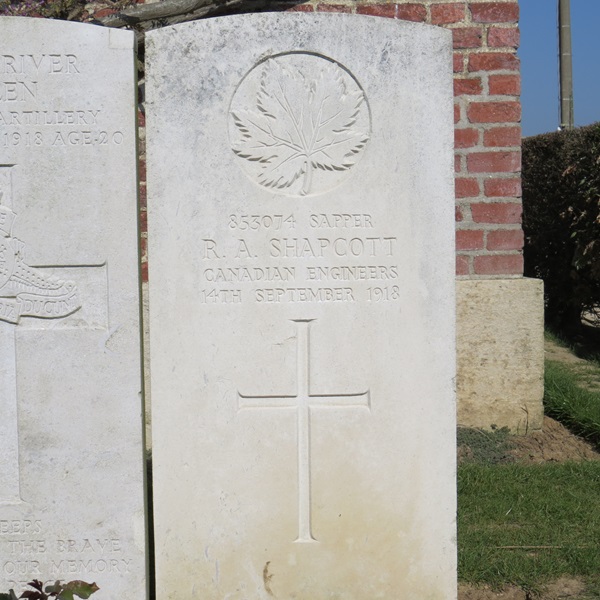
Sapper Roy Abraham Shapcott suffered the misfortune of being the final casualty of the 123rd Battalion in the Great War, falling 14 September 1918. Roy, along with 1,000 men of his battalion, had formed the 9th Battalion, Canadian Engineers earlier in May 1918.
Enlistment of Private Roy Abraham Shapcott
The son of Thomas and Sarah Ann Shapcott, of Elmvale, Ontario, Private Roy Abraham Shapcott 853074 enlisted on 15 March 1916 with the 177th Overseas Battalion.

Roy admitted to hospital at Camp Borden (pneumonia) on 13 September 1916, and later discharged on 28 September 1916.
England
Pte Shapcott sailed aboard SS METAGAMA on 3 May 1917.

At Otterpool, Pte Shapcott SoS 177th Bn to 3rd Reserve Battalion, 14 May 1917.
Pte Roy Abraham Shapcott SoS to 123rd Battalion on 9 November 1917.
France
Private R A Shapcott arrived at his unit just after the final assault at Passchendaele. He moved with the battalion from Ypres to Robecq, France, north of Bethune. Another move to Fiefs on the morning of 29 November 1917. The 123rd advised they would return to the line as Divisional troops at Vimy Ridge on 20 December 1917, relieving the 2nd Pioneer Battalion.

The men enjoyed a special turkey dinner with oranges and other extras on Christmas Day. At the end of the year, the Battalion strength was 192 officers and 1,001 other ranks.
1918
In January of 1918 a restructure established such that each Battalion to be composed of three Companies, thus reducing each Battalion to 600-700 men. Lieutenant-General Arthur Currie stubbornly refused to adopt the new British system. The decision would help solidify Canada’s role as the Allies elite shock troops in the Great War, but also deny Currie the command of an Army. The CEF would remain as a Corps.
Pte Shapcott awarded one Good Conduct Badge on 9 March 1918 in the Field. The Good Conduct Chevrons worn on the left sleeve of the Service Dress uniform, with each 1-bar chevron representing four years of service, to a maximum of four. Regulations stated that wound stripes, if worn, to be below the Good Conduct Badge.
9th Battalion, CE
On 30 May 1918, transferred to 9th Battalion, Canadian Engineers. On this date, 301 other ranks of the 123rd Battalion transferred to the 9th CE Battalion, along with 217 officers and men of the 9th Field Company, CE.

Major-General William Bethune Lindsay reorganized the Canadian Engineers in March of 1918. Pioneer battalions now part of the Engineers. Three Engineer Brigades formed, each comprising three Engineer Battalions of 1,000 all ranks.
Major Norman Roy Robertson commanding with Majors Charles Armel Boone and Edmund Percival Brown. Captain Alan Holmes MacDonald MC along with eleven Lieutenants.
The men now had to learn to work with other CE units such as the 3rd Pontoon Bridging Transport Unit.

Dominion Day
On 1 July 1918, 7th CE Battalion won the overall Corps baseball championship. However, only the detail of the 7th CE able to attend the event.

The Last Hundred Days
The 9th CE arrived at their new billets in Saleux by Amiens at the end of July 1918. The men told they were to be attached to Australian troops in order to build bridges at Domart, Hangard and Demiun. These false instructions helped ensure the German Army caught completely unaware on the morning of 8 August 1918. For Canada, it would be become the first of The Last Hundred Days in the war.

Two platoons of C Company ordered to follow a tank to the River Luce just south of Hangard on the eve of the battle. The task – construct a heavy bridge capable of handling horses, artillery, and large lorries. The work had to be completed by 10h00 on 8 August 1918. 9th CE managed to so at 10h30. Lt George Harry Thompson later awarded the MC for this action.

On 19 August 1918 the battalion once again moved under extreme secrecy. Marching to Boves, they boarded a train and later arrived at Bouquemaison station and moved to billets at Brevillers. By 22 August the battalion just outside Arras preparing for the Battle of the Scarpe.
Battle of the Scarpe
7th CE suffered many casualties over the first three days of the action, 26-28 August 1918, helping to push the front by 9,000 yards.

A major assault planned for the town of Cambrai in September, with the Canadians once again at the tip of the spear. 9th CE would be establishing new bridges across the Canal du Nord at Marquoin and Sauchy-Cauchy. However, orders changed on 3 September and the battalion employed on road repairs on the Arras-Cambrai road.

General Lipsett came by to say farewell to the battalion on 10 September 1918. He openly praised the work of the Engineers and Pioneers of the Brigade. Lipsett now transferred to the British 4th Division. A month after his address, news received he had been sniped by the River Selle.
Canal du Nord
While A Coy out on the night of 13 September 1918 performing repairs on a tramway track north of Ecourt-Saint-Quentin, Sappers Frederick James Farmer 431003, Roger Michael McGrath 793120 and Sapper Roy Abraham Shapcott wounded by shellfire. All evacuated by Field Ambulance to No 4 Casualty Clearing Station.

9th Canadian Field Ambulance Notes (Sapper Roy Abraham Shapcott): SW both legs (multiple), both fractured, and left hand. Tourniquet double. A.T. Serum 15h00, 14 September 1918.
Sappers Farmer and McGrath’s injuries not severe, but Roy’s wounds too severe. No 4 CCS Diagnosis at 19h00, 14 September 1918 – died immediately on admission.

Back at the camp, Sapper Willie Henderson and Wilfird Morin killed instantaneously by an enemy shell as they proceeded from the cook house their billets. Both later buried side-by-side in double graves at Vis-en-Artois British Cemetery. With so many casualties, the burial officer choosing an expedient method of filling the graves, explaining why Willie and Wilfrid not buried together, but beside each other.
Vis-en-Artois British Cemetery
This Memorial bears the names of over 9,000 men who fell in the period from 8 August 1918 to the date of the Armistice in the Advance to Victory in Picardy and Artois, between the Somme and Loos, and who have no known grave.

The cemetery begun immediately afterwards and used by fighting units and field ambulances until the middle of October. It consisted originally of 430 graves (in Plots I and II) of which 297 Canadian and 55 belonged to the 2nd Duke of Wellington’s Regiment.
Sapper Wilfrid Morin
Wilfrid Morin the son of Alfred and Mary Morin, of Penetanguishene, Ontario.

Sapper William Henderson
Husband of Bella Henderson of Alliston, Ontario. Attested with the 157th Overseas Battalion in Alliston on 21 November 1915. Previously, he served in the 36th Regiment Active Militia for seven years. After going overseas, transferred to the 9th Battalion, Canadian Engineers. His attestation papers indicate a stone cutter by trade. Survived by his wife, and his infant son, William Douglas Haig Henderson.

Note Sapper Wilfrid Morin 853588’s grave on the right.

Duisans British Cemetery
Duisans and Etrun are villages in the Department of the Pas-de-Calais, about 9 kilometres west of Arras. The DUISANS BRITISH CEMETERY lies in Etrun but takes its name from the nearer village of Duisans. It is one kilometre north of Duisans on the D339 road off the Route nationale N39 (Arras-St Pol), in the angle of the Arras Habarcq road and a track leading to Haute-Avesnes.
Sapper Roy Abraham Shapcott
Son of Thomas and Sarah Ann Shapcott, of Elmvale, Ontario.

More
- Home of CEFRG
- Blog
- CEFRG on FaceBook
- CEFRG on YouTube
- Soldiers and Nursing Sisters
- Units (Brigades, Battalions, Companies)
- War Diary of the 18th Battalion (Blog)
- 48th Highlanders of Canada
- 116th Battalion CEF – The Great War
- Les Soldats du Québec Morts en Service
- The Aerodrome (Aces and Aircraft)
- Montreal Aviation Museum
- Battles of the Great War
- Cases
- Cemeteries
- Memorials
- On This Day
- About CEFRG

