CEFRG.ca

Category: Soldiers

Between 1914 and 1919, over 650,000 Canadians served at home and overseas during the Great War. On the Western Front in Belgium and France, Canadian soldiers of the Great War distinguished themselves in numerous battles, including Second Battle of Ypres, Battle of Vimy Ridge, and Second Battle of Passchendaele. In Canada’s Last Hundred Days of the Great War, Canadian soldiers at the sharp end of the spear breaking through the enemy’s formidable trench defences, the Hindenburg Line. Their efforts have inspired these soldier stories.

Collections

Many collections used to bring the soldier stories to life. First, and foremost, the Personnel Records of the soldiers serving in the Canadian Expeditionary Force (CEF). This collection, like the others to follow, digitized and made available by Library and Archives Canada (LAC). Secondly, the War Diaries of the CEF often provide vital information about a soldier’s life not contained in their service file. Finally, Circumstances of Death (CoD), War Graves Registers (GRRF), and Veterans Death Cards provide further information on The Fallen. These three collections in conjunction with records of the Commonwealth War Graves Commission (CWGC) vital to cases of identification and recovery of The Missing.

Courts Martial Records (FGCM)

Additional collections used to present the soldier stories include Courts Martial Records. Courts martial had the authority to try a wide range of military offences that resembled civilian crimes like fraud, theft or perjury. Others, like desertion and cowardice – purely military crimes. Records of individual courts martial consist of an average of 20 to 25 documents, mainly standardized forms. These document the trial and the charges under the Army Act.

MIKAN photo collection

Finally, the most powerful way of bringing soldier stories of the Great War to life, the images of the MIKAN collection digitized by LAC.  Often complementing these photos – images held by the Imperial War Museum (IWM), some of which also contain images captured by the Official Canadian War Photographers (CWRO) during the Great War. Both LAC and IWM have film collections which further bring the reality of the soldier stories of the Great War to life.

  • Private Nathanael Earl Kern in the Great War

    Private Nathanael Earl Kern in the Great War

    No.1 Canadian War Graves Detachment

    Private Nathanael Earl Kern likely the last casualty and member of the CEF buried in France during the Great War. Son of Cyrus and Emily Walker Kern, of Brant Co., Ontario.

    OP-0347 Comrades. The verso of this painting has been painted blue, This is item 177 in the Hamilton inventory. MIKAN No 2836026
    OP-0347 Comrades. The verso of this painting has been painted blue, This is item 177 in the Hamilton inventory. MIKAN No 2836026

    Burying the Fallen

    The British Empire chose to bury its battlefield dead from the Great War near the sites where they had fallen, and not to repatriate remains to their home countries, as many grieving families and politicians had demanded. After battles, special grave detachments attempted to collect the unburied dead for proper burial, and to disinter remains from temporary graves for proper reburial elsewhere.

    Loos British Cemetery Extension

    After the Armistice, this process began in earnest with the vastly expanded Imperial War Graves Commission (IWGC) moving remains into newly established imperial military cemeteries. The process involved tens of thousands of burials and took many years. It still continues on a smaller scale as agricultural or construction work across old battlefields regularly uncovers additional human remains.

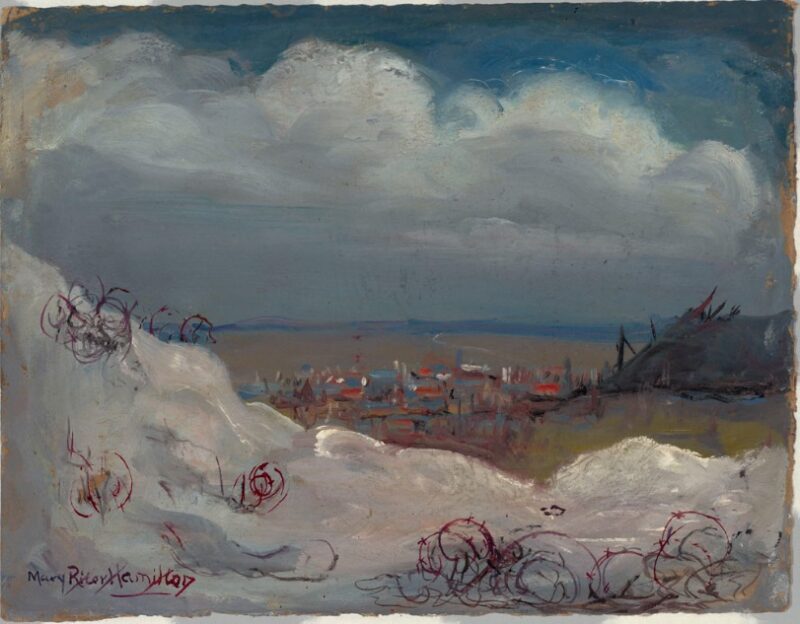
    OP-0323 Loos from the Crater, Hill 70, France. MIKAN No 2873611
    Mary Riter Hamilton. OP-0323 Loos from the Crater, Hill 70, France. MIKAN No 2873611

    Enlistment of Private Nathanael Earl Kern

    Pte Kern 3232399 signed up late, 26 February 1918 at Toronto with 1st C.O.R. Aged 25, standing 5′ 11″ tall, with medium complexion, brown eyes and hair.

    England

    Pte Kern arrived in England on 15 August 1918 aboard SS BELLEROPHON (13,000 tons – a cargo steamer of the Blue Funnel Line).

    SS BELLEROPHON
    SS BELLEROPHON

    Kern treated at No. 11 Canadian General Hospital, Moore Barracks during September 1918 (mild scabietic rash on ankles).

    France

    Private Nathanael Earl Kern arrived in France with No. 1 Canadian War Graves detachment on 18 May 1919.

    No. 1 Company, Canadian War Graves Detachment

    No. 1 Company, Canadian War Graves Detachment formed at Etaples on 18 May 1919 with 10 Officers and 450 Other Ranks. The Company divided into one HQ platoon and four working Platoons, with each working party under command of two Officers.

    Women’s Army Auxiliary Corps (WAAC) gardeners tending the graves of the war dead at Etaples. The wooden crosses would later be replaced by white headstones.

    Bully-Grenay

    The detachment entrained for Bully-Grenay on 24 May 1919, arriving at 19h00. Camp site close to the station with tents pitched for the whole company. Water facilities bad.

    THE GERMAN SPRING OFFENSIVE, MARCH-JULY 1918 (Q 11750) A Regimental Sergeant Major of 11th Battalion, Royal Scots hands out Mills bombs to a raiding party at Meteren. This raid was abandoned just when the party was ready to start owing to the leader being killed. Photograph taken on 12 July 1918. Copyright: © IWM. Original Source: http://www.iwm.org.uk/collections/item/object/205196070

    On 27 May 1918, special orders printed regarding the care to be taken with Unexploded Ammunition found in the devastated areas. The following day, Pte H T Miller 2355758 and Pte E MacMillan 3323615 accidentally injured through a Lorry passing over a Mills grenade which was half-buried. Again, on 21 May 1918, the men warned regarding the Unexploded Ammunitions.

    Death of Private Wilfred Acey Nickerson

    On 4 June 1919, while walking towards Roclincourt, Pte Wilfred Acey Nickerson 318176 picked up the nose cap of a shell, and proceeded to open it causing an explosion which killed him almost immediately.

    Private W A Nickerson, 20 April 2019. CEFRG
    Private W A Nickerson, 20 April 2019. CEFRG

    Death of Pte Nathanael Earl Kern

    On 12 June 1919, Private Nathanael Earl Kern accidentally killed in explosion of a gas cylinder. He died from phosgene gas exposure at No. 15 CCS.

    Houchin British Cemetery

    The cemetery opened in March 1918 when the 6th Casualty Clearing Station came to Houchin. From April to September the German advance made Houchin unsafe for hospitals, and the cemetery used by the 55th (West Lancashire) Division. In September 1918, the 6th Casualty Clearing Station returned to Houchin and joined by the 15th CCS in October.

    Houchin British Cemetery

    Houchin British Cemetery contains 700 Commonwealth burials of the Great War and two from the Second World War, along with 39 German and one Belgian war graves. The cemetery designed by Sir Edwin Lutyens.

    SADLY MISSED BY HIS LOVED ONES

    Pte Nathanael Earl Kern Gas Cylinder Explosion Accidental

    Houchin a village situated between Barlin and Bethune, about 5 kilometres south of Bethune in the Pas-de-Calais. HOUCHIN BRITISH CEMETERY found in open farmland on the south-west side of Houchin village. 

    Subscribe

    Contact CEFRG

    ← Back

    Thank you for your response. ✨