CEFRG.ca

Category: Soldiers

Between 1914 and 1919, over 650,000 Canadians served at home and overseas during the Great War. On the Western Front in Belgium and France, Canadian soldiers of the Great War distinguished themselves in numerous battles, including Second Battle of Ypres, Battle of Vimy Ridge, and Second Battle of Passchendaele. In Canada’s Last Hundred Days of the Great War, Canadian soldiers at the sharp end of the spear breaking through the enemy’s formidable trench defences, the Hindenburg Line. Their efforts have inspired these soldier stories.

Collections

Many collections used to bring the soldier stories to life. First, and foremost, the Personnel Records of the soldiers serving in the Canadian Expeditionary Force (CEF). This collection, like the others to follow, digitized and made available by Library and Archives Canada (LAC). Secondly, the War Diaries of the CEF often provide vital information about a soldier’s life not contained in their service file. Finally, Circumstances of Death (CoD), War Graves Registers (GRRF), and Veterans Death Cards provide further information on The Fallen. These three collections in conjunction with records of the Commonwealth War Graves Commission (CWGC) vital to cases of identification and recovery of The Missing.

Courts Martial Records (FGCM)

Additional collections used to present the soldier stories include Courts Martial Records. Courts martial had the authority to try a wide range of military offences that resembled civilian crimes like fraud, theft or perjury. Others, like desertion and cowardice – purely military crimes. Records of individual courts martial consist of an average of 20 to 25 documents, mainly standardized forms. These document the trial and the charges under the Army Act.

MIKAN photo collection

Finally, the most powerful way of bringing soldier stories of the Great War to life, the images of the MIKAN collection digitized by LAC.  Often complementing these photos – images held by the Imperial War Museum (IWM), some of which also contain images captured by the Official Canadian War Photographers (CWRO) during the Great War. Both LAC and IWM have film collections which further bring the reality of the soldier stories of the Great War to life.

  • Private Laurence Joseph Fewer in the Great War

    Private Laurence Joseph Fewer in the Great War

    Private Laurence Joseph Fewer 1268, son of William and Ellen Fewer, of Placentia, Newfoundland.

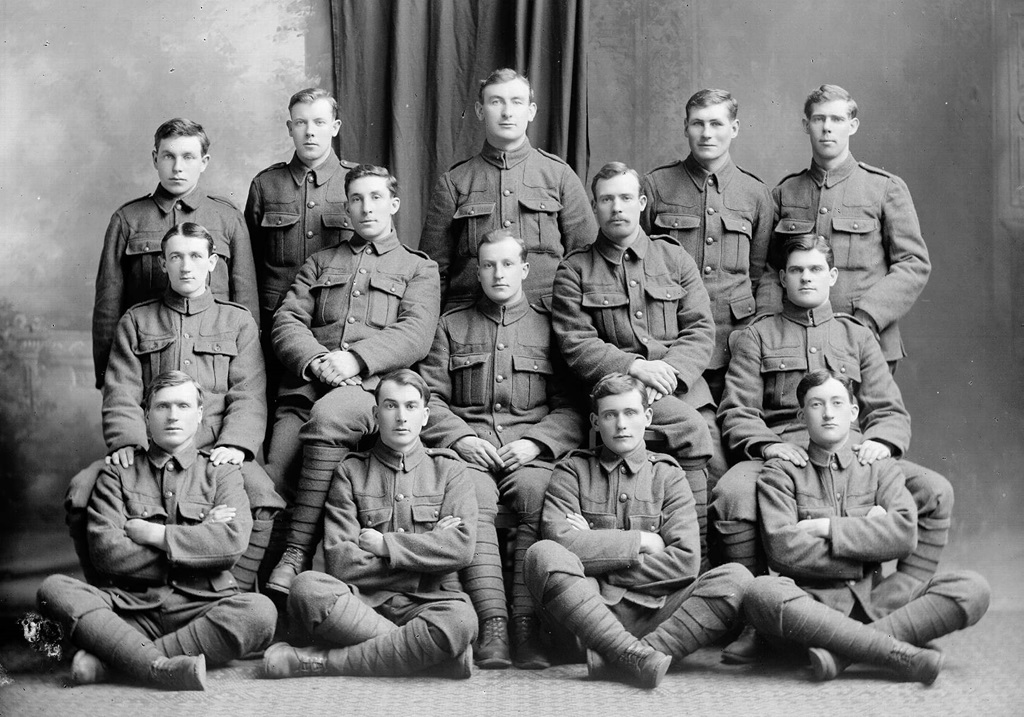
    Group Photo – Soldiers of the Royal Newfoundland Regiment, Lawrence Joseph Fewer, 2nd Row, far right.

    Enlistment of Private Laurence Joseph Fewer

    Pte Fewer enlisted 15 March 1915, standing 5′ 7″ tall, 141 pounds with brown hair and blue eyes. Occupation – Paper Maker, earning $3.50 a day.

    Laurence embarked for the UK on 22 April 1915. On 17 August 1915, awarded 5 days CC for creating a disturbance after lights out at le Buff by Captain Ayre. The following month, awarded 2 days CC for absent from 9:15am Parade by Lt Pippy.

    Private Laurence Joseph Fewer
    Private Laurence Joseph Fewer

    The Newfoundland Regiment disembarked in Gallipoli on 1 December 1915.

    France

    Disembarked the Gallipoli sector on 14 March 1916, Suez, arriving at Marseilles on 22 March 1916.

    Battle of the Somme

    Of all the battles that the Newfoundland Regiment fought during the Great War, none as devastating or defining as the first day of the Battle of the Somme. The Regiment’s tragic advance at Beaumont Hamel on the morning of July 1, 1916 became an enduring symbol of its valour and of its terrible wartime sacrifices. The events of that day forever seared into the cultural memory of the Newfoundland and Labrador people.

    Knightsbridge Cemetery

    Knightsbridge Cemetery used by units fighting on that front until the German withdrawal in February 1917 and used again by fighting units from the end of March to July 1918, when the German advance brought the front line back to the Ancre.

    Private Laurence Joseph Fewer

    After the Armistice, some burials in Rows G, H and J added when graves brought in from isolated positions on the battlefields of 1916 and 1918 round Mesnil.

    The cemetery, which is named from a communication trench, was begun at the outset of the Battle of the Somme in 1916.

    Knightsbridge Cemetery contains 548 Great War burials, 141 of them unidentified. The cemetery was designed by Sir Reginald Blomfield.

    Private Laurence Joseph Fewer

    Burial Report

    Burial report by Rev C Mayne, attached to the 86th Brigade. Grave 7, Knightsbridge on 1 July 1916. Buried by Rev H S Reid, attached to 87th Brigade.

    Private Laurence Joseph Fewer
    Private Laurence Joseph Fewer, Knightsbridge Cemetery, 12 August 2019, CEFRG.ca

    Location

    The village of Mesnil about 8 kilometres north of the town of Albert on the D129 road. Access by a farm track of which 1 kilometre is tarmac and 1 kilometre is dirt track (unsuitable for cars). The KNIGHTSBRIDGE CEMETERY 200 metres from the track and no permanent grass pathway exists.

    The KNIGHTSBRIDGE CEMETERY, situated in a valley among fields, is about 2 kilometres north-east of Mesnil (signposted in the centre of Mesnil).

    At the age of 55 (actually 66 years of age), Laurence’s father William Fewer 3408 enlisted with the RNR Forestry Companies on 15 February 1918. Finally discharged in Newfoundland on 8 July 1919.

    More

    Subscribe

    Contact CEFRG

    ← Back

    Thank you for your response. ✨