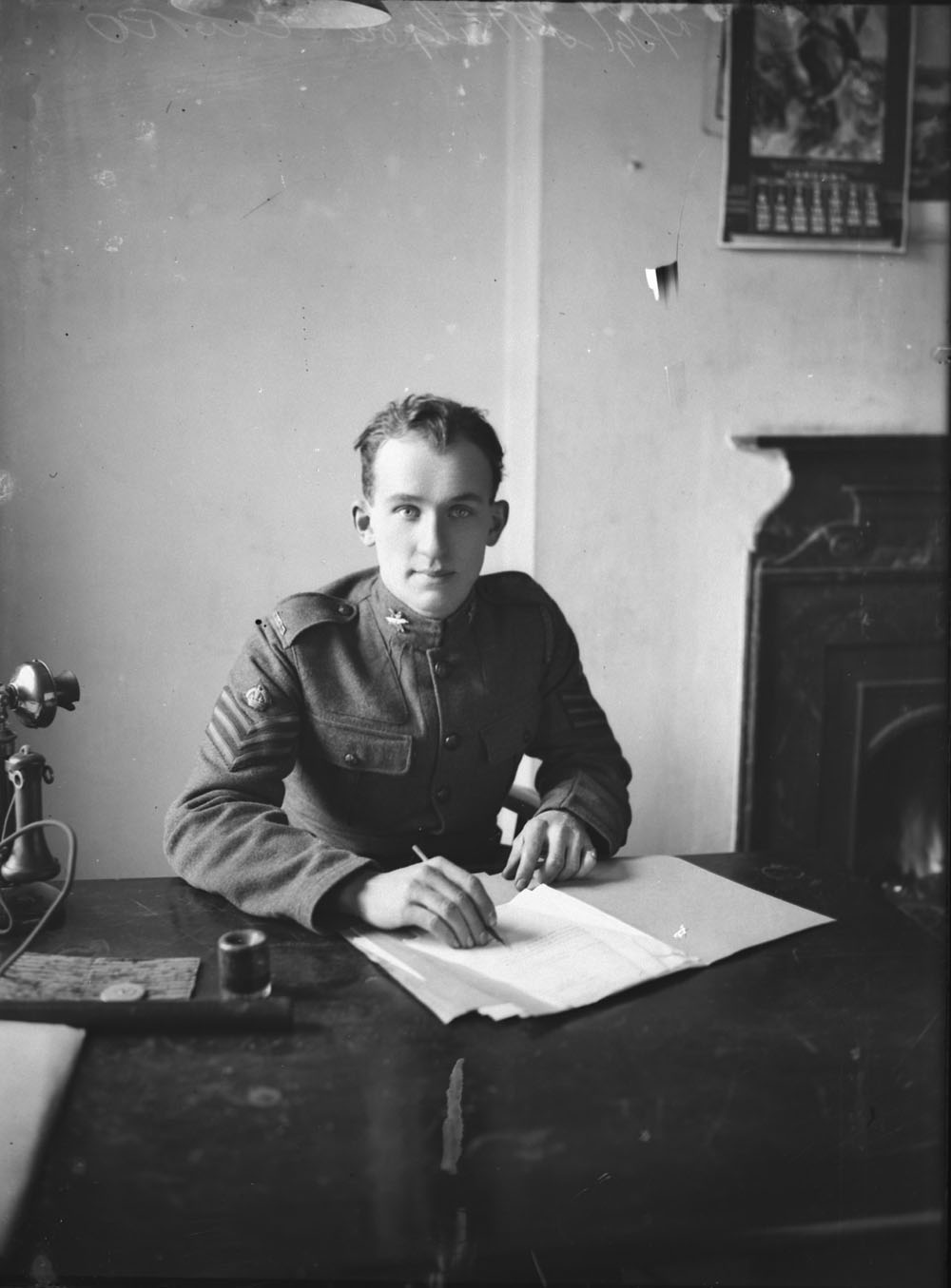
The Canadian War Records Office (CWRO) photographic collection includes many images of the CWRO team. Finding these photos has been a challenge, as has identifying the members of the group assembled by Sir Max Aitken (later Lord Beaverbrook).

Aitken assisted by several gifted individuals in his goals: Lieutenant Colonel (later Brigadier General) Reginald Frank Manley Sims, a former British regular officer and businessman, his chief liaison officer in France. Captain Theodore G Roberts, the younger brother of the New Brunswick poet and writer Charles G D Roberts, took up much of the day-to-day writing. Finally, Major Henry Beckles Willson, historian and man-of-letters, in charge of War Diaries until his rocky relationship with Aitken forced his resignation.

Later, Talbot Papineau, a well-known French Canadian nationalist, collected war records and wrote dispatches before returning to the front where he was killed.
Captain Talbot Papineau

In a letter home, Captain Talbot Papineau described his role as an historical officer in the field.
“You must understand that I am not a mere newspaper correspondent. Nothing makes me angrier. I write many official staff documents as well. For instance yesterday I made a complete tour of our whole battle front – interviewed almost all the Battalion commanders – personally examined the enemy lines and finally wrote a long report which the General favourably commented upon today.”
Captain Talbot Papineau
Lt-Col Francis Logie Armstrong
After serving on the staff of the Director of Records in London, England from 1914 to 1916, Brigadier Armstrong went to France and served on the staffs of the Canadian Light Infantry Brigade and the third division. For his services he received an OBE and was Mentioned in Despatches.

He married Marjorie Wilkes, daughter of the late Col A J Wilkes of Brantford, Ontario in 1915. Brigadier Francis Logie Armstrong died suddenly while playing golf in Florida on 22 December 1945, two months following his retirement from the military.
Major Arthur G Doughty

Wearing his new uniform and sporting an honorary rank of major (later colonel), Arthur G Doughty strode into the London offices of the CWRO in the summer of 1916, telling Aitken and his assistant, Lieutenant Henry Beckles Willson, “that, as Dominion Archivist, all Canadian records – civil, naval, and military – were by statute under his control.”
Aitken able to convince Doughty to relinquish his hold on this future archives for the duration of the war. As part of the negotiations, however, Aitken reiterated his promise to transfer all records to the Public Archives after the war. Doughty returned to Canada for duty on 14 August 1917.
Major Charles George D. Roberts
Major Charles George D. Roberts, a renowned Canadian poet, had served in the British Army early in the Great War. In July 1917 he enlisted directly into the Canadian War Records Office, in England.
Captain Theodore Goodridge Roberts
George Edwards Theodore Goodridge Roberts a Canadian novelist and poet. The author of thirty-four novels and over one hundred published stories and poems. He was the brother of poet Charles G. D. Roberts.
In November 1903, he married Frances Seymore Allen, daughter of the Reverend Thomas Allen. Since their marriage they have lived in Barbados, England, France, and much of the time in and near Fredericton, N.B. They had three children, a boy and two girls.
War Diaries
Meanwhile, the CWRO had two officers in France, Lieutenant W. Douglas and Captain I.T. Robertson. Throughout the last half of the year, these two officers visited 263 units in the field to:
“…impress on all concerned the importance which is attached to them for historical point of view … We found in a large number of cases that the object of a War Diary was not realized; that, in fact, it was generally regarded merely as an official return, to be rendered more or less perfunctorily every month. In other cases we encountered the belief that it was not permissible to include full details of an operation, much of the data being regarded as of a secret and confidential nature.”
Staff of Canadian War Records, Historical Section, December 1917
In September of 1918, good progress made under the policy of substituting female employees for military staff, 71 female clerks ToS, with 42 military clerks released, bringing the total strength of the office to 818 as compared to 806 on 30 August 1918.
Daily Record
Sgt. George Eugene Buttery, of the Daily Record.

Had been seriously wounded through both thighs, he gained Special Employment with the Daily Record in 1918.
Groups taken at Canadian Records Office, Green Arbour House, London


On 15 December 1919, the CWRO moved from Green Arbour House to Argyll House.

The C.W.R.O. Staff in March 1919
Lt Charles Hemmings Hastings
Hastings’ first attempt to Attest on October 1, 1914, rejected as Unfit due to a hernia. Reattested in 32nd Battalion May 27, 1916 in Shorncliffe Camp and again found to be Unfit for the same reason. Attestation papers for commission not on LAC. He served as a Lieutenant in the Canadian War Records Office in England
Lt Norman Roy Wright

Granted permission to marry in November of 1917. Lieutenant Norman Roy Wright received his Commission in December of 1918 (he had attested in 1914 at the outbreak of the war with the 17th Battalion, Nova Scotia Regiment). Later with the Canadian Pay Records Office).
Lt Alan T Waters

This most likely shows Lt. Alan T. Waters, a clerk from Lindsay, ON, enlisted in the 21st Battalion, in Kingston, ON, in Nov. 1914. He is wearing a service ribbon for the 1914-1915 star.
Lt Charles Vesta Victor Coombs
Lt. Charles Vesta V. Coombs, from Toronto, enlisted in the 169th Battalion in early 1916 and gave his occupation as an advertising manager on his declaration form. Lieutenant Charles Vesta Victor Coombs served with the 116th Battalion and badly gassed, buried by a shell and paralyzed, 22 July 1917 at Mericourt Maze. He was sent back to England to recover, and would never again return to the front.

Lieutenant C. V. V. Coombs, who suffered shell shock, shot himself in December 1919 in the Grosvenor Hotel, Victoria.
Lt Cyril Henry Barraud
An artist, Lieutenant Cyril Henry Barraud was born in Barnes, a suburb of London, on 9 July 1877, he came to Canada in 1913 with his art skills fully developed. He soon began exhibiting with the Royal Canadian Academy and taught at the Winnipeg School of Art (1913-1915) where he influenced a number of subsequently locally-important artists, including Walter Joseph Phillips. His metiers were landscape painting and etching.
He left for England with the Canadian Expeditionary Force in 1915 as a Lieutenant in the 43rd Battalion, teaching grenade weaponry. By 1916 he was in France, where he did much painting of the wartorn landscape and suffering, particularly at Ypres, Mont St. Eloy and Vlamerlinghe. He remained in Britain after demobilization and died in obscurity there in 1965.
Lt Robert Davidson Scott

Lieutenant Robert Davidson Scott
Lieutenant Ewart John Robertson

Lieutenant Ewart John Robertson
Sergeant George Edward Hewitt
Sgt G E Hewitt served with the 28th Battalion until December of 1918 when appointed to the CWRO.

Sergeant William Herbert Milbourne
Sgt William Herbert Milbourne ToS of the CWRO in November of 1917 after serving with the Divisional Engineers.

Sergeant Nipins
S/Sgt Williamson
S/Sgt. S.T. Kilgore

S/Sgt. Samuel Thorad Hay Kilgore
Miss D Kettle
Miss L. Mitchell

Mrs. Fleming

Private Bruce
Pte Martin
Private Hector William Millar
Pte H W Millar suffered a severe GSW to his left arm serving with the 73rd Battalion in March of 1917. He joined the CWRO a year later.

More
- Home of CEFRG
- Blog
- CEFRG on FaceBook
- CEFRG on YouTube
- Soldiers and Nursing Sisters
- Units (Brigades, Battalions, Companies)
- War Diary of the 18th Battalion (Blog)
- 116th Battalion CEF – The Great War
- Les Soldats du Québec Morts en Service
- The Aerodrome
- Battles of the Great War
- Cases
- Cemeteries
- Remembering the Fallen
- In Memory by Pierre Vandervelden
- Memorials
- On This Day
- About CEFRG

