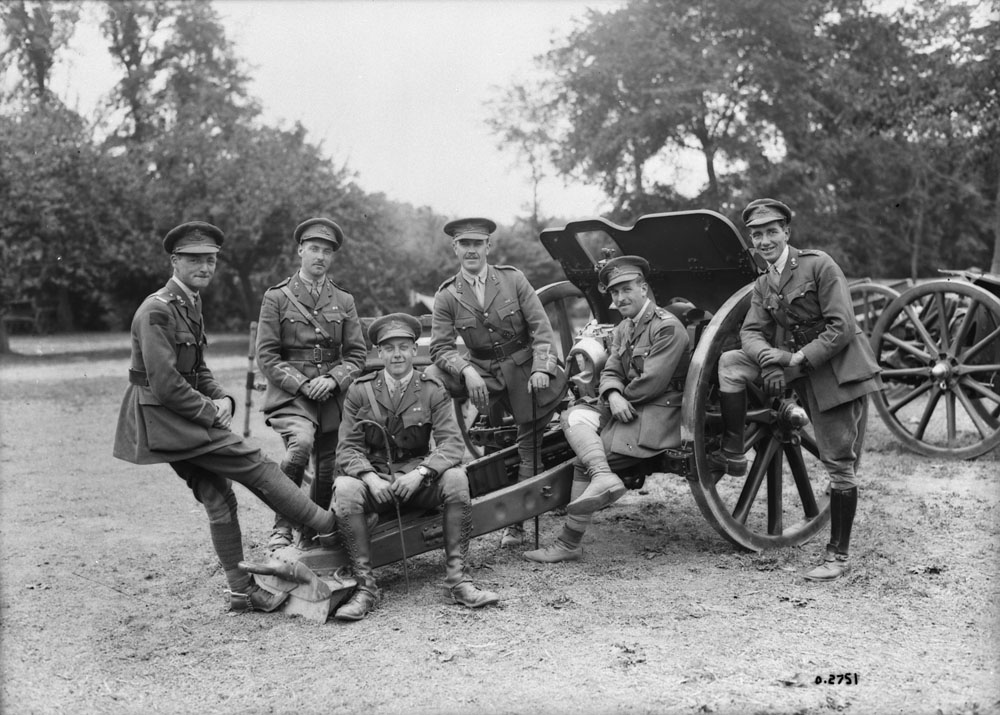
Second Lieutenant Raymond Hart Massey a member of the Canadian Officer Training Corps prior to the Great War.

Massey attested into the Canadian Overseas Expeditionary Force on 8 November 1915 and left Canada on 20th November.
30th Battery
The 30th Battery, Canadian Field Artillery organized in June 1915 under the command of Major Austin Bain Gillies. Mobilized at Toronto and recruited in Toronto, chiefly from 9th Battery, Non-Permanent Active Militia. Left Saint John 5 February 1916 aboard METAGAMA.

30th Battery arrived in England 14 February 1916. Arrived in France July 1916 with the 8th Brigade, 3rd Canadian Divisional Artillery.
On 22 Feb 1916 Lt Raymond Hart Massey shipped to France for instructional purposes and attached as supernumerary to the 4th Brigade Canadian Field Artillery.

Canadian Artillery in Action reconstructs an incident on July 16, 1916, during the Battle of the Somme. Suffering under an intense barrage that resulted in many casualties, the Canadian gunners nevertheless stayed at their posts.
Before the end of March 1916, Massey appointed to the 13th Field Battery.
13th Field Battery
Organized in November 1914 under the command of Lieutenant-Colonel George Septimus Rennie. Recruited from 32nd Howitzer Battery (Brantford) and 33rd Howitzer Battery (Hamilton), Non-Permanent Active Militia. Left Montreal 20 May 1915 aboard MISSANABIE with a strength of 4 officers, 138 other ranks. Arrived in France 15 September 1915 with the 4th Brigade, 2nd Canadian Divisional Artillery, later (20 June 1917) 4th Canadian Divisional Artillery.

Pounding the Enemey
On page 30 of Pounding the Enemy by Lucie E. Gagné, Massey describes the events watching led to the shelling of his dugout.
St Eloi
From the Battery’s trenches in the O Pip in the St Eloi area, a big white house had withstood the perils of the war, apparently undamaged for almost two years. Likely an enemy observation point and orders given to have it blown up.

Our battery given notice to shoot. It took eight rounds to level it then everything was quiet. Not even the observations balloons seemed to indicate that the enemy would retaliate.

Dugout shelled
I was about to call the Battery when we were shelled. I could neither breathe nor move. It took two signallers and an infantryman to dig me out with their bare hands. Later in a dugout after a night’s rest on May 14th while Major George Edward Vansittart lacing up his boots, while BSM Nick (Nicholas Baldwin) Rimmer 83430, the orderly sergeant, standing inside the opening and while Captain Norman Angelo Gianelli lying in his bunk, there was a horrible hit.

Both Rimmer and I thrown down on our backs, Gianelli sprawled behind the Major who had fallen on his side. They were covered by debris and a steel beam. The sergeant-major, Nick Rimmer’s brother William Baldwin 83426, and several gunners almost instantly freed us and the stretcher bearers arrived in a matter of seconds. Seriously wounded in the back, the Major was barely conscious. Gianelli wounded in the stomach, and was in excruciating pain.

Major George Edward Vansittart
Rimmer had been thrown on top of me, his thigh shattered. I was wounded on the back of my left hand. We were all rushed to the Casualty Clearing Station where Major George Edward Vansittart died shortly after (at age 31 and is buried in Lijssenthoek Military Cemetery. All others recovered.

Second & Third Wound Stripes
Massey wounded slightly but remained at duty on 16 May 1916. Massey granted a leave of absence on 24 May 1916 and wounded (shell shock) on 7 June 1916 shortly after his return.

image: a full length depiction of a soldier, seemingly shell-shocked, standing in front of the edge of a dugout.
PTSD
“He has lost all confidence in himself; thinks he will never be any good and dreads going back, and he is very nervous and shaky. Sir B. Dawson, A.M.S. considers this Officer requires a complete rest. A change and a sea voyage would greatly benefit this Officer.” – Proceedings of Medical Board, 20 June 1916, Strand, London.
Massey sailed for Canada per SS GRAMPIAN, 23 June 1916. Leave to 4 September 1916.

On 5 September 1916 posted to Yale University and engaged as an Army instructor for American officers. Promoted to temporary Captain in the CEF, whilst employed in the United States.
Captain Massey, Yale Artillery School congratulated on 21 November 1917 for his instruction. Massey resigned his post at Yale University on 29 May 1918.
Captain R H Massey, CFA transferred to the Royal Canadian Dragoons in August of 1918 upon the recommendation of Major-General W Gwatkin, Chief of General Staff, Ottawa.
Siberian Expedition
Massey promoted Lieutenant on 19 Sep 1918, and taken on strength of the 85th Battery Canadian Field Artillery and embarked for Siberia on 11 October 1918 per SS Emperor of Japan arriving on the 26th.

85th Field Battery
Organized in September 1918 under the command of Major Douglas Hinch Storms. Mobilized at Petawawa to be part of the Siberian Expeditionary Force.
Base Depot, CEF on 25 December 1918 dinner included Roast Goose with Apple Sauce, Coffee, Beer, Rum and Cigarettes.

The 85th Battery saw little action and Massey became involved in his first stage production in Siberia as part of a campaign to boost the morale of the troops. On 13 January 1919 a highly successful dramatic skit staged in the Sergeants’ Mess at East Barracks by Lt Massey. The role of “The Fire Chief” played by Mr Massey. He would eventually direct 35 plays on Broadway.
Return to Canada
Embarked Siberia per SS Monteagle April 21 1919.

Massey returned to Canada on 5 May 1919.
Second World War
Massey rejoined the Canadian Army in World War II working as a Major in the Adjutant General’s branch dealing with recreation, entertainment and athletics. He did not stay long, as he wrote in his autobiography.
“A little over a year, my futile service in the Canadian Army ended. I had learned a bitter lesson – that a man of forty-seven, who is not a professional soldier and completely inept at paperwork, is useless in any capacity in any army. Wretched Brigadier Mess was a good friend. He succeeded in getting me returned to civilian life in order, he confided to me, to protect his own mental health and mine.”
Massey released in 1943 and became an American citizen in 1944.

Deceased 29 July 1983, and buried at Beaverdale Memorial Park in New Haven, Connecticut. Massey died of pneumonia in Los Angeles, a month before he would have turned 87. His death came on the same day as that of David Niven, with whom he had co-starred in The Prisoner of Zenda and A Matter of Life and Death.
Vincent Massey
Raymond’s brother Vincent (Charles) Massey a Major with Canadian Officer Training Corps University of Toronto from March 1917. Lt-Col C V Massey with the Musketry Staff, M.D. No. 2 on 30 April 1918. Seconded as Secretary of the War Committee of the cabinet from 1 February 1918 to 31 December 1918. He demobilized on 1 March 1920.
Second World War Canadian War Artists
In 1939, Vincent Massey suggested Canada should have a war art program like Great Britain. The Department of National Defence’s initially indifferent, so H.O. McCurry, Eric Brown’s successor as director of the National Gallery of Canada, began his own lobbying effort.

“Pitched on an arid plain near Raddusa-Agira Station, Sicily, by No. 9 Canadian Field Ambulance, July 1943, these captured Italian hospital tents were of unusual design with double walls and a ventilating system. Although cumbersome, they were a welcome acquisition as the unit had lost much of its equipment at sea.”
Canadians soon producing war paintings, and in England, Massey arranged for Trooper William Abernethy to be attached to Canadian military headquarters as an artist. Late in 1942, Massey again tried to organize an official war art program, and Prime Minister William Lyon Mackenzie King finally approved it. Formally set up in January 1943, a committee consisting of H.O. McCurry and senior military personnel from the three services ran the program from Canada. In Britain, Massey the guiding light.

