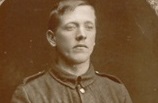

Shot at Dawn
Private Thomas Lionel Moles the son of Louisa Mudford (formerly Moles), of West Chinnock, Crewkerne, Somerset, England, and the late John Moles. Native of Brompton Ralph (a village and civil parish in the Somerset West and Taunton district of Somerset, England, about 11 miles west of Taunton).

Thomas had four years of experience with the 3rd Somerset Volunteers. The original Somerset Rifle Volunteer Corps (formed in 1859) became the 2nd and 3rd Battalions Somersetshire Light Infantry in 1881.
Pte Thomas Lionel Moles 443288 stood 5′ 9″ tall with fair complexion, blue eyes and fair hair, and attested at Vernon Camp on 28 August 1915.
Treated for tonsilitis at Vernon, BC, 2-21 October 1915. Private Moles forfeited a day’s pay in October and November of 1915.

England
Moles three times admitted to the hospital at Connaught, Aldershot for VDG during January and February of 1916.
Pte Moles charged for being AWOL on 18 December 1915, 23 March 1916, 6 June 1916 and 30 June 1916. He also had a conviction for drunkenness in December 1916.

Mumps
Private Moles admitted to No 7 General Hospital, St Omer and treated for Mumps in March and April of 1917.
Upon discharge, Moles ordered to rejoin his company which was about to go into action. Instead of going forward, Moles went to a village in the rear areas. He was eventually arrested 3 weeks later, and charged with desertion.

In confinement awaiting trial, 9 September 1917.
(1) When on active service, deserting his Majesty’s service. Refused to report to his company in the reserve trenches after given verbal and written orders. Instead went back to a village in the rear and remained there until arrested for theft, three weeks later. Conduct sheet records six previous convictions for absence in the field, and six convictions for drunkenness and other lesser offences.
(2) When on active service, stealing the property of a comrade.
Moles tried for desertion by FGCM on the 4th October 1917 and sentenced to death.

Lts Melville Clinton Brokenshire, David Kilgour, William Robert Adams and George Harvey Rochester reported to 11th CIB HQ for interview with the GOC, Brig-Gen Odlum on 16 October 1917. Sentence confirmed on 17 October 1917 by General Haig.
The battalion moved by motor lorries to Potijze on 18 October 1917.

Execution
The War Diary for the 54th Battalion reports the execution on 22nd October 1917. “Weather fair. Working party of 9 officers and 380 other ranks supplied carrying grading material … on tracks. Two men wounded. The sentence of death on no. 443288 Pte. T Moles was duly carried out at 5.50am at Ypres Prison. The firing party consisting of four men from each Company, one Sergeant, Lt Charles Hamilton Seaman in charge of party. Captain William Garland Foster, Adjutant, Captain James Hunter White, Chaplain, 54th Bn Chaplain (Robert Craig Horn). The Battalion moved to Toronto Camp, Brandhoek, where they were quartered in huts”. Thomas Lionel Moles was buried at Ypres Reservoir Cemetery, Belgium.
Ypres Reservoir Cemetery
From October 1914 to the autumn of 1918, Ypres (now Ieper) at the centre of a salient held by Commonwealth (and for some months by French) forces. From April 1915, bombarded and destroyed more completely than any other town of its size on the Western Front, but even so certain buildings remained distinguishable. The ruins of the cathedral and the cloth hall stood together in the middle of the city, part of the infantry barracks stood in an angle of the south walls and the prison, reservoir and water tower were together at the western gate.

Three cemeteries made near the western gate: two between the prison and the reservoir, both now removed into the third, and the third on the north side of the prison. The third was called at first the “Cemetery North of the Prison,” later “Ypres Reservoir North Cemetery, and now Ypres Reservoir Cemetery.
Apology
The Government of Canada offered an apology and formally announced its regret for this situation. On December 11, 2001, Veteran Affairs Minister, Dr. Ron Duhamel rose in the House of Commons and with sincerity and passion, read the names of those 23 Canadians into the Parliamentary record and announced their names will be written into Parliament Hill’s Book of Remembrance. He was whole-heartedly supported by all of Canada’s opposition Parties.
More
- Home of CEFRG
- Blog
- CEFRG on FaceBook
- CEFRG on YouTube
- Soldiers and Nursing Sisters
- Units (Brigades, Battalions, Companies)
- War Diary of the 18th Battalion (Blog)
- 48th Highlanders of Canada
- 116th Battalion CEF – The Great War
- Les Soldats du Québec Morts en Service
- Battles of the Great War
- Cases
- Cemeteries
- Memorials
- On This Day
- About CEFRG
Contact CEFRG


Or Subscribe
