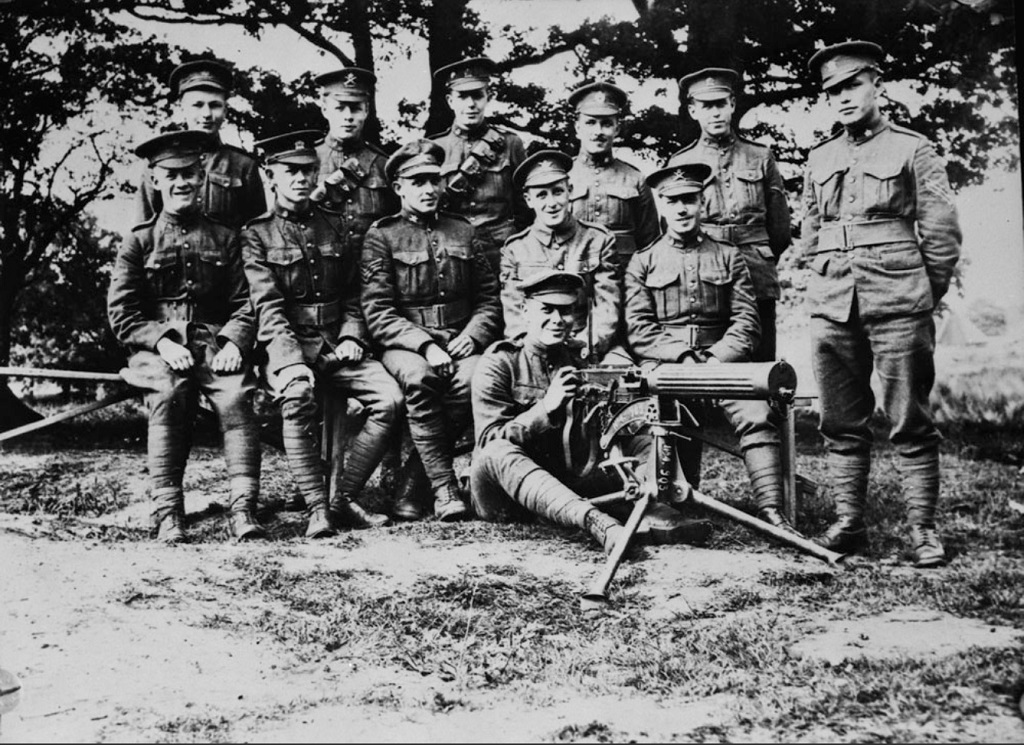
Private Russell Clarence McCollom a casualty of Spanish Influenza during the Allied Occupation of Germany in January 1919. At first interred among several famous figures of Bonn in Poppelsdorf Cemetery, McCollom later exhumed and placed in Brussels Town Cemetery.

Brussels Town Cemetery contains several mysterious cases of civilians buried among men and women having served in the Great Wars. Seven women buried in the cemetery, two having served with the 1st Continental Group, Auxiliary Territorial Service.
Enlistment of Private Russell Clarence McCollom
Russell Clarence McCollom born in Dunville, Ontario on 4 July 1871 (a steam engineer and miner by trade). Parents John and Marion McCollom.
Pte McCollom a massive man, standing 5′ 10″ tall, 214 pounds with reddish complexion, blue eyes and red, slightly greyish hair. He enlisted at Dawson City, Yukon on 5 October 1916 with the Yukon Infantry Company, CEF.

Yukon Motor Machine Gun Battery
Organized in August 1914 as Boyle’s Yukon Mounted Machine Gun Detachment. Composed of 50 men, originally commanded by Captain Knot, later by Captain H F V Meurling. Raised in Dawson and equipped by J W Boyle of Canadian Klondike Mining Co. Mobilized at Victoria and attached to 2nd Canadian Mounted Rifles. Left Montreal 12 June 1915. Attached to Eaton Motor Machine Gun Battery, 26 July 1915. Name changed unofficially to Boyle’s Yukon Motor Machine Gun Battery in July 1915.
Redesignated Yukon Motor Machine Gun Battery, 16 June 1916.
Arrived in France 16 August 1916 and attached to 1st Canadian Motor machine Gun Brigade.
Private Russell Clarence McCollom sailed from Halifax per SS CABADA on 24 January 1917, and later embarked for France on 27 April 1918 with the 17th Machine Gun Company. Pte McCollom catches up with his unit at Les Brebis.
Captain Harry Fred Victor Meurling MC

Captain Harry Fred Victor Meurling MC commanded the Yukon Motor Machine Gun Battery, First Canadian Motor Machine Gun Brigade, at this time (March-April 1918). He is wearing the Military Cross service ribbon. LCL Meurling Meurling died 4 May 1954.
For conspicuous gallantry and devotion to duty. He commanded a group of machine guns with great courage and skill throughout the action, materially assisting in the success of operations.
Meurling, Harry Frederick Victor, Capt., Yukon Motor Machine Gun Battery, LG 10/01/17, CG 10/02/17, P2792

These autocar armoured cars (no. 5793 and 5797) are marked with the triangle and 3 “C”s of the Canadian corps, circa March 1918.

This shows six armoured autocars of the First Canadian Motor Machine Gun Brigade, being cleaned. The nearest vehicle is fitted with two Vickers machine guns.

This shows armoured autocar no. 5792 of the Canadian Motor Machine Gun Brigade, in front of a row of similar autocars. It is armed with two Vickers machine guns and is painted with the 3 “C” mark of the Canadian Corps.

Armourers are working on a captured German MG08 on a sledge mounting in the center, a Lewis machine gun at right, and a Vickers machine gun at left.
Reorganization
On 6 June 1918, 17th Machine Gun Company (C Battery) absorbed into 2nd Canadian Motor Machine Gun Brigade, along with Yukon Motor Machine Gun Battery (now known as A Battery), Eaton Motor Machine Gun Battery (B Battery), 19th Machine Gun Company (D Battery), and finally part of 17th and 19th making up E Battery.

Distinguishing shoulder patches approved as a maroon arrow over a blue bar. Under the command of Lieutenant-Colonel
William James Austin Lalor MC.
Lieutenant-Colonel William James Austin Lalor MC
1st Battalion, Canadian Machine Gun Company initially organized at Mont du Cats in January 1916 as the 1st Canadian Infantry Brigade Machine Gun Company. Commanded by Lieutenant J R Anglin, later by Captain William James Austin Lalor.
Dear Sir & Bro.-
24 September 1915
The enclosed pocket book taken from the body of Lieutenant [Albert Norton] Morgan by a burial party from our brigade. The body given a Christian burial, and all done that possibly could be done under the awful shell fire that the party subjected to.
I was not with the party at the time, but this book given to me some time after. Kindly extend my sympathy to his family, and we all know that he died in a just cause.
Yours Fraternally,
(Sgd.) W.J.A. LALOR, Capt.
The letter above explains itself. The writer, Captain Lalor, a young man from Muskoka, well-acquainted with his father. In Lt Morgan’s pocket-book the photos of Mrs. Morgan and Mrs. (Capt.) Robinson, and some other photos. But what enabled Captain Lalor to forward the pocket-book was the Masonic certificate which it contained. This certificate printed on parchment, in English, French, and German and signed by Mr. Sutcliffe, Master, and Mr. E. Monaghan by Captain Lalor, also a Freemason.
Training
On 14 June 1918, the brigade in billets at Divion, and later moved to Hermaville on 16 July 1918. Training for Brigade sports on 29 July and a move to Friscamp, Dieppe on the last day of the month.
Battle of Amiens
The brigade finally takes action on the Amiens-Roye road on 8 August 1918 during the Battle of Amiens.

On 26 August 1918, the brigade in action on the Arras-Cambrai road.
Battle of Cambrai
The 2nd Motor Brigade in action again on 27 September 1918 in the Battle of Cambrai, until 12 October 1918.

Canadian Motor Machine Gun Brigade waiting alongside Arras-Cambrai Road, 29 September 1918.

Libération de Mons dans la Grande Guerre
Le brancardier William Fraser était le dernier survivant canadien des premiers libérateurs de Mons (le 10 novembre 1918). Il a été nommé citoyen d’honneur de la Ville de Mons par le Conseil communal (à l’unanimité de ses membres!), le 3 mars 1998. William Fraser est décédé le 29 janvier 1999 à l’âge de 101 ans.
Stretcher-bearer William Fraser the last Canadian survivor of early liberators of Mons (November 10, 1918). Named honorary citizen of the City of Mons by the Municipal Council (at the unanimity of its members!), March 3 1998. William Fraser died on January 29 1999 at the age of 101.

A Canadian Motor Machine Gun Brigade armoured autocar, armed with Vickers machine guns, and what appears to be a Lewis gun on the front, is on parade through the streets of Mons.
The March to the Rhine
Lieutenant-General Sir Arthur Currie received at Hotel-de-Ville, Vielsalm (the last town in Belgium before the German frontier) and crosses the German frontier in the hamlet of Poteau at noon, just before the 2nd Canadian Infantry Battalion, which had arrived earlier and had waited for their G.O.C. while having lunch, on 4th December 1918.

The Canadian Motor Machine Gun Brigade only a day behind Lt-Gen Currie at this time in Vielsalm, the last town before the German frontier.
The Allied Occupation of Germany
Mr Inglis Sheldon-Williams, Canadian War Records Office artist attached to the 2nd Motor Brigade in order to obtain local colour for pictures since 6 November 1918 at Valenciennes.

Oddly, Sheldon-Williams has recorded 1st Canadian Division HQ elements at Bonn on 13 December 1918. The 1st Division along with select Corps troops had crossed the Rhine at Cologne, where it also rained heavily throughout the day.
Lt-Gen Arthur Currie slept in the bed of the Kaiser’s daughter at the Schaumberg Palace following the March to the Rhine. The Princess declined the offer to sleep elsewhere in the palace.

Spanish Influenza
Private Russell Clarence McCollom admitted No 2 Canadian Casualty Clearing Station, Bonn on 28 December 1918.
Death of Private Russell Clarence McCollom
Private Russell Clarence McCollom died of Broncho-Pneumonia at No 2 CCCS (Bonn), 2 January 1919.

The following day, McCollom’s unit captured in several photographs by CWRO photographer Lt William Rider-Rider.

A total of eleven men died at No 2 CCCS during the month of January 1919 at Bonn.

These men all present at the funeral of Private Russell Clarence McCollom the following day in the historic Friedhof Poppelsdorf.
Funeral of Private Russell Clarence McCollom
An armoured autocar with a lewis gun fitted in the front is following the funeral cortege. Pte R C McCollom given a funeral with full military honours in Bonn, Germany, 4 January 1919.

McCollom buried in Bonn Friedhof Poppelsdorf, but later exhumed to Brussels Town Cemetery on 27 January 1921.

Had McCollom died in Cologne, he would likely still be buried in Südfriedhof Cologne.

Poppelsdorf Cemetery
In addition to the Old Cemetery, the Poppelsdorf Cemetery one of the oldest cemeteries in Bonn still in use today. The old burial ground on today’s Sebastianstraße next to the village chapel from the 17th century. The hillside location of the Kreuzberg in connection with the tall old trees below the Kreuzberg chapel is what makes it so attractive today.

Many famous Bonn citizens known beyond the city limits buried here. Numerous Bonn professors and founding professors of Bonn University buried in the Poppelsdorf cemetery. Examples include the chemist and rector Friedrich August Kekulé von Stradonitz and the mathematician Friedrich Prym. The manufacturer Friedrich Soennecken, the newspaper publishers Peter and Hermann Neusser, but also the mayor of Bonn, singers and composers are buried in the cemetery.
Brussels Town Cemetery
Brussels in German hands from 20 August 1914 to the date of the Armistice. Plot X of the cemetery contains the graves of 54 Commonwealth casualties, 50 of which were prisoners of war whose bodies were brought back from Germany by the Canadian Corps in April 1919.
Commonwealth forces did not return until September 1944, but in the intervening years, many airmen shot down or crashed in raids on strategic objectives in Belgium, or while returning from missions over Germany. Most of the Second World War casualties buried in the town cemetery died on lines of communication duties after the liberation of Brussels at the beginning of September 1944, but a few date from the brief period that the BEF spent in Belgium in May 1940.
Grave of Private Russell McCollom

Brussels Town Cemetery contains 54 Commonwealth burials of the Great War and a further 587 from the Second World War, 4 of which unidentified. Also 35 Foreign National burials here and 5 Non-world war Service burials (four of these are women).

There are also two servicewomen of the Second World War buried among the Fallen (Private Elizabeth Pearson Easton of the 1st Continental Group, Auxiliary Territorial Service and Private Beatrice Mary Smith, ‘E’ Coy., 1st Continental Group, Auxiliary Territorial Service), making for a total of seven women buried in this CWGC cemetery.

Imperial War Graves Commission Wives

Paula Maria Gamble (nee Affenaer), and Anna White (nee Wachtelaer) wives of men working for the Imperial War Graves Commission also buried in this cemetery.

Margaret Mary Coyne-Davey, N.A. A.F.I., died 14 February 1946 and buried along the outer perimeter, yet a civilian, Doris Sullivan, who died 28 July 1944, mysteriously buried close to the Fallen, not far from the Cross of Sacrifice.

Ruth Margaret (Adams) Sowerby
More mysterious, the grave of civilian Ruth Margaret Sowerby, buried between two Dutch and Canadian soldiers.

CWGC commemorates Commonwealth civilian casualties of the Second World War in its Civilian War Dead Roll of Honour if death occurred:
- as a direct consequence of enemy action or munitions;
- while detained by the enemy;
- after release from enemy detention if death was due to a condition directly attributable to the conditions suffered while detained;
- as a result of allied munitions (including accidental shootings but excluding factory accidents); or
- allied weapons of war conducting military operations, where the military are at fault.
Ruth Margaret Sowerby not listed in the Civilian War Dead Roll of Honour, and most mysterious of all, breaking CWGC protocol, how did it come to be a civilian is buried in the military section reserved for men and women who have served?
Please subscribe to CEFRG to be notified by email when there are new posts. Subscription is free, and your email kept confidential.