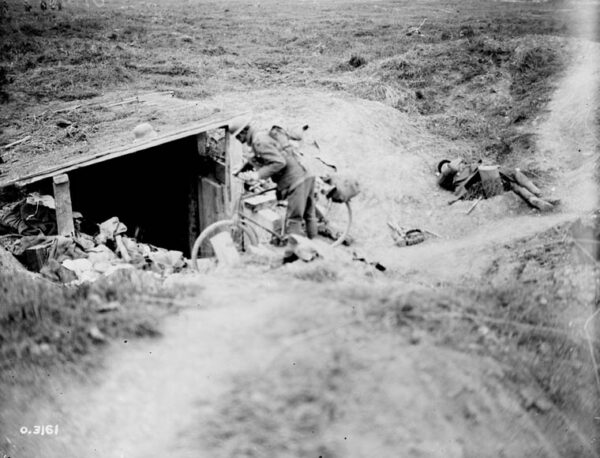
Effective 16 May 1916 the 1st, 2nd and 3rd Divisional Cyclist Companies amalgamated to form the Canadian Corps Cyclist Battalion.

The 4th Divisional Cyclist Battalion in England disbanded and the troops assigned to the Canadian Reserve Cyclist Company as reinforcements.
1st Divisional Cyclist Company
Authority issued on 14 September 1914 to form a cyclist company for inclusion in the 1st Contingent this being raised from volunteers at the Cyclist Depot. Five officers and 78 OR’s selected forming the 1st Canadian Division Cyclist Company this sailed with 1st Contingent in October 1914 being billeted at Bustard Camp, where they were to spend the next four months under canvas.

In December 1914 the establishment of the 1st Divisional Cyclist Company in England was increased by adding 200 more personnel, these being obtained from volunteers in England. The Cyclist Company of the 1st Divisional Mounted Troops sailed for France on the 8th February 1915 with a total of eight officers and 195 OR’s (and two horses).
2nd Divisional Cyclist Company
The Cyclist Company of the 2nd Divisional Mounted Troops raised at the Canadian Cyclist Depot at Camp Valcartier in November 9th 1914 with a strength of 200 All Ranks. Each Military District, with the exception of the 1st, 5th and 13th contributing a platoon.

Most of the 2nd Division Cyclist Company sailed for England May 16th 1915 with a final platoon sailing on 15 June 1915. The Company settled at Dibgate Camp under canvas.
L/Cpl CHARLES MILLINGTON STREET MM
On 9 October 1916, L/Cpl C M Street 238 made several trips with a squad of stretcher bearers, showed great devotion to duty and was a fine example to others. He was severely wounded while carrying water to the dressing station. On 22 March 1917 at Chiseldon Camp, he was decorated on parade with the Military Medal by Col HUGH de CRESPIGNY EASTWOOD, DSO, Commandant, Army Cyclist Corps.
3rd Divisional Cyclist Company
The Cyclist Company of the 3rd Divisional Mounted Troops raised in February 1916 from the Canadian Reserve Cyclist Company in England replenished by volunteers from the Canadian Overseas Cyclist Depot in Canada. Captain L P O Picard in command.

The infantry battalions of the 3rd Division sailed for France in the fall of 1915, followed in the spring of 1916 by the 3rd Divisional Cavalry and Cyclists. Almost immediately, on 11/12 May 1916, the 1st, 2nd and 3rd Divisional Cyclist Companies amalgamated to form the Canadian Corps Cyclist Battalion.
4th Divisional Cyclist Company
Formed in England April 1916 and disbanded May 1916, the 4th Cyclist Company Divisional Mounted Troops raised from the Canadian Reserve Cyclist Company in England in April 1916, being authorized under General Order 63 1917 with other personnel in Canada ready to sail. Under command of Captain G L Berkeley.

A shortage of accommodation in England restricted the movement of these troops from Canada. Effective 16 May 1916 the 1st 2nd and 3rd Divisional Cyclist Companies amalgamated to form the Canadian Corps Cyclist Battalion.

At this time, the 4th Divisional Cyclist Battalion disbanded and the troops in England re-assigned to the Canadian Reserve Cyclist Company as reinforcements. Those in Canada assigned to the Canadian Divisional Cyclist Depot.

Canadian Reserve Cyclist Company
When the 1st Division of the CEF went to France in February 1915, no reserve Depot existed for the Divisional Cyclist Company. Captain F B Goodwillie (1tth Reserve Infantry Battalion) instructed to organize as Officer in Command.
Lt H M Bailey, one CQMS, one Sergeant , two Corporals, one LCpl, and 22 Other Ranks. The Company transferred from Shorncliffe to hutments on Hounslow Heath on 19 May 1915. The men equipped with long Ross rifles and BSA push bicycles. Four Douglas motorcycles provided for training supervision and dispatch riding.
- Lt H M Bailey and Lt C A Brosseau proceed to France in September and November 1915. Captain C G Childs ToS of the Company as a casualty from 1st Divisional Cyclist Company on 20 August 1915, and later SoS on 20 January 1916 having proceeded to Canada.
- On 4 December 1915, Pte D Berard 23628 killed in an accident near Andover.
- LCpl F W Rogers 119060 SoS on 14 October 1915 on appointment as a 2nd Lt, Special reserve of Officers, Royal Flying Corps.
- Cpl R V Waters 540400 SoS on 13 February 1917 on appointment as a 2nd Lt, Royal Flying Corps.
- Private J C Huggard 541399 On Command at the RFC Officer’s Cadet Training Battalion, Denham, as of 28 December 1916.
Canadian Corps Cyclist Battalion
Effective 16 May 1916 the 1st, 2nd and 3rd Divisional Cyclist Companies amalgamated to form the Canadian Corps Cyclist Battalion. The 4th Divisional Cyclist Battalion in England disbanded and the troops assigned to the Canadian Reserve Cyclist Company as reinforcements. Major A McMillan DSO of RCD Regiment given command.

The formation patch for the Canadian Corps cyclist was a triangle of Red, Royal blue and French Grey representing the colours of the Division patch of the three Divisional Cyclist Companies forming the unit. The Canadian Corps Cyclist Battalion likely not awarded battle honours because the battalion had been disbanded by the time the government awarding battle honours in the late 1920s, and had no formal predecessor at the time in a position to advocate for it.
Colours
Significantly (and symbolically), the “Colours” deposited at the Canadian War Museum by the unanimous decision of the two surviving members (Billy Richardson and Capt (Ret) Wilfred Dancy “Dick” Ellis) of the Canadian Corps Cyclist Battalion Association on 16 April 1987. The decision to deposit the “Colours” significant because it acknowledged on the part of the men of the Battalion Association that they would not live forever. Its symbolic importance must also be recognized: Colours can either be laid-up (as is the case with most retired Colours), or deposited (placed into safe-keeping). Those Colours which have been deposited (as opposed to laid-up) can be retrieved at a later date when the unit is revived to serve the nation again.

The “Colours” of the Canadian Corps Cyclist Battalion Association remain deposited in the archives of the Canadian War Museum today.
Companies
Three companies of 99 officers and men each, plus battalion HQ for a total establishment of 329 officers and men.
- A Company – Captain Robertson
- B Company – Captain Kennedy
- C Company – Captain Picard
Captain Humphrey appointed Adjutant, and Lt Saunders Quarter Master.
Cyclist Battalion at St Nazaire
The cyclists left Saint Nazaire by train at 7 PM on 12 February 1915.

Arrived at Hazebrouck and billeted at LEROY FARMS. Bac St Maur from 22 February 1915. Training with 6th Divisional Cyclists (Imperial).
Abeele
Temporary HQ of Battalion at APM’s office in Abeele, Belgium, moving to Boeschepe on 15 May 1916.

Private ALEXABDER PEATTIE 18386 Canadian Div. Cyclist Company 24/02/1915 CITE BONJEAN MILITARY CEMETERY, ARMENTIERES IX. C. 72. Son of Paul and Mary Peattie, of Annan, Scotland. Brother of George Peattie who died of wounds on 28 September 1918.

On 22 April 1915, the Company at Elverdinghe, north-west of Ypres, and moves to Chateau du Trois Tours the following day.

Located to the west of Brielen, north west of Ypres on the road to Elverdinge (N8)
Belgium 1915
Private HENRY JAMES CHILDS 22040 Canadian Div. Cyclist Company 26/04/1915 BAILLEUL COMMUNAL CEMETERY, NORD K. 4. Killed while guarding the canal west of Ypres. Died of wounds at No. 2 Clearing Hospital, Bailleul.

Private W F SMITH 18548 Canadian Div. Cyclist Company 29/04/1915 YPRES RESERVOIR CEMETERY IV. C. 17. Killed at Divisional Artillery HQ.

15 April 2018, CEFRG.ca
Private HARRY GOOD 2127 Canadian Div. Cyclist Company 29/04/1915 WIMEREUX COMMUNAL CEMETERY I. F. 10A. 132 Old George St., Cork, Ireland. Killed at STEENSTRAATE bridgehead.

24 April 2018, CEFRG.ca
France 1916
Lieutenant JOHN ROMEYN DENNISTOUN Canadian Div. Cyclist Company 04/05/1916 HALLUIN COMMUNAL CEMETERY D. 1. Son of Mr. Justice R. M. Dennistoun (Court of Appeal), of 216, Cockburn St., Winnipeg, Canada. Serving with the RFC, shot down in flames on 1916-05-04 at Warneton when his aircraft suffered engine trouble in flight and dropped back from the squadron.

Canadian Div. Cyclist Company
16 April 2016, CEFRG.ca
HALLUIN COMMUNAL CEMETERY
He and his pilot, Lt. Edward Gurney Ryckman, (British) captured and made POWs, but both died of their burns and crash injuries later that day.
Corporal CHARLES CAMERON FLIEGER 2151 Canadian Corps Cyclist Battalion 16/09/1916 VIMY MEMORIAL. Son of the late Howard W. Flieger and of Eliza K. Flieger, of Chatham, New Brunswick.
Private ALLEN NEIL McCULLOUGH 540099 Canadian Corps Cyclist Battalion 30/09/1916 ST. SEVER CEMETERY, ROUEN B. 15. 18.
Private SYDNEY MURRAY GARRETT 540468 Canadian Div. Cyclist Company 10/11/1916 AUBIGNY COMMUNAL CEMETERY EXTENSION I. E. 59.
Private JOHN JAMES BUCHANAN 92 Canadian Div. Cyclist Company 21/10/1916 BOULOGNE EASTERN CEMETERY VIII. D. 146.

Snipers’ heads completed and in position in trench.
Corporal HAROLD JOHN CORBIN 22717 Canadian Div. Cyclist Company 24/11/1916 ECOIVRES MILITARY CEMETERY, MONT-ST. ELOI III. J. 7. Killed by a sniper.
France and Belgium 1917
Lieutenant JAMES WILLIAM BOYD Canadian Div. Cyclist Company 04/02/1917 AUBIGNY COMMUNAL CEMETERY EXTENSION V. A. 25. Son of Mr. and Mrs. William Boyd, of 84, Delaware Avenue, Toronto. Attached to the Garrison Duty Battalion (Royal Flying Corps) died of gunshot wounds to the chest at No. 42 CCS.

(HU 129641) Clay pigeon shooting. Harlaxton.
SWITZER ROBERT HARCOURT 21 22/02/1917 Private Canadian Div. Cyclist Company ‘540029’ ECOIVRES MILITARY CEMETERY, MONT-ST. ELOI. Son of Robert Hezekiah Switzer and Alberta Francis Victoria May Switzer, of 271, Kennedy Avenue, Toronto. Born at Ottawa Canada.
Private ALBERT METHERALL BRIMMELL 540316 Canadian Corps Cyclist Battalion 04/09/1917 VIMY MEMORIAL. Son of John and Charlotte Brimmell. Husband of Pearl Brimmell.

MORLEY ROBERT EDGAR 23 10/11/1917 Private Canadian Corps Cyclist Battalion ’65’ WHITE HOUSE CEMETERY, ST. JEAN-LES-YPRES. Son of James William and Mary Hannah Morley, of Winnipeg, Manitoba.

France, Belgium and Germany 1918
Three years of static trench warfare ended with the Final German Spring Offensive in 1918. Like the Cavalry, the Canadian Corps Cyclist Battalion’s mobility restored, and they began to perform the work for which they had trained.
August 1918 – Canadian Corps Cyclists
FALKNER ALLAN CRAWFORD 22 02/02/1918 Private Canadian Div. Cyclist Company ‘2150’ FOSSE NO.10 COMMUNAL CEMETERY EXTENSION, SAINS-EN-GOHELLE

MUSGROVE HAROLD STONE 20 09/08/1918 Second Lieutenant Canadian Corps Cyclist Battalion ARRAS FLYING SERVICES MEMORIAL
McEVAY 10/08/1918 Private Canadian Corps Cyclist Battalion ‘541224’ BOUCHOIR NEW BRITISH CEMETERY
CHARRON LORENZO 20 29/08/1918 Private Canadian Corps Cyclist Battalion ‘23254’ VIS-EN-ARTOIS BRITISH CEMETERY, HAUCOURT

September 1918
At a rendezvous on the Cambrai Road, 2 September 1918, a patrol badly cutup by MG fire and artillery. Lt Sellers and several others killed. The Company remained under fire at the location all afternoon.

GABBOTT THOMAS WORSWICK 32 02/09/1918 Corporal Canadian Corps Cyclist Battalion “B” Coy. ’62’ TIGRIS LANE CEMETERY, WANCOURT

SELLERS 02/09/1918 Lieutenant Canadian Corps Cyclist Battalion TIGRIS LANE CEMETERY, WANCOURT

VIDAL RICHARD 38 02/09/1918 Private Canadian Corps Cyclist Battalion ‘541414’ TIGRIS LANE CEMETERY, WANCOURT

WILCOX PHILLIP 20 04/09/1918 Private Canadian Corps Cyclist Battalion ‘542533’ DUISANS BRITISH CEMETERY, ETRUN
October 1918
CAMPBELL JOHN 29 10/10/1918 Private Canadian Corps Cyclist Battalion ‘119005’ RAMILLIES BRITISH CEMETERY

CASE 10/10/1918 Private Canadian Corps Cyclist Battalion ‘2298314’ RAMILLIES BRITISH CEMETERY

FERGUS JOHN KIRK 26 10/10/1918 Private Canadian Corps Cyclist Battalion ‘18794’ RAMILLIES BRITISH CEMETERY

NORRIS 10/10/1918 Private Canadian Corps Cyclist Battalion ‘2600826’ RAMILLIES BRITISH CEMETERY

WALPOLE OLLY (Oiley) 23 M M 11/10/1918 Corporal Canadian Corps Cyclist Battalion ‘2196’ QUEANT COMMUNAL CEMETERY BRITISH EXTENSION

McDONNELL 13/10/1918 Private Canadian Div. Cyclist Company ‘190’ BUCQUOY ROAD CEMETERY, FICHEUX
November 1918

21 April 2016, CEFRG.ca
FOLLIOTT JOHN HENRY (HARRY) 22 02/11/1918 Private Canadian Div. Cyclist Company ‘541185’ AULNOY COMMUNAL CEMETERY
ROY 02/11/1918 Private Canadian Div. Cyclist Company ‘3106743’ AULNOY COMMUNAL CEMETERY
WRIGHT HERBERT 30 02/11/1918 Private Canadian Div. Cyclist Company Cyclist Coy. ‘23326’ AULNOY COMMUNAL CEMETERY
Valenciennes
PENNIE 03/11/1918 Private Canadian Corps Cyclist Battalion ‘541130’ VALENCIENNES (ST. ROCH) COMMUNAL CEMETERY

DUKE H G 03/11/1918 Private Canadian Corps Cyclist Battalion ‘3130431’ VALENCIENNES (ST. ROCH) COMMUNAL CEMETERY

On 7 November 1918, two patrols sent out and the exact location of the front line to the north and south of Mons Rd obtained. One patrol had seven casualties – one man wounded and six men badly gassed.
ROGERS 25 07/11/1918 Private Canadian Div. Cyclist Company ‘541249’ QUIEVRECHAIN COMMUNAL CEMETERY

Thulin
On 9 November 1918, Company moved at 10h10 to THULIN and at 14h00 moved to a point on MONS ROAD, 1 mile east of BOUSSU. Company arrived at FRAMERIES at 19h00 and billeted for the night.

Lance Corporal Delbert Bean awarded the Military Medal posthumously, London Gazette No 31227, 13 March 1919.

Three men wounded on 10 November 1918 during the day.

QUINN D C M 09/11/1918 Sergeant Canadian Div. Cyclist Company ‘2182’ CUESMES COMMUNAL CEMETERY

11 November 1918
On the last day of the war at 10h45 to 11h00, the Company came under heavy shell fire at FRAMERIES, but no one was hit.

“On Nov. 11, there was naturally a big celebration in Mons, including a march past, but some of our men who were then over three miles past Mons did not know that the war was over actually at 11 a.m. until a German official car came through to arrange the take-over by the British.” – Captain Ellis
The following day at 11h00 Cyclists paraded with the 7th Brigade on the Square at MONS.
HEROD 19 18/11/1918 Private Canadian Corps Cyclist Battalion ‘2334444’ ETAPLES MILITARY CEMETERY
DOUGLAS 19 24/11/1918 Private Canadian Corps Cyclist Battalion ‘2486312’ VALENCIENNES (ST. ROCH) COMMUNAL CEMETERY.
Captain Robert Sheriff Robinson
Private Edward Cressell Ramsay
Pallbearer at funeral of Thomas Hughes at POPPELSDORF.

Lt William Henry Baines
Lieutenant Baines Commanding No. 4 Platoon in November 1918.

Baines in hospital 14-2-18 to have his tonsils removed.

Before that he had several attacks of Influenza, boils, and corneal ulcer and was rundown.

Charles Edward Hornibrook
Private Charles Edward Hornibrook born in Sundridge, Ontario, on July 5th, 1885. He enlisted in Hamilton on February 2nd, 1918, with the 1st Depot Battalion, 2nd Central Ontario Regiment.

Charles had a red-complexion, evident in this photo. He would comment several times in his letters about this ’embarrassment’.

Shipping for England on board the S.S. Melita in March of 1918, he transferred to the Canadian Corps Cyclists Battalion and sent over to France that September.

Following the end of the war he was demobilized on April 23rd, 1919.
Francis Roy Brown
Francis Roy Brown born in Stockton, Manitoba, on September 13, 1896. He attended school in Winnipeg, Manitoba, until his enlistment in the Canadian Cycle Corps at the outbreak of the war. He served with that unit in France at Ypres, Vimy Ridge, and Passchendaele, until he joined the Royal Flying Corps in 1917.

After graduating from flying training as a pilot he joined No. 204 Squadron in France and shortly before the November 11, 1918, Armistice, he was shot down over Belgium.

He returned to Canada in 1923. He died at Winnipeg on 30 November 1960.

Canada’s Aviation Hall of Fame
Francis Roy Brown inducted as a Member of Canada’s Aviation Hall of Fame in 1976 at a ceremony held in Edmonton, Alberta.

Although he was a fighter pilot, he was not the Roy Brown who shot down the “Red Baron,” a point he reiterated throughout his life.
In 1927 Brown became a bush pilot with Western Canadian Airways, and he was one of the pilots who found a lost Arctic party in 1929. He and men like him opened the north, freighting whole towns and untold tons of mining machinery into an untapped land. He had the first mail contract with Western Canada Airways in 1930.

Later he founded Wings Limited, which was bought by CP Air in 1941. He subsequently became Vice-President of Central Northern Airways.

He was elected MLA for Rupert’s Land as a Liberal-Progressive in 1953 and served as a spokesman for northern interests in the House, but was defeated by a large margin in the 1958 general election.
Private Edward Cressell Ramsey
Private Edward “Eddie” Cresswell Ramsey born on February 2, 1896, in Newcastle-upon-Tyne, England. Immigrating to Canada prior to the outbreak of the war, Ramsey enlisted in Toronto on December 8, 1914, with the Canadian Expeditionary Force’s 2nd Divisional Cyclist Corps in Toronto, Ontario.

He arrived in England aboard the SS Corinthian in May 1915 and soon on his way to France where he would serve a remarkable total of 42 months without being seriously wounded or ill.
He remained with the Cyclists for the entirety of his service (within his letters there are several name changes from the original “Divisional Cyclist Corps,” most notably in mid-1916 to the “Canadian Corps Cyclist Battalion”). Following the armistice in November of 1918, Ramsey demobilized on April 23, 1919.
The Canadian Letters and Images Project
The letters in the collection written by “Eddie” Ramsey to his father Capt. E.C. Ramsey, his mother Nellie Ramsey, his sister Eve, and his Aunt Madge & Uncle Jack (J.R. Arkley).

Included are photos of Pte. Ramsey and the Cyclist Corps, as well as photos of the funeral and gravesite of fellow 2nd Division Cyclist Private Thomas Hughes. Hughes had enlisted alongside Ramsey in 1914 but died in Belgium of pneumonia on January 27, 1919, only a few months before he would have been demobilized back to Canada.
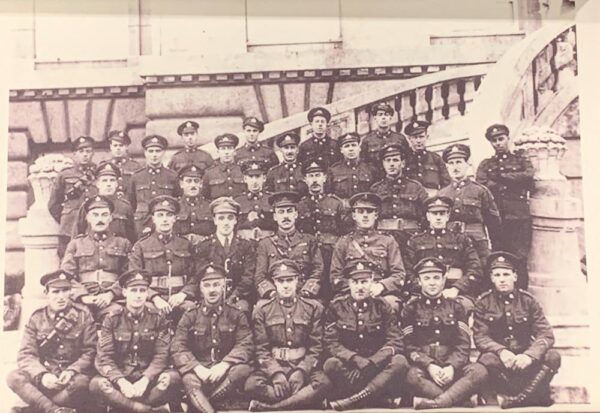
After the armistice signed, the First and Second Canadian Divisions assigned occupation duties and ordered on a 400 km march into Germany. Right behind the Canadian Cavalry, A and B Companies of the Cyclist Battalion. During the march they conducted screening and piquet duties. Once in Germany, the cyclists returned to light duties such as manning check points on the main roads.
March to the Rhine by the Canadian Corps Cyclist Battalion
Platoons 4, 5 (with HQ) and 6 allotted to the 1st, 2nd, and 3rd Canadian Infantry Brigades, respectively. These men used as an advanced guard. Each night on reaching the destination of the march, they selected the Outpost Line and occupied this until relieved by the Infantry of the Advance Guard.
The March a logistics nightmare, with several accidents on the railways causing delays, and shortage of rations, especially for the horses. The landscape wet and dull, the dirt roads become muddy, and the Cyclists often forced to push their bicycles. At times, men on the verge of mutiny. Accommodation for the Cyclists rather posh, as they often billeted in a chateau.

Several columns, approximately 10 km apart, advanced on the Rhine. With few roads available, the troops tightly packed, and the train of troops stretched for five walking days. Over thirty years later, a German General would conceive of a plan to do the same in reverse, knowing the 6th British Army had done what was thought impossible.
Distance by the Canadian Corps Cyclist Battalion
The routes approximately 340 kms long, which if travelled by bicycle today, would take 90 hours of constant travel time. Note the included images during April, when the spectacular beauty of the area clearly evident.
The 1st Canadian Division moved on a 3 Brigade Frontage with the line on the first night as THEOSIS-SOIGNES-LOUVIGNY.
20 November 1918
A halt for all but No. 4 Platoon which moved to Feluy during the day.
21 November 1918
Halt on the above line.

21 November 1918.
22 November 1918
Lt Brown reported to B Company from 10th Battalion.

The platoons on the line FELUY-NIVELLES-RONQUIERES.
23 November 1918
Halt for the day. Most of the men visited Waterloo.

British troops marching past the historic battlefield at Waterloo on the their way to the Rhine,
to later become the British Army of the Rhine, 21 November 1918.
24 November 1918
The historic abbey at Villers-la-Ville the scene of Victor Hugo’s Les Miserables. Almost every man during the March had a chance to visit the ruins, though few understood it was famous since the Napoleonic Wars.

B Company moved to line MARBAIS-VILLERS-DE-LA-VILLE-GEMAPPE. No. 6 Platoon furnished a guard for Ammunition Dump on railway.
25 November 1918
1st Canadian Division moved two a two Brigade Frontage with No. 4 at LOMZEE, No 5 at GEMBLOUX, and No. 6 at GENTINNES.
26 November 1918
Halt for today.

27 November 1918
No. 4 and 5 to line ANDENNE-PETIT WARET, No. 6 on Fire Picquet at VILLERS-LA-VILLE.

28 November 1918
1st Canadian Division moved on a One Brigade Frontage with 1st CIB leading. No. 4 Platoon at ORCHAIN, No. 5 at BENHAM and No. 6 at PETIT WARET.

29 November 1918
Halt for today.

30 November 1918
1st Canadian Division commences to swing south to avoid the British 6th Army and Royal Newfoundland Regiment. No. 4 Platoon at TROIS PONT, No. 5 at MODAVE, and No. 6 at ANDENNE.

General Currie would return to ANDENNE after the March, in February 1919 to visit the scene of the Massacre of Andenne.

1 December 1918
No. 4 Platoon moved to LONGVILLE, No. 5 rested. Shortage of rations, the Division held up.

The Company crosses the ‘old’ German Frontier at 10h05. Following the Treaty of Versailles, Belgium reclaims Eupen and Malmédy (including the Vennbahn railway line), and Moresnet.

2 December 1918
No. 4 rested, No 5 at TROIS PONT, and No. 6 at TOHOGNE. No.s 5 and 6 on Orderly work, B Company HQ reported into CCC bn HQ with 2 officers and 8 other ranks.
3 December 1918
No. 4 at SATVEY, No.s 5 and 6 halted for day.
4 December 1918
Currie and his staff a few days behind at Vielsalm. Currie alternated between the routes of the two Canadian Division’s, leaving it a mystery as to whether he would greet his troops at Bonn or Cologne.

No. 4 at SATVEY, No.s 5 and 6 at CAHAY and CHEVRON.

5 December 1918.
No. 6 halt for day, No.5 at AMEL, No. 4 still at SATVEY.

6 December 1918
No. 5 at HOLERATH, No. 6 at LIERNEUX, and No. 4 still at SATVEY.
7 December 1918
No. 4 at SATVEY, No 5 and 6 at HOLLERATH and AMEL. No. 6 platoon crossed border at 11h00 today.

The pole marks the location of the former border, now about 10 km further east.
28 April 2018. CEFRG.ca
8 December 1918
No. 4 at DE RUM, No. 5 at KOMMERIN, No. 6 remained at AMEL but made a Road Reconnaissance with a small patrol.
9 December 1918
No. 4 Platoon the first to reach the Rhine at Cologne, 08h00. Billetted at BAUHL. No. 6 at VILLERSWIST, No. 6 at HELLENTHAL.

10 December 1918
No. 4 rested, No. 5 at SURTH, and No. 6 at SINSENTH.
11/12 December 1918
No. 4 rested, No. 5 at SURTH, and No. 6 at WIERLERWIST.
13 December 1918
The battalion afforded the honour of being the first Canadian unit to cross the Rhine River at Cologne. This accomplished on 9 December 1918, four days prior to the official crossing of the Rhine by the Canadian Corps.

No.4 Platoon formed part of the Advanced Guard as they were reviewed on main bridge at Cologne by General Plumer, and billeted in WAHN. No. 6 Platoon crossed the Rhine at Bonn at 10h00 and billeted in RATHEUMAR.

The Cyclists the only unit to simultaneously cross the Rhine at Cologne and Bonn. Following the crossing Captain Chadwick unimpressed with the whole affair, only noting the men resting – nothing to report. Afterwards, the Company concentrated at Komigswinter for guard duty, and finally relieved by the 27th Battalion.
Lt Wilson evacuated to CCS with pleurisy on 15 December 1918.
Christmas Dinner
Preparation for the Christmas Dinner postponed until 27 December 1918 due to a shortage of roasts.
Canadian Corps Cyclist Battalion in Germany
The Battalion spends much of January at ENDENICH. A Bath parade at the Victoria Baths in Bonn included use of the swimming pool on 4 January 1919. Roman Catholic Church parade held the next day at 9h30, Church of England at 10h45.

KHAKI School began for two hours a day on 9 January 1919. Another weekly Bath Parade on 10 January 1919, the men likely had their photographs taken afterwards.

Accidental Death
Private Robert Wilfred Prior accidentally killed by a street car in Bonn at 14h15 on 24 January 1919. He was initially buried two days later in the prestigious cemetery POPPELSDORF MILITARY CEMETERY.

Influenza
The following day, 27 January 1919, Private’s George Jack Nisbet and Thomas Hughes died of Influenza. At least 300 Canadians died of Influenza in Germany, France and Belgium in the early months of 1919.

In 1920 the IWGC removed dozens of all graves from POPPELSDORF and brought them to BRUSSELS TOWN CEMETERY where these men now rest.
Brussels Town Cemetery
George Jack Nisbet, Thomas Hughes and Robert Wilfred Prior from POPPELSDORF.

Brussels in German hands from 20 August 1914 to the date of the Armistice. Plot X of the cemetery contains the graves of 54 Commonwealth casualties, 50 of which were prisoners of war whose bodies were brought back from Germany by the Canadian Corps in April 1919.

Commonwealth forces did not return until September 1944, but in the intervening years, many airmen shot down or crashed in raids on strategic objectives in Belgium, or while returning from missions over Germany. Most of the Second World War casualties buried in the town cemetery died on lines of communication duties after the liberation of Brussels at the beginning of September 1944, but a few date from the brief period that the BEF spent in Belgium in May 1940.

By 7 April 1919, The Canadian Corps Cyclist Battalion at South Camp, Ripon in England. Of the 1,138 cyclists who enlisted, 261 killed or wounded, a casualty rate of 23 per cent.
Wounded Warriors Canada
Three years after a global pandemic, more than 65 Canadians from across the Nation assembled in France to begin their week long 400km cycling journey over the Battlefields during Canada’s Last Hundred Days of the Great War.

Participants comprised of serving and retired members of the Canadian Armed Forces, Veterans, Active and Retired members of our First Responder community and civilians from coast-to-coast.
“BBR22 will celebrate, commemorate and reflect on Canada’s considerable contribution and sacrifice during the last 100 days of the WW1. What’s more, the Battlefield Bike Ride is the largest single fundraising event each year for the charity and provides significant funds to help make our life-changing mental health programs possible.” – Scott Maxwell, Executive Director of Wounded Warriors Canada

Over 750 cyclists have participated in Battlefield Bike Ride events, collectively raising over $3M in support of national mental health programs and services benefiting ill and injured Veterans, First Responders and their families across Canada.
Contact Wounded Warriors Canada
- Phone: 1-888-706-4808
- Fax: 1-905-430-9419

