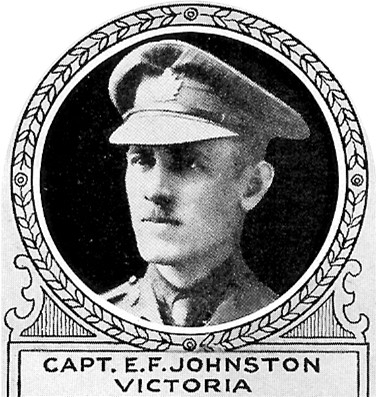
Honourary Captain Eric Franklin Johnston one of four members of the Canadian Chaplain Services buried in France during the Great War.

“I spent last Sunday at No.3 Canadian Casualty Clearing Station, and strangely enough one of the sisters asked me ‘Who is Captain Eric Johnston, a padre?’ I asked her why she wished to know. She replied that all the boys who came from his unit wounded, to pass through the Casualty Clearing Station, simply raved about him.” – LtCol G. O. Fallis, A.D.C.S.
Lieutenant-Colonel George Oliver Fallis, CBE, ED, BD, DD, (1885–1952) a Canadian military chaplain during the Great War and the founder of the Canadian Memorial Church in Vancouver.

Pastor at Collingwood
Eric Franklin Johnston graduated from Victoria College in 1915. Served as pastor in Collingwood.
Son of Joshua Reynolds Johnston and Jennie Poole Johnston, of Carleton Place, Ontario. Husband of Jessie Louise Johnston, of Toronto, Ontario.
1916
Eric enlisted with 201st Overseas Battalion on 1 April 1916, having had one year with high school Cadets, and one year with COTC (Military College). Transferred to the 198th Overseas Battalion on 1 October 1916.
198th Battalion (Canadian Buffs)
Organized in February 1916 under the command of Lieutenant-Colonel J. A. Cooper. Mobilized at Toronto and also recruited in Toronto. The unit assembled at Exhibition Camp for a unit photo on 20 February 1917.


The 198th Battalion embarked from Halifax 28 March 1917 aboard METAGAMA. Disembarked England 10 April 1917. With a strength of 31 officers, 841 other ranks. 5th Division, 15th Canadian Infantry Brigade, 10 May 1917 – February 1918. Drafts of 100 to 3rd, 19th, 20th and 75th Battalions on 15 February 1918.

1917
Embarked Canada from Halifax on 25 March 1917. In August 1917, SoS of the 198th to Chaplain Services at Witley Camp. To be Honourary Captain with a Canadian Infantry Battalion from 30 August 1917.

Attached to HQ of the 5th Canadian Division on 30 November 1917. The 5th division would eventually contributed reinforcements to the four Canadian Divisions overseas.

1918
Ceases to be attached to HQ on 19 May 1918. Repatriated from Witley to Bramshott area on 7 August 1918. SoS Chaplain Services on proceeding overseas to the 2nd Canadian Division, 17 September 1918.

Bronchial Pneumonia
Honourary Captain Eric Franklin Johnston admitted to No. 6 CFA, myalgia, 9 November 1918. 11 November 1918, admitted to No. 20 General Hospital, Camiers, seriously ill. Died of bronchial pneumonia, 18 November 1918.

Etaples Military Cemetery
During the Great War, the area around Etaples the scene of immense concentrations of Commonwealth reinforcement camps and hospitals. Remote from attack, except from aircraft, and accessible by railway from both the northern or the southern battlefields. In 1917, 100,000 troops camped among the sand dunes and the hospitals, which included eleven general, one stationary, four Red Cross hospitals and a convalescent depot, could deal with 22,000 wounded or sick. In September 1919, ten months after the Armistice, three hospitals and the Q.M.A.A.C. convalescent depot remained.

The cemetery contains 10,771 Commonwealth burials, the earliest dating from May 1915. Only 35 of these burials unidentified.
Soldiers’ Tower
Situated at the western end of Hart House and standing 43.5 metres (143 feet) tall, the Soldiers’ Tower a memorial to the 628 members of the University of Toronto who gave their lives while on active service in 1914 to 1918 and to the 557 men and women lost from 1939 to 1945.

Carved in stone on the memorial screen are the ranks, names and units of those lost to the university in the Great War. Stained glass windows, paintings, inscriptions and artifacts commemorate those who served and those who fell in the two World Wars.

Canterbury Cathedral
The “Canadian Buffs Memorial” at Canterbury Cathedral a memorial dedicated to officers of the 198th Battalion (Canadian Buffs). The memorial was erected by their comrades and was dedicated in 1917 when the battalion’s colours ceremonially deposited in the Cathedral’s Warrior’s Chapel.

Canadian Chaplains buried in France
Including Reverend Johnston, four Canadian Army Chaplains buried in France during the Great War.
- The Rev. GEORGES ETIENNE R. CROCHETIERE, BAILLEULMONT COMMUNAL CEMETERY
- Killed-in-action 2 April 1918 at Mercatel.
- The Rev. DONALD GEORGE MacPHAIL, LAMPAUL CHURCHYARD, ILE D’OUESSANT
- Llandovery Castle victim, 27 June 1918. Body recovered from the sea months later.
- The Rev. WILLIAM HENRY DAVIS, LE QUESNEL COMMUNAL CEMETERY
- Killed-in-action 9 August 1918 at Le Quesnel.

Artist – Maurice Randall
Canadian Chaplains buried in England
Two Canadian Army Chaplains buried in England during the Great War. One Chaplain wounded on the Western Front and later succumbed to wounds.
- The Rev. WEBSTER HENRY FANNING HARRIS, BROOKWOOD MILITARY CEMETERY
- Paralyzed by a shell on the Somme in September 1916.
- Evacuated to England, and died of wounds in May 1917,
- The Rev. GEORGE LEYCESTER INGLES, BULFORD CHURCH CEMETERY
- Spinal meningitis victim on Salisbury Plain, 1 January 1915.

Contact CEFRG

