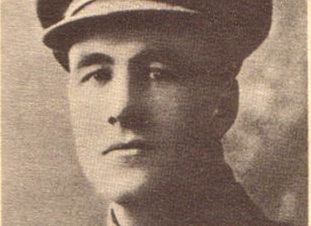
Major John Gibson Anderson MC’s body recovered by the Canadian First Division’s Chaplain Frederick G Scott during the Second Battle of Passchendaele. Anderson’s family notified of the exact burial location, and that the service had been performed by Canon Scott. Yet, the IWGC failed to record the particulars, and his grave never registered. Therefore, his name listed on the Menin Gate Memorial as one of over 6,900 Canadians with no known grave in Belgium. Canadian National Vimy Memorial lists the names of another 11,285 Missing Canadians in France.

Sir Arthur Currie
“I knew John for over twenty years, as it was my privilege to be his teacher in the public schools of Victoria, B.C., in the year 1896. Shortly after that time I lost track of him. I remember the day in May, 1915, during the battle of Festubert, that I was brought a message by a mounted orderly, in whom I recognized as my old pupil. Later in the year, it was my privilege to recommend him for a commission, and I have watched with a great deal of pride his military career.”
Sir Arthur Currie

5th Canadian Infantry Battalion
John the son of Mrs. Mary Anderson, of Esquimalt, Victoria, British Columbia. Born 19 January 1885 in Glascow, Greenwichshire, England.

Sergeant Bill’s story from February 2021 at CEFRG.ca


First-in-command
Following the promotion of Hugh Dyer to brigadier general at the end of June 1917, Lorn Paulet Owen Tudor assumed command of the 5th Battalion. Formerly the battalion’s adjutant, a native of England, born on 3 July 1876. He had served for three years in the Royal Buckinghamshire Yeomanry before moving to Canada and joining the British Columbia Horse. At the time of his enlistment with Lieutenant Colonel Tuxford’s 5th Battalion in September 1914, Tudor worked as a rancher in Saskatchewan.

Tudor assumed temporary command of the 5th during the battle of Vimy Ridge in April 1917. Two months later he formally took over from Hugh Dyer on his promotion to brigadier general. In recognition for his leadership at Vimy, Tudor received the Distinguished Service Order:
The magnificent success with which his battalion carried out its objective and consolidated the captured position was mainly due to his personal example of coolness and disregard of safety, and to the thoroughness with which all details had been prepared by him.
Second-in-command
Second-in-command, Ian Laurie Crawford was a native of Quebec born on 10 July 1892. He was a member of the 8th Regiment and had originally enlisted in the 12th Battalion as a subaltern before being drafted to the 5th. He took temporary command of the battalion in spring 1918. Tudor resumed command in April 1918 until the end of the war. Twice wounded in action, Crawford was awarded the Distinguished Service Order and Bar. He died on 20 February 1932.
Third-in-command
Third-in-command, Major John Gibson Anderson born in Glasgow, Scotland on 19 January 1885. He immigrated to Canada as a child and was a school student of Arthur Currie in the late 1890s. Twenty-years later, during the battle of Festubert in May 1915, General Currie recognized his “old pupil” and followed the progress of Anderson’s military career.
Battle of Mount Sorrel
The Canadians fought the Battle of Mount Sorrel in the Ypres salient from 2 to 13 June 1916.
“During the fighting at Ypres salient last June he (Major Anderson) and a subaltern the only officers of C Company, 5th Battalion, to survive.”
From the Daily Colonist of April 27, 1917.

2 June 1916
The 5th Battalion’s war diaries state 10 other ranks killed on 2 June 1916, with another 8 other ranks killed on the 3rd. At Hill 60 on 6 June 1916, 60 other ranks killed, along with Lt H T Taylor. One other rank killed on 25 June 1916 while in Brigade Support. A total of 84 men killed in action during June of 1916.
CWGC records the death of 27 soldiers of the 5th Battalion on 2 June 1916, including the following NCOs.
- Sergeant William Halliday (LARCH WOOD (RAILWAY CUTTING) CEMETERY)
- Corporal Hopwood (YPRES (MENIN GATE) MEMORIAL)
- LCpl Francis Henry Marshall (LARCH WOOD (RAILWAY CUTTING) CEMETERY)
- LCpl Percy James Sargent (LARCH WOOD (RAILWAY CUTTING) CEMETERY)
- Cpl Watson (YPRES (MENIN GATE) MEMORIAL)

4 June 1916
No casualties of the 5th Battalion recorded by the CWGC for 3 June 1916. But, two men registered on 4 June 1916.
- Pte Arthur Leggott (LIJSSENTHOEK MILITARY CEMETERY)
- Pte Pickard (YPRES (MENIN GATE) MEMORIAL)
Five other ranks, all recovered and buried at LIJSSENTHOEK MILITARY CEMETERY or LARCH WOOD (RAILWAY CUTTING) CEMETERY on 5 June 1916.

6 June 1916
Thirty-one registered on 6 June 1916, including Lt Taylor and 3 NCOs.
- Lt Taylor (LARCH WOOD (RAILWAY CUTTING) CEMETERY)
- Sergeant Brand (YPRES (MENIN GATE) MEMORIAL)
- LCpl Newman (RAILWAY DUGOUTS BURIAL GROUND (TRANSPORT FARM))
- LCpl Wrennick (YPRES (MENIN GATE) MEMORIAL)

Succumbed to Wounds
Four other ranks registered on 7 June 1916, and another two on 14 June 1916. All men buried in CWGC cemeteries suggest these men all succumbed to wounds from the Battle of Mount Sorrel.
- Private Crook (LIJSSENTHOEK MILITARY CEMETERY)
- Pvt Hall (BOULOGNE EASTERN CEMETERY)
- Pvt Mason (LIJSSENTHOEK MILITARY CEMETERY)
- Private Alfred Gordon Travers (LIJSSENTHOEK MILITARY CEMETERY)
- Pte McDougall (RAILWAY DUGOUTS BURIAL GROUND (TRANSPORT FARM))
- Pte Roy Moody (LIJSSENTHOEK MILITARY CEMETERY)
Lt. Gen. Sir Julian Byng paid a visit to the 5th Battalion on 22 June 1916. He also attended the Canadian Corps Sports held on 26 June 1916, while the 5th Battalion was in Brigade Support.

3387307
The 5th Battalion in Brigade Support in the Scottish Lines on 26 June 1916.

28 June 1916
Farewell banquet to Major General L J Lipsett CMG at Poperinghe, 8 pm, 28 June 1916.

LCpl Francis Henry Marshall died 2 June 1916, followed the next day by LCpl Henry Chilton. Both recovered and buried at Larch Wood (Railway Cutting) Cemetery.

Lt G L Smith, 29 May 1916, Boulogne Eastern Cemetery

Hedge Row Trench
Dug-outs

During the second week of August 1916, Captain Henry Knobel (formerly of the 8th Battalion), now the first CWRO photographer captured a series of remarkable images involving the 5th Battalion. No deaths among the battalion during August 1916 – the wounded man must have recovered.

Battle of Arras
Known to Canadians as the Battle of Vimy Ridge, the action part of the British offensive named the Battle of Arras, itself part of the wider Nivelle Offensive. Battalion HQ at 51b.A.22.a.9.2. The assembly position hit by a 5.9 shell, killing one, and wounding 5 others prior to zero-hour at 5:30am.

The first objective, the Black Line obtained at 6:10 am. Casualties estimated at 200 – a great many of which succumbed to machine-gun fire. The Red Line, the second objective reached at 9 am. The men not relieved at the Red Line until 6:30 pm by the 8th Battalion, falling back to the Black Line with HQ at 51b.A.17.c.5.2.

Following the reorganization of the 5th Battalion after Vimy Ridge, Anderson promoted to major.
Second Battle of Passchendaele
He was killed at Passchendaele on 10 November 1917. Currie expressed his condolences to Anderson’s mother, stating, “I pray that the great God of battles may grant you some measure of consolation.” Calling the major one of his “best officers,” Tudor wrote, “He is a very great loss to the Battalion, and will never be forgotten.”
Reverend Canon Scott, who found Major John Gibson Anderson MC’s body on 11 November, arranged for proper burial and conducted the funeral service. He sermonized: “I am sure Major Anderson did not suffer, but entered peacefully into the fuller life beyond. Please accept my heartfelt sympathy, and yet, what more glorious or Christ-like death could one wish friends.”
His body recovered and buried, but not registered. Circumstances of Death card only noted he was “killed in action.” Anderson named on Panel 18 – 26 – 28 at the Menin Gate Memorial.
“He was buried on the battlefield (and I will forward the exact location to you) and Canon Scott, the senior Chaplain of the 1st Canadian Division, read the burial service.”
LCol Paul O. Tudor
In Faith Under Fire, Canon Scott does not mention the death nor burial of Major John Gibson Anderson MC.

“He early gave evidence of possessing a superlative degree those qualities which go to make up a successful soldier. He was gallant to a fault, devoted to duty, loyal to his superiors, and a real leader of men. His loss is most keenly felt, not only by all ranks of the 5th Battalion, but by his Brigade and Division as well.”
Officers’ Casualty List
2nd Canadian Infantry Brigade – Period: Noon, 8th November to noon 12th November 1917 (inclusive).
- 5th CIB
- Major Johan Gibson Anderson (MENIN GATE (YPRES) MEMORIAL)
- Lt John Cochrane Smith (MENIN GATE (YPRES) MEMORIAL)
- 6th CIB
- Lt George McLeod Rock (YPRES RESERVOR CEMETERY)
- Lieutenant Victor Stone (VLAMERTINGHE NEW MILITARY CEMETERY)
- Lt Landell Newcombe (missing, believed killed) (MENIN GATE (YPRES) MEMORIAL)
- 7th CIB
- Captain Cyril Knox Barrow Mogg (MENIN GATE (YPRES) MEMORIAL)
- Lt Harry Carter (MENIN GATE (YPRES) MEMORIAL)
- Lt James Thomas Hewitt (MENIN GATE (YPRES) MEMORIAL)
- Lieutenant William Steven Fielding (MENIN GATE (YPRES) MEMORIAL)
- 10th CIB
- Captain Charles Telford Costigan (missing) (PASSCHENDALE NEW BRITISH CEMETERY)
Major J G Anderson the highest ranking officer in the 2nd Canadian Infantry Brigade killed in action during the final assault on Passchendaele. If his burial location had been recorded and transmitted to his family, perhaps one of the other dead officer’s in the 2nd Canadian Infantry Brigade may have a recorded burial coinciding with Anderson’s.
Three officer’s may have been concentrated (exhumed and buried in an IWGC cemetery following the Armistice), rather than buried in the IWGC cemetery in 1917. What do their CoG and GRRF files reveal?
Lt George Mcleod Rock
Lt George McLeod Rock (YPRES RESERVOIR CEMETERY). GRRF checked 1-5-22. Plot I.I.124. No CoG file, suggesting originally buried here. Likely died of wounds at a Casualty Clearing Station.
Lt Victor Stone
Lieutenant Victor Stone (VLAMERTINGHE NEW MILITARY CEMETERY). GRRF checked 27-5-21. No CoG file, also suggesting originally buried here. Likely died of wounds at a CSS.
Captain C T Costigan MC DSO
Captain Charles Telford Costigan (missing) (PASSCHENDALE NEW BRITISH CEMETERY). Costigan has a CoG file. Where was he recovered from? Was he recovered with others? Was there other remains buried with him?
A Burial return dated 27 March 1920 indicates an Unknown Canadian Officer now buried in XII.F.7 recovered at 28.D.5.b.5.6. along with an Unknown British Officer (2nd Lt) of a Rifle Brigade. The location barely outside the perimeter wall of Passchendaele New British Cemetery today.

The location only two hundred yards forward of the 5th Batallion’s HQ, and directly along the path of battalion towards Vindictive Crossroads. No images exist of the location known as Vindictive Crossroads during the battle, though MIKAN No. 3397040.

Ribbons, identified as a VC and MC, later provided clues to Costigan’s identity (the DSO misidentified as a Victoria Cross ribbon).

These men all recovered from the immediate vicinity of Passchendaele New British Cemetery.

Frustration
Tremendously frustrating to know the battlefield burial location of Major Anderson never transmitted to the IWGC. Without this detail, a search for his body never initiated. Many families pushed the IWGC for information regarding battlefield burial locations of their loved ones even before the Armistice, and for decades following the Great War. Unknown if the family of Major John Gibson Anderson MC made a request to the IWGC, but hundreds of families in the same predicament did so. What became of his remains? Difficult to order in terms of likelihood, any of these possibilities equally likely.
- Remains never recovered.
- Remains still exist at the original burial location, or,
- Remains destroyed in subsequent battles, with an equal likelihood.
- Exhumed, and buried as an Unknown British Officer of the Great War at Tyne Cot Military Cemetery.
- Exhumed, and buried as an Unknown Canadian Officer of the Great War at Passchendaele New British Cemetery.
- Finally, exhumed, and buried as an Unknown Soldier or Officer of the Great War in any CWGC concentration cemetery in the Ypres Salient.
Red Ensign

After the war, LCol Tudor donated the tattered Red Ensign flown by the 5th Battalion at Vimy Ridge to the Imperial War Museum in London. It was later presented to the Canadian War Museum in Ottawa.

This flag was flown during the First World War at Vimy Ridge, Lens, Hill 70, and Passchendaele, 1917. One other ‘Red Ensign’ with Vimy Ridge associations survives in the museum at Penticton, British Columbia, but that is a simple Red Ensign without the Provinces’ coats of arms. This version of the Red Ensign, with the arms of four provinces, was the national flag of Canada from 1868 to 1870. It is not clear why this ‘old’ flag was carried by the Battalion – it may have simply been ‘souvenired’ from the flag locker of the merchant ship that brought the battalion to Europe.
IWM
The Imperial War Museum’s Red Ensign donated to the Museum by Lieutenant Colonel Lorn Paulet Owen Tudor DSO and Bar, an Englishman who emigrated to Canada before the First World War and served in the Canadian Army : specifically the 5th Canadian Infantry Battalion (Western Cavalry), Canadian Expeditionary Force, raised in Saskatchewan. He commanded the battalion from June 1917 to March 1918, and from April 1918 to demobilization in 1919. He was awarded the DSO and bar and mentioned in despatches.

The Canadian experience at Vimy Ridge has come to be recognised as a pivotal event in the emergence of Canada’s national identity, and this flag is believed to be a unique survivor in this form. The Red Ensign, originally the British merchant flag, a red flag with the Union Flag in the upper left quarter, was adopted in this form as Canada’s national flag in 1868. It bears the coats of arms of Canada’s four founding provinces, and was superseded in 1870 when Manitoba was added, so is a very early example. The Canadian Red Ensign continued as the national flag until 1965.
Contact CEFRG

