Private John James Todd born in Lauder, Berwickshire, Scotland on 28 June 1892. He was a Farmer. He attested 14 April 1915 in Regina with ‘B’ Company, 46th Battalion, CEF. John stood 5’8″ tall, with fresh complexion, blue eyes and red hair. He was Presbyterian. William Todd lives in Berwickshire, with his unmarried mother, Isabella.

Sailed from Halifaz per S.S. LAPLAND, with Second Contingent, 21 October 1915. Disembarked, Devenport, 30 October 1915. Appointed Lance-Corporal 1 November 1915. John trains at Bramshott Camp.
Battle of Mount Sorrel
Private John James Todd proceeded overseas for service with 3rd Battalion, 16 June 1916. Reverts to ranks, 17 June 1916. Taken-on-Strength in the Field, with 125 Other Ranks, 17 June 1916. The 3rd Battalion recently suffered heavy casualties at the Battle of Mount Sorrel. Ninety men from the 3rd Battalion die on 13 June 1916. Nearly 150 during the battle. The 3rd Battalion desperately needs reinforcements.
Joined unit, 19 June 1916. John just missed a big visit. Following Church Parade, the previous day, Lt-Gen. Sir Julian Byng, G.O.C., Canadian Corps, Maj-Gen. Currie, G.O.C., 1st Canadian Division, and Brig-Gen. Hughes, G.O.C., 1st Canadian Brigade visited the troops. Then, on 21 June 1916, another draft of 224 Other Ranks arrive.
Major-General Mercer
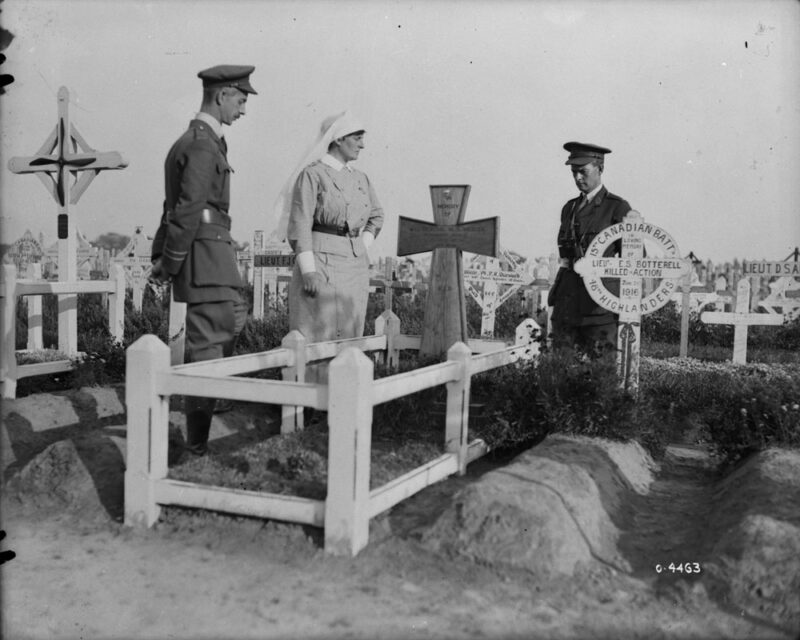
On 24 June 1916, at 3 PM, Major-General Mercer, wounded three times during the Battle of Mount Sorrel, is buried at No.10 Casualty Clearing Cemetery. All available officers attended. Later that night, the men relieve the 10th Battalion in 2nd G.H.Q. line.

The 3rd Battalion takes up positions at Swan Chateau, Moated Farm and Chateau Segard. They are just north-east of Kruisstraathoek, south of Ypres. By night, massive work parties of over 400 men are busy repairing and constructing new trenches. Then, on the night of 8 June at 20h00, the companies at Moated Farm and Chateau Segard are shelled heavily. Later, three men come out with shell shock. Before it is over, five are killed, and twelve wounded.
Bombing Exhibition
Over the next few days, another eight men are wounded, but no one else is killed. Finally, relieved by the 16th Battalion, the Canadian Scottish, on 30 June 1916 and move to VICTORIA CAMP, north of Westoutre. Then, on 1 July 1916, the 3rd Battalion has a holiday – Dominion Day. Then, on 3 July 1916, the battalion is inspected by Brig-Gen. Hughes, and the battalion played the 1st Battalion in baseball, winning a close game, 5-4. Finally, on 4 June, the battalion march to Gas School, to have their helmets tested. It rains heavily in the afternoon.


On 6 July, the 3rd Battalion is back in the trenches at Larch Wood, 4th Bn. on their left, 2nd Bn. on their right. Then, on 8 July, the battalion attempts a small attack to recover a trench over the crest of Mount Sorrel. Held up by the wire, they have to pull back. Casualties are heavy. Finally, on 9 July, the German artillery bombards Observatory Ridge for 3 hours, but no attack follows. Then, Canadian artillery respond in kind. Finally at dusk, in Railway Dugouts Cemetery, the 3rd Battalion buries four of their dead from the day before.
Railway Dugouts Burial Ground (Transport Farm)
On 10 July 1916, the 3rd Battalion return to Railway Dugouts Cemetery, and bury another three men, Bicknell, Merson, and Cuss. Then, the battalion marches to Devonshire Lines, for a week of training. Another informal visit came on 19 July from Maj.-Gen. Currie, during Bayonet training. A formal visit, with Currie, Brig-Gen. Hughes, Sir George Foster and members of the Canadian Parliamentary Committee followed the next day. Weather was fine. Visited again on 23 July 1916. This time, Brig-Gen Rennie presented the battalion with 10 awards for the Military Medal, for actions at Mount Sorrel on 13 June 1916. In the last week of July 1916, the 3rd Battalion returns a few times to Railway Dugouts Cemetery to bury more of their dead.

Nordausques
The first ten days of August 1916 are spent in training at DOMINION LINES, north of Ouderdom, Belgium. On a long march to Nordausques for training, they are inspected en route by General Sam Hughes. On 15 August, at Tournehem-sur-la-Hem, Maj-Gen. Currie and Brig.-Gen. Garnet Hughes (son of Sam Hughes) once again pay the 3rd Battalion an informal visit. Weather – sultry. Finally, on night of 27 August 1916, the 3rd Battalion march to entrain at Nordasques. The adjutant notes the civilians were sorry to see them go.

On 31 August 1916, the 3rd Battalion relieves the Australians in SAUSAGE VALLEY. Private John James Todd is now on the Somme, just east of la-Boiselle. They are preparing for the Battle of Flers-Courcelette.
The Death of Private John James Todd
John’s ‘C’ Company temporarily attached to the 2nd Battalion. They attempt to make contact with the 49th Australian Battalion 500 yards south of MOUQUET FARM. Along the way, Lieutenant Dyas suffers shell shock. Twenty four men are wounded, and 4 men killed. Then again, they are heavily shelled by the Germans on 4 September 1916. Nine men are killed, and 65 are wounded. Then, they are heavily shelled on 5 September. Two killed, 25 wounded. And then, on 6 September, it is more of the same. Three men are killed at dawn, and later another four die later in the day. Further, another 14 men are wounded.

Finally, Private John James Todd is one of the men transported to No.35 Casualty Clearing Station. John soon dies from massive blood loss, 6 September 1916, at No.35 C.C.S.
Please subscribe to CEFRG to be notified by email when there are new posts. Subscription is free, and your email kept confidential.