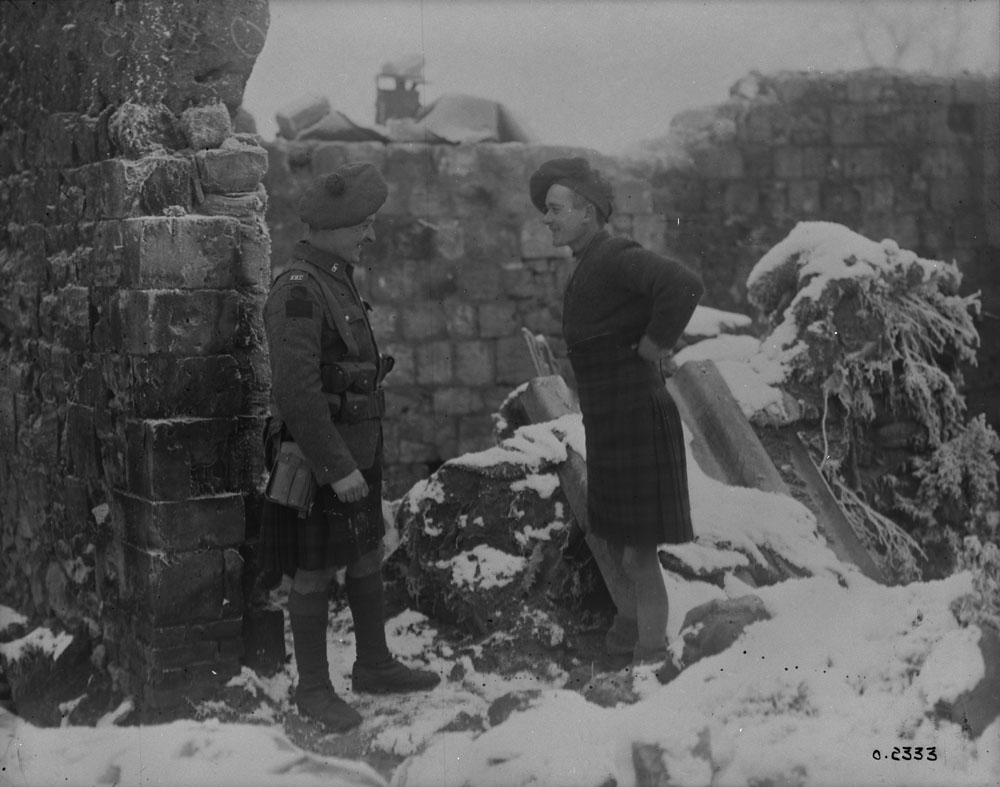
Private Roy Charles Horton 141602, born 27 April 1894, was a painter, son of Robert and Maria Horton of 39 Elgin Street, Collingwood, Ontario. Roy, a Roman Catholic, had service with the 44th Regiment, prior to attesting on 27 July 1915 at Welland, Ontario with the 76th Battalion. His attestation paper was certified by Lt.-Col. James Ballantine. Roy was 21 years old, standing 5′ 8″, 156 lbs, with fair complexion, blue eyes, and light-brown hair.

13th Battalion (Royal Highlanders of Canada – The Black Watch)
Roy sailed from Montreal 1st October 1915 onboard S.S. SCANDINAVIAN. Transferred to the 39th Battalion on 4 November 1915. And, transferred again to the 13th Battalion (Royal Highlanders of Canada – The Black Watch) on 29 February 1916.
Roy is about to proceed overseas, and arrived in Le Havre, France on 2 March 1916. He proceeded to join his unit on the 14 March. Then, arriving the following day as his unit engaged with the enemy. Three months later, Killed-in-Action. When soldiers die so soon after arriving on the front, their service files are normally very short. This is the case for Private Roy Charles Horton.

After four harrowing days, Roy is in billets at Red Lodge (east of Dranouter). On 25 March 1916 they are in the front lines at Meteren. Casualties occurring daily, arriving back at Dickebusch Huts on the 29th. The location provides short relief, as casualties continue to mount from the 1st of April due to artillery fire. Finally relieved by the 10th Bn on 6 April 1916, the unit moves to the security of Poperinghe Hop Factory.
Mid-April 1916 the unit is located by Gordon Terrace, and the casualties are heavy, particularly on the 19 April 1916. The unit returns to better protection at Dickebusch Huts on the 25 April. During May of 1916, the unit’s casualties are low, though they are still engaging with the enemy.

Battle of Mount Sorrel
On 13 June 1916, the second-to-last day of the Battle of Mount Sorrel, casualties of the Black Watch are very heavy. Yet, the adjutant still records every soldier, including Roy, listed as Killed-in-Action. It is important to note Roy not listed as missing. Killed-in-action, yet his body not able to be recovered. Therefore, listed on the Menin Gate Memorial.
Between 2 and 14 June of 1916, 8,430 men of the Canadian Corps killed, wounded or reported missing. The Germans suffered 5,765 men killed, injured or missing.
The Mount Sorrel Battlefield Memorial sits by the Sanctuary Wood Museum near Ypres. The inscription reads: “Here at Mount Sorrel and on the line from Hooge to St. Eloi, the Canadian Corps fought in the defence of Ypres April-August 1916”.

Menin Gate Memorial
The Menin Gate Memorial situated at the eastern side of the town of Ypres (now Ieper). In the Province of West Flanders, on the road to Menin and Courtrai. It bears the names of 55,000 men. Lost without trace during the defence of the Ypres Salient in the Great War. Designed by Sir Reginald Blomfield, and erected by the Imperial (now Commonwealth) War Graves Commission. It consists of a Hall of Memory, 36.6 metres long by 20.1 metres wide. In the centre are broad staircases leading to the ramparts which overlook the moat. And, to pillared loggias which run the whole length of the structure. One of the most beautiful CWGC cemeteries incorporates the ramparts, and is a short walk from the Menin Gate.
On the inner walls of the Hall, on the side of the staircases, and on the walls of the loggias, panels of Portland stone bear the names of the dead. Inscribed by regiment and corps. Carved in stone above the central arch are the words. TO THE ARMIES OF THE BRITISH EMPIRE WHO STOOD HERE FROM 1914 TO 1918 AND TO THOSE OF THEIR DEAD WHO HAVE NO KNOWN GRAVE.

More
The Royal Highlanders of Canada also represented by the 42nd Battalion.
Private Roy Edward Henley in the Great War
42nd Battalion (Royal Highlanders of Canada) in the Great War
Please subscribe to CEFRG to be notified by email when there are new posts. Subscription is free, and your email kept confidential.